
yu4u/noise2noise
yu4u/noise2noise has 1,090 GitHub stars and 232 forks. GitHot measured -1 stars in 24 hours and -1 in 7 days. Last checked 2026-11-13 05:38 UTC. Last push 2021-08-12.
측정된 스타 증가
- in 24h
- -1
- in 7 days
- -1
- in 15 days
- 기록 수집 중
- in 1 month
- 기록 수집 중
서로 겹치는 기간의 순증가량이며 일별 합계가 아닙니다. 측정값이 없으면 비워 둡니다. 스타는 관심도를 나타내며 품질을 보장하지 않습니다.
소개
An unofficial and partial Keras implementation of "Noise2Noise: Learning Image Restoration without Clean Data"
머신러닝README.md
OriginalNoise2Noise
This is an unofficial and partial Keras implementation of "Noise2Noise: Learning Image Restoration without Clean Data" [1].
There are several things different from the original paper (but not a fatal problem to see how the noise2noise training framework works):
- Training dataset (orignal: ImageNet, this repository: [2])
- Model (original: RED30 [3], this repository: SRResNet [4] or UNet [5])
Updates:
- [Sep. 21, 2018] Random-valued impulse noise model and L0 loss were added
- [Aug. 25, 2018] UNet model can be used in training
- [Aug. 25, 2018] Add trained weights
Dependencies
- Keras >= 2.1.2, TensorFlow, NumPy, OpenCV
Train Noise2Noise
Download Dataset
mkdir dataset
cd dataset
wget https://cv.snu.ac.kr/research/VDSR/train_data.zip
wget https://cv.snu.ac.kr/research/VDSR/test_data.zip
unzip train_data.zip
unzip test_data.zip
cd ..
Any dataset can be used in training and validation instead of the above dataset.
Train Model
Please see python3 train.py -h for optional arguments.
Train with Gaussian noise
# train model using (noise, noise) pairs (noise2noise)
python3 train.py --image_dir dataset/291 --test_dir dataset/Set14 --image_size 128 --batch_size 8 --lr 0.001 --output_path gaussian

# train model using (noise, clean) paris (standard training)
python3 train.py --image_dir dataset/291 --test_dir dataset/Set14 --image_size 128 --batch_size 8 --lr 0.001 --target_noise_model clean --output_path clean
Train with text insertion
# train model using (noise, noise) pairs (noise2noise)
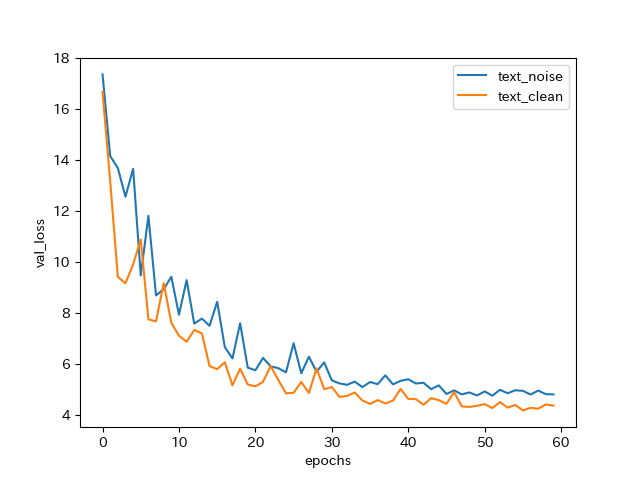
python3 train.py --image_dir dataset/291 --test_dir dataset/Set14 --image_size 128 --batch_size 8 --lr 0.001 --source_noise_model text,0,50 --target_noise_model text,0,50 --val_noise_model text,25,25 --loss mae --output_path text_noise

# train model using (noise, clean) paris (standard training)
python3 train.py --image_dir dataset/291 --test_dir dataset/Set14 --image_size 128 --batch_size 8 --lr 0.001 --source_noise_model text,0,50 --target_noise_model clean --val_noise_model text,25,25 --loss mae --output_path text_clean
Train with random-valued impulse noise
# train model using (noise, noise) pairs (noise2noise)
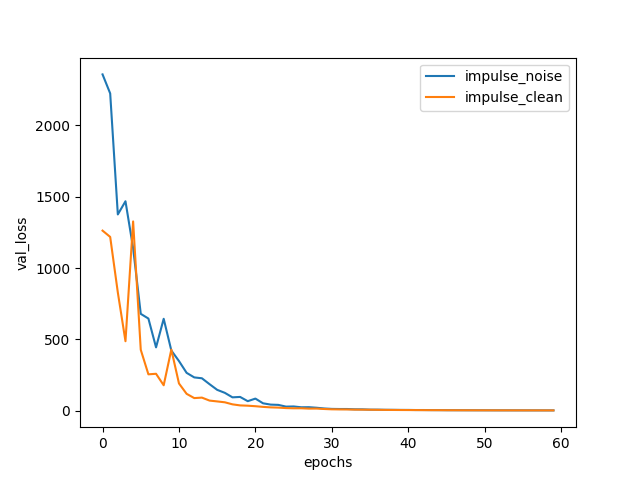
python3 train.py --image_dir dataset/291 --test_dir dataset/Set14 --image_size 128 --batch_size 8 --lr 0.001 --source_noise_model impulse,0,95 --target_noise_model impulse,0,95 --val_noise_model impulse,70,70 --loss l0 --output_path impulse_noise

# train model using (noise, clean) paris (standard training)
python3 train.py --image_dir dataset/291 --test_dir dataset/Set14 --image_size 128 --batch_size 8 --lr 0.001 --source_noise_model impulse,0,95 --target_noise_model clean --val_noise_model impulse,70,70 --loss l0 --output_path impulse_clean
Model architectures
With --model unet, UNet model can be trained instead of SRResNet.
Resume training
With --weight path/to/weight/file, training can be resumed with trained weights.
Noise Models
Using source_noise_model, target_noise_model, and val_noise_model arguments,
arbitrary noise models can be set for source images, target images, and validatoin images respectively.
Default values are taken from the experiment in [1].
- Gaussian noise
- gaussian,min_stddev,max_stddev (e.g. gaussian,0,50)
- Clean target
- clean
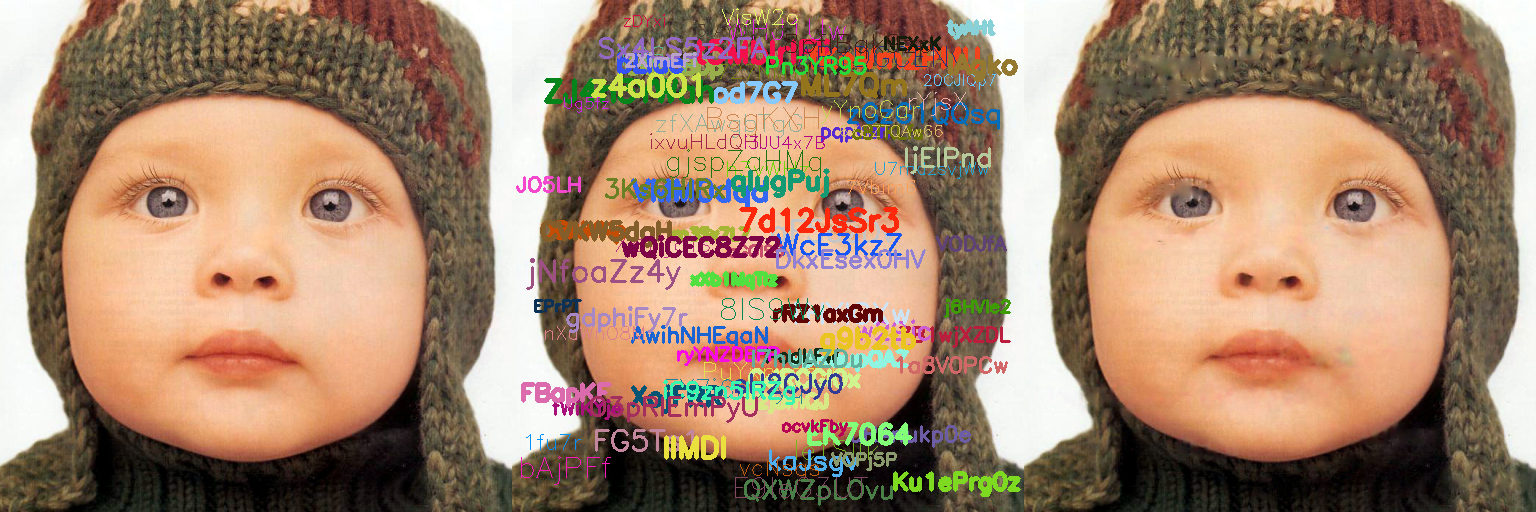
- Text insertion
- text,min_occupancy,max_occupancy (e.g. text,0,50)
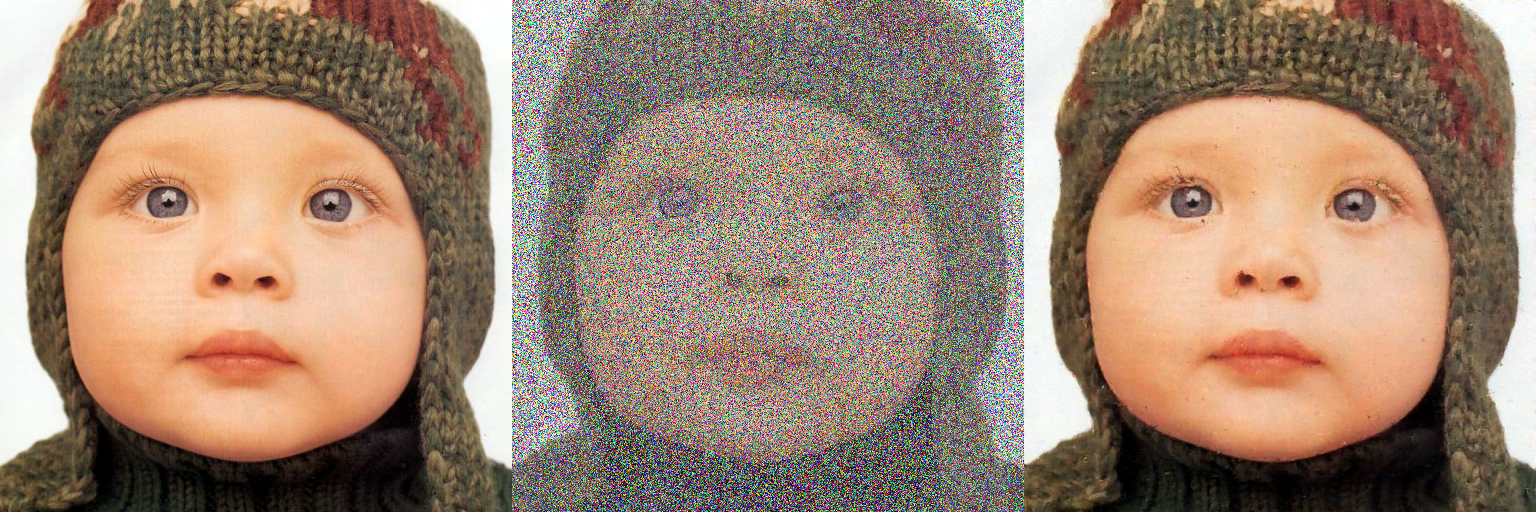
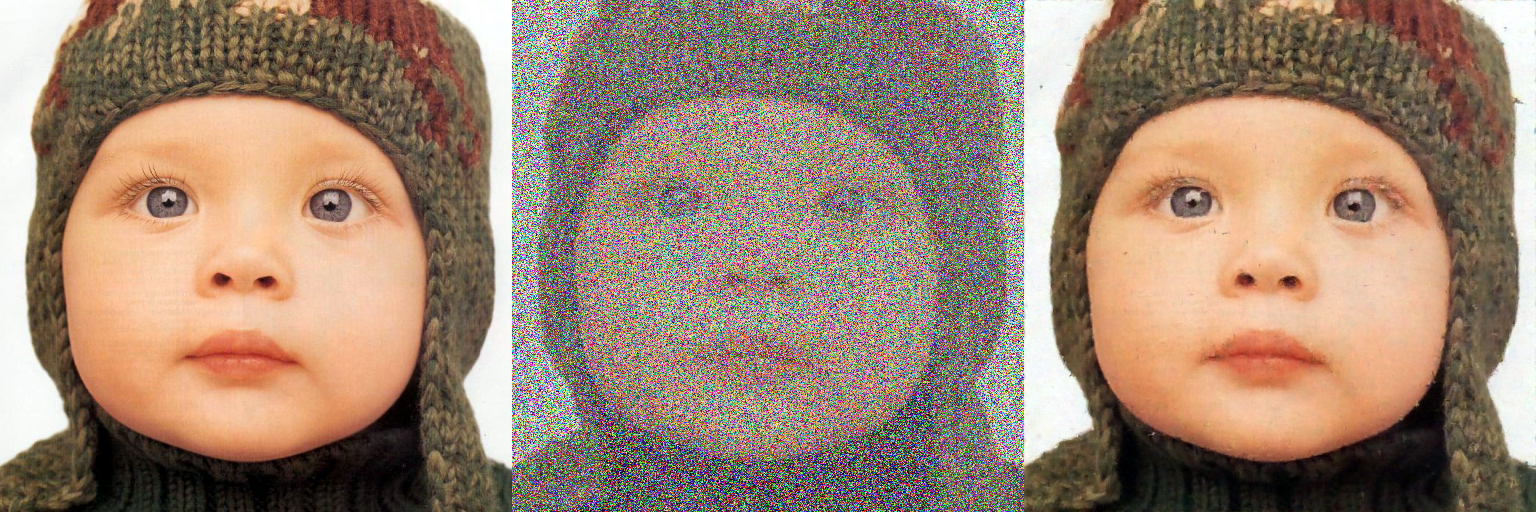
- Random-valued impulse noise
- impulse,min_occupancy,max_occupancy (e.g. impulse,0,50)
You can see how these noise models work by:
python3 noise_model.py --noise_model text,0,95
Results
Plot training history
python3 plot_history.py --input1 gaussian --input2 clean
Gaussian noise
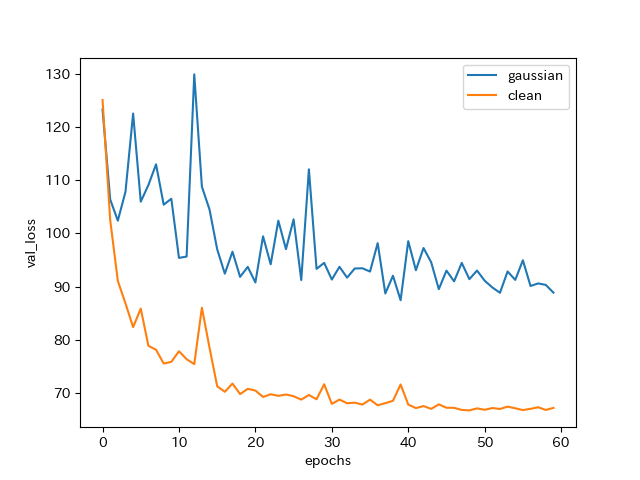
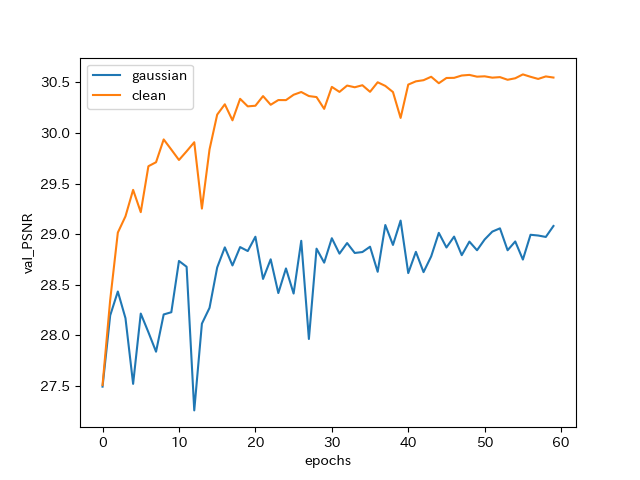
From the above result, I confirm that we can train denoising model using noisy targets but it is not comparable to the model trained using clean targets. If UNet is used, the result becomes 29.67 (noisy targets) vs. 30.14 (clean targets).
Text insertion

Random-valued impulse noise
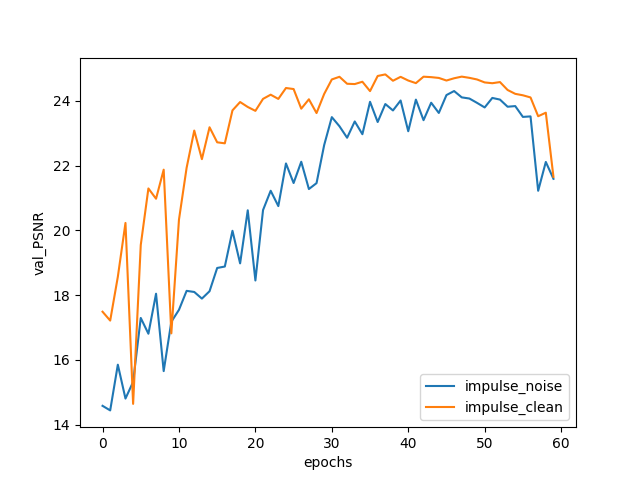
Check denoising result
python3 test_model.py --weight_file [trained_model_path] --image_dir dataset/Set14
The detailed options are:
optional arguments:
  -h, --help            show this help message and exit
  --image_dir IMAGE_DIR
                        test image dir (default: None)
  --model MODEL         model architecture ('srresnet' or 'unet') (default:
                        srresnet)
  --weight_file WEIGHT_FILE
                        trained weight file (default: None)
  --test_noise_model TEST_NOISE_MODEL
                        noise model for test images (default: gaussian,25,25)
  --output_dir OUTPUT_DIR
                        if set, save resulting images otherwise show result
                        using imshow (default: None)
This script adds noise using test_noise_model to each image in image_dir and performs denoising.
If you want to perform denoising to already noisy images, use --test_noise_model clean.
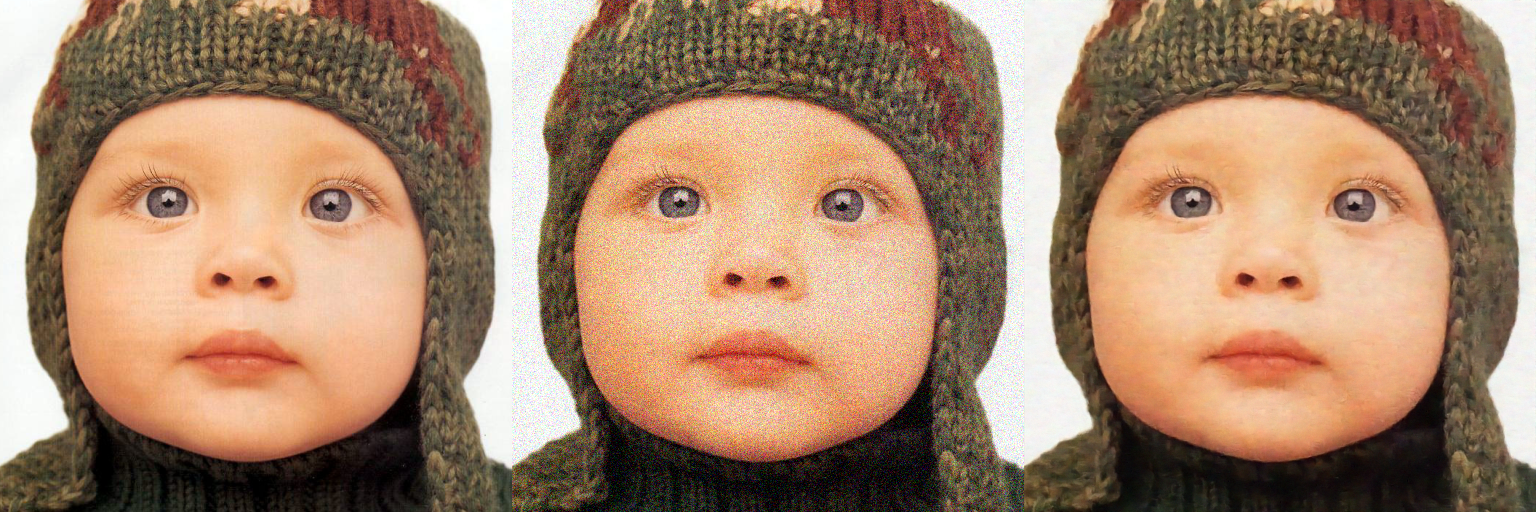
Gaussian noise
Denoising result by clean target model (left to right: original, degraded image, denoised image):
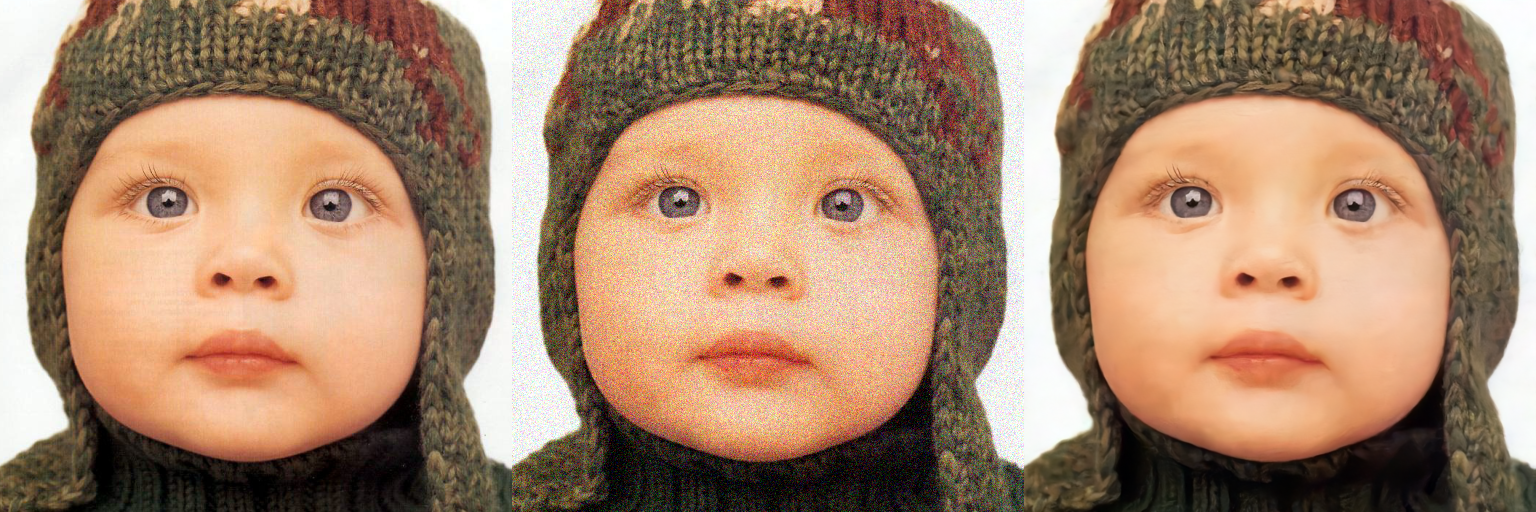
Denoising result by noise target model:
Text insertion
Denoising result by clean target model
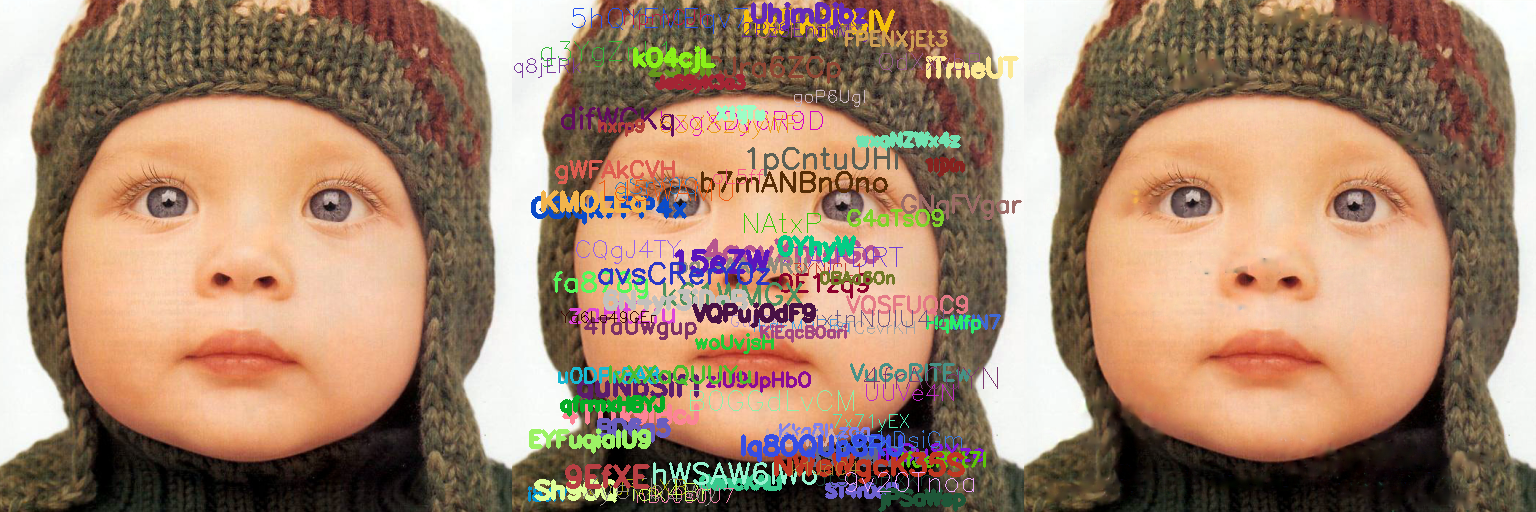
Denoising result by noise target model:
Random-valued impulse noise
Denoising result by clean target model
Denoising result by noise target model:
Trained weights
Random-valued impulse noise, noise target
Random-valued impulse noise, clean target
TODOs
- Compare (noise, clean) training and (noise, noise) training
- Add different noise models
- Write readme
References
[1] J. Lehtinen, J. Munkberg, J. Hasselgren, S. Laine, T. Karras, M. Aittala, T. Aila, "Noise2Noise: Learning Image Restoration without Clean Data," in Proc. of ICML, 2018.
[2] J. Kim, J. K. Lee, and K. M. Lee, "Accurate Image Super-Resolution Using Very Deep Convolutional Networks," in Proc. of CVPR, 2016.
[3] X.-J. Mao, C. Shen, and Y.-B. Yang, "Image Restoration Using Convolutional Auto-Encoders with Symmetric Skip Connections," in Proc. of NIPS, 2016.
[4] C. Ledig, et al., "Photo-Realistic Single Image Super-Resolution Using a Generative Adversarial Network," in Proc. of CVPR, 2017.
[5] O. Ronneberger, P. Fischer, and T. Brox, "U-Net: Convolutional Networks for Biomedical Image Segmentation," in MICCAI, 2015.
관련 프로젝트 살펴보기
tensorflow/tensorflow
모두를 위한 오픈소스 머신러닝 프레임워크
201,584 스타huggingface/transformers
🤗 Transformers: 텍스트, 비전, 오디오, 멀티모달 분야의 최첨단 머신러닝 모델을 위한 모델 정의 프레임워크로, 추론과 학습을 모두 지원합니다.
168,943 스타AUTOMATIC1111/stable-diffusion-webui
Stable Diffusion 웹 UI
165,303 스타Comfy-Org/ComfyUI
그래프와 노드로 구성된 인터페이스를 갖춘, 가장 강력하고 모듈성이 뛰어난 확산 모델 GUI, API, 백엔드입니다. 세계에서 가장 빠른 로컬 추론 엔진입니다.
146,622 스타