
xiaoyu258/GeoProj
xiaoyu258/GeoProj has 221 GitHub stars and 61 forks. GitHot measured 0 stars in 24 hours. Last checked 2026-11-21 18:08 UTC. Last push 2022-09-28.
측정된 스타 증가
- in 24h
- 0
- in 7 days
- 기록 수집 중
- in 15 days
- 기록 수집 중
- in 1 month
- 기록 수집 중
서로 겹치는 기간의 순증가량이며 일별 합계가 아닙니다. 측정값이 없으면 비워 둡니다. 스타는 관심도를 나타내며 품질을 보장하지 않습니다.
소개
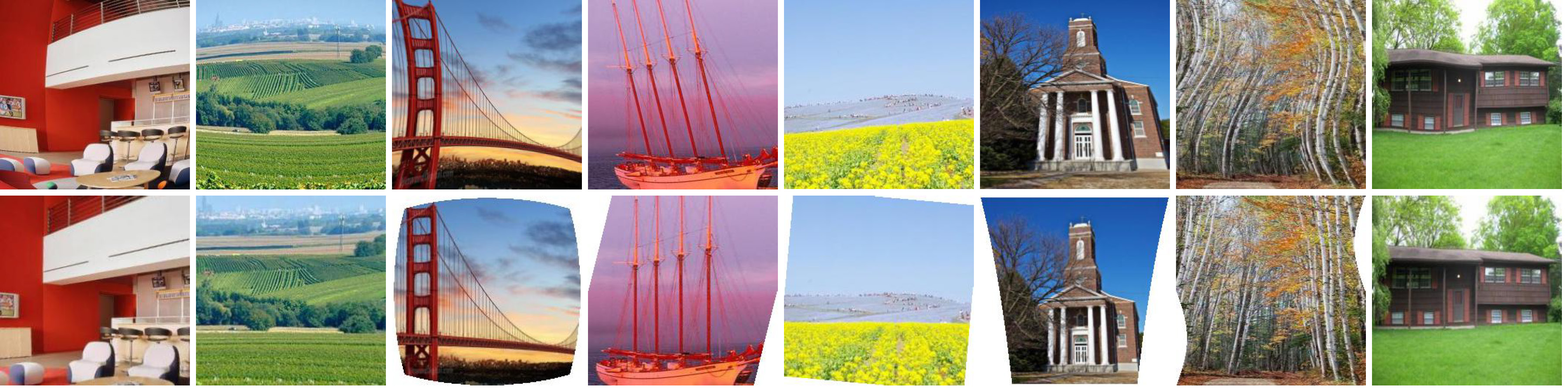
Blind Geometric Distortion Correction on Images Through Deep Learning
머신러닝README.md
OriginalGeoProj
Paper
The source code of Blind Geometric Distortion Correction on Images Through Deep Learning by Li et al, CVPR 2019.
Prerequisites
- Linux or Windows
- Python 3
- CPU or NVIDIA GPU + CUDA CuDNN
Getting Started
Dataset Generation
In order to train the model using the provided code, the data needs to be generated in a certain manner.
You can use any distortion-free images to generate the dataset. In this paper, we use Places365-Standard dataset at the resolution of 512*512 as the original non-distorted images to generate the 256*256 dataset.
Run the following command for dataset generation:
python data/dataset_generate.py [--sourcedir [PATH]] [--datasetdir [PATH]]
                                [--trainnum [NUMBER]] [--testnum [NUMBER]]

--sourcedir           Path to original non-distorted images
--datasetdir          Path to the generated dataset
--trainnum            Number of generated training samples
--testnum             Number of generated testing samples
Training
Run the following command for help message about optional arguments like learning rate, dataset directory, etc.
python trainNetS.py --h # if you want to train GeoNetS
python trainNetM.py --h # if you want to train GeoNetM
Use a Pre-trained Model
You can download the pretrained model here.
You can also use eval.py and modify the model path, image path and saved result path to your own directory to generate your own results.
Resampling
Import resample.resampling.rectification function to resample the distorted image by the forward flow.
The distorted image should be a Numpy array with the shape of H*W*3 for a color image or H*W for a greyscale image, the forward flow should be an array with the shape of 2*H*W.
The function will return the resulting image and a mask to indicate whether each pixel will converge within the maximum iteration.
Citation
@inproceedings{li2019blind,
  title={Blind Geometric Distortion Correction on Images Through Deep Learning},
  author={Li, Xiaoyu and Zhang, Bo and Sander, Pedro V and Liao, Jing},
  booktitle={Proceedings of the IEEE Conference on Computer Vision and Pattern Recognition},
  pages={4855--4864},
  year={2019}
}
관련 프로젝트 살펴보기
불러오는 중…