
warpfront/hipfire
warpfront/hipfire has 812 GitHub stars and 108 forks. Star changes are not measured yet. Last checked 2026-11-14 04:08 UTC. Last push 2026-11-13.
측정된 스타 증가
- in 24h
- 기록 수집 중
- in 7 days
- 기록 수집 중
- in 15 days
- 기록 수집 중
- in 1 month
- 기록 수집 중
서로 겹치는 기간의 순증가량이며 일별 합계가 아닙니다. 측정값이 없으면 비워 둡니다. 스타는 관심도를 나타내며 품질을 보장하지 않습니다.
소개
RDNA-native LLM inference engine in Rust.
머신러닝README.md
Original
hipfire
Local LLM inference for AMD GPUs. Tuned first for RDNA, with CDNA support.
Rust + HIP + Redline. No Python in the hot path. Pull, serve, chat.




Quickstart · What's new · Performance · Models · GPU support · PeaceMaker · Install · Docs
What hipfire is
hipfire is an inference engine for AMD GPUs. It ships its own Rust runtime, model implementations, quantization formats (MQ3–MQ6, MQ4R, MFP4), typed kernel dispatch and HIP kernels. ROCm is loaded dynamically. There is no Python, PyTorch, CUDA translation layer or third-party inference engine in the hot path.
You get a curated model registry, a CLI (pull, run, chat, serve,
bench, quantize) and an OpenAI-compatible HTTP daemon. Speculative
decoding (DFlash draft models, native MTP heads), multi-GPU expert and
tensor parallelism and the Redline replay path ship with the engine.
Quickstart
hipfire pull qwen3.8:27b-mq4-xts
hipfire serve qwen3.8:27b-mq4-xts -d
hipfire chat qwen3.8:27b-mq4-xts
This downloads about 15 GB and needs a 24 GB+ card or a Strix Halo system. On
smaller cards, use qwen3.5:4b or qwen3.5:9b with the same commands.
Pick a model for your GPU lists recommendations for
each GPU tier.
For one-shot inference:
hipfire run qwen3.8:27b-mq4-xts "What is the capital of France?"
Qwen3.8-Flash (qwen3.8:flash-next) is a MoE model. The tag resolves to the
split base qwen3.8-flash-next-base.mq4-xts (about 70.9 GB), plus a shared
per-token-embedding (PLE) sidecar (29.1 GB for q4 rows, 54.4 GB for q8 rows)
and, on gfx1201, a 213 KB expert hot-set file. The old 125 GB monolith
(qwen3.8-flash-next.mq4-xts, formerly qwen3.8-flash-next-gptq3.mq4) stays
published for existing clients:
hipfire pull qwen3.8:flash-next
hipfire serve qwen3.8:flash-next -d
A 32 GB card alone is not enough for Qwen3.8-Flash. It needs a 128 GB Strix Halo system, or a discrete card with enough host RAM for the mapped experts (the 0.4.4 release smoke ran it on an R9700 and on a 7900 XTX), or two R9700s (EP2). Native context is 262K tokens, subject to available memory.
Image generation (RDNA3/3.5 measured):
hipfire pull flux.schnell:1
hipfire img --out x.png flux.schnell:1 "a red cube on a wooden table"
The daemon serves an OpenAI-compatible API on 127.0.0.1:11435. It listens
on loopback only unless you set serve.host.
curl -s http://127.0.0.1:11435/v1/chat/completions \
  -H "Content-Type: application/json" \
  -d '{"model": "qwen3.8:27b-mq4-xts",
       "messages": [{"role": "user", "content": "What is 2+2?"}],
       "max_tokens": 256,
       "chat_template_kwargs": {"enable_thinking": false}}'
Qwen models think by default, and max_tokens counts the <think> span as
well as the answer. If thinking is on and the cap is small, content can come
back empty with finish_reason: "length". Turn thinking off as shown above,
or raise max_tokens. Qwen3.8 and Ornith 1.5 default to medium reasoning
effort. See docs/SERVE.md.
What's new in 0.4.4
Every figure in this section comes from the v0.4.4 release notes and the CHANGELOG 0.4.4 entry. Each is a measurement on one named fixture and card, not a general throughput claim. Rows marked contributor-measured were not re-run by the maintainers on the contributor's card; the merge gates ran the build, the CPU tests and a smoke on a different card. The CHANGELOG entry has the fixtures, methods, kill switches and upgrade notes.
- 7900 XTX (gfx1100) speculative decode is faster (two PRs and a draft
change by @Ben1078, default on for exact gfx1100, all NUMERIC, not
byte-identical). On one 7900 XTX,
qwen3.8-27b.mq4-xts,hipfire bench --spec mtp, Q8 KV, 256 tokens, fresh-process ABBA:- #987, an int8-activation GEMV for 2..=5-row verify (maintainer gate):
decode code-1k 104.7 to 127.4 tok/s (1.217x), prose-1k 106.7 to 131.1
(1.229x), code-32k 81.8 to 95.5 (1.168x), prose-32k 51.7 to 58.9
(1.139x). Off:
HIPFIRE_GFX1100_Q8X_VERIFY=0. - #989, a WMMA split-K verify attention (standalone figures are the
author's; stacked figures are the maintainer gate): stacked on #987,
code 32K 95.7 to 121.2 tok/s (1.27x) and prose 32K 59.0 to 73.3 (1.24x),
1K neutral. Off:
HIPFIRE_GFX1100_WMMA_VERIFY_ATTN=0. - #998, an MTP draft over a 65,536-token vocabulary subset: a further 1.074x
to 1.094x decode at 1K and 32K stacked on the other two, measured on the
27B at up to 39K context only. Greedy MTP text matches beta on 3 of 4
mtpfloorprompts. Off:HIPFIRE_GFX1100_DRAFT_VOCAB=0.
- #987, an int8-activation GEMV for 2..=5-row verify (maintainer gate):
decode code-1k 104.7 to 127.4 tok/s (1.217x), prose-1k 106.7 to 131.1
(1.229x), code-32k 81.8 to 95.5 (1.168x), prose-32k 51.7 to 58.9
(1.139x). Off:
- Dense
serve --tp Nloads the generic mesh executor by default (Qwen3.5/3.6/3.8 dense, #927;HIPFIRE_DENSE_TP_ROUTE=handrestores the hand route). It runs the LM head on rank 0 only, as the hand route does. Maintainer-measured on 4x R9700,qwen3.8-27b.mq4-xts,bench --matrix --spec off, 3 fresh processes per arm, mesh vs hand route. TP2 (2026-10-26, beta3385df7ea5): pp512 2,866.9 to 3,293.4 tok/s (+14.9%), pp2048 2,746.1 to 3,358.5 (+22.3%), and decode matches the hand route (54.89 vs 54.95 tok/s at 128 context, 54.19 vs 54.24 at 4K). TP4 (2026-10-26, the #927 pre-land build, before the rank-0 LM head): pp512 1,919.4 to 2,061.0 (+7.4%), pp2048 1,997.4 to 2,113.4 (+5.8%), decode 43.96 to 51.77 tok/s (+17.8%) at 128 context. TP2 prompts of 16 and 32 tokens prefill 2.5% to 3.3% slower than on the hand route (pp16 479.6 vs 496.2 tok/s).speculation.mtp = onand uneven TP3/TP5 splits still take the hand route. - Vision is on by default with a streamed tower.
vision_modenow defaults toauto: a present vision sidecar is loaded and the Qwen3.5/3.8-VL tower streams from host per block, so a vision load costs about 128-142 MiB of idle VRAM instead of about 0.94 GiB (vision_mode=residentkeeps the whole-tower upload;hipfire config set vision_mode offrestores the text-only load). Image turns prefill in batched chunks: on the R9700 (qwen3.8-27b.mq4-xts+ vision, 1024x1024, HTTP TTFT, greedy) TTFT goes from 37.3 s to 0.51 s. Streamed-tower TTFT is 0.81 s on the 7900 XTX and 1.84 s on Strix Halo. Batched image prefill is numeric; the tower GEMM is bit-identical and the streamed embeddings are byte-identical to the resident path on gfx1201. - LLaMA-arch models prefill in batched chunks (LLaMA, Mistral, SmolLM2,
#982), numeric rather than byte-identical
(
HIPFIRE_PREFILL_BATCHED=0restores per-token). Maintainer gate: SmolLM2-360M mq4v1 on gfx1201, 148 to 3,705 tok/s at 1,169 tokens; Llama-3.2-1B HFQ4G256 on a 7900 XTX (gfx1100), 463 to 8,130 tok/s. A head_dim-64 Q8 flash decode tile (#978, also numeric) removes the decode fall-off with context for SmolLM2 and Llama-3.2-1B. MQ4G256V2 (.mq4) LLaMA-arch files still prefill per token. - Strix Halo (gfx1151) wave (@fivetide, @HUSRCF). Contributor-measured on
Strix Halo: Qwen3-8B (
qwen3-8b.mq4, 7,741-token prompt) DFlash prefill 538 s to 13.1 s and decode 7.4 to 20.8 tok/s (#958); 9B DFlash 2K 45.7 to 59.6 tok/s and 4K 36.0 to 56.5, byte-identical to the previous build (#961, #962, shared box, indicative). Flash-Next prefill gains (persistent HC-up v2, fused HC-down, one-pass MoE front) are byte-identical by GPU oracle, default on, with kill switches in the CHANGELOG. Qwen3-8B DFlash stays slower than AR at tau 0.2-0.8, so AR remains the faster choice there. A Flash-Next reload is no longer refused for RAM left in the TTM page pool, andhipfire pullno longer downloads the 305.5 MB trunk overlay on a host that will not apply it. - Flash-Next on the R9700: decode-share is on by default (admitted loads
only; byte-identical;
HIPFIRE_QWEN4_DECODE_SHARE=offdisables it). One R9700, 3 rounds of fresh processes per arm: MTP decode 61.82 vs 51.14 tok/s with it off (+20.9%), pp16384 6,677.5 vs 6,686.7 (-0.1%). The second token after a 16K prompt takes 78.7 ms instead of 22.7 ms. The 0.4.3 Flash-Next defaults (16,384-row chunk, hot set) are unchanged. On one R9700 (split base, 3 fresh processes per arm, 2026-10-26) the hot set makes--spec autodecode on real text 34% to 50% faster thanHIPFIRE_QWEN4_EXPERT_HOTSET=0(prose 49.7 vs 37.2 tok/s, code 80.6 vs 55.2 and 78.6 vs 52.4) at equal pp16384 (6,648 vs 6,646 tok/s); it costs 4.2% at pp512 and 4.8% on synthetic random-id tg128. AgainstHIPFIRE_PREFILL_CHUNK_ROWS=4096, the 16,384-row chunk is 25.7% faster at pp16384 (6,648 vs 5,288 tok/s) and 1.9% to 3.7% slower on real-text--spec autodecode, so a 4,096-row chunk only helps decode-bound workloads with short prompts. - Long-context DFlash on the R9700: the native-fp8 split-KV verifier is
default on for exact gfx1201 (#921, #922, @paleluna82-del; 27B-class
H24/KV4/D256, fp8 KV, live context at or above 8,192, at most 16 verify
rows;
HIPFIRE_GFX12_FA2_SPLIT_VERIFY_FP8=0turns it off). Maintainer-measured on one R9700, 27B mq4-xts with the registry DFlash draft, median over 3 fresh processes per arm: decode 16K 53.30 to 59.60 tok/s (+11.8%), 32K 40.40 to 51.40 (+27.2%), 64K 29.93 to 43.37 (+44.9%), 128K 18.93 to 33.70 (+78.0%); 4K is unchanged within noise. NUMERIC, not byte-identical (coherent output).
Upgrade notes: greedy text can differ from 0.4.3.1 at near-ties because of
the numeric changes above. Registry sampling for the Qwen3.5 and
Qwen3.6-35B-A3B tags now defaults to presence_penalty 0.0 (was 1.5). The
rest of the upgrade notes and known issues are in the
CHANGELOG.
Measured performance (v0.4.4)
Each row is one measurement on the named date, fixture, card and build, in the claim language of BENCHMARKS.md. None is a speed floor, a product admission or a guarantee for other prompts, contexts or hosts. Decode is tok/s per request; prefill is prompt tok/s. The source in each row has the method; the CHANGELOG has the history.
| Card | Model and route | Fixture and method | Result | Date, build | Source |
|---|---|---|---|---|---|
| R9700 | qwen3.8-27b.mq4-xts: AR (--spec off), native MTP head (--spec mtp), registry DFlash draft (--spec dflash) |
committed prompts humaneval_0_has_close_elements.txt (code, 134 tokens) and fiction_lighthouse.txt (prose, 44 tokens), bench --runs 5 --warmups 3 --backend noslots --workload stateless, 128 tokens, 3 fresh processes x 5 runs (median of 15) |
decode AR 41.2 (code and prose); DFlash 313.6 (code), 63.4 (prose); MTP 95.0 (code), 55.5 (prose) | 2026-10-27, published v0.4.4 gfx1201 binary archive (tag 75c28fc064) |
v0.4.4 release-binary bench |
| R9700 | qwen3.8-27b.mq4-xts, AR, fp8 KV |
bench --matrix --spec off --pp 512,2048,16384, 3 fresh processes x 5 runs |
prefill 4,936 (pp512), 5,278 (pp2048), 4,888 (pp16384) | 2026-10-27, published v0.4.4 gfx1201 binary archive | v0.4.4 release-binary bench |
| R9700 | qwen3.8-27b.mq4-xts + registry DFlash draft, fp8 KV, native-fp8 split-KV verifier (default) |
serve battery long turns, 1,024 max tokens, 3 fresh processes per arm | decode 59.60 (16K), 51.40 (32K), 43.37 (64K), 33.70 (128K) | 2026-10-26, 0.4.4 cycle beta | CHANGELOG 0.4.4 (#921, #922) |
| 7900 XTX | qwen3.8-27b.mq4-xts + native MTP, Q8 KV (#987 + #989 + #998) |
committed mtpfloor prompts, bench --spec mtp, 256 tokens, fresh-process ABBA |
decode 136.5-136.8 (code 1K), 141.1 (prose 1K), 129.5-129.9 (code 32K), 79.7-80.1 (prose 32K) | 2026-10-26, beta 085dd189b5 + #998 |
#998 merge gate (speedups in release notes 0.4.4) |
| Strix Halo | qwen3.8-27b.mq4-xts + paired DFlash draft |
committed merge_sort_thinking_off code prompt, bench, 256 tokens, 3 fresh processes |
decode 135.3 | 2026-10-13, v0.4.2 (not re-measured on 0.4.4) | CHANGELOG 0.4.2 |
| R9700 | qwen3.8-flash-next-gptq3.mq4 (monolith, q4 PLE), native MTP, decode-share |
11-prompt MTP suite and bench --matrix, 3 rounds of fresh processes |
decode 61.82 (MTP suite); pp16384 6,677.5 | 2026-10-27, v0.4.4 RC2 (125b2b5ca9) |
release notes 0.4.4 |
| R9700 | qwen3.8-flash-next-base.mq4-xts (split base, the qwen3.8:flash-next pull), hot set, q4 PLE rows: AR (--spec off) and native MTP (--spec mtp, which runs MTP + n-gram) |
committed prompts humaneval_0_has_close_elements.txt (code) and fiction_lighthouse.txt (prose), bench --runs 5 --warmups 3, 640 tokens, 3 fresh processes x 5 runs; pp16384 from bench --matrix --spec off |
decode AR 49.7 (code), 45.6 (prose); MTP 82.9 (code), 48.5 (prose); prefill 6,647.8 (pp16384) | 2026-10-27, published v0.4.4 gfx1201 binary archive | v0.4.4 release-binary bench |
| Strix Halo + XDNA2 | qwen3.8-flash-next-gptq3.mq4 (monolith, q4 PLE, trunk overlay, NPU trunk auto) |
16,355-token prompt, cold serve TTFT, 3 fresh processes x 3 requests | prefill 2,472.7 (TTFT 6.61 s) | 2026-10-27, v0.4.4 release head 943b5323da |
v0.4.4 Halo 16K release gate |
| R9700 | qwen3.6:35b-a3b-mq4rs, AR |
bench --matrix --spec off --pp 512,4096,16384 --tg 128 --ctx 128, 3 fresh processes x 5 runs |
prefill 11,788 (pp512), 19,867 (pp4096), 18,567 (pp16384); decode 242.2 (tg128 at 128 context) | 2026-10-27, published v0.4.4 gfx1201 binary archive | v0.4.4 release-binary bench |
| 2x / 4x R9700 | qwen3.8-27b.mq4-xts, dense TP on the mesh route |
bench --matrix --spec off, 3 fresh processes |
TP2 pp2048 3,358.5, decode 54.89; TP4 pp2048 2,113.4, decode 51.77 (128 context) | 2026-10-26; TP2 beta 3385df7ea5, TP4 the #927 pre-land build |
release notes 0.4.4, multi-gpu.md |
v0.4.5, Flash-Next EP2 serving on 2x R9700 (2026-11-10/11, beta
13a4ba3c66, fixture qwen3.8-flash-next-base.mq4-xts-symtrunk with its
hot-unit sidecar, 12 fresh serves, pooled median aggregate tok/s with 95%
bootstrap CI vs a published dual-R9700 Flash-Next result): code C8 930.9
(1.058x [1.032, 1.071]), code C4 579.0 (0.936x), code C1 205.1 (0.781x),
story C8 527.3 (0.794x), story C4 336.2 (0.720x), story C1 135.9 (0.718x).
The code prompt is mostly prompt copy (about 60%), which favours speculative
drafting. Full record, TTFT/decode split and caveats:
docs/perf-checkpoints/2026-11-11-flash-next-ep2-cp20.md.
qwen3.6:35b-a3b-mq4rs loads on gfx1201 only; see
MODELS.md. Flash-Next on a 24 GB card (7900 XTX) runs with
host-mapped experts, so its speed depends on the host link; no v0.4.4
measurement of it is listed here. Earlier releases, including the 0.4.2
expert parallelism (EP2 to EP8), the Strix Halo NPU prefill route,
engine-level YaRN and the 0.4.3 mq4rs quant, are described in the
CHANGELOG.
BENCHMARKS.md explains fixture identity and the requirements for admitting a measurement. Its older tables are historical, not current product baselines.
Models
The bundled registry (registry/v1.json) contains 94 curated entries
(models, quant variants and draft sidecars) and 85 aliases. Run
hipfire list -r for the live list.
| Family | Pull tags |
|---|---|
| Qwen 3.8 dense | qwen3.8:27b (MQ4V2 default), qwen3.8:27b-mq4-xts (flagship), -mq4-xt, -mq4-pro; MQ3, MQ5 and MQ6 -xt / base / -pro tiers; drafts qwen3.8:27b-draft-mq3 … -mq6 |
| Qwen 3.8 Flash | qwen3.8:flash-next (alias qwen3.8:flash; MQ4 XTS split base), -mq3-xts, -mq2-xts, -mq2-xts-4500 |
| Qwen 3.6 35B-A3B | qwen3.6:35b-a3b (MQ4P default), -mq2, -mq3p, -mq4p, -mfp4, -mq4r, -mq4rs (symmetric experts, gfx1201 fast prefill), -mq5, -mq6 |
| Qwen 3.6 dense | qwen3.6:27b, qwen3.6:27b-mq3, drafts qwen3.6:27b-draft, -draft-mq3 |
| Qwen 3.5 dense | qwen3.5:0.8b, 2b, 4b, 9b, 27b, with -mq3 / -mq6 variants and 9b / 27b drafts |
| Qwen 3.5 MoE | qwen3.5:35b-a3b |
| Qwen3 | qwen3:0.6b, qwen3:8b |
| Muse Glimmer | muse-glimmer, muse-glimmer:fast (MQ4R), muse-glimmer:draft |
| Ornith 1.5 | ornith-1.5:35b-a3b, ornith-1.5:fast (MQ4R) |
| DeepSeek V4 Flash | deepseek-v4-flash |
| MiniMax-M2.7 | minimax-m2.7 |
| North-Mini-Code-1.0 | north-mini-code |
| Carnice (Hermes tool calls) | carnice:9b, carnice:27b, -mq6 variants |
| Qwopus | qwopus:4b, 9b, 27b, -mq6 variants, qwopus3.6:27b-coder |
| LFM2.5 | lfm2.5:350m, 1.2b, 1.2b-thinking, 8b-a1b |
| NEX N2 Mini | nex-n2:mini |
| VibeThinker | vibethinker:3b, vibethinker:3b-mq6 |
| FLUX (image) | flux.schnell:1 and others in IMAGEGEN.md |
Curated weights are published under
huggingface.co/hipfire-models.
docs/MODELS.md covers sizes, minimum VRAM, sampling
defaults, sidecars and provenance. To bring your own model, use
hipfire quantize.
Qwen 3.8 Flash Next split-PLE tiers (0.4.3)
The hipfire-models/qwen3.8-flash-next repository publishes three plain
split-PLE trunk files at its root, next to the shared PLE sidecar. The sizes
below are file sizes in bytes, not VRAM or peak-memory requirements.
Publishing a file is not a claim that every GPU route or speed has been
measured on it.
The published model card
records the receipt-backed measurements and their acceptance scope.
| Tier | File (HF link) | Bytes | SHA-256 |
|---|---|---|---|
| MQ3 | qwen3.8-flash-next-base.mq3-xts |
59109362200 | d35896ca69b87d3e93176847a036db3e2cb1554931f130a842b13718b486238b |
| MQ2 (6,306 hot) | qwen3.8-flash-next-base.mq2-xts |
46895167000 | e2ba747485190da92cd7a36d3f56809e6db31a3ec328f5ab23e000275d798e57 |
| MQ2 (4,500 hot) | qwen3.8-flash-next-base.mq2-xts-4500 |
44537253400 | 9087d7d8f67629a3256c26bfeb705e7ed22dd1622bb91e074035543d6caea5c2 |
| Shared PLE sidecar (Q4) | qwen3.8-flash-next.ple-q4 |
29120146432 | fc78d30b9d2376db2b713732e80de2069f1cd1d6e1e40b50c716927dcc18ee1e |
Trunk plus the Q4 sidecar totals 88,229,508,632 (MQ3), 76,015,313,432 (MQ2
6,306) and 73,657,399,832 (MQ2 4,500) bytes on disk. The MQ2 tiers need
hipfire at or after ea2abd111f06339e9f25ac86715b7d210d0c5ae8; the MQ3 tier
needs ca0aee9c925b4180651b194b440bcda80f656ac5.
MQ2 KLD on an RX 7900 XTX (gfx1100), post-land. Mean KLD against the FP8
reference, hipfire ea2abd111f06339e9f25ac86715b7d210d0c5ae8, with the
shipping MQ2 hashes above. WikiText-2 (wt2): 32 chunks, 8160 scored rows;
code24: 24 chunks, 6120 scored rows. Pre-land references describe earlier
d2 predecessor bytes, not fresh measurements of the published roots; decode
rows are paired against the weight-only reference and prefill rows against
the prefill reference. The pre-land
decode references (MQ2 6,306: 0.1851 wt2 / 0.1981 code24; MQ2 4,500: 0.2078 /
0.2077) are weight-only model KLD, not GPU route measurements; the XTX
columns are GPU route measurements.
| Tier | Corpus | Route | Pre-land reference | XTX post-land | Paired Δ (95% CI) | Relative Δ | Status |
|---|---|---|---|---|---|---|---|
| MQ2 6,306 | wt2 | decode | 0.1851 | 0.1966 | +0.0115 (+0.0075, +0.0155) | +6.23% | accepted by Kaden exact-row exception |
| MQ2 6,306 | code24 | decode | 0.1981 | 0.2083 | +0.0103 (+0.0018, +0.0160) | +5.18% | accepted, relative budget |
| MQ2 6,306 | wt2 | prefill | 0.2095 | 0.2106 | +0.0011 (−0.0058, +0.0080) | +0.55% | accepted, not significant |
| MQ2 6,306 | code24 | prefill | 0.2111 | 0.2112 | +0.0001 (−0.0059, +0.0068) | +0.05% | accepted, not significant |
| MQ2 4,500 | wt2 | decode | 0.2078 | not re-measured (identity + G2 pass) | — | — | not re-measured (identity + G2 pass) |
| MQ2 4,500 | code24 | decode | 0.2077 | 0.2192 | +0.0116 (+0.0053, +0.0179) | +5.56% | accepted, relative budget |
| MQ2 4,500 | wt2 | prefill | 0.2274 | 0.2291 | +0.0017 (−0.0055, +0.0091) | +0.76% | accepted, not significant |
| MQ2 4,500 | code24 | prefill | 0.2237 | not re-measured (identity + G2 pass) | — | — | not re-measured (identity + G2 pass) |
Six of the eight cells were measured on the XTX. The MQ2 6,306 wt2 decode row (0.1966, +6.23%) exceeds the 6% relative budget and is accepted only as an explicit exact-row exception by Kaden; it is not a budget pass. The two remaining MQ2 4,500 cells were not re-measured. Product identity compared the builds on earlier d2 bytes (32 identical greedy token ids); G2 AR-lane parity passed on the published root hashes. Neither is a KLD measurement. This is not an all-eight-measured result. MQ3 XTX evidence is refusal-only; no XTX KLD or speed measurement is claimed.
GPU support
| Family | Architectures | Notes |
|---|---|---|
| Vega / CDNA | gfx906, gfx908, gfx940–gfx942 |
Wave64 HIP; gfx906 dp4a MMQ prefill; some formats use a per-token GEMV fallback |
| RDNA1 | gfx1010–gfx1013 |
Portable HIP and Redline dispatch; MQ6/HFQ6 GEMV admitted in 0.4.4 (#478; resolve-tested on CPU, not on RDNA1 hardware) |
| RDNA2 | gfx1030–gfx1032 |
Portable HIP and Redline dispatch; MQ6/HFQ6 GEMV admitted in 0.4.4 (#478; resolve-tested on CPU, so the load still warns "UNVALIDATED on RDNA2") |
| RDNA3 | gfx1100–gfx1103 |
WMMA kernels, validated MQ4R Redline route; gfx1100 int8 MTP verify GEMV, WMMA verify attention and MTP draft vocabulary (default on) |
| RDNA3.5 | gfx1150–gfx1152 |
WMMA kernels; Strix Halo (gfx1151) XDNA2 NPU prefill route |
| RDNA4 | gfx1200, gfx1201 |
WMMA kernels, retained-PM4 Redline route, native-fp8 split-KV DFlash verify, opt-in EP2-EP8 expert parallelism, dense TP2/TP4 |
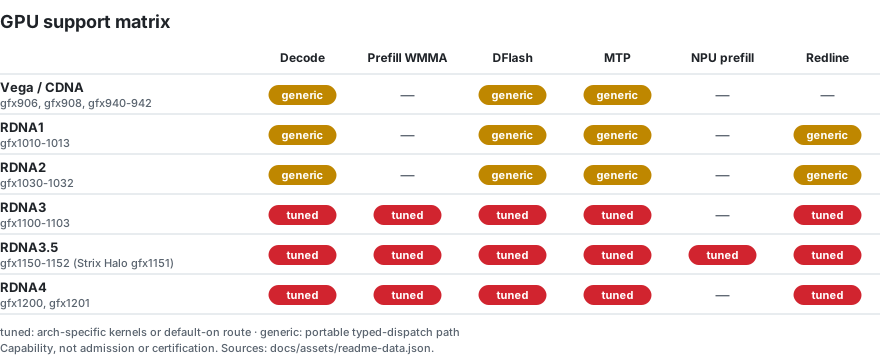
Kernels are chosen through typed per-architecture dispatch tables. A specialization that is not available falls back to the portable or architecture fallback kernel. It is never borrowed from a neighbouring GPU family. Support for a GPU family does not mean every optimized route is admitted on it.
Redline
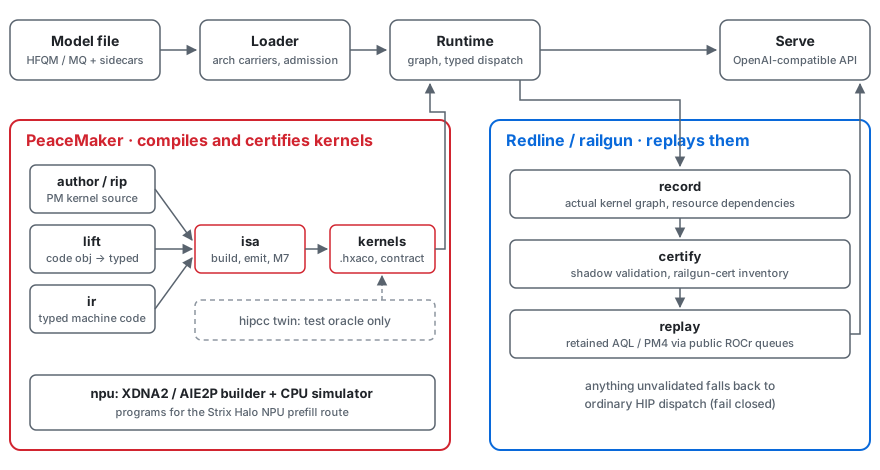
Redline is hipfire's in-tree dispatch and retained-replay layer. It records the actual kernel graph, derives resource dependencies, retains invariant command state, and lowers validated paths through public ROCr queue interfaces. If a graph is unsupported, shadow validation fails, the ABI does not match, a queue faults or the model changes, Redline falls back to ordinary HIP dispatch.
The Golden Redline guide reproduces the sealed
MQ4R fixture (python3 -m tools.redline golden). Historical MQ4R
measurements are in the
gfx1201 campaign report.
For the integration boundary, see
HIPFIRE-GRAFT.md.
PeaceMaker
PeaceMaker is hipfire's own kernel toolchain. It builds AMD GPU and XDNA2 NPU programs directly, without hipcc. It works on typed machine code, and it can lift existing code objects so they can be checked against what PeaceMaker emits. It has six crates:
| Crate | Role |
|---|---|
peacemaker-ir |
Typed RDNA machine-code representation and instruction tables |
peacemaker-lift |
Lifter for ELF, offload bundles, descriptors and metadata. Decoded kernels are re-encoded from typed fields and compared word for word |
peacemaker-isa |
Kernel builder and emitter (peacemaker-isa binary), with region import, wait-ledger checks and certification |
peacemaker-author |
PM kernel language (milestone M0, experimental, build-time only) |
peacemaker-rip |
Standalone .rip front end that lowers Rust-shaped kernel scripts onto the builder, without rustc |
peacemaker-npu |
XDNA2 / AIE2P program builder: encoder/scheduler, CDO/PDI and DPU transaction writers, CPU simulator |
Since 0.4.2, more production routes run builder-emitted, M7-certified
PeaceMaker kernels. These ship as embedded kernels/*.hxaco modules with
shape contracts. The hipcc versions of those kernels are kept only as oracle
twins for exactness tests, not as runtime fallbacks. Examples from the
CHANGELOG:
- sampled DFlash device acceptance on gfx1201
- CPU-AR sampled target rows and ordered acceptance on gfx1151 and gfx1201
- Qwen3.8-Flash EP owner assignment on gfx1201
- the gfx1151 MTP prompt-fill projections
The Strix Halo NPU prefill route builds its programs with peacemaker-npu.
The offline railgun-cert recording-inventory gate keeps the list of
recording and capture predicates in sync with the source tree. A kernel
route with a certified PeaceMaker kernel is still subject to hipfire's
normal admission and validation gates.
PeaceMaker is also published as a standalone repository,
github.com/warpfront/peacemaker.
scripts/mirror-push.sh peacemaker builds a history-preserving split of
the PeaceMaker crates and their path dependencies. It then checks that the
split builds and tests on its own, checks author identities and runs the
publication guard on every commit. Only then does it push to main. Like
hipfire, PeaceMaker is Apache-2.0. Some files remain MIT under their
per-file SPDX header, and the mirror's LICENSE adds the LLVM exception
notice (see scripts/mirror_split.py).
Install
Linux with ROCm 6 or newer:
curl -fsSL https://raw.githubusercontent.com/warpfront/hipfire/v0.4.6/scripts/install.sh | bash

# Or install the integration branch for testing:
curl -fsSL https://raw.githubusercontent.com/warpfront/hipfire/v0.4.6/scripts/install.sh \
  | bash -s -- --branch beta
RDNA4 requires ROCm 6.4 or newer, and gfx1151 requires ROCm 7.2 or newer. Release-tag installs download a verified prebuilt kernel pack for the detected arch when one is available. Otherwise they build kernels locally with hipcc. See Prebuilt kernel packs.
Before the first pull, hipfire doctor checks the driver and ROCm install, and
hipfire fit <model> --ctx N says whether that model loads at that context on
this machine, what the load would choose, and what to change if it does not.
hipfire version compares the installed binary, the managed source checkout
and the daemon. To switch revisions, use hipfire update @beta,
hipfire update --tag <tag> or hipfire update --commit <sha>. To
uninstall while keeping models and settings:
curl -fsSL https://raw.githubusercontent.com/warpfront/hipfire/v0.4.6/scripts/uninstall.sh | bash
--dry-run previews the uninstall. --purge also deletes ~/.hipfire and
asks for confirmation first.
Native Windows and WSL2 are untested on GPU hardware; install notes, limits, and
how to help test (scripts/windows-check.ps1) are in
docs/GETTING_STARTED.md. NixOS has
a flake and a module (docs/NIXOS.md):
nix develop github:warpfront/hipfire  # dev shell with Rust + ROCm
nix build github:warpfront/hipfire    # build package
Containers (docs/CONTAINER.md):
docker compose up -d      # or: podman compose up -d
curl http://127.0.0.1:11435/v1/models
The image is ghcr.io/warpfront/hipfire:latest (docker pull ghcr.io/warpfront/hipfire:0.4.6); HIPFIRE_IMAGE=ghcr.io/warpfront/hipfire:0.4.6
pins compose to a release.
Deprecated features
PFlash prefill compression, CASK / TriAttention KV eviction, Givens/asymmetric KV modes and the legacy DFlash knobs have been deprecated since 0.4.0. They are unsupported and will be removed in 0.5.0. See configuration for supported settings and validation for the current gates.
Documentation
| Page | Topic |
|---|---|
| GETTING_STARTED.md | Install, first run, what to read next |
| PICK-A-MODEL.md | Model recommendations by GPU tier |
| CLI.md | Every subcommand, flags, file locations |
| MODELS.md | Curated tags, BYO models, file extensions |
| QUANTIZE.md | hipfire quantize for HF / safetensors |
| CONFIG.md | Every config key and env override |
| SERVE.md | OpenAI-compatible HTTP API |
| multi-gpu.md | EP, TP and pipeline parallelism; budgets and refusals |
| IMAGEGEN.md | FLUX image generation |
| ARCHITECTURE.md | Engine layout and dispatch |
| QUANTIZATION.md | MQ formats, KV cache modes, FWHT |
| BENCHMARKS.md | Admitted measurements and claim requirements |
| VALIDATION.md | Correctness and speed gates |
| methodology/perf-benchmarking.md | Benchmark protocol |
| peacemaker-isa map / peacemaker-author map | PeaceMaker builder and kernel language |
| npu/README.md / peacemaker-npu map | XDNA2 NPU builder, simulator and tools |
| NIXOS.md / CONTAINER.md | NixOS and container builds |
Contributing
See CONTRIBUTING.md, including the
release cadence and PR cutoff.
Install local hooks with ./scripts/install-hooks.sh.
./scripts/no-gpu-ci.sh runs the no-GPU CI subset, but it does not replace
the hardware gates. No single gate establishes correctness on its own.
Choose the route your change needs from
docs/VALIDATION.md:
scripts/serve_harness.pyfor generation and state-lifecycle changes.scripts/redline_daemon_harness.pyfor kernel, dispatch, graph or replay changes.
Do not bypass hooks with --no-verify.
Discord: https://discord.gg/F3BaywB8Rs
Acknowledgements
hipfire's gfx906 MMQ prefill path follows the design of the MMQ kernels in upstream llama.cpp. The community-maintained gfx906 forks of llama.cpp also informed that work. CREDITS.md lists contributors.
License
hipfire is licensed under Apache-2.0 as of v0.3.0. See
LICENSE, LICENSE-APACHE and NOTICE.
Releases up to and including v0.2.1 were dual MIT/Apache-2.0, and that grant
is not revoked. Files whose authors have not elected Apache-2.0 remain MIT
(LICENSE-MIT) and say so in their SPDX-License-Identifier.
The decision record is
docs/governance/relicense-2026-05.md.
Architectural work that originated in hipfire is catalogued in
PRIOR-ART.md. Derivative works should attribute it as
described in AGENTS.md.
관련 프로젝트 살펴보기
tensorflow/tensorflow
모두를 위한 오픈소스 머신러닝 프레임워크
201,591 스타huggingface/transformers
🤗 Transformers: 텍스트, 비전, 오디오, 멀티모달 분야의 최첨단 머신러닝 모델을 위한 모델 정의 프레임워크로, 추론과 학습을 모두 지원합니다.
168,956 스타AUTOMATIC1111/stable-diffusion-webui
Stable Diffusion 웹 UI
165,307 스타Comfy-Org/ComfyUI
그래프와 노드로 구성된 인터페이스를 갖춘, 가장 강력하고 모듈성이 뛰어난 확산 모델 GUI, API, 백엔드입니다. 세계에서 가장 빠른 로컬 추론 엔진입니다.
146,724 스타