
twehrbein/ExMR
twehrbein/ExMR has 120 GitHub stars and 13 forks. GitHot measured +6 stars in 24 hours. Last checked 2026-11-13 21:47 UTC. Last push 2026-10-30.
측정된 스타 증가
- in 24h
- +6
- in 7 days
- 기록 수집 중
- in 15 days
- 기록 수집 중
- in 1 month
- 기록 수집 중
서로 겹치는 기간의 순증가량이며 일별 합계가 아닙니다. 측정값이 없으면 비워 둡니다. 스타는 관심도를 나타내며 품질을 보장하지 않습니다.
소개
3D body, hand and foot motion (SMPL-X) from a single monocular video: world-grounded, with export for Blender, Unity, Unreal and humanoid robots. Official code of ExMR (arXiv 2610.26213).
머신러닝README.md
OriginalExMR: Extremity Motion Refinement for Monocular Human Motion Capture



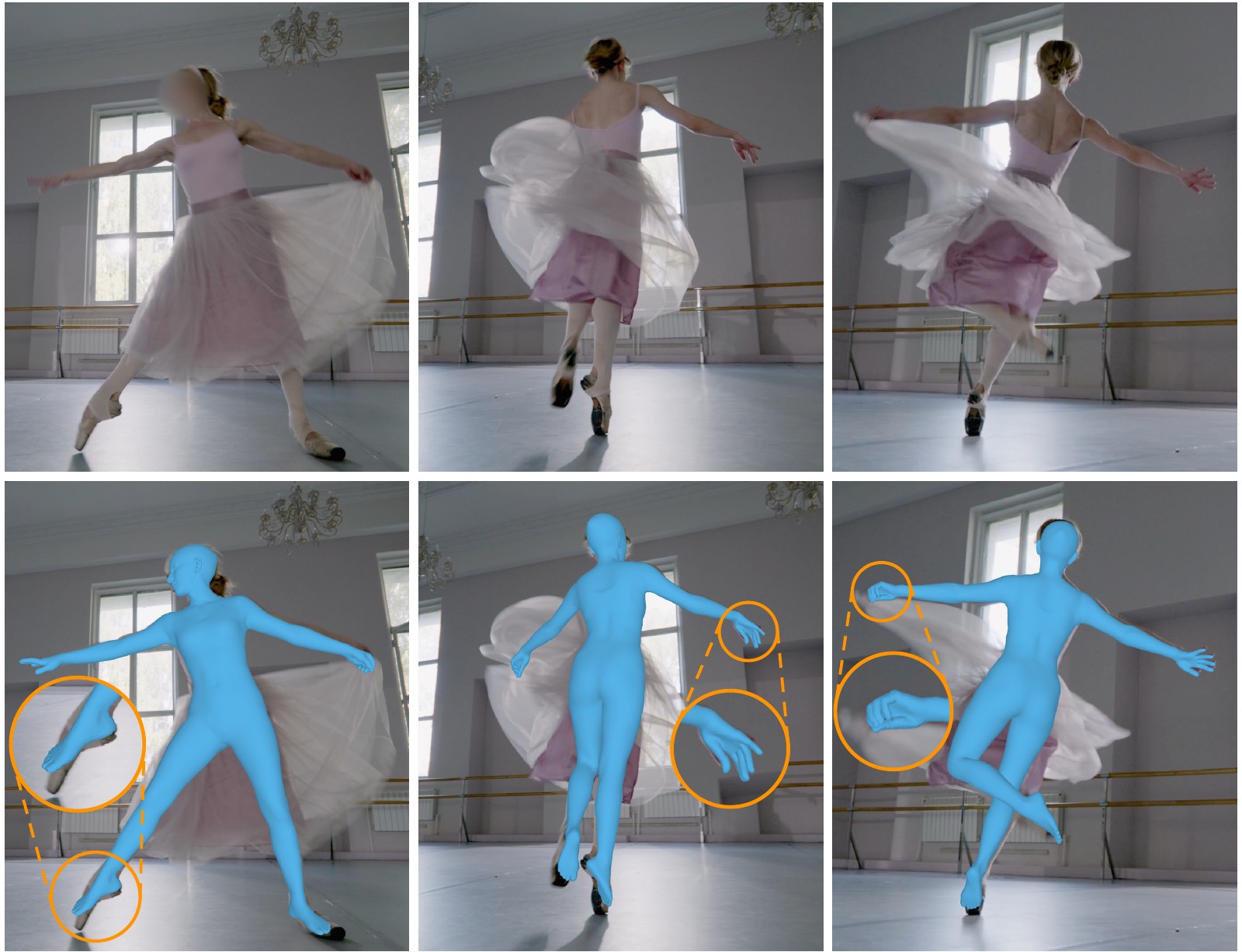
ExMR: Extremity Motion Refinement for Monocular Human Motion Capture
Tom Wehrbein and Bodo Rosenhahn
arXiv 2026 (journal extension of FootMR, 3DV 2026)
[!NOTE] This repository currently contains the demo code. Evaluation and training code will follow.
News
- [2026-10-29] v0.1.5: fixes for
portrait phone videos (the mesh was beside the person) and for ffmpeg crashing at the end of a run;
foot contacts in the results,
--export_fps(e.g. 24 or 30 fps exports), a world-frame motion that starts facing +z, the mesh's shadow in the world view and world-frame ankles closer to the network's. - [2026-10-26] Online demo on Hugging Face Spaces: try ExMR in the browser, without installing anything.
- [2026-10-26] v0.1.4: 3D and 2D joints in the results, BVH export, FBX for Unity and Unreal (through Blender) and retargeting to humanoid robots with GMR, see outputs; a demo about 10 % faster.
- [2026-10-22] v0.1.3: export for
Blender (AMASS SMPL-X file),
--snap_to_groundand temporal smoothing. - [2026-10-21] Demo code and model weights released.
- [2026-10-20] Paper on arXiv.
Overview
Detailed hand and foot articulation is important for animation and motion analysis, yet remains challenging to recover from monocular video. ExMR (Extremity Motion Refinement) reconstructs 3D body, hand, and foot motion from monocular video: an initial temporal estimator predicts whole-body motion, after which a foot refinement module (FootMR) and a hand refinement module (HandMR) revisit local evidence to predict residual joint rotations for the extremities.
Setup
Tested on Linux with an NVIDIA GPU (about 8 GB of GPU memory, driver >= 570 for CUDA 12.8). Request access to SAM 3D Body on Hugging Face first: its weights are gated and access is approved manually, which can take a while. Please see installation for details.
Quick Start
To try ExMR without installing it, the online demo runs the default mode on up to 20 seconds of a video and returns the same outputs. On Windows, the community app RGB MoCap runs ExMR with a graphical interface, contact editing and retargeting to Mixamo, VRM and MMD characters.
Reconstruct the main person in a video:
python tools/demo.py --video path/to/video.mp4      # moving camera
python tools/demo.py --video path/to/video.mp4 -s   # static camera (better world trajectory)
For example, download the dancing video from Pexels (1906x1080, filmed with a static camera; the ground is flat) and run
python tools/demo.py --video 3690649-hd_1906_1080_30fps.mp4 -s --snap_to_ground
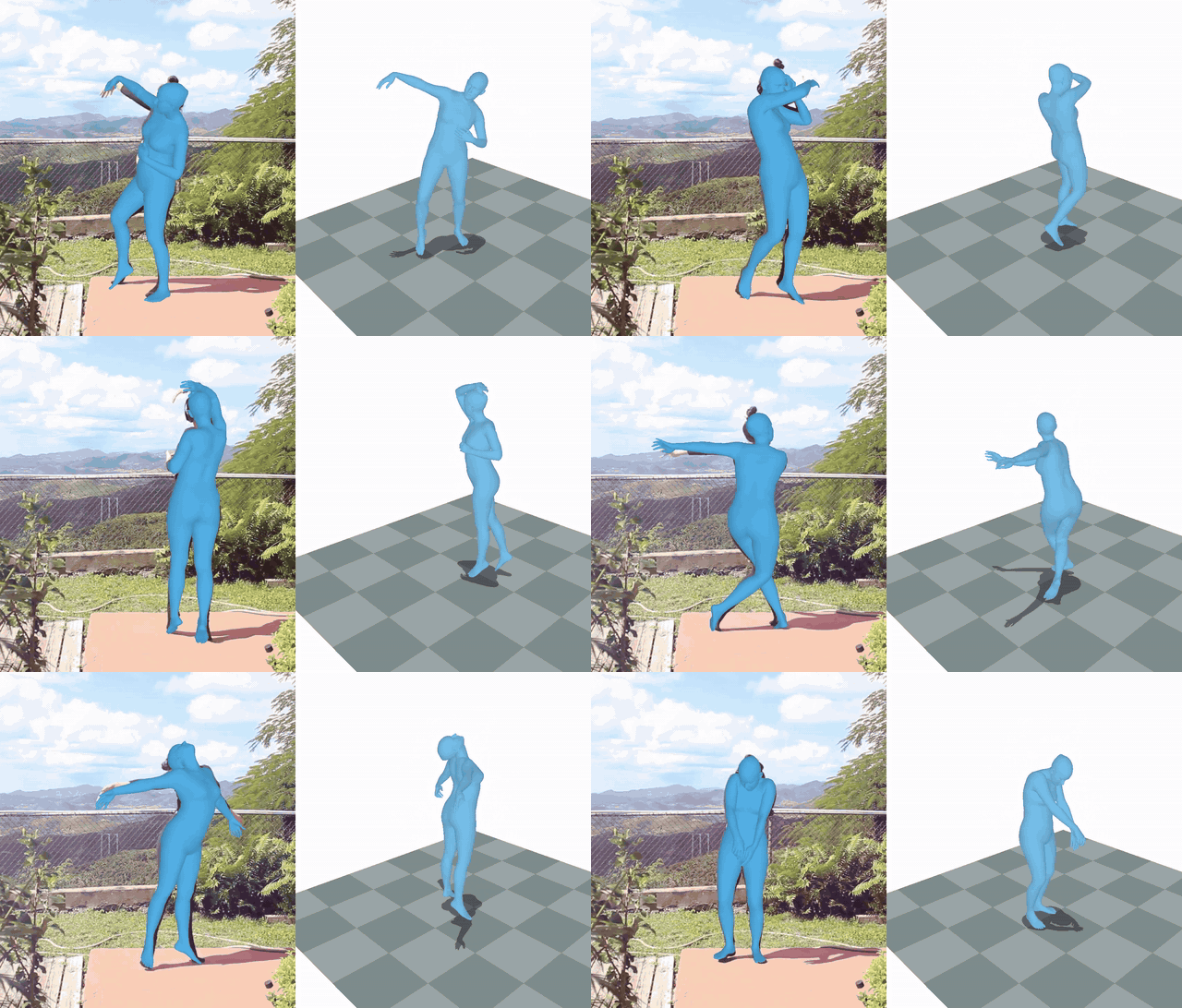
Results go to outputs/<video name>/ (see outputs):
results.pt,results.npz: SMPL-X parameters and joints in the camera and in a gravity-aligned world frame<video name>_amass.npz: the world-frame motion as an AMASS SMPL-X file, e.g. for Blender, Unity and Unreal (FBX through Blender) or humanoid robots<video name>.bvh: the world-frame motion as a BVH skeleton animation- rendered videos of the SMPL-X mesh in the camera view and in the world frame
--mode trades speed for accuracy. Times are for the 37-second example video (1122 frames, -s)
on an RTX 4090, including model loading and rendering:
--mode |
Person detector | 2D keypoints | Camera motion (moving camera) | Time |
|---|---|---|---|---|
fast |
YOLO11m | RTMW-x | SimpleVO | 1 min 3 s |
balanced (default) |
YOLO11m | Sapiens2-1B 448x336 | SimpleVO | 1 min 17 s |
accurate |
YOLO11x | Sapiens2-1B 1024x768 | DPVO | 2 min 58 s |
In our evaluation, Sapiens2-1B gives nearly the same accuracy at 448x336 and 1024x768; RTMW-x is
slightly less accurate, mostly for the feet. With -s (static camera), no mode estimates camera
motion; otherwise accurate uses DPVO, which needs the optional DPVO install (see
camera motion).
Other options:
--detector,--pose_backend,--sapiens2_resolution,--vo: override single parts of the mode, e.g.--mode accurate --vo simplevowithout DPVO.--start,--end: only the part of the video between these times, in seconds (83.5) or as in a video player (1:23.5,1:02:03); either can be left out. The outputs go tooutputs/<video name>_<start>-<end>s/and cover only that part (see outputs).--f_mm: the camera's focal length in mm as for a full-frame camera (35 mm equivalent), if you know it; for phones about 13 (0.5x lens), 24-26 (1x), 48 (2x) or 77 (3x). Without it, ExMR assumes a 53° diagonal field of view (about 43 mm). The focal length is used by the model, SAM 3D Body and the camera motion estimation.--fps30: resample the video to 30 fps first. Usually not needed; ExMR is trained on 30 fps videos, so you may try it for videos far from 30 fps (e.g. 50 fps or more). For such videos it also makes the demo faster, since fewer frames are processed. The results then follow the frames of the resampled video.--snap_to_ground: in long videos, the world-frame motion can drift vertically (the person seems to fly or sink). If the scene has a single flat ground and nothing to stand on (no stairs, chairs, ...), the body touches the ground at least every 0.5 s, about the hang time of a jump; this option moves the world-frame motion vertically so that it does, as in PRIMAL. Jumps with a longer flight are pulled down. The demo suggests this option when the feet end up far above the ground where they touch it.--export_fps: frame rate of the exported motion (<name>_amass.npz,<name>.bvh), e.g. 24 for film or 60 for games, resampled from the video's (default). The other outputs keep the video's frames.--smoothing {global,both,none}: temporal smoothing of the output motion (Gaussian, ~33 ms). By default (global) only the world-frame motion is smoothed; the camera-frame motion stays raw, best aligned with the image.bothalso smooths the camera-frame motion (smoother, but fast foot motion is followed slightly less closely in the image);nonekeeps the raw output.--no_render: no videos, only the results (needs no nvdiffrast).
Intermediate results are cached in outputs/<video name>/cache/, so rerunning the demo (e.g.
with --no_render removed, or another option) only recomputes what changed.
Camera motion
ExMR uses the camera's rotation over time to place the motion in the world frame. If the camera
does not move, pass -s: this gives the best world trajectory. Otherwise the rotation is estimated
from the video:
- SimpleVO (default): a simple classical method from GVHMR (SIFT feature matches between every 8th frame and two-view geometry, on the CPU). It needs no extra installation and runs while the GPU stages run, so it adds no time.
- DPVO (
--vo dpvo, used by--mode accurate): Deep Patch Visual Odometry, a learned and widely used method that tracks every frame on the GPU. It needs an optional source build (installation), adds about 1-2.5 s per 100 frames on an RTX 4090 (1080p to 4K), and repeated runs differ slightly.
If the world-frame motion looks wrong with SimpleVO, try DPVO.
Python
The demo is a thin wrapper around run_video, which you can also call from your own code:
from exmr.pipeline import Options, run_video

results = run_video("video.mp4", "outputs/video", Options(static_cam=True, render=False))
body_pose = results["smplx_global"]["body_pose"]  # (L, 63), see docs/OUTPUTS.md
Options has the same settings as the demo's command-line options (default: balanced mode;
start and end in seconds). The model files are read from checkpoints/ (or
$EXMR_CHECKPOINT_DIR). exmr.pipeline also exposes the pieces run_video is built from, e.g.
for a pipeline with preloaded models: hand_boxes, model_inputs, compute_joints,
save_results and render.
How it works
run_video (exmr/pipeline.py) runs these steps and caches the result of each one:
| Step | Code |
|---|---|
| Frame extraction | exmr/preprocessing/video.py |
| Person detection and tracking (YOLO11 + ByteTrack) | exmr/preprocessing/tracker.py |
| 2D keypoints (Sapiens2 or RTMW) | exmr/preprocessing/keypoints/ |
| Body image features (SAM 3D Body) | exmr/preprocessing/body_features.py |
| Hand image features (HaMeR) | exmr/preprocessing/hand_features.py |
| Camera rotations (SimpleVO or DPVO) | exmr/preprocessing/visual_odometry.py |
| ExMR: initial whole-body estimate, then FootMR and HandMR | exmr/model/exmr.py, with body_net.py and refiners.py |
| World-frame trajectory and post-processing (static joints, camera drift, ground contact, IK) | exmr/model/global_traj.py |
| Temporal smoothing | exmr/model/exmr.py, exmr/geometry/smoothing.py |
| Export for Blender and robot retargeting (AMASS SMPL-X file) and BVH | exmr/export.py |
| Rendered videos | exmr/vis/ |
Citation
If you find this work useful, please cite our papers and the original GVHMR work:
@Article{wehrbein26exmr,
    author    = {Wehrbein, Tom and Rosenhahn, Bodo},
    title     = {{ExMR}: Extremity Motion Refinement for Monocular Human Motion Capture},
    journal   = {arXiv preprint arXiv:2610.26213},
    year      = {2026},
}
@InProceedings{wehrbein26footmr,
    author    = {Wehrbein, Tom and Rosenhahn, Bodo},
    title     = {Improving 3D Foot Motion Reconstruction in Markerless Monocular Human Motion Capture},
    booktitle = {International Conference on 3D Vision (3DV)},
    year      = {2026},
    pages     = {871--881},
    doi       = {10.1109/3DV69130.2026.00088},
}
@InProceedings{shen2024gvhmr,
    author    = {Shen, Zehong and Pi, Huaijin and Xia, Yan and Cen, Zhi and Peng, Sida and Hu, Zechen and Bao, Hujun and Hu, Ruizhen and Zhou, Xiaowei},
    title     = {World-Grounded Human Motion Recovery via Gravity-View Coordinates},
    booktitle = {SIGGRAPH Asia Conference Proceedings},
    year      = {2024},
}
License
This code is a derivative work of GVHMR and is released for educational, research and non-profit purposes only, see LICENSE. It builds on third-party models and code under their own licenses, see THIRD_PARTY_NOTICES.md. Person detection and tracking use Ultralytics YOLO (AGPL-3.0). ExMR uses SAM 3D Body under the SAM License, which requires publications of results obtained with it to acknowledge the use of SAM materials.
관련 프로젝트 살펴보기
tensorflow/tensorflow
모두를 위한 오픈소스 머신러닝 프레임워크
201,593 스타huggingface/transformers
🤗 Transformers: 텍스트, 비전, 오디오, 멀티모달 분야의 최첨단 머신러닝 모델을 위한 모델 정의 프레임워크로, 추론과 학습을 모두 지원합니다.
168,949 스타AUTOMATIC1111/stable-diffusion-webui
Stable Diffusion 웹 UI
165,305 스타Comfy-Org/ComfyUI
그래프와 노드로 구성된 인터페이스를 갖춘, 가장 강력하고 모듈성이 뛰어난 확산 모델 GUI, API, 백엔드입니다. 세계에서 가장 빠른 로컬 추론 엔진입니다.
146,683 스타