
sniklaus/softmax-splatting
sniklaus/softmax-splatting has 514 GitHub stars and 58 forks. Star changes are not measured yet. Last checked 2026-11-14 06:07 UTC. Last push 2025-05-26.
측정된 스타 증가
- in 24h
- 기록 수집 중
- in 7 days
- 기록 수집 중
- in 15 days
- 기록 수집 중
- in 1 month
- 기록 수집 중
서로 겹치는 기간의 순증가량이며 일별 합계가 아닙니다. 측정값이 없으면 비워 둡니다. 스타는 관심도를 나타내며 품질을 보장하지 않습니다.
소개
an implementation of softmax splatting for differentiable forward warping using PyTorch
머신러닝README.md
Originalsoftmax-splatting
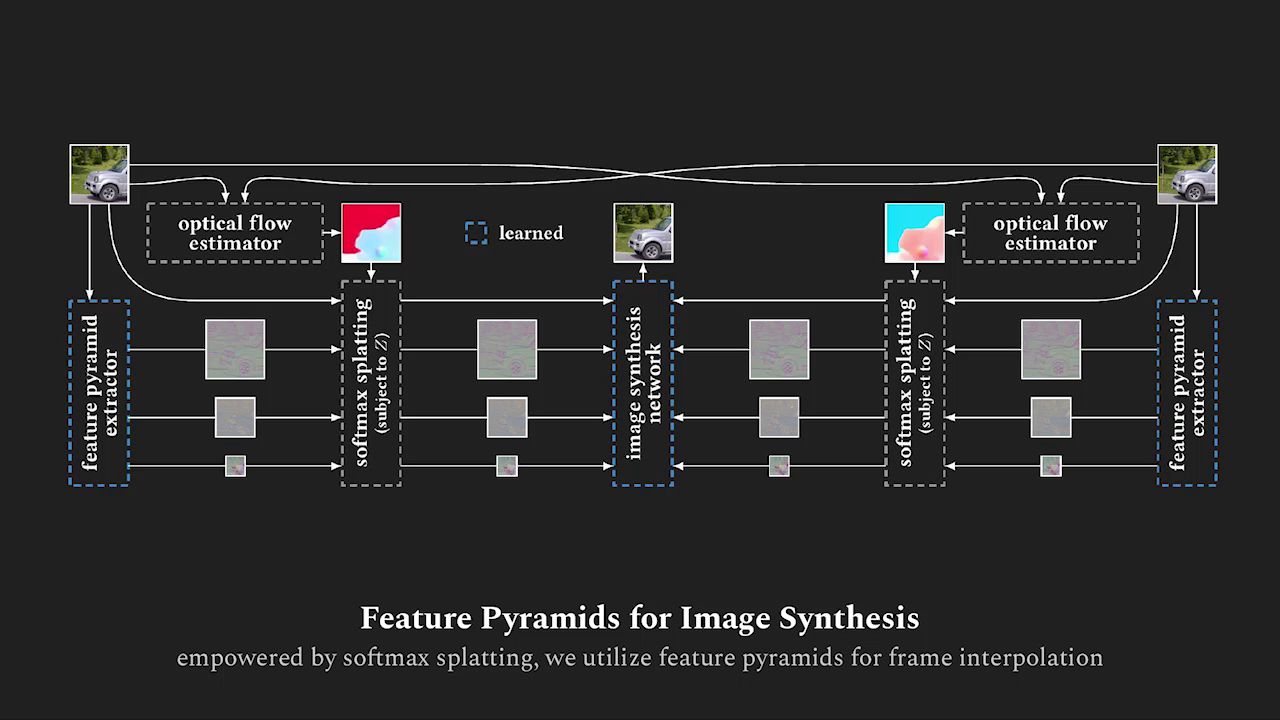
This is a reference implementation of the softmax splatting operator, which has been proposed in Softmax Splatting for Video Frame Interpolation [1], using PyTorch. Softmax splatting is a well-motivated approach for differentiable forward warping. It uses a translational invariant importance metric to disambiguate cases where multiple source pixels map to the same target pixel. Should you be making use of our work, please cite our paper [1].

For our previous work on SepConv, see: https://github.com/sniklaus/revisiting-sepconv
setup
The softmax splatting is implemented in CUDA using CuPy, which is why CuPy is a required dependency. It can be installed using pip install cupy or alternatively using one of the provided binary packages as outlined in the CuPy repository.
If you plan to process videos, then please also make sure to have pip install moviepy installed.
usage
To run it on your own pair of frames, use the following command.
python run.py --model lf --one ./images/one.png --two ./images/two.png --out ./out.png
To run in on a video, use the following command.
python run.py --model lf --video ./videos/car-turn.mp4 --out ./out.mp4
For a quick benchmark using examples from the Middlebury benchmark for optical flow, run python benchmark_middlebury.py. You can use it to easily verify that the provided implementation runs as expected.
warping
We provide a small script to replicate the third figure of our paper [1]. You can simply run the following to obtain the comparison between summation splatting, average splatting, linear splatting, and softmax splatting.
The example script is using OpenCV to load and display images, as well as to read the provided optical flow file. An easy way to install OpenCV for Python is using the pip install opencv-contrib-python package.
import cv2
import numpy
import torch

import run

import softsplat # the custom softmax splatting layer

##########################################################

torch.set_grad_enabled(False) # make sure to not compute gradients for computational performance

torch.backends.cudnn.enabled = True # make sure to use cudnn for computational performance

##########################################################

tenOne = torch.FloatTensor(numpy.ascontiguousarray(cv2.imread(filename='./images/one.png', flags=-1).transpose(2, 0, 1)[None, :, :, :].astype(numpy.float32) * (1.0 / 255.0))).cuda()
tenTwo = torch.FloatTensor(numpy.ascontiguousarray(cv2.imread(filename='./images/two.png', flags=-1).transpose(2, 0, 1)[None, :, :, :].astype(numpy.float32) * (1.0 / 255.0))).cuda()
tenFlow = torch.FloatTensor(numpy.ascontiguousarray(run.read_flo('./images/flow.flo').transpose(2, 0, 1)[None, :, :, :])).cuda()

tenMetric = torch.nn.functional.l1_loss(input=tenOne, target=run.backwarp(tenIn=tenTwo, tenFlow=tenFlow), reduction='none').mean([1], True)

for intTime, fltTime in enumerate(numpy.linspace(0.0, 1.0, 11).tolist()):
    tenSummation = softsplat.softsplat(tenIn=tenOne, tenFlow=tenFlow * fltTime, tenMetric=None, strMode='sum')
    tenAverage = softsplat.softsplat(tenIn=tenOne, tenFlow=tenFlow * fltTime, tenMetric=None, strMode='avg')
    tenLinear = softsplat.softsplat(tenIn=tenOne, tenFlow=tenFlow * fltTime, tenMetric=(0.3 - tenMetric).clip(0.001, 1.0), strMode='linear') # finding a good linearly metric is difficult, and it is not invariant to translations
    tenSoftmax = softsplat.softsplat(tenIn=tenOne, tenFlow=tenFlow * fltTime, tenMetric=(-20.0 * tenMetric).clip(-20.0, 20.0), strMode='soft') # -20.0 is a hyperparameter, called 'alpha' in the paper, that could be learned using a torch.Parameter

    cv2.imshow(winname='summation', mat=tenSummation[0, :, :, :].numpy(force=True).transpose(1, 2, 0))
    cv2.imshow(winname='average', mat=tenAverage[0, :, :, :].numpy(force=True).transpose(1, 2, 0))
    cv2.imshow(winname='linear', mat=tenLinear[0, :, :, :].numpy(force=True).transpose(1, 2, 0))
    cv2.imshow(winname='softmax', mat=tenSoftmax[0, :, :, :].numpy(force=True).transpose(1, 2, 0))
    cv2.waitKey(delay=0)
# end
xiph
In our paper, we propose to use 4K video clips from Xiph to evaluate video frame interpolation on high-resolution footage. Please see the supplementary benchmark_xiph.py on how to reproduce the shown metrics.
video
license
The provided implementation is strictly for academic purposes only. Should you be interested in using our technology for any commercial use, please feel free to contact us.
references
[1]  @inproceedings{Niklaus_CVPR_2020,
         author = {Simon Niklaus and Feng Liu},
         title = {Softmax Splatting for Video Frame Interpolation},
         booktitle = {IEEE Conference on Computer Vision and Pattern Recognition},
         year = {2020}
     }
acknowledgment
The video above uses materials under a Creative Common license as detailed at the end.
관련 프로젝트 살펴보기
tensorflow/tensorflow
모두를 위한 오픈소스 머신러닝 프레임워크
201,590 스타huggingface/transformers
🤗 Transformers: 텍스트, 비전, 오디오, 멀티모달 분야의 최첨단 머신러닝 모델을 위한 모델 정의 프레임워크로, 추론과 학습을 모두 지원합니다.
168,957 스타AUTOMATIC1111/stable-diffusion-webui
Stable Diffusion 웹 UI
165,307 스타Comfy-Org/ComfyUI
그래프와 노드로 구성된 인터페이스를 갖춘, 가장 강력하고 모듈성이 뛰어난 확산 모델 GUI, API, 백엔드입니다. 세계에서 가장 빠른 로컬 추론 엔진입니다.
146,728 스타