
rusty1s/pytorch_scatter
rusty1s/pytorch_scatter has 1,751 GitHub stars and 207 forks. GitHot measured 0 stars in 24 hours, +1 in 7 days, and +2 in 15 days. Last checked 2026-11-19 05:21 UTC. Last push 2026-06-03.
측정된 스타 증가
- in 24h
- 0
- in 7 days
- +1
- in 15 days
- +2
- in 1 month
- 업데이트 지연
서로 겹치는 기간의 순증가량이며 일별 합계가 아닙니다. 측정값이 없으면 비워 둡니다. 스타는 관심도를 나타내며 품질을 보장하지 않습니다.
소개
PyTorch Extension Library of Optimized Scatter Operations
머신러닝README.md
OriginalPyTorch Scatter




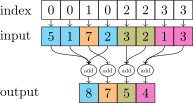
This package consists of a small extension library of highly optimized sparse update (scatter and segment) operations for the use in PyTorch, which are missing in the main package. Scatter and segment operations can be roughly described as reduce operations based on a given "group-index" tensor. Segment operations require the "group-index" tensor to be sorted, whereas scatter operations are not subject to these requirements.
The package consists of the following operations with reduction types "sum"|"mean"|"min"|"max":
- scatter based on arbitrary indices
- segment_coo based on sorted indices
- segment_csr based on compressed indices via pointers
In addition, we provide the following composite functions which make use of scatter_* operations under the hood: scatter_std, scatter_logsumexp, scatter_softmax and scatter_log_softmax.
All included operations are broadcastable, work on varying data types, are implemented both for CPU and GPU with corresponding backward implementations, and are fully traceable.
Installation
Binaries
We provide pip wheels for all major OS/PyTorch/CUDA combinations, see here.
PyTorch 2.12
To install the binaries for PyTorch 2.12, simply run
pip install torch-scatter -f https://data.pyg.org/whl/torch-2.12.0+${CUDA}.html
where ${CUDA} should be replaced by either cpu, cu126, cu130, or cu132 depending on your PyTorch installation.
cpu |
cu126 |
cu130 |
cu132 |
|
|---|---|---|---|---|
| Linux | ✅ | ✅ | ✅ | ✅ |
| Windows | ✅ | ✅ | ✅ | ✅ |
| macOS | ✅ |
PyTorch 2.11
To install the binaries for PyTorch 2.11, simply run
pip install torch-scatter -f https://data.pyg.org/whl/torch-2.11.0+${CUDA}.html
where ${CUDA} should be replaced by either cpu, cu126, cu128, or cu130 depending on your PyTorch installation.
cpu |
cu126 |
cu128 |
cu130 |
|
|---|---|---|---|---|
| Linux | ✅ | ✅ | ✅ | ✅ |
| Windows | ✅ | ✅ | ✅ | ✅ |
| macOS | ✅ |
PyTorch 2.10
To install the binaries for PyTorch 2.10, simply run
pip install torch-scatter -f https://data.pyg.org/whl/torch-2.10.0+${CUDA}.html
where ${CUDA} should be replaced by either cpu, cu126, cu128, or cu130 depending on your PyTorch installation.
cpu |
cu126 |
cu128 |
cu130 |
|
|---|---|---|---|---|
| Linux | ✅ | ✅ | ✅ | ✅ |
| Windows | ✅ | ✅ | ✅ | ✅ |
| macOS | ✅ |
PyTorch 2.9
To install the binaries for PyTorch 2.9, simply run
pip install torch-scatter -f https://data.pyg.org/whl/torch-2.9.0+${CUDA}.html
where ${CUDA} should be replaced by either cpu, cu126, cu128, or cu130 depending on your PyTorch installation.
cpu |
cu126 |
cu128 |
cu130 |
|
|---|---|---|---|---|
| Linux | ✅ | ✅ | ✅ | ✅ |
| Windows | ✅ | ✅ | ✅ | ✅ |
| macOS | ✅ |
Note: Binaries of older versions are also provided for PyTorch 1.4.0, PyTorch 1.5.0, PyTorch 1.6.0, PyTorch 1.7.0/1.7.1, PyTorch 1.8.0/1.8.1, PyTorch 1.9.0, PyTorch 1.10.0/1.10.1/1.10.2, PyTorch 1.11.0, PyTorch 1.12.0/1.12.1, PyTorch 1.13.0/1.13.1, PyTorch 2.0.0/2.0.1, PyTorch 2.1.0/2.1.1/2.1.2, PyTorch 2.2.0/2.2.1/2.2.2, PyTorch 2.3.0/2.3.1, PyTorch 2.4.0/2.4.1, PyTorch 2.5.0/2.5.1, PyTorch 2.6.0, PyTorch 2.7.0/2.7.1, and PyTorch 2.8.0 (following the same procedure).
For older versions, you need to explicitly specify the latest supported version number or install via pip install --no-index in order to prevent a manual installation from source.
You can look up the latest supported version number here.
From source
Ensure that at least PyTorch 1.4.0 is installed and verify that cuda/bin and cuda/include are in your $PATH and $CPATH respectively, e.g.:
$ python -c "import torch; print(torch.__version__)"
>>> 1.4.0

$ echo $PATH
>>> /usr/local/cuda/bin:...

$ echo $CPATH
>>> /usr/local/cuda/include:...
Then run:
pip install torch-scatter
When running in a docker container without NVIDIA driver, PyTorch needs to evaluate the compute capabilities and may fail.
In this case, ensure that the compute capabilities are set via TORCH_CUDA_ARCH_LIST, e.g.:
export TORCH_CUDA_ARCH_LIST = "6.0 6.1 7.2+PTX 7.5+PTX"
Example
import torch
from torch_scatter import scatter_max

src = torch.tensor([[2, 0, 1, 4, 3], [0, 2, 1, 3, 4]])
index = torch.tensor([[4, 5, 4, 2, 3], [0, 0, 2, 2, 1]])

out, argmax = scatter_max(src, index, dim=-1)
print(out)
tensor([[0, 0, 4, 3, 2, 0],
        [2, 4, 3, 0, 0, 0]])

print(argmax)
tensor([[5, 5, 3, 4, 0, 1]
        [1, 4, 3, 5, 5, 5]])
Running tests
pytest
C++ API
torch-scatter also offers a C++ API that contains C++ equivalent of python models.
For this, we need to add TorchLib to the -DCMAKE_PREFIX_PATH (run import torch; print(torch.utils.cmake_prefix_path) to obtain it).
mkdir build
cd build
# Add -DWITH_CUDA=on support for CUDA support
cmake -DCMAKE_PREFIX_PATH="..." ..
make
make install