
nandometzger/MLFocalLengths
nandometzger/MLFocalLengths has 47 GitHub stars and 7 forks. Star changes are not measured yet. Last checked 2026-11-14 08:17 UTC. Last push 2026-08-12.
What you can do
- 🎯 16 mm mean absolute error on a held-out set of real photographs
- 📐 Reports both the 35mm-equivalent and the physical focal length, deriving the sensor crop factor from EXIF when the camera recorded it
- 🔍 Reads any focal length metadata still in the file and scores its own prediction against it
- 🤖 JSON and CSV output, non-interactive, for scripting and batch jobs
측정된 스타 증가
- in 24h
- 기록 수집 중
- in 7 days
- 기록 수집 중
- in 15 days
- 기록 수집 중
- in 1 month
- 기록 수집 중
서로 겹치는 기간의 순증가량이며 일별 합계가 아닙니다. 측정값이 없으면 비워 둡니다. 스타는 관심도를 나타내며 품질을 보장하지 않습니다.
소개
Estimating the Focal Length of a Monocular Image
머신러닝README.md
Original📷 MLFocalLengths
Estimating the focal length of a single image





Point it at a photo. Get the focal length back — no EXIF required.
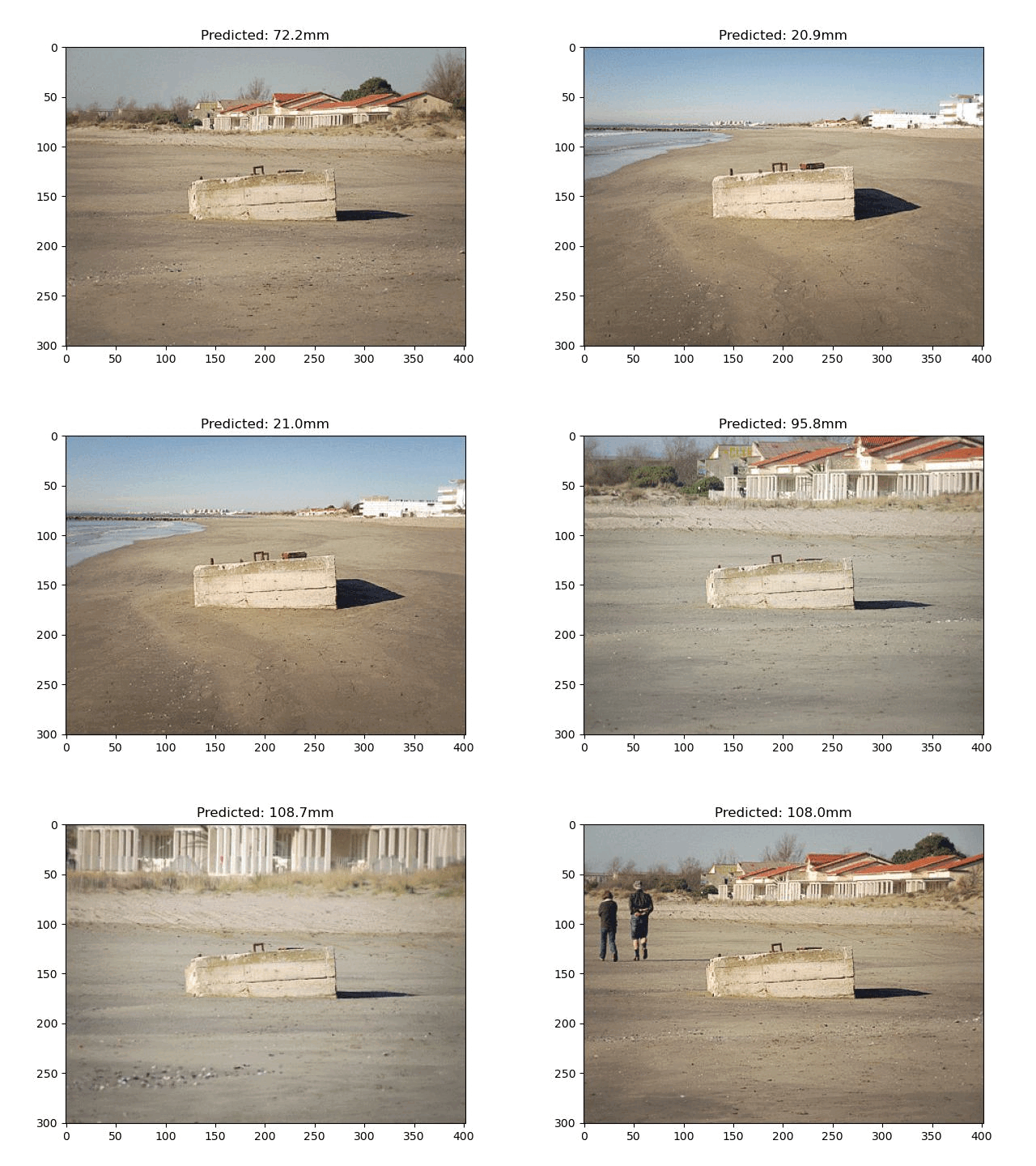
Same subject size, changing focal length. The model reads the geometry of the scene and predicts the lens.
Source sequence by Reddit user u/scyshc
Why this is interesting
The focal length a photo was taken with is often missing: stripped from images on the internet, never recorded on vintage film scans, or lost in a screenshot.
Recovering it from a single image is ill-posed. There is no depth cue to measure against, so the network has to lean on something else entirely: how big objects ought to be, how far away they ought to sit, and how perspective bends the scene at 16 mm versus 200 mm. In other words, guessing the lens requires understanding the scene.
This repository trains a CNN to do exactly that, and ships the pretrained model.
Highlights
- 🎯 16 mm mean absolute error on a held-out set of real photographs
- 📐 Reports both the 35mm-equivalent and the physical focal length, deriving the sensor crop factor from EXIF when the camera recorded it
- 🔍 Reads any focal length metadata still in the file and scores its own prediction against it
- 🤖 JSON and CSV output, non-interactive, for scripting and batch jobs
- 📦 Weights download themselves on first run — one command from clone to prediction
Quick start
pip install -r requirements.txt
python predict.py img/stone
That is the whole setup. The pretrained weights (233 MB) are fetched automatically on first use and cached in ~/.cache/mlfocallengths/.
frame_00_delay-0.03s.jpg     72.1 mm equiv    72.1 mm physical  crop 1x (assumed_full_frame)
frame_08_delay-0.03s.jpg     21.0 mm equiv    21.0 mm physical  crop 1x (assumed_full_frame)
On a photo that still has its EXIF, the model's prediction is scored against what the camera recorded:
$ python predict.py IMG_9010.CR2
IMG_9010.CR2     62.1 mm equiv    62.0 mm physical  crop 1.002x (exif_sensor_width)
                                  | EXIF 50.1 mm equiv [derived_from_physical], error +12.0 mm
Common invocations
| Goal | Command |
|---|---|
| One image | python predict.py photo.jpg |
| A whole library | python predict.py ~/Pictures --recursive |
| Machine-readable output | python predict.py ~/Pictures --json out.json --csv out.csv |
| Annotated preview images | python predict.py img/stone --save-demo demo/ |
| Known APS-C body | python predict.py photo.jpg --crop-factor 1.5 |
| Tag the files themselves | python predict.py ~/Pictures --write-exif |
Run python predict.py --help for the full set.
The two focal lengths
The network can only predict a 35mm-equivalent focal length, because that is the one number comparable across sensor sizes — a 25 mm lens on Micro Four Thirds frames the same scene as a 50 mm lens on full frame, and the image alone cannot tell the two apart.
Turning that back into the physical focal length engraved on the lens needs the sensor's crop factor, which the pixels genuinely do not contain. It is taken from the first source available:
| Source | Meaning |
|---|---|
user_crop_factor |
You passed --crop-factor |
user_sensor_width |
You passed --sensor-width (mm) |
exif_35mm_ratio |
Camera recorded both focal lengths; their ratio is exact |
exif_sensor_width |
Derived from the EXIF FocalPlane* tags |
assumed_full_frame |
Nothing was available — physical equals equivalent, and this label says so |
Every result carries its source, so an assumed number is never mistaken for a measured one.
Reading and writing EXIF
Whatever focal length metadata survives in the file is read out and reported alongside the prediction: physical focal length, 35mm equivalent, camera make and model, lens model. Where the camera recorded a physical focal length but no equivalent — common on older full-frame bodies — the equivalent is reconstructed from the measured crop factor and labelled derived_from_physical.
--write-exif records predictions back into JPEGs. It is off by default, and even when enabled it will not overwrite focal length tags the camera itself wrote — that metadata is provenance, and it is the ground truth this tool reports against. The prediction always lands in UserComment, clearly marked:
MLFocalLengths: 72.1mm 35mm-equivalent, 72.1mm physical (crop factor 1, assumed_full_frame) -- predicted, not measured
Pass --overwrite-exif to deliberately replace the camera's own tags. RAW files are read but never written to.
Results
| Mean absolute error (hold-out) | 16 mm (35 mm equivalent) |
| Backbone | EfficientNet-B4, ImageNet-initialised |
| Training data | ~15k personal photographs |
| Input resolution | 256 × 256, centre-cropped to square |
| Optimisation | Adam, L1 loss on log-focal-length |
How it works
Labels. Focal lengths were read from the EXIF field FocalLengthIn35mmFilm and normalised to 35 mm equivalent with Jeffrey Friedl's Lightroom plugin, so that photos from different sensor sizes are directly comparable.
Images. Each photo is centre-cropped to a square, resized to 256 × 256, min-max normalised, then standardised with ImageNet statistics. The full set is cached into an HDF5 file so training does not re-decode RAWs every epoch. Splits are made chronologically rather than randomly, which keeps near-duplicate shots from the same session out of both train and test.
Model. An ImageNet-pretrained EfficientNet-B4 with a linear head that maps to a single scalar (model.py).
Loss. L1, but computed on log(focal length). Focal length is perceptually multiplicative — the step from 16 mm to 24 mm matters far more than 180 mm to 188 mm — and the log transform makes the loss reflect that. A softplus keeps predictions positive before the log.
Training. Adam with a step LR schedule, gradient clipping, and horizontal/vertical flip augmentation. Metrics stream to Weights & Biases when you are logged in, and are silently skipped when you are not.
Training it yourself
Training data is available upon request. Given a folder of photos with intact EXIF:
# 1. Build the HDF5 cache (keeps only images with a focal length tag)
python dataset.py --data-dir ~/Pictures/2022 --hdf5-path data/imgdataset4.h5

# 2. Train
python train.py --save-dir myoutdir --batch-size 64 --lr 0.0001 \
    --lr-step 4 --lr-gamma 0.9 --in_memory

# 3. Evaluate on the held-out split
python evaluate.py --checkpoint myoutdir/My/experiment_0/best_model.pth
Checkpoints land in myoutdir/<dataset>/experiment_<n>/. Add --wandb disabled to turn off experiment logging entirely, or --wandb online to force it. Run any script with --help for the full set of options.
Tests
pip install pytest && python -m pytest tests/
47 tests covering the crop-factor maths, EXIF round-trips, and the image loader's edge cases (square, portrait, panoramic, grayscale, uniform images, and folders containing sidecar files). The end-to-end test runs only when the pretrained checkpoint is present locally.
Repository layout
├── predict.py     Inference CLI: focal lengths, EXIF readout, JSON/CSV, previews
├── exif_tools.py  EXIF reading, crop-factor derivation, prediction write-back
├── model.py       EfficientNet-B4 regressor + log-space L1 loss
├── dataset.py     Image loading and preprocessing, HDF5 cache builder, splits
├── train.py       Training loop, optional W&B logging, checkpointing
├── evaluate.py    Evaluation on the held-out split
├── utils.py       Seeding, logging directories, CUDA helpers
├── tests/         pytest suite
└── img/           Demo sequences and example outputs
Citation
If you use this work, please cite:
@misc{Metzger2023MLFocalLengths,
  author       = {Nando Metzger},
  title        = {MLFocalLengths: Estimating the Focal Length of a Single Image},
  year         = {2023},
  url          = {https://github.com/nandometzger/MLFocalLengths},
  note         = {GitHub repository}
}
License
Released under the MIT License.
Acknowledgements
Demo sequence courtesy of Reddit user u/scyshc. Focal length normalisation relies on Jeffrey Friedl's Lightroom plugin.
관련 프로젝트 살펴보기
tensorflow/tensorflow
모두를 위한 오픈소스 머신러닝 프레임워크
201,594 스타huggingface/transformers
🤗 Transformers: 텍스트, 비전, 오디오, 멀티모달 분야의 최첨단 머신러닝 모델을 위한 모델 정의 프레임워크로, 추론과 학습을 모두 지원합니다.
168,961 스타AUTOMATIC1111/stable-diffusion-webui
Stable Diffusion 웹 UI
165,311 스타Comfy-Org/ComfyUI
그래프와 노드로 구성된 인터페이스를 갖춘, 가장 강력하고 모듈성이 뛰어난 확산 모델 GUI, API, 백엔드입니다. 세계에서 가장 빠른 로컬 추론 엔진입니다.
146,763 스타