
markdregan/K-Nearest-Neighbors-with-Dynamic-Time-Warping
markdregan/K-Nearest-Neighbors-with-Dynamic-Time-Warping has 793 GitHub stars and 209 forks. GitHot measured 0 stars in 24 hours. Last checked 2026-11-18 20:42 UTC. Last push 2018-10-03.
측정된 스타 증가
- in 24h
- 0
- in 7 days
- 기록 수집 중
- in 15 days
- 기록 수집 중
- in 1 month
- 기록 수집 중
서로 겹치는 기간의 순증가량이며 일별 합계가 아닙니다. 측정값이 없으면 비워 둡니다. 스타는 관심도를 나타내며 품질을 보장하지 않습니다.
소개
Python implementation of KNN and DTW classification algorithm
머신러닝README.md
OriginalK Nearest Neighbors & Dynamic Time Warping
When it comes to building a classification algorithm, analysts have a broad range of open source options to choose from. However, for time series classification, there are less out-of-the box solutions.
I began researching the domain of time series classification and was intrigued by a recommended technique called K Nearest Neighbors and Dynamic Time Warping. A meta analysis completed by Mitsa (2010) suggests that when it comes to timeseries classification, 1 Nearest Neighbor (K=1) and Dynamic Timewarping is very difficult to beat [1].
This repo contains a python implementation (and IPython notebook) of KNN & DTW classification algorithm.
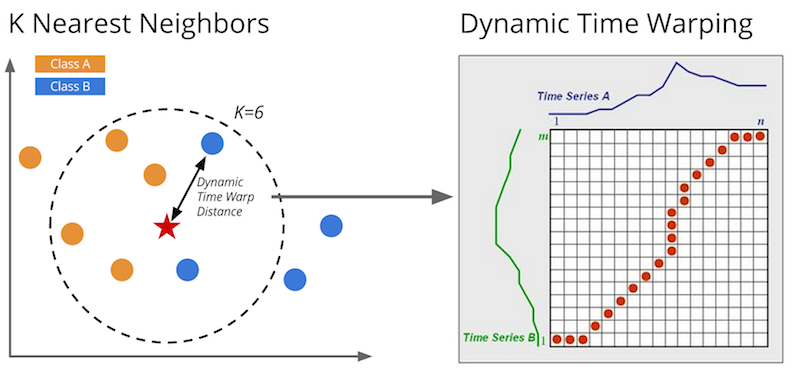
The following IPython notebook evaluates the KNN and DTW classifer by using it to classify human activities (sitting, walking, lying) when given timeseries data from a smart phones gyroscope and accelerometer (HAR dataset).

Human Activity Recognition Dataset
The Human Activity Recognition Dataset (HAR) dataset is chosen to test the classification performance of DTW & KNN [3].
The experiments were carried out with a group of 30 volunteers within an age bracket of 19-48 years. Each person performed six activities (walking, walking upstairs, walking downstairs, sitting, standing and laying) wearing a smartphone (Samsung Galaxy S II) on the waist. Using its embedded accelerometer and gyroscope, we captured 3-axial linear acceleration and 3-axial angular velocity at a constant rate of 50Hz. The experiments have been video-recorded to label the data manually.
References
- Mitsa (2010). Temporal Data Mining (Chapter on Temporal Classification).
- Xi (2006). Fast Time Series Classification Using Numerosity Reduction.
- Davide Anguita, Alessandro Ghio, Luca Oneto, Xavier Parra and Jorge L. Reyes-Ortiz. Human Activity Recognition on Smartphones using a Multiclass Hardware-Friendly Support Vector Machine. International Workshop of Ambient Assisted Living (IWAAL 2012). Vitoria-Gasteiz, Spain. Dec 2012. Read Paper
Credit
- The progressbar used in the
DtwKnn()class was taken from PYMC - The matplotlib style and IPython notebook was taken from Cameron Davidson-Pilon's excelent "Bayesian Methods for Hackers"