
lululxvi/deepxde
lululxvi/deepxde has 4,506 GitHub stars and 1,014 forks. GitHot measured +2 stars in 24 hours and +10 in 7 days. Last checked 2026-11-12 12:34 UTC. Last push 2026-11-02.
A library for scientific machine learning and physics-informed learning
What you can do
- enables the user code to be compact, resembling closely the mathematical formulation.
- 5 types of boundary conditions (BCs): Dirichlet, Neumann, Robin, periodic, and a general BC, which can be defined on an arbitrary domain or on a point set; and approximate distance functions for hard constraints.
- 3 automatic differentiation (AD) methods to compute derivatives: reverse mode (i.e., backpropagation), forward mode, and zero coordinate shift (ZCS).
- different neural networks: fully connected neural network (FNN), stacked FNN, residual neural network, (spatio-temporal) multi-scale Fourier feature networks, etc.
측정된 스타 증가
- in 24h
- +2
- in 7 days
- +10
- in 15 days
- 업데이트 지연
- in 1 month
- 업데이트 지연
서로 겹치는 기간의 순증가량이며 일별 합계가 아닙니다. 측정값이 없으면 비워 둡니다. 스타는 관심도를 나타내며 품질을 보장하지 않습니다.
README.md
OriginalDeepXDE


DeepXDE is a library for scientific machine learning and physics-informed learning. DeepXDE includes the following algorithms:
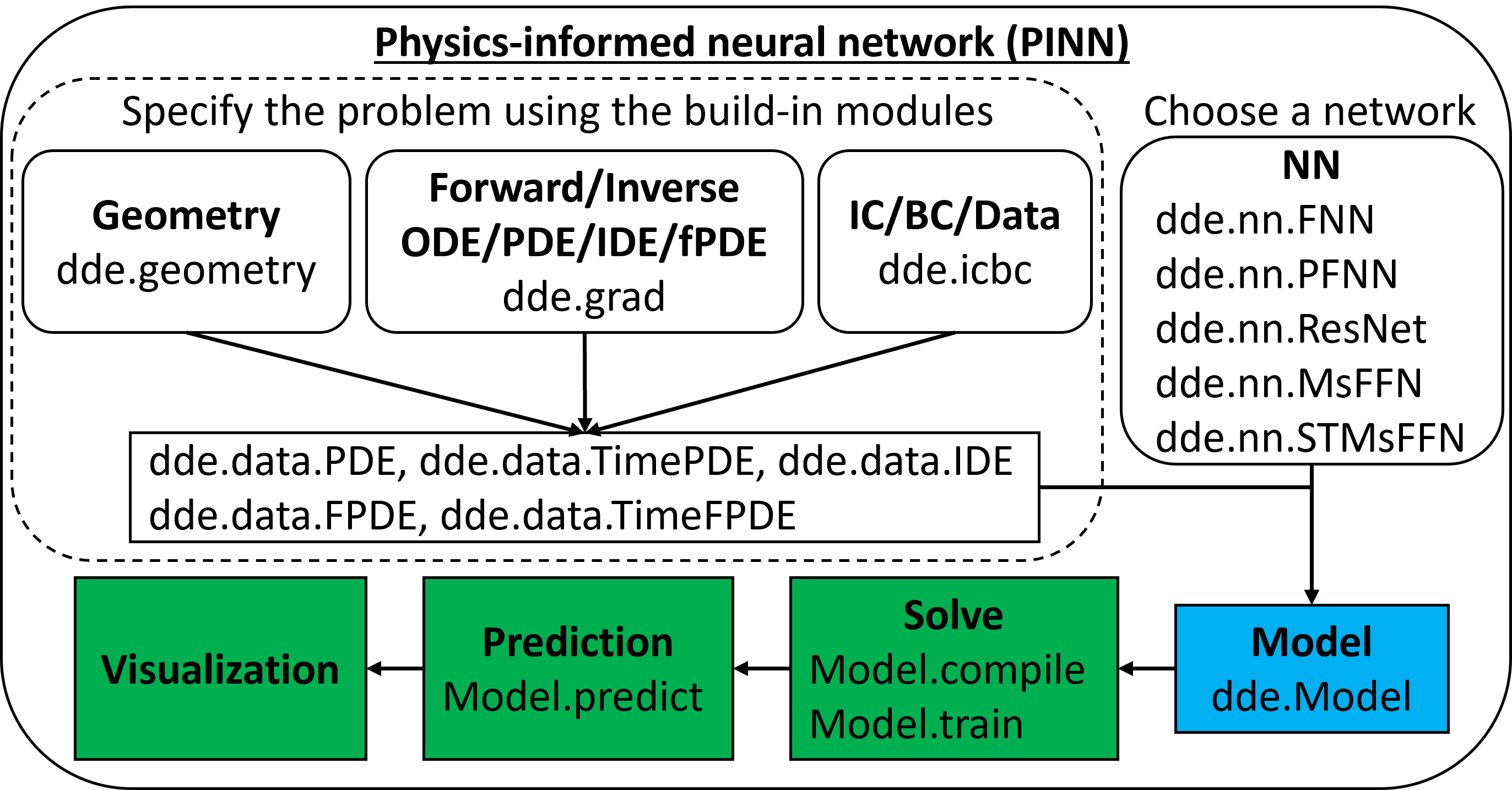
- physics-informed neural network (PINN)
- solving different problems
- solving forward/inverse ordinary/partial differential equations (ODEs/PDEs) [SIAM Rev.]
- solving forward/inverse integro-differential equations (IDEs) [SIAM Rev.]
- fPINN: solving forward/inverse fractional PDEs (fPDEs) [SIAM J. Sci. Comput.]
- NN-arbitrary polynomial chaos (NN-aPC): solving forward/inverse stochastic PDEs (sPDEs) [J. Comput. Phys.]
- PINN with hard constraints (hPINN): solving inverse design/topology optimization [SIAM J. Sci. Comput.]
- improving PINN accuracy
- residual-based adaptive sampling [SIAM Rev., Comput. Methods Appl. Mech. Eng.]
- gradient-enhanced PINN (gPINN) [Comput. Methods Appl. Mech. Eng.]
- PINN with multi-scale Fourier features [Comput. Methods Appl. Mech. Eng.]
- Slides, Video, Video in Chinese
- solving different problems
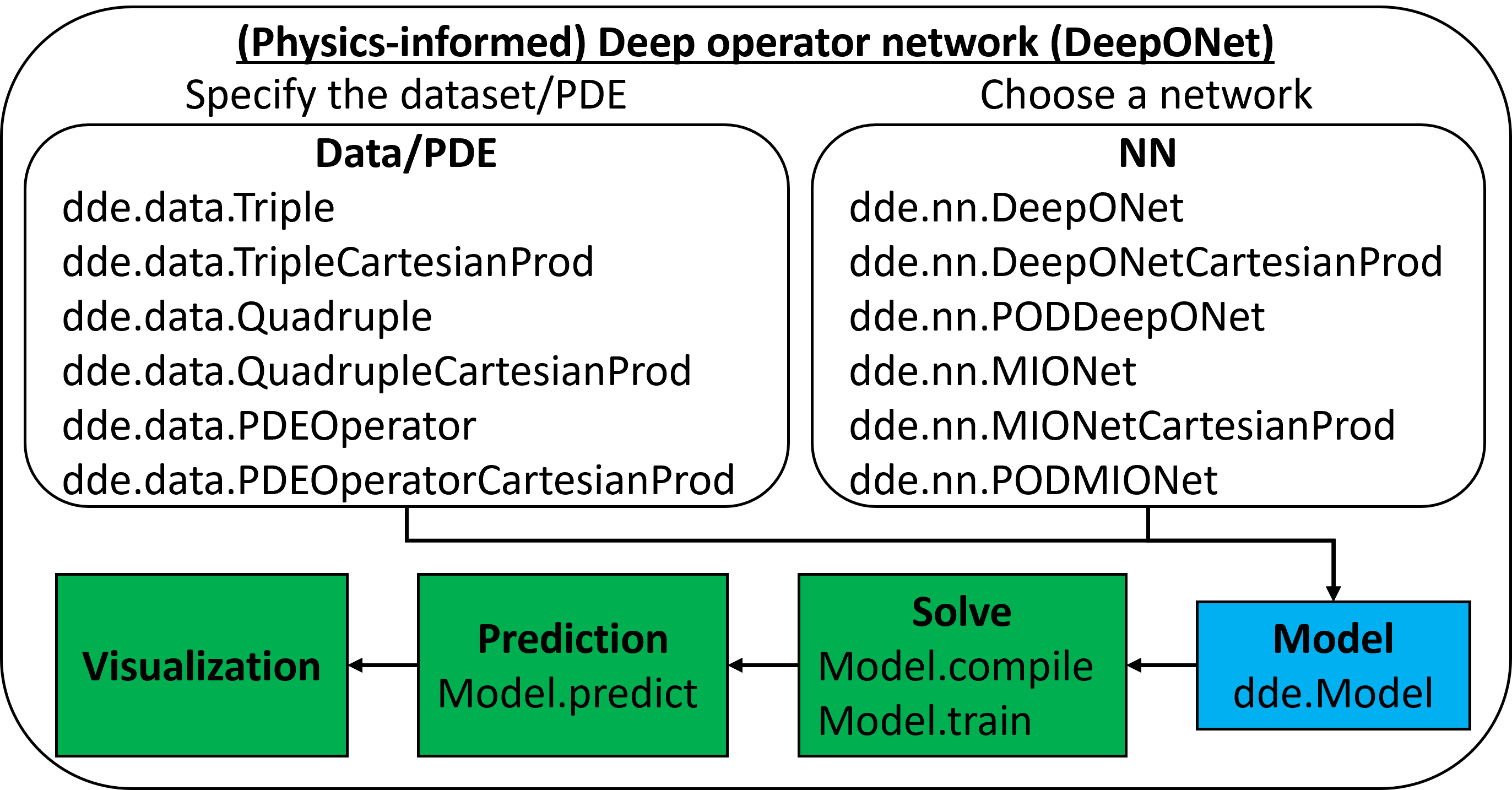
- (physics-informed) deep operator network (DeepONet)
- DeepONet: learning operators [Nat. Mach. Intell.]
- DeepONet extensions, e.g., POD-DeepONet [Comput. Methods Appl. Mech. Eng.]
- MIONet: learning multiple-input operators [SIAM J. Sci. Comput.]
- Fourier-DeepONet [Comput. Methods Appl. Mech. Eng.], Fourier-MIONet [arXiv]
- physics-informed DeepONet [Sci. Adv.]
- multifidelity DeepONet [Phys. Rev. Research]
- DeepM&Mnet: solving multiphysics and multiscale problems [J. Comput. Phys., J. Comput. Phys.]
- Reliable extrapolation [Comput. Methods Appl. Mech. Eng.]
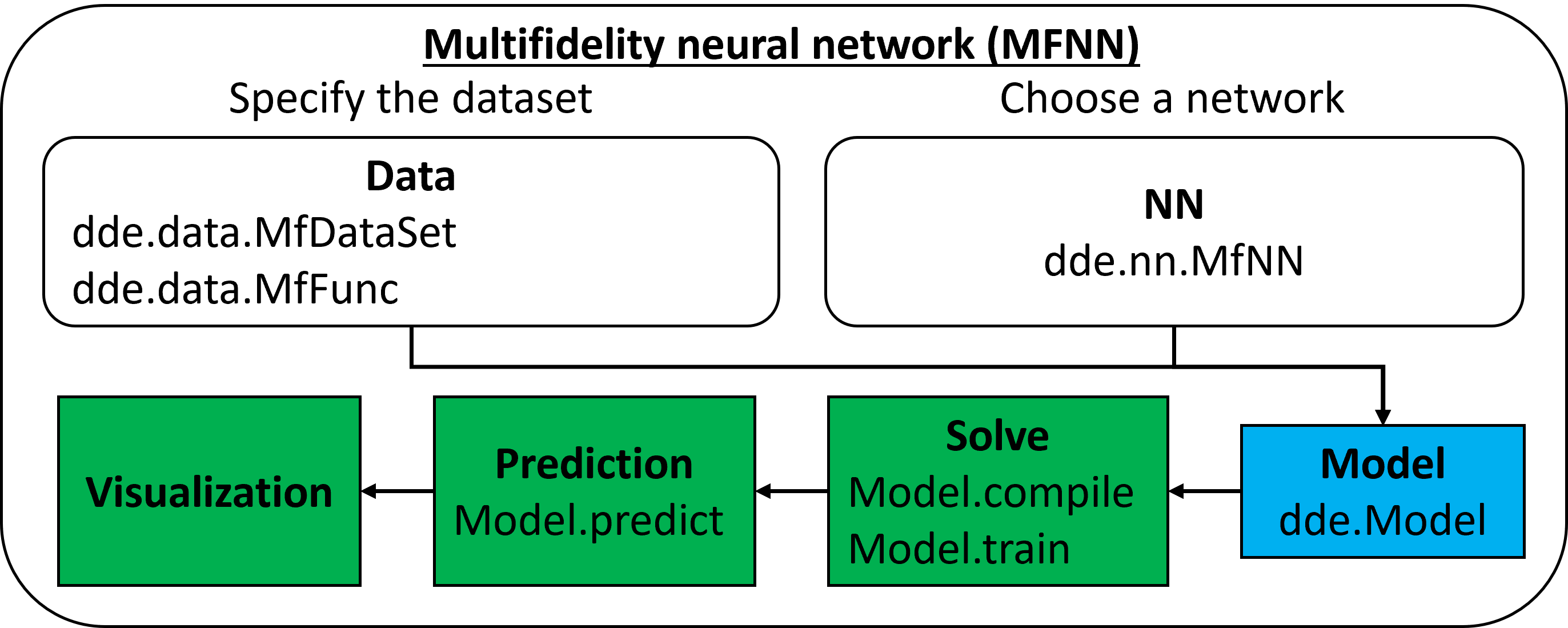
- multifidelity neural network (MFNN)
- learning from multifidelity data [J. Comput. Phys., PNAS]
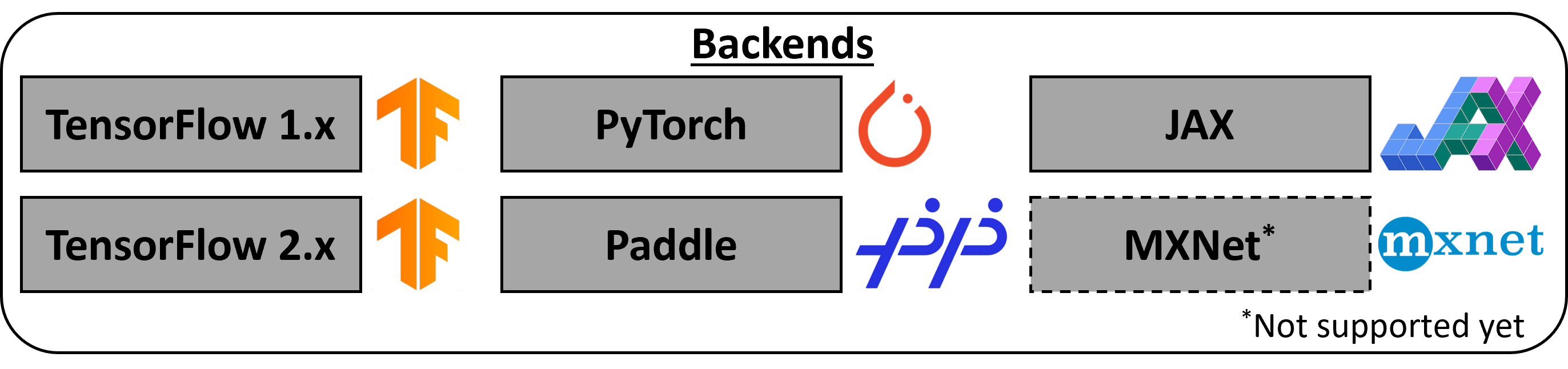
DeepXDE supports five tensor libraries as backends: TensorFlow 1.x (tensorflow.compat.v1 in TensorFlow 2.x), TensorFlow 2.x, PyTorch, JAX, and PaddlePaddle. For how to select one, see Working with different backends.
Documentation: ReadTheDocs
Features
DeepXDE has implemented many algorithms as shown above and supports many features:
- enables the user code to be compact, resembling closely the mathematical formulation.
- complex domain geometries without tyranny mesh generation. The primitive geometries are interval, triangle, rectangle, polygon, disk, ellipse, star-shaped, cuboid, sphere, hypercube, and hypersphere. Other geometries can be constructed as constructive solid geometry (CSG) using three boolean operations: union, difference, and intersection. DeepXDE also supports a geometry represented by a point cloud.
- 5 types of boundary conditions (BCs): Dirichlet, Neumann, Robin, periodic, and a general BC, which can be defined on an arbitrary domain or on a point set; and approximate distance functions for hard constraints.
- 3 automatic differentiation (AD) methods to compute derivatives: reverse mode (i.e., backpropagation), forward mode, and zero coordinate shift (ZCS).
- different neural networks: fully connected neural network (FNN), stacked FNN, residual neural network, (spatio-temporal) multi-scale Fourier feature networks, etc.
- many sampling methods: uniform, pseudorandom, Latin hypercube sampling, Halton sequence, Hammersley sequence, and Sobol sequence. The training points can keep the same during training or be resampled (adaptively) every certain iterations.
- 4 function spaces: power series, Chebyshev polynomial, Gaussian random field (1D/2D).
- data-parallel training on multiple GPUs.
- different optimizers: Adam, L-BFGS, etc.
- conveniently save the model during training, and load a trained model.
- callbacks to monitor the internal states and statistics of the model during training: early stopping, etc.
- uncertainty quantification using dropout.
- float16, float32, and float64.
- many other useful features: different (weighted) losses, learning rate schedules, metrics, etc.
All the components of DeepXDE are loosely coupled, and thus DeepXDE is well-structured and highly configurable. It is easy to customize DeepXDE to meet new demands.
Installation
DeepXDE requires one of the following backend-specific dependencies to be installed:
- TensorFlow 1.x: TensorFlow>=2.7.0
- TensorFlow 2.x: TensorFlow>=2.3.0, TensorFlow Probability>=0.11.0
- PyTorch: PyTorch>=2.0.0
- JAX: JAX, Flax, Optax
- PaddlePaddle: PaddlePaddle>=2.6.0
Then, you can install DeepXDE itself.
- Install the stable version with
pip:
$ pip install deepxde
- Install the stable version with
conda:
$ conda install -c conda-forge deepxde
- For developers, you should clone the folder to your local machine and put it along with your project scripts.
$ git clone https://github.com/lululxvi/deepxde.git
Explore more
- Install and Setup
- Demos of function approximation
- Demos of forward problems
- Demos of inverse problems
- Demos of operator learning
- FAQ
- Research papers used DeepXDE
- API
Cite DeepXDE
If you use DeepXDE for academic research, you are encouraged to cite the following paper:
@article{lu2021deepxde,
  author  = {Lu, Lu and Meng, Xuhui and Mao, Zhiping and Karniadakis, George Em},
  title   = {{DeepXDE}: A deep learning library for solving differential equations},
  journal = {SIAM Review},
  volume  = {63},
  number  = {1},
  pages   = {208-228},
  year    = {2021},
  doi     = {10.1137/19M1274067}
}
Contributing to DeepXDE
First off, thanks for taking the time to contribute!
- Reporting bugs. To report a bug, simply open an issue in the GitHub Issues.
- Suggesting enhancements. To submit an enhancement suggestion for DeepXDE, including completely new features and minor improvements to existing functionality, let us know by opening an issue in the GitHub Issues.
- Pull requests. If you made improvements to DeepXDE, fixed a bug, or had a new example, feel free to send us a pull-request.
- Asking questions. To get help on how to use DeepXDE or its functionalities, you can open a discussion in the GitHub Discussions.
- Answering questions. If you know the answer to any question in the Discussions, you are welcomed to answer.
Slack. The DeepXDE Slack hosts a primary audience of moderate to experienced DeepXDE users and developers for general chat, online discussions, collaboration, etc. If you need a slack invite, please send me an email.
The Team
DeepXDE was developed by Lu Lu under the supervision of Prof. George Karniadakis at Brown University from the summer of 2018 to 2020. DeepXDE was originally self-hosted in Subversion at Brown University, under the name SciCoNet (Scientific Computing Neural Networks). On Feb 7, 2019, SciCoNet was moved from Subversion to GitHub, renamed to DeepXDE.
DeepXDE is currently maintained by Lu Lu at Yale University with major contributions coming from many talented individuals in various forms and means. A non-exhaustive but growing list needs to mention: Paul Escapil-Inchauspé, Zongren Zou, Jialin Li, Saransh Chopra, Sensen He, Vladimir Dudenkov, Anran Jiao, Zhongyi Jiang, Shunyuan Mao.
License
관련 프로젝트 살펴보기
tensorflow/tensorflow
모두를 위한 오픈소스 머신러닝 프레임워크
201,584 스타huggingface/transformers
🤗 Transformers: 텍스트, 비전, 오디오, 멀티모달 분야의 최첨단 머신러닝 모델을 위한 모델 정의 프레임워크로, 추론과 학습을 모두 지원합니다.
168,917 스타AUTOMATIC1111/stable-diffusion-webui
Stable Diffusion 웹 UI
165,300 스타Comfy-Org/ComfyUI
그래프와 노드로 구성된 인터페이스를 갖춘, 가장 강력하고 모듈성이 뛰어난 확산 모델 GUI, API, 백엔드입니다. 세계에서 가장 빠른 로컬 추론 엔진입니다.
146,472 스타