
lance-format/lance
lance-format/lance has 7,279 GitHub stars and 927 forks. GitHot measured +3 stars in 24 hours, +26 in 7 days, and +63 in 15 days. Last checked 2026-11-11 15:09 UTC. Last push 2026-11-03.
멀티모달 AI를 위한 오픈 Lakehouse 포맷입니다. 코드 2줄로 Parquet에서 변환할 수 있으며, 랜덤 액세스는 100배 더 빨라지고 벡터 인덱스와 데이터 버전 관리를 지원합니다. Pandas, DuckDB, Polars, Pyarrow, PyTorch와 호환되며, 더 많은 연동이 추가될 예정입니다.
측정된 스타 증가
- in 24h
- +3
- in 7 days
- +26
- in 15 days
- +63
- in 1 month
- 업데이트 지연
서로 겹치는 기간의 순증가량이며 일별 합계가 아닙니다. 측정값이 없으면 비워 둡니다. 스타는 관심도를 나타내며 품질을 보장하지 않습니다.
README.md
Original
The Open Lakehouse Format for Multimodal AI
High-performance vector search, full-text search, random access, and feature engineering capabilities for the lakehouse.
Compatible with Pandas, DuckDB, Polars, PyArrow, Ray, Spark, and more integrations on the way.
Documentation • Community • Discord • Mailing List



Lance is an open lakehouse format for multimodal AI. It contains a file format, table format, and catalog spec that allows you to build a complete lakehouse on top of object storage to power your AI workflows. Lance is perfect for:
- Building search engines and feature stores with hybrid search capabilities.
- Large-scale ML training requiring high performance IO and random access.
- Storing, querying, and managing multimodal data including images, videos, audio, text, and embeddings.
The key features of Lance include:
Expressive hybrid search: Combine vector similarity search, full-text search (BM25), and SQL analytics on the same dataset with accelerated secondary indices.
Lightning-fast random access: 100x faster than Parquet or Iceberg for random access without sacrificing scan performance.
Native multimodal data support: Store images, videos, audio, text, and embeddings in a single unified format with efficient blob encoding and lazy loading.
Data evolution: Efficiently add columns with backfilled values without full table rewrites, perfect for ML feature engineering.
Zero-copy versioning: Automatic versioning with ACID transactions, time travel, tags, and branches—no extra infrastructure needed.
Rich ecosystem integrations: Apache Arrow, Pandas, Polars, DuckDB, Apache Spark, Ray, Trino, Apache Flink, and open catalogs (Apache Polaris, Unity Catalog, Apache Gravitino).
For more details, see the full Lance format specification.
[!TIP] Lance is in active development and we welcome contributions. Please see our contributing guide for more information.
File format stability
Lance releases frequently because the SDKs, integrations, and performance work are moving quickly. This does not mean the Lance file format changes incompatibly in every release. The Lance file format is identified by the data_storage_version stored in each dataset, and stable storage versions are a long-term compatibility contract.
- Once a dataset is written with a stable
data_storage_version, future Lance releases will continue to support reading that storage version. - SDK and API compatibility is separate from file format compatibility. SDK/API changes follow semantic versioning and are documented in the migration guide.
- Older Lance releases may not understand file format versions introduced later. If you run mixed Lance versions, pin
data_storage_versionfor deterministic writes. - The
nextfile format alias is unstable and should only be used for experimentation, never for production data.
For production, write data with a stable data_storage_version. See the format versioning guide for the current compatibility matrix.
Quick Start
Installation
pip install pylance
To install a preview release:
pip install --pre --extra-index-url https://pypi.fury.io/lance-format pylance
[!TIP] Preview releases are released more often than full releases and contain the latest features and bug fixes. They receive the same level of testing as full releases. We guarantee they will remain published and available for download for at least 6 months. When you want to pin to a specific version, prefer a stable release.
Converting to Lance
import lance

import pandas as pd
import pyarrow as pa
import pyarrow.dataset

df = pd.DataFrame({"a": [5], "b": [10]})
uri = "/tmp/test.parquet"
tbl = pa.Table.from_pandas(df)
pa.dataset.write_dataset(tbl, uri, format='parquet')

parquet = pa.dataset.dataset(uri, format='parquet')
lance.write_dataset(parquet, "/tmp/test.lance")
Reading Lance data
dataset = lance.dataset("/tmp/test.lance")
assert isinstance(dataset, pa.dataset.Dataset)
Pandas
df = dataset.to_table().to_pandas()
df
DuckDB
import duckdb

# If this segfaults, make sure you have duckdb v0.7+ installed
duckdb.query("SELECT * FROM dataset LIMIT 10").to_df()
Vector search
Download the sift1m subset
wget ftp://ftp.irisa.fr/local/texmex/corpus/sift.tar.gz
tar -xzf sift.tar.gz
Convert it to Lance
import lance
from lance.vector import vec_to_table
import numpy as np
import struct

nvecs = 1000000
ndims = 128
with open("sift/sift_base.fvecs", mode="rb") as fobj:
    buf = fobj.read()
    data = np.array(struct.unpack("<128000000f", buf[4 : 4 + 4 * nvecs * ndims])).reshape((nvecs, ndims))
    dd = dict(zip(range(nvecs), data))

table = vec_to_table(dd)
uri = "vec_data.lance"
sift1m = lance.write_dataset(table, uri, max_rows_per_group=8192, max_rows_per_file=1024*1024)
Build the index
sift1m.create_index("vector",
                    index_type="IVF_PQ",
                    num_partitions=256,  # IVF
                    num_sub_vectors=16)  # PQ
Search the dataset
# Get top 10 similar vectors
import duckdb

dataset = lance.dataset(uri)

# Sample 100 query vectors. If this segfaults, make sure you have duckdb v0.7+ installed
sample = duckdb.query("SELECT vector FROM dataset USING SAMPLE 100").to_df()
query_vectors = np.array([np.array(x) for x in sample.vector])

# Get nearest neighbors for all of them
rs = [dataset.to_table(nearest={"column": "vector", "k": 10, "q": q})
      for q in query_vectors]
Directory structure
| Directory | Description |
|---|---|
| rust | Core Rust implementation |
| python | Python bindings (PyO3) |
| java | Java bindings (JNI) |
| docs | Documentation source |
Benchmarks
Vector search
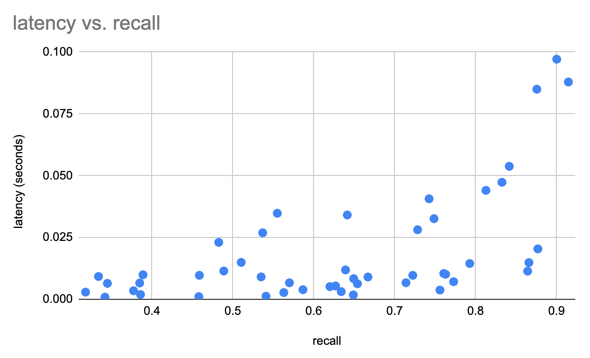
We used the SIFT dataset to benchmark our results with 1M vectors of 128D
- For 100 randomly sampled query vectors, we get <1ms average response time (on a 2023 m2 MacBook Air)
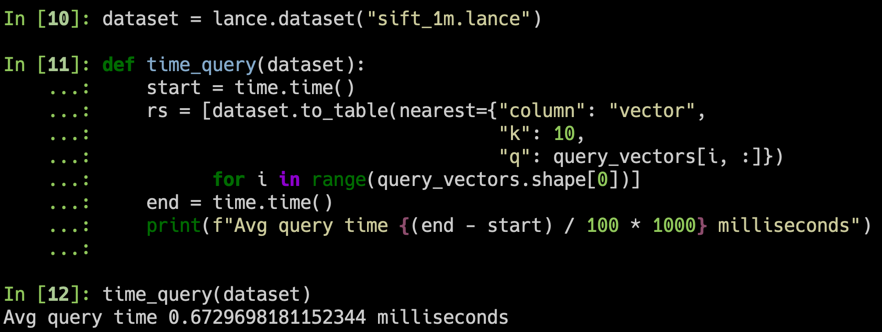
- ANNs are always a trade-off between recall and performance
Vs. parquet
We create a Lance dataset using the Oxford Pet dataset to do some preliminary performance testing of Lance as compared to Parquet and raw image/XMLs. For analytics queries, Lance is 50-100x better than reading the raw metadata. For batched random access, Lance is 100x better than both parquet and raw files.

Why Lance for AI/ML workflows?
The machine learning development cycle involves multiple stages:
graph LR
    A[Collection] --> B[Exploration];
    B --> C[Analytics];
    C --> D[Feature Engineer];
    D --> E[Training];
    E --> F[Evaluation];
    F --> C;
    E --> G[Deployment];
    G --> H[Monitoring];
    H --> A;
Traditional lakehouse formats were designed for SQL analytics and struggle with AI/ML workloads that require:
- Vector search for similarity and semantic retrieval
- Fast random access for sampling and interactive exploration
- Multimodal data storage (images, videos, audio alongside embeddings)
- Data evolution for feature engineering without full table rewrites
- Hybrid search combining vectors, full-text, and SQL predicates
While existing formats (Parquet, Iceberg, Delta Lake) excel at SQL analytics, they require additional specialized systems for AI capabilities. Lance brings these AI-first features directly into the lakehouse format.
A comparison of different formats across ML development stages:
| Lance | Parquet & ORC | JSON & XML | TFRecord | Database | Warehouse | |
|---|---|---|---|---|---|---|
| Analytics | Fast | Fast | Slow | Slow | Decent | Fast |
| Feature Engineering | Fast | Fast | Decent | Slow | Decent | Good |
| Training | Fast | Decent | Slow | Fast | N/A | N/A |
| Exploration | Fast | Slow | Fast | Slow | Fast | Decent |
| Infra Support | Rich | Rich | Decent | Limited | Rich | Rich |
Supported Storage
Lance reads and writes datasets stored on local disk or in object storage. The storage backend is selected automatically by the URI scheme of the dataset path.
| Storage | URI scheme | Notes |
|---|---|---|
| Local filesystem | file:// |
Default; also accepts plain paths. file+uring:// (Linux only) uses io_uring for better local I/O performance. |
| AWS S3 | s3:// |
Supports S3 Express One Zone buckets. Use s3+ddb:// to version datasets with DynamoDB-managed metadata. |
| S3-compatible stores | s3:// |
MinIO, Cloudflare R2, Wasabi, and other S3-compatible stores via the endpoint storage option. |
| Microsoft Azure Blob Storage | az:// |
Also supports Azure Data Lake Storage Gen2 via abfss://. |
| Google Cloud Storage | gs:// |
|
| Alibaba Cloud Object Storage Service | oss:// |
|
| Tencent Cloud Object Storage | cos:// |
|
| Volcengine Object Storage (TOS) | tos:// |
|
| Hugging Face Hub | hf:// |
|
| GooseFS | goosefs:// |
|
| In-memory | memory:// |
Intended for testing only. |
For credentials, authentication, and per-store configuration options, see the object store configuration guide.
관련 프로젝트 살펴보기
tensorflow/tensorflow
모두를 위한 오픈소스 머신러닝 프레임워크
201,505 스타huggingface/transformers
🤗 Transformers: 텍스트, 비전, 오디오, 멀티모달 분야의 최첨단 머신러닝 모델을 위한 모델 정의 프레임워크로, 추론과 학습을 모두 지원합니다.
168,815 스타AUTOMATIC1111/stable-diffusion-webui
Stable Diffusion 웹 UI
165,289 스타Comfy-Org/ComfyUI
그래프와 노드로 구성된 인터페이스를 갖춘, 가장 강력하고 모듈성이 뛰어난 확산 모델 GUI, API, 백엔드입니다. 세계에서 가장 빠른 로컬 추론 엔진입니다.
146,271 스타