
krasserm/super-resolution
krasserm/super-resolution has 1,514 GitHub stars and 341 forks. GitHot measured 0 in 7 days. Last checked 2026-11-15 20:48 UTC. Last push 2022-05-13.
측정된 스타 증가
- in 24h
- 업데이트 지연
- in 7 days
- 0
- in 15 days
- 업데이트 지연
- in 1 month
- 업데이트 지연
서로 겹치는 기간의 순증가량이며 일별 합계가 아닙니다. 측정값이 없으면 비워 둡니다. 스타는 관심도를 나타내며 품질을 보장하지 않습니다.
소개
Tensorflow 2.x based implementation of EDSR, WDSR and SRGAN for single image super-resolution
머신러닝README.md
Original
Single Image Super-Resolution with EDSR, WDSR and SRGAN
A Tensorflow 2.x based implementation of
- Enhanced Deep Residual Networks for Single Image Super-Resolution (EDSR), winner of the NTIRE 2017 super-resolution challenge.
- Wide Activation for Efficient and Accurate Image Super-Resolution (WDSR), winner of the NTIRE 2018 super-resolution challenge (realistic tracks).
- Photo-Realistic Single Image Super-Resolution Using a Generative Adversarial Network (SRGAN).
This is a complete re-write of the old Keras/Tensorflow 1.x based implementation available here. Some parts are still work in progress but you can already train models as described in the papers via a high-level training API. Furthermore, you can also fine-tune EDSR and WDSR models in an SRGAN context. Training and usage examples are given in the notebooks
A DIV2K data provider automatically downloads DIV2K
training and validation images of given scale (2, 3, 4 or 8) and downgrade operator ("bicubic", "unknown", "mild" or
"difficult").
Important: if you want to evaluate the pre-trained models with a dataset other than DIV2K please read this comment (and replies) first.
Environment setup
Create a new conda environment with
conda env create -f environment.yml
and activate it with
conda activate sisr
Introduction
You can find an introduction to single-image super-resolution in this article. It also demonstrates how EDSR and WDSR models can be fine-tuned with SRGAN (see also this section).
Getting started
Examples in this section require following pre-trained weights for running (see also example notebooks):
Pre-trained weights
- weights-edsr-16-x4.tar.gz
- EDSR x4 baseline as described in the EDSR paper: 16 residual blocks, 64 filters, 1.52M parameters.
- PSNR on DIV2K validation set = 28.89 dB (images 801 - 900, 6 + 4 pixel border included).
- weights-wdsr-b-32-x4.tar.gz
- WDSR B x4 custom model: 32 residual blocks, 32 filters, expansion factor 6, 0.62M parameters.
- PSNR on DIV2K validation set = 28.91 dB (images 801 - 900, 6 + 4 pixel border included).
- weights-srgan.tar.gz
- SRGAN as described in the SRGAN paper: 1.55M parameters, trained with VGG54 content loss.
After download, extract them in the root folder of the project with
tar xvfz weights-<...>.tar.gz
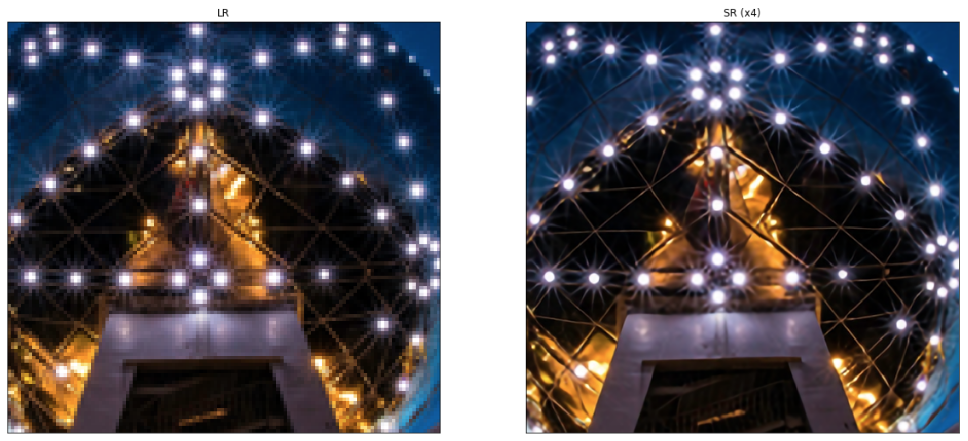
EDSR
from model import resolve_single
from model.edsr import edsr

from utils import load_image, plot_sample

model = edsr(scale=4, num_res_blocks=16)
model.load_weights('weights/edsr-16-x4/weights.h5')

lr = load_image('demo/0851x4-crop.png')
sr = resolve_single(model, lr)

plot_sample(lr, sr)
WDSR
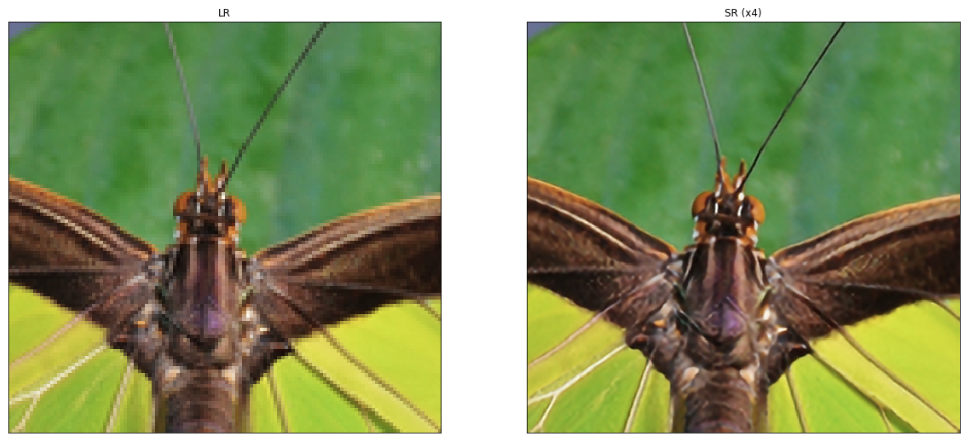
from model.wdsr import wdsr_b

model = wdsr_b(scale=4, num_res_blocks=32)
model.load_weights('weights/wdsr-b-32-x4/weights.h5')

lr = load_image('demo/0829x4-crop.png')
sr = resolve_single(model, lr)

plot_sample(lr, sr)
Weight normalization in WDSR models is implemented with the new WeightNormalization layer wrapper of
Tensorflow Addons. In its latest version, this wrapper seems to
corrupt weights when running model.predict(...). A workaround is to set model.run_eagerly = True or
compile the model with model.compile(loss='mae') in advance. This issue doesn't arise when calling the
model directly with model(...) though. To be further investigated ...
SRGAN
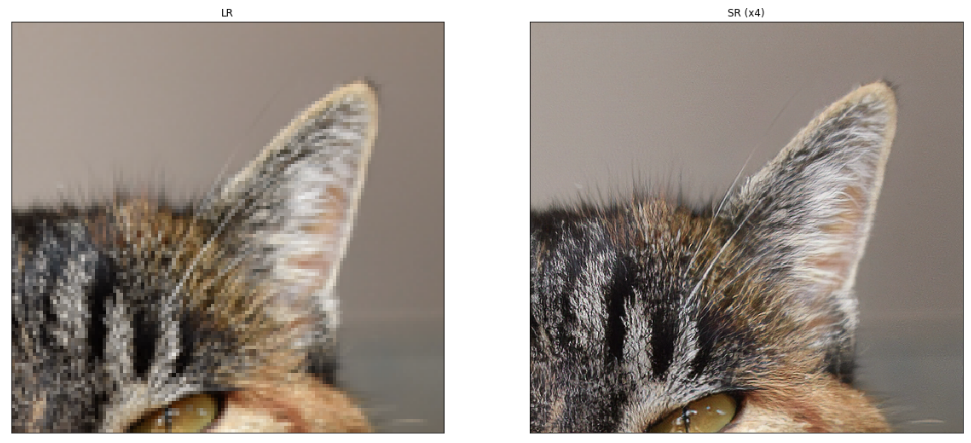
from model.srgan import generator

model = generator()
model.load_weights('weights/srgan/gan_generator.h5')

lr = load_image('demo/0869x4-crop.png')
sr = resolve_single(model, lr)

plot_sample(lr, sr)
DIV2K dataset
For training and validation on DIV2K images, applications should use the
provided DIV2K data loader. It automatically downloads DIV2K images to .div2k directory and converts them to a
different format for faster loading.
Training dataset
from data import DIV2K

train_loader = DIV2K(scale=4,             # 2, 3, 4 or 8
                     downgrade='bicubic', # 'bicubic', 'unknown', 'mild' or 'difficult'
                     subset='train')      # Training dataset are images 001 - 800

# Create a tf.data.Dataset
train_ds = train_loader.dataset(batch_size=16,         # batch size as described in the EDSR and WDSR papers
                                random_transform=True, # random crop, flip, rotate as described in the EDSR paper
                                repeat_count=None)     # repeat iterating over training images indefinitely

# Iterate over LR/HR image pairs
for lr, hr in train_ds:
    # ....
Crop size in HR images is 96x96.
Validation dataset
from data import DIV2K

valid_loader = DIV2K(scale=4,             # 2, 3, 4 or 8
                     downgrade='bicubic', # 'bicubic', 'unknown', 'mild' or 'difficult'
                     subset='valid')      # Validation dataset are images 801 - 900

# Create a tf.data.Dataset
valid_ds = valid_loader.dataset(batch_size=1,           # use batch size of 1 as DIV2K images have different size
                                random_transform=False, # use DIV2K images in original size
                                repeat_count=1)         # 1 epoch

# Iterate over LR/HR image pairs
for lr, hr in valid_ds:
    # ....
Training
The following training examples use the training and validation datasets described earlier. The high-level training API is designed around steps (= minibatch updates) rather than epochs to better match the descriptions in the papers.
EDSR
from model.edsr import edsr
from train import EdsrTrainer

# Create a training context for an EDSR x4 model with 16
# residual blocks.
trainer = EdsrTrainer(model=edsr(scale=4, num_res_blocks=16),
                      checkpoint_dir=f'.ckpt/edsr-16-x4')

# Train EDSR model for 300,000 steps and evaluate model
# every 1000 steps on the first 10 images of the DIV2K
# validation set. Save a checkpoint only if evaluation
# PSNR has improved.
trainer.train(train_ds,
              valid_ds.take(10),
              steps=300000,
              evaluate_every=1000,
              save_best_only=True)

# Restore from checkpoint with highest PSNR.
trainer.restore()

# Evaluate model on full validation set.
psnr = trainer.evaluate(valid_ds)
print(f'PSNR = {psnr.numpy():3f}')

# Save weights to separate location.
trainer.model.save_weights('weights/edsr-16-x4/weights.h5')
Interrupting training and restarting it again resumes from the latest saved checkpoint. The trained Keras model can be
accessed with trainer.model.
WDSR
from model.wdsr import wdsr_b
from train import WdsrTrainer

# Create a training context for a WDSR B x4 model with 32
# residual blocks.
trainer = WdsrTrainer(model=wdsr_b(scale=4, num_res_blocks=32),
                      checkpoint_dir=f'.ckpt/wdsr-b-8-x4')

# Train WDSR B model for 300,000 steps and evaluate model
# every 1000 steps on the first 10 images of the DIV2K
# validation set. Save a checkpoint only if evaluation
# PSNR has improved.
trainer.train(train_ds,
              valid_ds.take(10),
              steps=300000,
              evaluate_every=1000,
              save_best_only=True)

# Restore from checkpoint with highest PSNR.
trainer.restore()

# Evaluate model on full validation set.
psnr = trainer.evaluate(valid_ds)
print(f'PSNR = {psnr.numpy():3f}')

# Save weights to separate location.
trainer.model.save_weights('weights/wdsr-b-32-x4/weights.h5')
SRGAN
Generator pre-training
from model.srgan import generator
from train import SrganGeneratorTrainer

# Create a training context for the generator (SRResNet) alone.
pre_trainer = SrganGeneratorTrainer(model=generator(), checkpoint_dir=f'.ckpt/pre_generator')

# Pre-train the generator with 1,000,000 steps (100,000 works fine too).
pre_trainer.train(train_ds, valid_ds.take(10), steps=1000000, evaluate_every=1000)

# Save weights of pre-trained generator (needed for fine-tuning with GAN).
pre_trainer.model.save_weights('weights/srgan/pre_generator.h5')
Generator fine-tuning (GAN)
from model.srgan import generator, discriminator
from train import SrganTrainer

# Create a new generator and init it with pre-trained weights.
gan_generator = generator()
gan_generator.load_weights('weights/srgan/pre_generator.h5')

# Create a training context for the GAN (generator + discriminator).
gan_trainer = SrganTrainer(generator=gan_generator, discriminator=discriminator())

# Train the GAN with 200,000 steps.
gan_trainer.train(train_ds, steps=200000)

# Save weights of generator and discriminator.
gan_trainer.generator.save_weights('weights/srgan/gan_generator.h5')
gan_trainer.discriminator.save_weights('weights/srgan/gan_discriminator.h5')
SRGAN for fine-tuning EDSR and WDSR models
It is also possible to fine-tune EDSR and WDSR x4 models with SRGAN. They can be used as drop-in replacement for the original SRGAN generator. More details in this article.
# Create EDSR generator and init with pre-trained weights
generator = edsr(scale=4, num_res_blocks=16)
generator.load_weights('weights/edsr-16-x4/weights.h5')

# Fine-tune EDSR model via SRGAN training.
gan_trainer = SrganTrainer(generator=generator, discriminator=discriminator())
gan_trainer.train(train_ds, steps=200000)
# Create WDSR B generator and init with pre-trained weights
generator = wdsr_b(scale=4, num_res_blocks=32)
generator.load_weights('weights/wdsr-b-16-32/weights.h5')

# Fine-tune WDSR B  model via SRGAN training.
gan_trainer = SrganTrainer(generator=generator, discriminator=discriminator())
gan_trainer.train(train_ds, steps=200000)