
karpathy/micrograd
karpathy/micrograd has 18,740 GitHub stars and 2,991 forks. GitHot measured +18 stars in 24 hours. Last checked 2026-11-07 19:42 UTC. Last push 2026-08-03.
스칼라 값을 다루는 작은 자동 미분 엔진과, 이를 기반으로 PyTorch와 유사한 API를 제공하는 신경망 라이브러리입니다.
측정된 스타 증가
- in 24h
- +18
- in 7 days
- 업데이트 지연
- in 15 days
- 업데이트 지연
- in 1 month
- 업데이트 지연
서로 겹치는 기간의 순증가량이며 일별 합계가 아닙니다. 측정값이 없으면 비워 둡니다. 스타는 관심도를 나타내며 품질을 보장하지 않습니다.
README.md
Originalmicrograd

A tiny Autograd engine (with a bite! :)). Implements backpropagation (reverse-mode autodiff) over a dynamically built DAG and a small neural networks library on top of it with a PyTorch-like API. Both are tiny, with about 100 and 50 lines of code respectively. The DAG only operates over scalar values, so e.g. we chop up each neuron into all of its individual tiny adds and multiplies. However, this is enough to build up entire deep neural nets doing binary classification, as the demo notebook shows. Potentially useful for educational purposes.
Installation
pip install micrograd
Example usage
Below is a slightly contrived example showing a number of possible supported operations:
from micrograd.engine import Value

a = Value(-4.0)
b = Value(2.0)
c = a + b
d = a * b + b**3
c += c + 1
c += 1 + c + (-a)
d += d * 2 + (b + a).relu()
d += 3 * d + (b - a).relu()
e = c - d
f = e**2
g = f / 2.0
g += 10.0 / f
print(f'{g.data:.4f}') # prints 24.7041, the outcome of this forward pass
g.backward()
print(f'{a.grad:.4f}') # prints 138.8338, i.e. the numerical value of dg/da
print(f'{b.grad:.4f}') # prints 645.5773, i.e. the numerical value of dg/db
Training a neural net
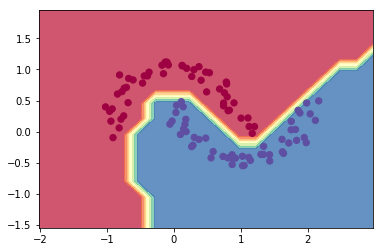
The notebook demo.ipynb provides a full demo of training an 2-layer neural network (MLP) binary classifier. This is achieved by initializing a neural net from micrograd.nn module, implementing a simple svm "max-margin" binary classification loss and using SGD for optimization. As shown in the notebook, using a 2-layer neural net with two 16-node hidden layers we achieve the following decision boundary on the moon dataset:
Training a GPT
For a more advanced example, see microgpt, which trains and samples from a full GPT-2-like transformer in pure, dependency-free Python. It builds on a more efficient and better version of the autograd engine here (storing local gradients at forward time instead of per-op backward closures), and is the complete algorithm in a single file — everything else is just efficiency. See also the accompanying explainer post for a detailed walkthrough.
Tracing / visualization
For added convenience, the notebook trace_graph.ipynb produces graphviz visualizations. E.g. this one below is of a simple 2D neuron, arrived at by calling draw_dot on the code below, and it shows both the data (left number in each node) and the gradient (right number in each node).
from micrograd import nn
n = nn.Neuron(2)
x = [Value(1.0), Value(-2.0)]
y = n(x)
dot = draw_dot(y)

Running tests
To run the unit tests you will have to install PyTorch, which the tests use as a reference for verifying the correctness of the calculated gradients. Then simply:
python -m pytest
License
MIT
관련 프로젝트 살펴보기
tensorflow/tensorflow
모두를 위한 오픈소스 머신러닝 프레임워크
201,388 스타huggingface/transformers
🤗 Transformers: 텍스트, 비전, 오디오, 멀티모달 분야의 최첨단 머신러닝 모델을 위한 모델 정의 프레임워크로, 추론과 학습을 모두 지원합니다.
168,636 스타AUTOMATIC1111/stable-diffusion-webui
Stable Diffusion 웹 UI
165,251 스타Comfy-Org/ComfyUI
그래프와 노드로 구성된 인터페이스를 갖춘, 가장 강력하고 모듈성이 뛰어난 확산 모델 GUI, API, 백엔드입니다. 세계에서 가장 빠른 로컬 추론 엔진입니다.
145,629 스타