
jaywalnut310/vits has 7,905 GitHub stars and 1,369 forks. GitHot measured +1 stars in 24 hours and +2 in 7 days. Last checked 2026-11-13 18:50 UTC. Last push 2023-12-06.
측정된 스타 증가
- in 24h
- +1
- in 7 days
- +2
- in 15 days
- 기록 수집 중
- in 1 month
- 기록 수집 중
서로 겹치는 기간의 순증가량이며 일별 합계가 아닙니다. 측정값이 없으면 비워 둡니다. 스타는 관심도를 나타내며 품질을 보장하지 않습니다.
소개
VITS: Conditional Variational Autoencoder with Adversarial Learning for End-to-End Text-to-Speech
머신러닝README.md
OriginalVITS: Conditional Variational Autoencoder with Adversarial Learning for End-to-End Text-to-Speech
Jaehyeon Kim, Jungil Kong, and Juhee Son
In our recent paper, we propose VITS: Conditional Variational Autoencoder with Adversarial Learning for End-to-End Text-to-Speech.
Several recent end-to-end text-to-speech (TTS) models enabling single-stage training and parallel sampling have been proposed, but their sample quality does not match that of two-stage TTS systems. In this work, we present a parallel end-to-end TTS method that generates more natural sounding audio than current two-stage models. Our method adopts variational inference augmented with normalizing flows and an adversarial training process, which improves the expressive power of generative modeling. We also propose a stochastic duration predictor to synthesize speech with diverse rhythms from input text. With the uncertainty modeling over latent variables and the stochastic duration predictor, our method expresses the natural one-to-many relationship in which a text input can be spoken in multiple ways with different pitches and rhythms. A subjective human evaluation (mean opinion score, or MOS) on the LJ Speech, a single speaker dataset, shows that our method outperforms the best publicly available TTS systems and achieves a MOS comparable to ground truth.
Visit our demo for audio samples.
We also provide the pretrained models.
** Update note: Thanks to Rishikesh (ऋषिकेश), our interactive TTS demo is now available on Colab Notebook.
| VITS at training | VITS at inference |
|---|---|
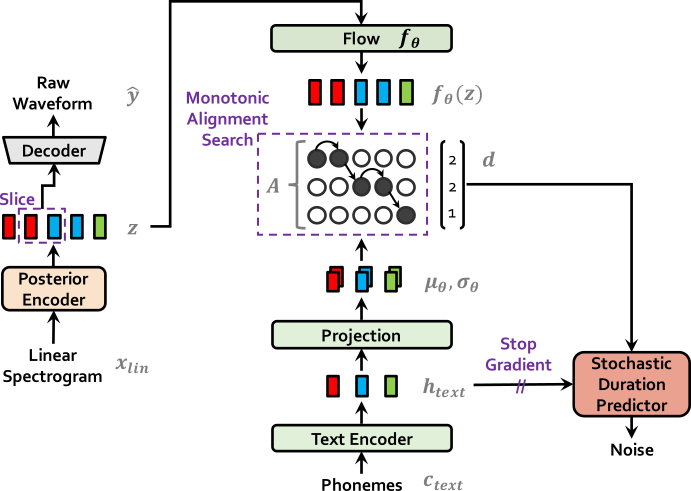 |
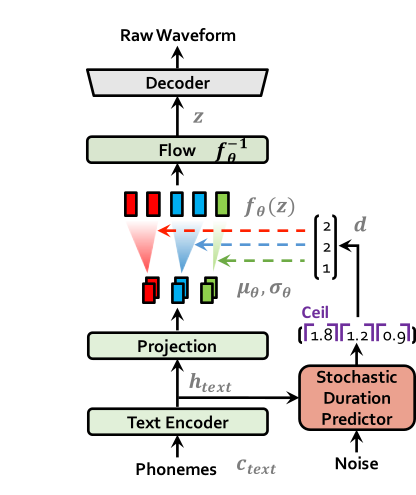 |
Pre-requisites
- Python >= 3.6
- Clone this repository
- Install python requirements. Please refer requirements.txt
- You may need to install espeak first:
apt-get install espeak
- You may need to install espeak first:
- Download datasets
- Download and extract the LJ Speech dataset, then rename or create a link to the dataset folder:
ln -s /path/to/LJSpeech-1.1/wavs DUMMY1 - For mult-speaker setting, download and extract the VCTK dataset, and downsample wav files to 22050 Hz. Then rename or create a link to the dataset folder:
ln -s /path/to/VCTK-Corpus/downsampled_wavs DUMMY2
- Download and extract the LJ Speech dataset, then rename or create a link to the dataset folder:
- Build Monotonic Alignment Search and run preprocessing if you use your own datasets.
# Cython-version Monotonoic Alignment Search
cd monotonic_align
python setup.py build_ext --inplace

# Preprocessing (g2p) for your own datasets. Preprocessed phonemes for LJ Speech and VCTK have been already provided.
# python preprocess.py --text_index 1 --filelists filelists/ljs_audio_text_train_filelist.txt filelists/ljs_audio_text_val_filelist.txt filelists/ljs_audio_text_test_filelist.txt
# python preprocess.py --text_index 2 --filelists filelists/vctk_audio_sid_text_train_filelist.txt filelists/vctk_audio_sid_text_val_filelist.txt filelists/vctk_audio_sid_text_test_filelist.txt
Training Exmaple
# LJ Speech
python train.py -c configs/ljs_base.json -m ljs_base

# VCTK
python train_ms.py -c configs/vctk_base.json -m vctk_base
Inference Example
See inference.ipynb
관련 프로젝트 살펴보기
tensorflow/tensorflow
모두를 위한 오픈소스 머신러닝 프레임워크
201,593 스타huggingface/transformers
🤗 Transformers: 텍스트, 비전, 오디오, 멀티모달 분야의 최첨단 머신러닝 모델을 위한 모델 정의 프레임워크로, 추론과 학습을 모두 지원합니다.
168,950 스타AUTOMATIC1111/stable-diffusion-webui
Stable Diffusion 웹 UI
165,305 스타Comfy-Org/ComfyUI
그래프와 노드로 구성된 인터페이스를 갖춘, 가장 강력하고 모듈성이 뛰어난 확산 모델 GUI, API, 백엔드입니다. 세계에서 가장 빠른 로컬 추론 엔진입니다.
146,686 스타