
idealo/imagededup
idealo/imagededup has 5,682 GitHub stars and 477 forks. GitHot measured 0 stars in 24 hours, 0 in 7 days, and +2 in 15 days. Last checked 2026-11-14 11:49 UTC. Last push 2025-08-15.
측정된 스타 증가
- in 24h
- 0
- in 7 days
- 0
- in 15 days
- +2
- in 1 month
- 기록 수집 중
서로 겹치는 기간의 순증가량이며 일별 합계가 아닙니다. 측정값이 없으면 비워 둡니다. 스타는 관심도를 나타내며 품질을 보장하지 않습니다.
소개
😎 중복 이미지를 쉽게 찾아보세요!
머신러닝README.md
OriginalImage Deduplicator (imagededup)




imagededup is a python package that simplifies the task of finding exact and near duplicates in an image collection.
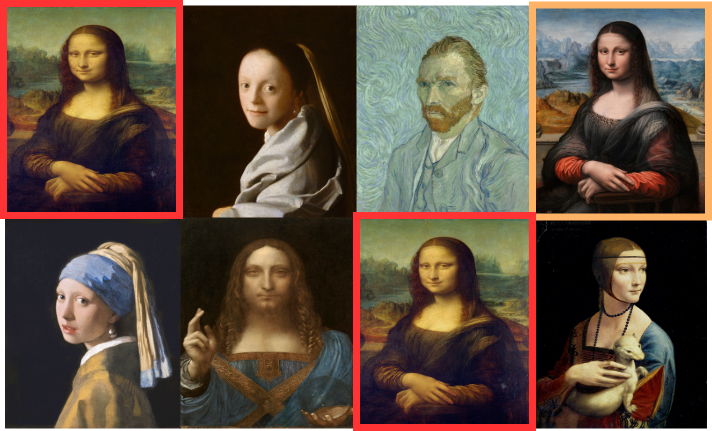
This package provides functionality to make use of hashing algorithms that are particularly good at finding exact duplicates as well as convolutional neural networks which are also adept at finding near duplicates. An evaluation framework is also provided to judge the quality of deduplication for a given dataset.
Following details the functionality provided by the package:
- Finding duplicates in a directory using one of the following algorithms:
- Convolutional Neural Network (CNN) - Select from several prepackaged models or provide your own custom model.
- Perceptual hashing (PHash)
- Difference hashing (DHash)
- Wavelet hashing (WHash)
- Average hashing (AHash)
- Generation of encodings for images using one of the above stated algorithms.
- Framework to evaluate effectiveness of deduplication given a ground truth mapping.
- Plotting duplicates found for a given image file.
Detailed documentation for the package can be found at: https://idealo.github.io/imagededup/
imagededup is compatible with Python 3.9+ and runs on Linux, MacOS X and Windows. It is distributed under the Apache 2.0 license.
📖 Contents
⚙️ Installation
There are two ways to install imagededup:
- Install imagededup from PyPI (recommended):
pip install imagededup
- Install imagededup from the GitHub source:
git clone https://github.com/idealo/imagededup.git
cd imagededup
pip install .
🚀 Quick Start
In order to find duplicates in an image directory using perceptual hashing, following workflow can be used:
- Import perceptual hashing method
from imagededup.methods import PHash
phasher = PHash()
- Generate encodings for all images in an image directory
encodings = phasher.encode_images(image_dir='path/to/image/directory')
- Find duplicates using the generated encodings
duplicates = phasher.find_duplicates(encoding_map=encodings)
- Plot duplicates obtained for a given file (eg: 'ukbench00120.jpg') using the duplicates dictionary
from imagededup.utils import plot_duplicates
plot_duplicates(image_dir='path/to/image/directory',
                duplicate_map=duplicates,
                filename='ukbench00120.jpg')
The output looks as below:
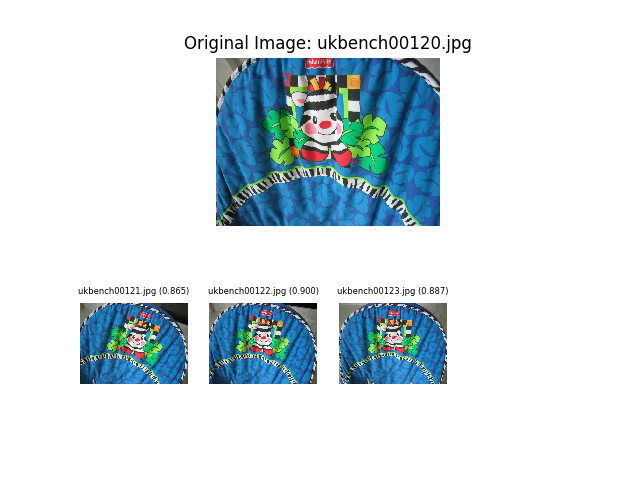
The complete code for the workflow is:
from imagededup.methods import PHash
phasher = PHash()

# Generate encodings for all images in an image directory
encodings = phasher.encode_images(image_dir='path/to/image/directory')

# Find duplicates using the generated encodings
duplicates = phasher.find_duplicates(encoding_map=encodings)

# plot duplicates obtained for a given file using the duplicates dictionary
from imagededup.utils import plot_duplicates
plot_duplicates(image_dir='path/to/image/directory',
                duplicate_map=duplicates,
                filename='ukbench00120.jpg')
To run the above snippet on Windows, have a look here. It is also possible to use your own custom models for finding duplicates using the CNN method.
For examples, refer this part of the repository.
For more detailed usage of the package functionality, refer: https://idealo.github.io/imagededup/
⏳ Benchmarks
Update: Provided benchmarks are only valid upto imagededup v0.2.2. The next releases have significant changes to all methods, so the current benchmarks may not hold.
Detailed benchmarks on speed and classification metrics for different methods have been provided in the documentation. Generally speaking, following conclusions can be made:
- CNN works best for near duplicates and datasets containing transformations.
- All deduplication methods fare well on datasets containing exact duplicates, but Difference hashing is the fastest.
🤝 Contribute
We welcome all kinds of contributions. See the Contribution guide for more details.
📝 Citation
Please cite Imagededup in your publications if this is useful for your research. Here is an example BibTeX entry:
@misc{idealods2019imagededup,
  title={Imagededup},
  author={Tanuj Jain and Christopher Lennan and Zubin John and Dat Tran},
  year={2019},
  howpublished={\url{https://github.com/idealo/imagededup}},
}
🏗 Maintainers
© Copyright
See LICENSE for details.
관련 프로젝트 살펴보기
tensorflow/tensorflow
모두를 위한 오픈소스 머신러닝 프레임워크
201,595 스타huggingface/transformers
🤗 Transformers: 텍스트, 비전, 오디오, 멀티모달 분야의 최첨단 머신러닝 모델을 위한 모델 정의 프레임워크로, 추론과 학습을 모두 지원합니다.
168,964 스타AUTOMATIC1111/stable-diffusion-webui
Stable Diffusion 웹 UI
165,312 스타Comfy-Org/ComfyUI
그래프와 노드로 구성된 인터페이스를 갖춘, 가장 강력하고 모듈성이 뛰어난 확산 모델 GUI, API, 백엔드입니다. 세계에서 가장 빠른 로컬 추론 엔진입니다.
146,776 스타