
hughperkins/VeriGPU
hughperkins/VeriGPU has 1,414 GitHub stars and 147 forks. GitHot measured +1 stars in 24 hours and +8 in 7 days. Last checked 2026-11-14 00:24 UTC. Last push 2024-11-22.
측정된 스타 증가
- in 24h
- +1
- in 7 days
- +8
- in 15 days
- 기록 수집 중
- in 1 month
- 기록 수집 중
서로 겹치는 기간의 순증가량이며 일별 합계가 아닙니다. 측정값이 없으면 비워 둡니다. 스타는 관심도를 나타내며 품질을 보장하지 않습니다.
소개
OpenSource GPU, in Verilog, loosely based on RISC-V ISA
머신러닝README.md
OriginalOpenSource GPU
Build an opensource GPU, targeting ASIC tape-out, for machine learning ("ML"). Hopefully, can get it to work with the PyTorch deep learning framework.
Vision
Create an opensource GPU for machine learning.
I don't actually intend to tape this out myself, but I intend to do what I can to verify somehow that tape-out would work ok, timings ok, etc.
Intend to implement a HIP API, that is compatible with pytorch machine learning framework. Open to provision of other APIs, such as SYCL or NVIDIA® CUDA™.
Internal GPU Core ISA loosely compliant with RISC-V ISA. Where RISC-V conflicts with designing for a GPU setting, we break with RISC-V.
Intend to keep the cores very focused on ML. For example, brain floating point ("BF16") throughout, to keep core die area low. This should keep the per-core cost low. Similarly, Intend to implement only few float operations critical to ML, such as exp, log, tanh, sqrt.
Architecture
Big Picture:
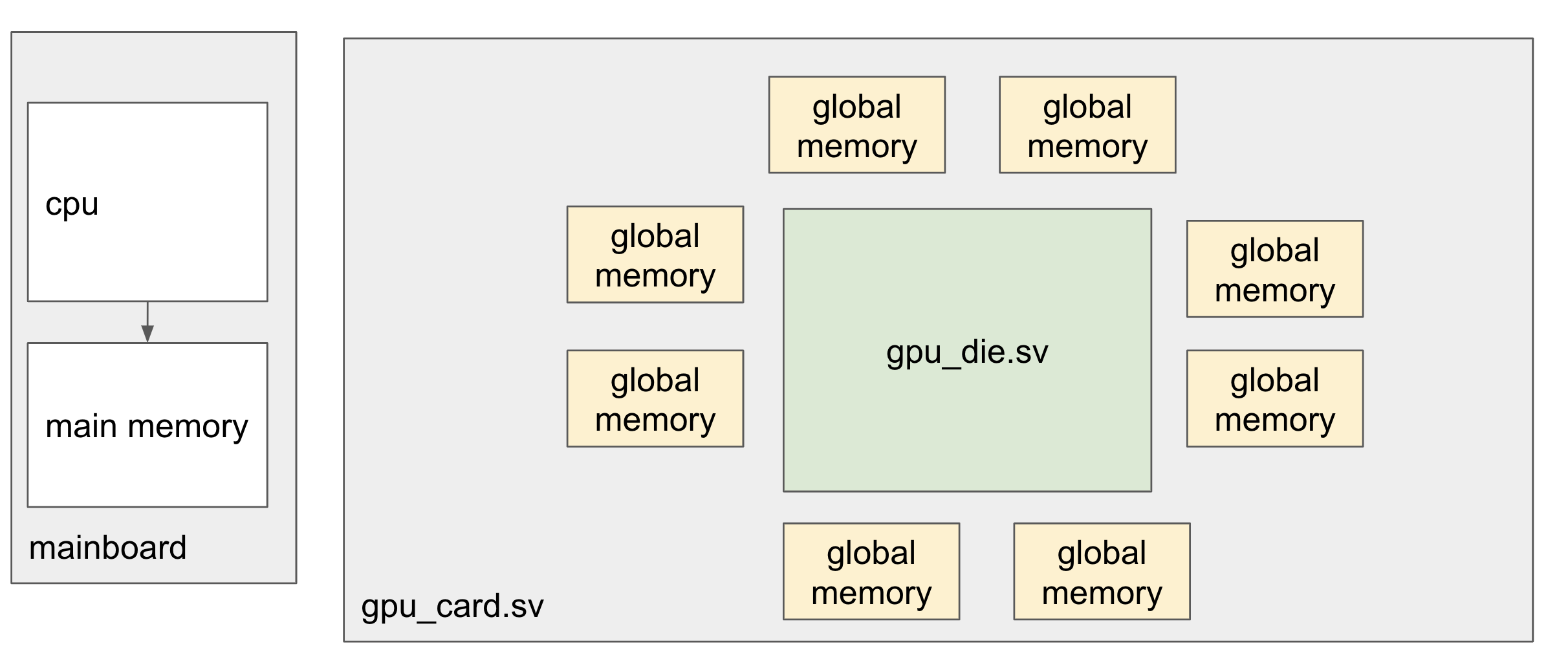
GPU Die Architecture:

Single Core:

Single-source compilation and runtime

Simulation
Single-source C++
Single-source C++:

Compile the GPU and runtime:
- CMakeLists.txt: src/gpu_runtime/CMakeLists.txt
- GPU runtime: src/gpu_runtime/gpu_runtime.cpp
- GPU controller: src/gpu_controller.sv
- Single GPU RISC-V core: src/core.sv

Compile the single-source C++, and run:

Planning
What direction are we thinking of going in? What works already? See:
Tech details
Our assembly language implementation and progress. Design of GPU memory, registers, and so on. See:
Verification
If we want to tape-out, we need solid verification. Read more at:
Metrics
we want the GPU to run quickly, and to use minimal die area. Read how we measure timings and area at:
관련 프로젝트 살펴보기
tensorflow/tensorflow
모두를 위한 오픈소스 머신러닝 프레임워크
201,591 스타huggingface/transformers
🤗 Transformers: 텍스트, 비전, 오디오, 멀티모달 분야의 최첨단 머신러닝 모델을 위한 모델 정의 프레임워크로, 추론과 학습을 모두 지원합니다.
168,951 스타AUTOMATIC1111/stable-diffusion-webui
Stable Diffusion 웹 UI
165,306 스타Comfy-Org/ComfyUI
그래프와 노드로 구성된 인터페이스를 갖춘, 가장 강력하고 모듈성이 뛰어난 확산 모델 GUI, API, 백엔드입니다. 세계에서 가장 빠른 로컬 추론 엔진입니다.
146,694 스타