
hbofz/NeSLE
hbofz/NeSLE has 36 GitHub stars and 2 forks. GitHot measured 0 stars in 24 hours and 0 in 7 days. Last checked 2026-11-21 08:47 UTC. Last push 2026-11-11.
What you can do
- GPU-resident PPO that keeps rollouts and training on device.
- Stable-Baselines3 compatible VecEnv, drops into existing code.
- Instant resets from bundled save states for all 8 worlds.
- On-GPU reward shaping and Mario RAM parsing.
측정된 스타 증가
- in 24h
- 0
- in 7 days
- 0
- in 15 days
- 기록 수집 중
- in 1 month
- 기록 수집 중
서로 겹치는 기간의 순증가량이며 일별 합계가 아닙니다. 측정값이 없으면 비워 둡니다. 스타는 관심도를 나타내며 품질을 보장하지 않습니다.
소개
An NES emulator that runs as a CUDA kernel, one console per thread
머신러닝README.md
OriginalNeSLE
Thousands of NES consoles on one GPU, for reinforcement learning.
NeSLE runs the whole NES (6502 CPU, PPU, bus) inside a CUDA kernel, one thread per console. Observations never leave the GPU, so your RL loop stops waiting on the emulator.


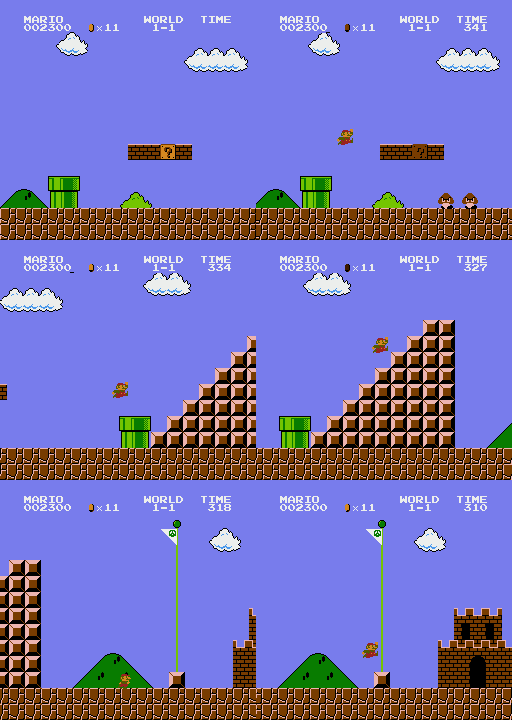
A PPO agent clearing World 1-1 after 2.5 hours of training on a GTX 1050 Ti.
Why
| Setup | Env-steps/s |
|---|---|
nes-py on all 12 CPU threads |
767 |
| NeSLE, GTX 1050 Ti, 4,096 envs | 177,401 |
| NeSLE, A100, 65,536 envs | 3,267,050 |
That's about 13 million NES frames per second on one A100. These numbers are best case (every env pressing the same button). With random per-env actions the 1050 Ti is about 6x slower, still 37x the CPU stack. Full benchmarks and method.
Features
- GPU-resident PPO that keeps rollouts and training on device.
- Stable-Baselines3 compatible
VecEnv, drops into existing code. - Instant resets from bundled save states for all 8 worlds.
- On-GPU reward shaping and Mario RAM parsing.
Quickstart
Needs a CUDA GPU, CUDA Toolkit 12.x, Python 3.10+, and a C++20 compiler.
git clone https://github.com/hbofz/NeSLE.git && cd NeSLE
python -m pip install -e '.[dev,rl]'
python -m pip install --force-reinstall torch --index-url https://download.pytorch.org/whl/cu126
Bring your own legally obtained Super Mario Bros. (World).nes. No ROMs are
included. Windows and Docker: docs/install.md.
import nesle

envs = nesle.make_vec(
    "Super Mario Bros. (World).nes",
    num_envs=2048,
    backend="cuda",
    observation_mode="ram",
    action_space="mario",
    reset_state_path="docs/data/smb_level1_1.state",
)
obs = envs.reset()
obs, rewards, dones, infos = envs.step([envs.action_space.sample() for _ in range(envs.num_envs)])
Train an agent:
python examples/native_ppo_train.py "Super Mario Bros. (World).nes" \
    --reset-state-path docs/data/smb_level1_1.state \
    --action-space mario --reward-mode smart \
    --num-envs 2048 --total-timesteps 25_000_000
All flags: docs/training.md.
Limitations
- Mappers 0, 2, 34 and 94 only (no MMC1/MMC3 yet). The RL tooling targets Super Mario Bros.
- Windows caps training near 3k env-steps/s. Linux is unaffected.
- Everything else.
Contributing
PRs welcome. Start with a good first issue, or take on the big one: MMC1/MMC3 mappers, which would unlock hundreds of games. See CONTRIBUTING.md.
More docs: architecture · design · GPU scaling
MIT licensed. Not affiliated with Nintendo.