
deep-learning-with-pytorch/dlwpt-code
deep-learning-with-pytorch/dlwpt-code has 5,254 GitHub stars and 2,135 forks. GitHot measured -1 stars in 24 hours. Last checked 2026-11-07 17:58 UTC. Last push 2024-07-25.
Eli Stevens, Luca Antiga, Thomas Viehmann이 쓴 『Deep Learning with PyTorch』의 코드입니다.
측정된 스타 증가
- in 24h
- -1
- in 7 days
- 업데이트 지연
- in 15 days
- 업데이트 지연
- in 1 month
- 업데이트 지연
서로 겹치는 기간의 순증가량이며 일별 합계가 아닙니다. 측정값이 없으면 비워 둡니다. 스타는 관심도를 나타내며 품질을 보장하지 않습니다.
README.md
OriginalDeep Learning with PyTorch
This repository contains code for the book Deep Learning with PyTorch by Eli Stevens, Luca Antiga, and Thomas Viehmann, published by Manning Publications.
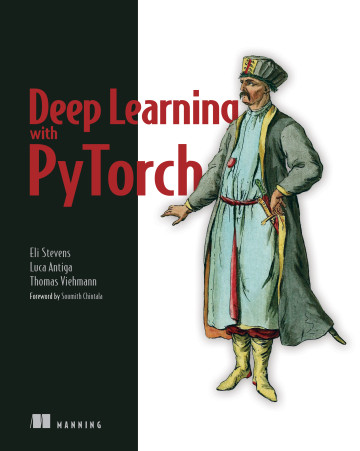
The Manning site for the book is: https://www.manning.com/books/deep-learning-with-pytorch
The book can also be purchased on Amazon: https://amzn.to/38Iwrff (affiliate link; as per the rules: "As an Amazon Associate I earn from qualifying purchases.")
The errata for the book can be found on the manning website, or at https://deep-learning-with-pytorch.github.io/dlwpt-code/errata.html
About Deep Learning with PyTorch
This book has the aim of providing the foundations of deep learning with PyTorch and showing them in action in a real-life project. We strive to provide the key concepts underlying deep learning and show how PyTorch puts them in the hands of practitioners. In the book, we try to provide intuition that will support further exploration, and in doing so we selectively delve into details to show what is going on behind the curtain. Deep Learning with PyTorch doesn’t try to be a reference book; rather, it’s a conceptual companion that will allow you to independently explore more advanced material online. As such, we focus on a subset of the features offered by PyTorch. The most notable absence is recurrent neural networks, but the same is true for other parts of the PyTorch API.
Who should read this book
This book is meant for developers who are or aim to become deep learning practitioners and who want to get acquainted with PyTorch. We imagine our typical reader to be a computer scientist, data scientist, or software engineer, or an undergraduateor-later student in a related program. Since we don’t assume prior knowledge of deep learning, some parts in the first half of the book may be a repetition of concepts that are already known to experienced practitioners. For those readers, we hope the exposition will provide a slightly different angle to known topics. We expect readers to have basic knowledge of imperative and object-oriented programming. Since the book uses Python, you should be familiar with the syntax and operating environment. Knowing how to install Python packages and run scripts on your platform of choice is a prerequisite. Readers coming from C++, Java, JavaScript, Ruby, or other such languages should have an easy time picking it up but will need to do some catch-up outside this book. Similarly, being familiar with NumPy will be useful, if not strictly required. We also expect familiarity with some basic linear algebra, such as knowing what matrices and vectors are and what a dot product is.
About the authors
Eli Stevens has spent the majority of his career working at startups in Silicon Valley, with roles ranging from software engineer (making enterprise networking appliances) to CTO (developing software for radiation oncology). At publication, he is working on machine learning in the self-driving-car industry.
Luca Antiga worked as a researcher in biomedical engineering in the 2000s, and spent the last decade as a cofounder and CTO of an AI engineering company. He has contributed to several open source projects, including the PyTorch core. He recently cofounded a US-based startup focused on infrastructure for data-defined software.
Thomas Viehmann is a machine learning and PyTorch specialty trainer and consultant based in Munich, Germany, and a PyTorch core developer. With a PhD in mathematics, he is not scared by theory, but he is thoroughly practical when applying it to computing challenges.
관련 프로젝트 살펴보기
tensorflow/tensorflow
모두를 위한 오픈소스 머신러닝 프레임워크
201,388 스타huggingface/transformers
🤗 Transformers: 텍스트, 비전, 오디오, 멀티모달 분야의 최첨단 머신러닝 모델을 위한 모델 정의 프레임워크로, 추론과 학습을 모두 지원합니다.
168,636 스타AUTOMATIC1111/stable-diffusion-webui
Stable Diffusion 웹 UI
165,251 스타Comfy-Org/ComfyUI
그래프와 노드로 구성된 인터페이스를 갖춘, 가장 강력하고 모듈성이 뛰어난 확산 모델 GUI, API, 백엔드입니다. 세계에서 가장 빠른 로컬 추론 엔진입니다.
145,629 스타