
coreylynch/async-rl
coreylynch/async-rl has 1,003 GitHub stars and 168 forks. GitHot measured -1 stars in 24 hours and -1 in 7 days. Last checked 2026-11-11 03:04 UTC. Last push 2018-03-18.
Tensorflow + Keras + OpenAI Gym implementation of 1-step Q Learning from "Asynchronous Methods for Deep Reinforcement Learning"
측정된 스타 증가
- in 24h
- -1
- in 7 days
- -1
- in 15 days
- 업데이트 지연
- in 1 month
- 업데이트 지연
서로 겹치는 기간의 순증가량이며 일별 합계가 아닙니다. 측정값이 없으면 비워 둡니다. 스타는 관심도를 나타내며 품질을 보장하지 않습니다.
README.md
OriginalAsyncronous RL in Tensorflow + Keras + OpenAI's Gym

This is a Tensorflow + Keras implementation of asyncronous 1-step Q learning as described in "Asynchronous Methods for Deep Reinforcement Learning".
Since we're using multiple actor-learner threads to stabilize learning in place of experience replay (which is super memory intensive), this runs comfortably on a macbook w/ 4g of ram.
It uses Keras to define the deep q network (see model.py), OpenAI's gym library to interact with the Atari Learning Environment (see atari_environment.py), and Tensorflow for optimization/execution (see async_dqn.py).
Requirements
- tensorflow
- gym
- [gym's atari environment] (https://github.com/openai/gym#atari)
- skimage
- Keras
Usage
Training
To kick off training, run:
python async_dqn.py --experiment breakout --game "Breakout-v0" --num_concurrent 8
Here we're organizing the outputs for the current experiment under a folder called 'breakout', choosing "Breakout-v0" as our gym environment, and running 8 actor-learner threads concurrently. See this for a full list of possible game names you can hand to --game.
Visualizing training with tensorboard
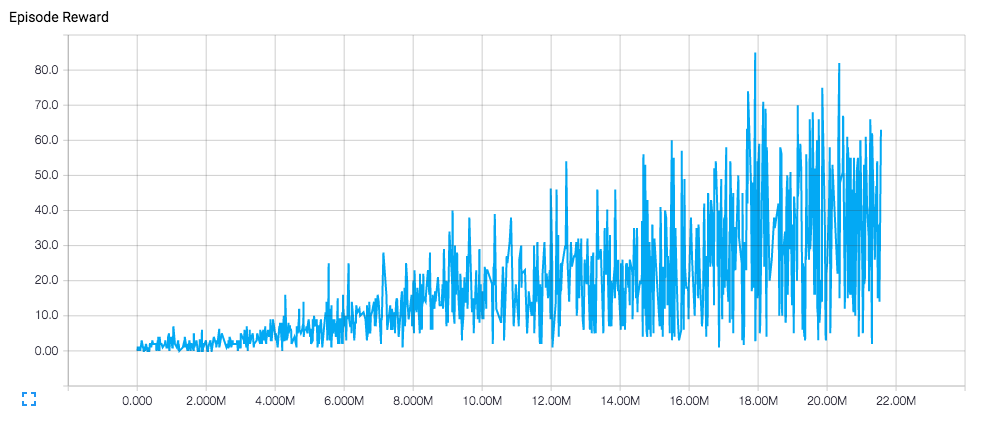
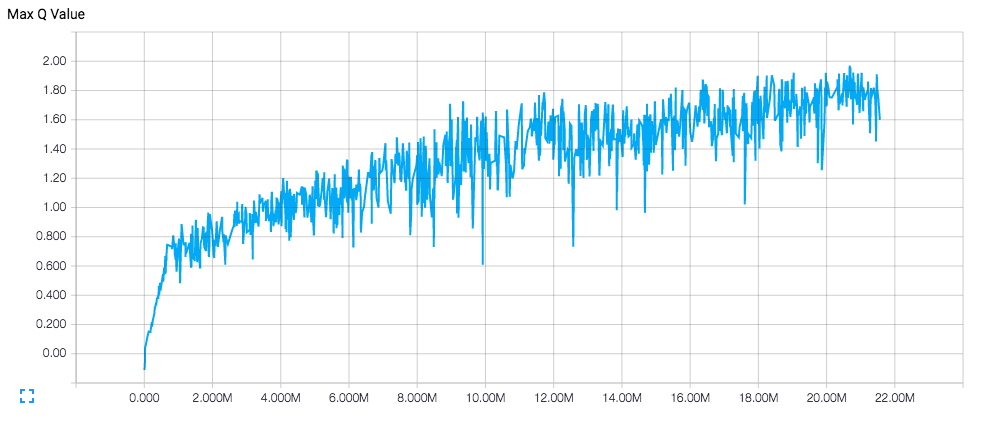
We collect episode reward stats and max q values that can be vizualized with tensorboard by running the following:
tensorboard --logdir /tmp/summaries/breakout
This is what my per-episode reward and average max q value curves looked like over the training period:
Evaluation
To run a gym evaluation, turn the testing flag to True and hand in a current checkpoint file:
python async_dqn.py --experiment breakout --testing True --checkpoint_path /tmp/breakout.ckpt-2690000 --num_eval_episodes 100
After completing the eval, we can upload our eval file to OpenAI's site as follows:
import gym
gym.upload('/tmp/breakout/eval', api_key='YOUR_API_KEY')
Now we can find the eval at https://gym.openai.com/evaluations/eval_uwwAN0U3SKSkocC0PJEwQ
Next Steps
See a3c.py for a WIP async advantage actor critic implementation.
Resources
I found these super helpful as general background materials for deep RL:
- David Silver's "Deep Reinforcement Learning" lecture
- Nervana's Demystifying Deep Reinforcement Learning blog post
Important notes
- In the paper the authors mention "for asynchronous methods we average over the best 5 models from 50 experiments". I overlooked this point when I was writing this, but I think it's important. These async methods seem to vary in performance a lot from run to run (at least in my implementation of them!). I think it's a good idea to run multiple seeded versions at the same time and average over their performance to get a good picture of whether or not some architectural change is good or not. Equivalently don't get discouraged if you don't see performance on your task right away; try rerunning the same code a few more times with different seeds.
- This repo has no affiliation with Deepmind or the authors; it was just a simple project I was using to learn TensorFlow. Feedback is highly appreciated.
관련 프로젝트 살펴보기
tensorflow/tensorflow
모두를 위한 오픈소스 머신러닝 프레임워크
201,505 스타huggingface/transformers
🤗 Transformers: 텍스트, 비전, 오디오, 멀티모달 분야의 최첨단 머신러닝 모델을 위한 모델 정의 프레임워크로, 추론과 학습을 모두 지원합니다.
168,815 스타AUTOMATIC1111/stable-diffusion-webui
Stable Diffusion 웹 UI
165,289 스타Comfy-Org/ComfyUI
그래프와 노드로 구성된 인터페이스를 갖춘, 가장 강력하고 모듈성이 뛰어난 확산 모델 GUI, API, 백엔드입니다. 세계에서 가장 빠른 로컬 추론 엔진입니다.
146,271 스타