
albermax/innvestigate
albermax/innvestigate has 1,310 GitHub stars and 230 forks. GitHot measured 0 stars in 24 hours and -1 in 7 days. Last checked 2026-11-12 00:33 UTC. Last push 2025-04-11.
A toolbox to iNNvestigate neural networks' predictions!
측정된 스타 증가
- in 24h
- 0
- in 7 days
- -1
- in 15 days
- 업데이트 지연
- in 1 month
- 업데이트 지연
서로 겹치는 기간의 순증가량이며 일별 합계가 아닙니다. 측정값이 없으면 비워 둡니다. 스타는 관심도를 나타내며 품질을 보장하지 않습니다.
README.md
Original
iNNvestigate neural networks!


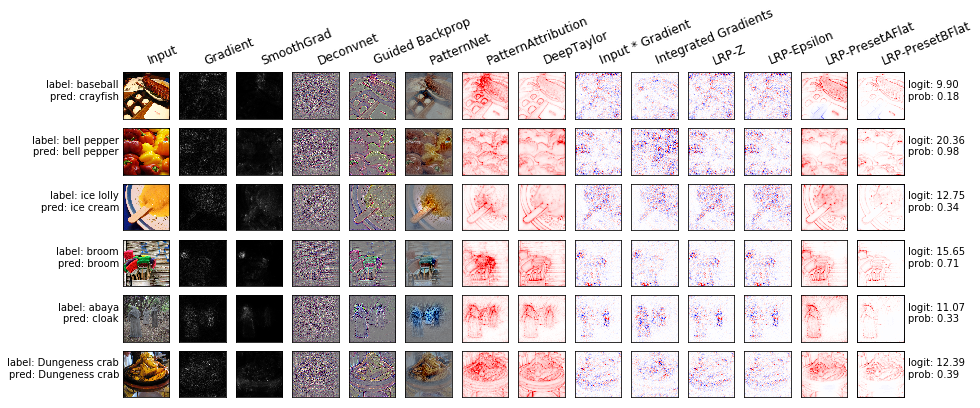
Table of contents
Introduction
In the recent years neural networks furthered the state of the art in many domains like, e.g., object detection and speech recognition. Despite the success neural networks are typically still treated as black boxes. Their internal workings are not fully understood and the basis for their predictions is unclear. In the attempt to understand neural networks better several methods were proposed, e.g., Saliency, Deconvnet, GuidedBackprop, SmoothGrad, IntegratedGradients, LRP, PatternNet and PatternAttribution. Due to the lack of a reference implementations comparing them is a major effort. This library addresses this by providing a common interface and out-of-the-box implementation for many analysis methods. Our goal is to make analyzing neural networks' predictions easy!
If you use this code please star the repository and cite the following paper:
@article{JMLR:v20:18-540,
author  = {Maximilian Alber and Sebastian Lapuschkin and Philipp Seegerer and Miriam H{{\"a}}gele and Kristof T. Sch{{\"u}}tt and Gr{{\'e}}goire Montavon and Wojciech Samek and Klaus-Robert M{{\"u}}ller and Sven D{{\"a}}hne and Pieter-Jan Kindermans},
title   = {iNNvestigate Neural Networks!},
journal = {Journal of Machine Learning Research},
year    = {2019},
volume  = {20},
number  = {93},
pages   = {1-8},
url     = {http://jmlr.org/papers/v20/18-540.html}
}
Installation
iNNvestigate is based on Keras and TensorFlow 2 and can be installed with the following commands:
pip install innvestigate
Please note that iNNvestigate currently requires disabling TF2's eager execution.
To use the example scripts and notebooks one additionally needs to install the package matplotlib:
pip install matplotlib
The library's tests can be executed via pytest. The easiest way to do reproducible development on iNNvestigate is to install all dev dependencies via Poetry:
git clone https://github.com/albermax/innvestigate.git
cd innvestigate

poetry install
poetry run pytest
Usage and Examples
The iNNvestigate library contains implementations for the following methods:
- function:
- gradient: The gradient of the output neuron with respect to the input.
- smoothgrad: SmoothGrad averages the gradient over number of inputs with added noise.
- signal:
- deconvnet: DeConvNet applies a ReLU in the gradient computation instead of the gradient of a ReLU.
- guided: Guided BackProp applies a ReLU in the gradient computation additionally to the gradient of a ReLU.
- pattern.net: PatternNet estimates the input signal of the output neuron. (Note: not available in iNNvestigate 2.0)
- attribution:
- input_t_gradient: Input * Gradient
- deep_taylor[.bounded]: DeepTaylor computes for each neuron a root point, that is close to the input, but which's output value is 0, and uses this difference to estimate the attribution of each neuron recursively.
- lrp.*: LRP attributes recursively to each neuron's input relevance proportional to its contribution of the neuron output.
- integrated_gradients: IntegratedGradients integrates the gradient along a path from the input to a reference.
- miscellaneous:
- input: Returns the input.
- random: Returns random Gaussian noise.
The intention behind iNNvestigate is to make it easy to use analysis methods, but it is not to explain the underlying concepts and assumptions. Please, read the according publication(s) when using a certain method and when publishing please cite the according paper(s) (as well as the iNNvestigate paper). Thank you!
All the available methods have in common that they try to analyze the output of a specific neuron with respect to input to the neural network. Typically one analyses the neuron with the largest activation in the output layer. For example, given a Keras model, one can create a 'gradient' analyzer:
import tensorflow as tf
import innvestigate
tf.compat.v1.disable_eager_execution()

model = create_keras_model()

analyzer = innvestigate.create_analyzer("gradient", model)
and analyze the influence of the neural network's input on the output neuron by:
analysis = analyzer.analyze(inputs)
To analyze a neuron with the index i, one can use the following scheme:
analyzer = innvestigate.create_analyzer("gradient",
                                        model,
					neuron_selection_mode="index")
analysis = analyzer.analyze(inputs, i)
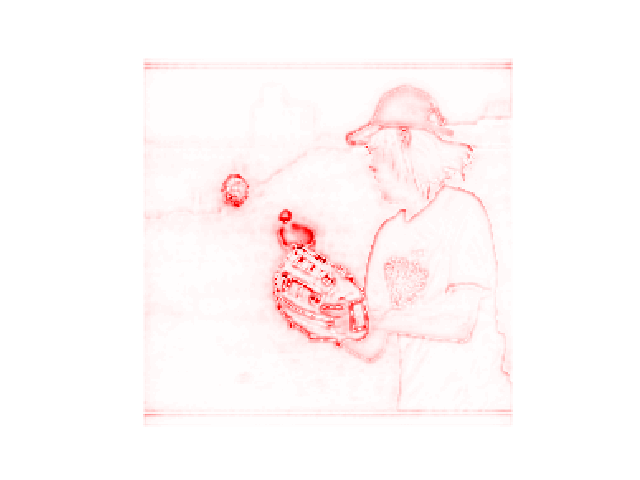
Let's look at an example (code) with VGG16 and this image:

import tensorflow as tf
import tensorflow.keras.applications.vgg16 as vgg16
tf.compat.v1.disable_eager_execution()

import innvestigate

# Get model
model, preprocess = vgg16.VGG16(), vgg16.preprocess_input
# Strip softmax layer
model = innvestigate.model_wo_softmax(model)

# Create analyzer
analyzer = innvestigate.create_analyzer("deep_taylor", model)

# Add batch axis and preprocess
x = preprocess(image[None])
# Apply analyzer w.r.t. maximum activated output-neuron
a = analyzer.analyze(x)

# Aggregate along color channels and normalize to [-1, 1]
a = a.sum(axis=np.argmax(np.asarray(a.shape) == 3))
a /= np.max(np.abs(a))
# Plot
plt.imshow(a[0], cmap="seismic", clim=(-1, 1))
Tutorials
In the directory examples one can find different examples as Python scripts and as Jupyter notebooks:
- Introduction to iNNvestigate: shows how to use iNNvestigate.
- Comparing methods on MNIST: shows how to train and compare analyzers on MNIST.
- Comparing output neurons on MNIST: shows how to analyze the prediction of different classes on MNIST.
- Comparing methods on ImageNet: shows how to compare analyzers on ImageNet.
- Comparing networks on ImageNet: shows how to compare analyzes for different networks on ImageNet.
- Sentiment Analysis.
- Development with iNNvestigate: shows how to develop with iNNvestigate.
- Perturbation Analysis.
To use the ImageNet examples please download the example images first (script).
More documentation
... can be found here:
- Alber, M., Lapuschkin, S., Seegerer, P., Hägele, M., Schütt, K. T., Montavon, G., Samek, W., Müller, K. R., Dähne, S., & Kindermans, P. J. (2019). INNvestigate neural networks! Journal of Machine Learning Research, 20.](https://jmlr.org/papers/v20/18-540.html)
@article{JMLR:v20:18-540, author = {Maximilian Alber and Sebastian Lapuschkin and Philipp Seegerer and Miriam H{{\"a}}gele and Kristof T. Sch{{\"u}}tt and Gr{{\'e}}goire Montavon and Wojciech Samek and Klaus-Robert M{{\"u}}ller and Sven D{{\"a}}hne and Pieter-Jan Kindermans}, title = {iNNvestigate Neural Networks!}, journal = {Journal of Machine Learning Research}, year = {2019}, volume = {20}, number = {93}, pages = {1-8}, url = {http://jmlr.org/papers/v20/18-540.html} } - https://innvestigate.readthedocs.io/en/latest/
Contributing
If you would like to contribute or add your analysis method please open an issue or submit a pull request.
Releases
Acknowledgements
Adrian Hill acknowledges support by the Federal Ministry of Education and Research (BMBF) for the Berlin Institute for the Foundations of Learning and Data (BIFOLD) (01IS18037A).
관련 프로젝트 살펴보기
tensorflow/tensorflow
모두를 위한 오픈소스 머신러닝 프레임워크
201,505 스타huggingface/transformers
🤗 Transformers: 텍스트, 비전, 오디오, 멀티모달 분야의 최첨단 머신러닝 모델을 위한 모델 정의 프레임워크로, 추론과 학습을 모두 지원합니다.
168,815 스타AUTOMATIC1111/stable-diffusion-webui
Stable Diffusion 웹 UI
165,300 스타Comfy-Org/ComfyUI
그래프와 노드로 구성된 인터페이스를 갖춘, 가장 강력하고 모듈성이 뛰어난 확산 모델 GUI, API, 백엔드입니다. 세계에서 가장 빠른 로컬 추론 엔진입니다.
146,472 스타