
agrimgupta92/sgan has 921 GitHub stars and 273 forks. GitHot measured 0 stars in 24 hours and -2 in 7 days. Last checked 2026-11-22 08:28 UTC. Last push 2023-11-24.
측정된 스타 증가
- in 24h
- 0
- in 7 days
- -2
- in 15 days
- 기록 수집 중
- in 1 month
- 기록 수집 중
서로 겹치는 기간의 순증가량이며 일별 합계가 아닙니다. 측정값이 없으면 비워 둡니다. 스타는 관심도를 나타내며 품질을 보장하지 않습니다.
소개
Code for "Social GAN: Socially Acceptable Trajectories with Generative Adversarial Networks", Gupta et al, CVPR 2018
머신러닝README.md
OriginalSocial GAN
This is the code for the paper
Social GAN: Socially Acceptable Trajectories with Generative Adversarial Networks
Agrim Gupta,
Justin Johnson,
Fei-Fei Li,
Silvio Savarese,
Alexandre Alahi
Presented at CVPR 2018
Human motion is interpersonal, multimodal and follows social conventions. In this paper, we tackle this problem by combining tools from sequence prediction and generative adversarial networks: a recurrent sequence-to-sequence model observes motion histories and predicts future behavior, using a novel pooling mechanism to aggregate information across people.
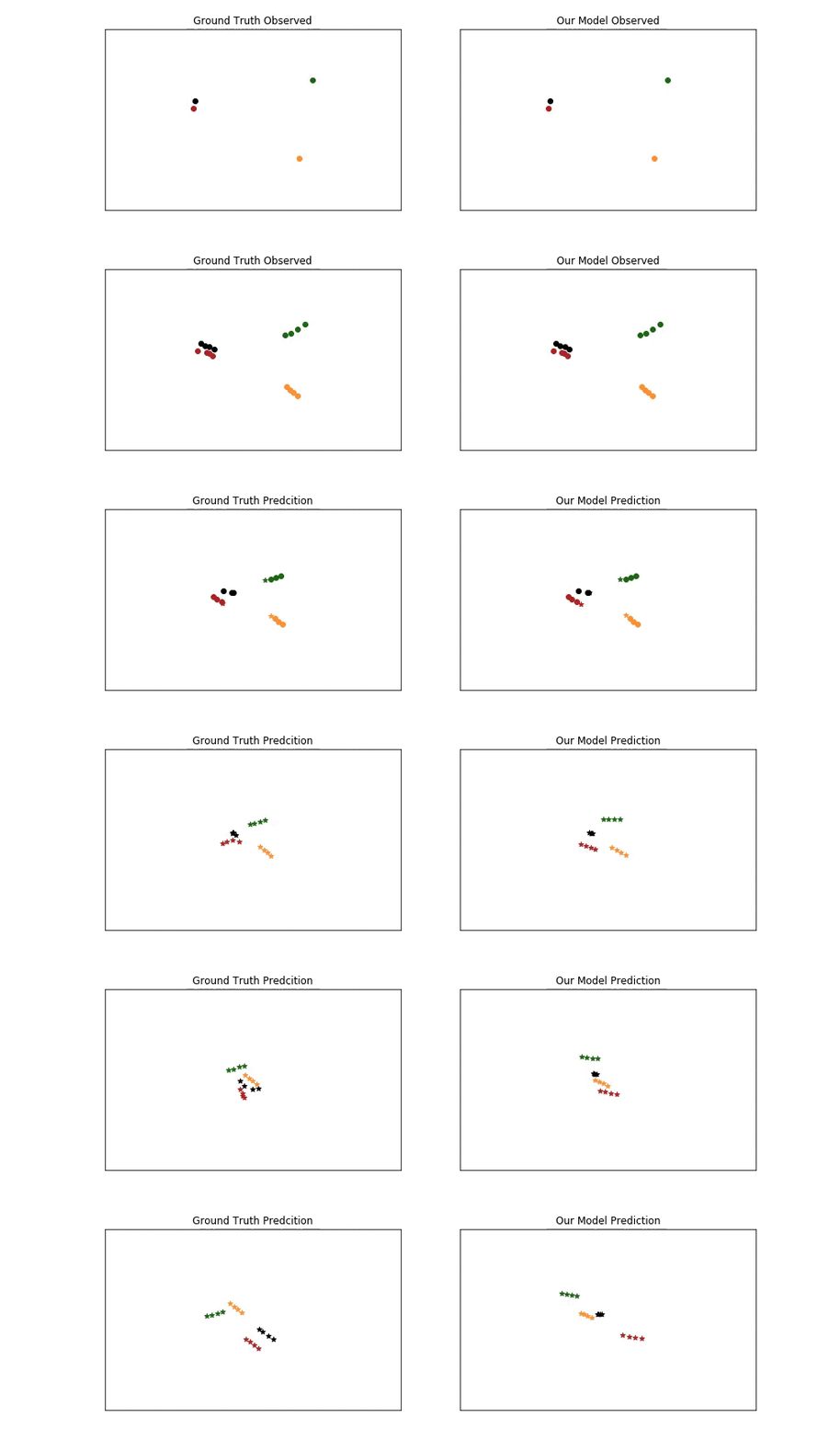
Below we show an examples of socially acceptable predictions made by our model in complex scenarios. Each person is denoted by a different color. We denote observed trajectory by dots and predicted trajectory by stars.

If you find this code useful in your research then please cite
@inproceedings{gupta2018social,
  title={Social GAN: Socially Acceptable Trajectories with Generative Adversarial Networks},
  author={Gupta, Agrim and Johnson, Justin and Fei-Fei, Li and Savarese, Silvio and Alahi, Alexandre},
  booktitle={IEEE Conference on Computer Vision and Pattern Recognition (CVPR)},
  number={CONF},
  year={2018}
}
Model
Our model consists of three key components: Generator (G), Pooling Module (PM) and Discriminator (D). G is based on encoder-decoder framework where we link the hidden states of encoder and decoder via PM. G takes as input trajectories of all people involved in a scene and outputs corresponding predicted trajectories. D inputs the entire sequence comprising both input trajectory and future prediction and classifies them as “real/fake”.

Setup
All code was developed and tested on Ubuntu 16.04 with Python 3.5 and PyTorch 0.4.
You can setup a virtual environment to run the code like this:
python3 -m venv env               # Create a virtual environment
source env/bin/activate           # Activate virtual environment
pip install -r requirements.txt   # Install dependencies
echo $PWD > env/lib/python3.5/site-packages/sgan.pth  # Add current directory to python path
# Work for a while ...
deactivate  # Exit virtual environment
Pretrained Models
You can download pretrained models by running the script bash scripts/download_models.sh. This will download the following models:
sgan-models/<dataset_name>_<pred_len>.pt: Contains 10 pretrained models for all five datasets. These models correspond to SGAN-20V-20 in Table 1.sgan-p-models/<dataset_name>_<pred_len>.pt: Contains 10 pretrained models for all five datasets. These models correspond to SGAN-20VP-20 in Table 1.
Please refer to Model Zoo for results.
Running Models
You can use the script scripts/evaluate_model.py to easily run any of the pretrained models on any of the datsets. For example you can replicate the Table 1 results for all datasets for SGAN-20V-20 like this:
python scripts/evaluate_model.py \
  --model_path models/sgan-models
Training new models
Instructions for training new models can be found here.
관련 프로젝트 살펴보기
불러오는 중…