
Zguoxu/tiny-transformer-from-scratch
Zguoxu/tiny-transformer-from-scratch has 103 GitHub stars and 4 forks. GitHot measured 0 stars in 24 hours and +4 in 7 days. Last checked 2026-11-13 01:08 UTC. Last push 2026-11-02.
A tiny Transformer built from scratch in PyTorch, with an English-to-Chinese translation demo | 用 PyTorch 从零实现的小型 Transformer,附英译中演示,帮助理解模型原理
What you can do
- One Python file: data processing, the model, training, and translation all live in transformer.py.
- Core components implemented by hand: scaled dot-product attention, multi-head attention, causal masking, and cross-attention.
- No dataset downloads: 8 built-in English–Chinese sentence pairs, a model dimension of 32, 2 attention heads, 2 encoder layers, and 2 decoder layers.
- A complete workflow: build vocabularies → train the model → save the loss curve → generate a Chinese translation.
측정된 스타 증가
- in 24h
- 0
- in 7 days
- +4
- in 15 days
- 기록 수집 중
- in 1 month
- 기록 수집 중
서로 겹치는 기간의 순증가량이며 일별 합계가 아닙니다. 측정값이 없으면 비워 둡니다. 스타는 관심도를 나타내며 품질을 보장하지 않습니다.
README.md
OriginalTiny Transformer from Scratch
English | 简体中文

New to this? Click here to run the demo in your browser — no local installation needed.
After opening Colab, sign in to Google and choose Runtime → Run all. Use a standard CPU runtime; no GPU is needed.
Understand how a Transformer translates English into Chinese—with a single Python file.
A small Transformer implemented from scratch in PyTorch, covering token embeddings, positional encoding, multi-head attention, the encoder and decoder, training, and autoregressive generation.
No nn.Transformer or nn.MultiheadAttention. Designed for learners who know the basics of PyTorch and want to follow the computations inside a Transformer.
Features
- One Python file: data processing, the model, training, and translation all live in
transformer.py. - Core components implemented by hand: scaled dot-product attention, multi-head attention, causal masking, and cross-attention.
- No dataset downloads: 8 built-in English–Chinese sentence pairs, a model dimension of 32, 2 attention heads, 2 encoder layers, and 2 decoder layers.
- A complete workflow: build vocabularies → train the model → save the loss curve → generate a Chinese translation.
- Chinese code comments: explanations of key components and training steps for Chinese-speaking learners.
Architecture
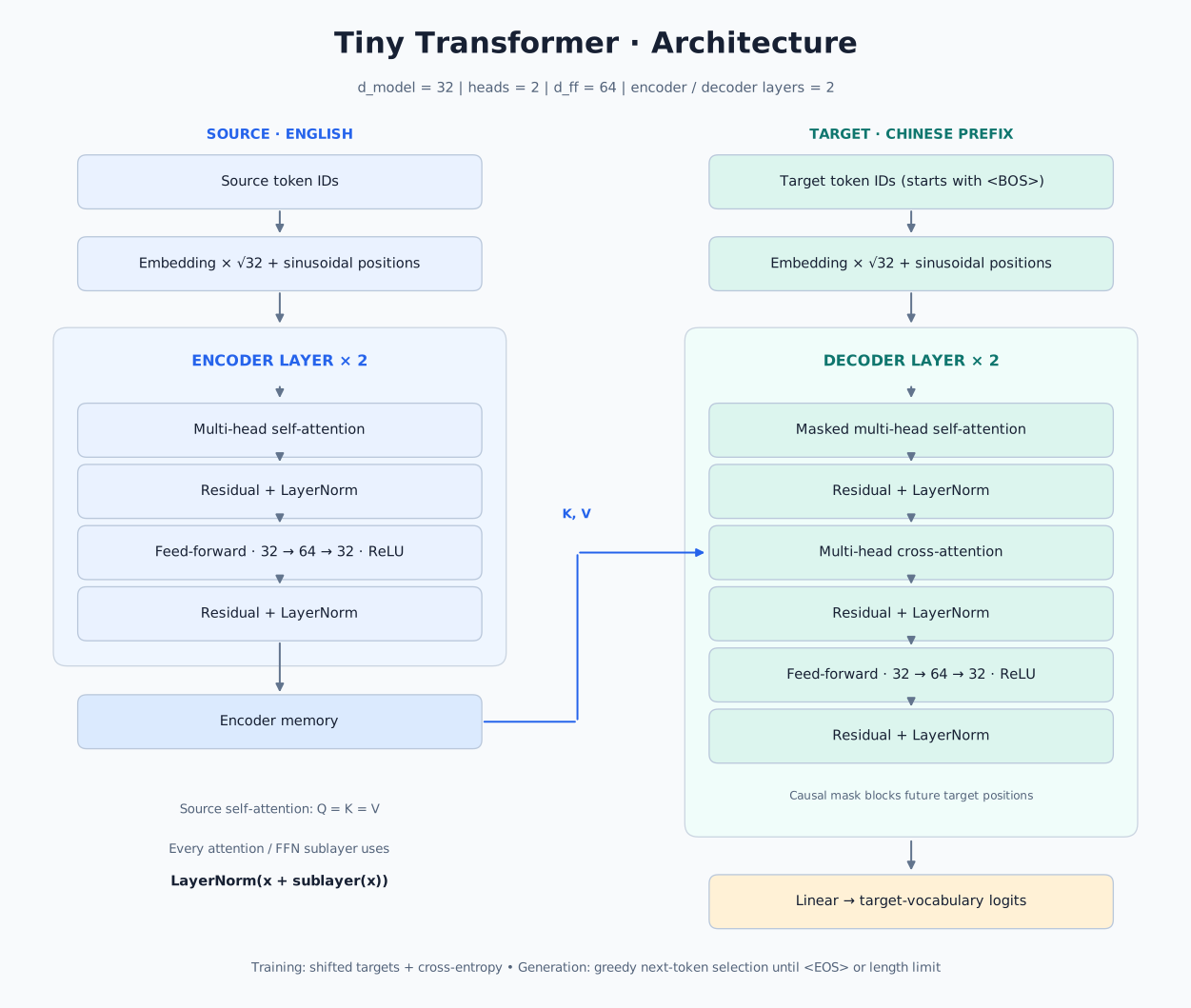
The encoder and decoder each stack two layers. In decoder cross-attention, queries come from the decoder, while keys and values come from the encoder output. Each attention and feed-forward sublayer uses a residual connection followed by layer normalization, matching the implementation.
Example
Input:
there is a black dog under the chair
Output from an actual run:
椅子下面有一只黑色狗
Training log:
Epoch   1 | loss=2.1297
Epoch  20 | loss=0.0163
Epoch  40 | loss=0.0050
Epoch  60 | loss=0.0025
Epoch  80 | loss=0.0015
Epoch 100 | loss=0.0010
Training loss
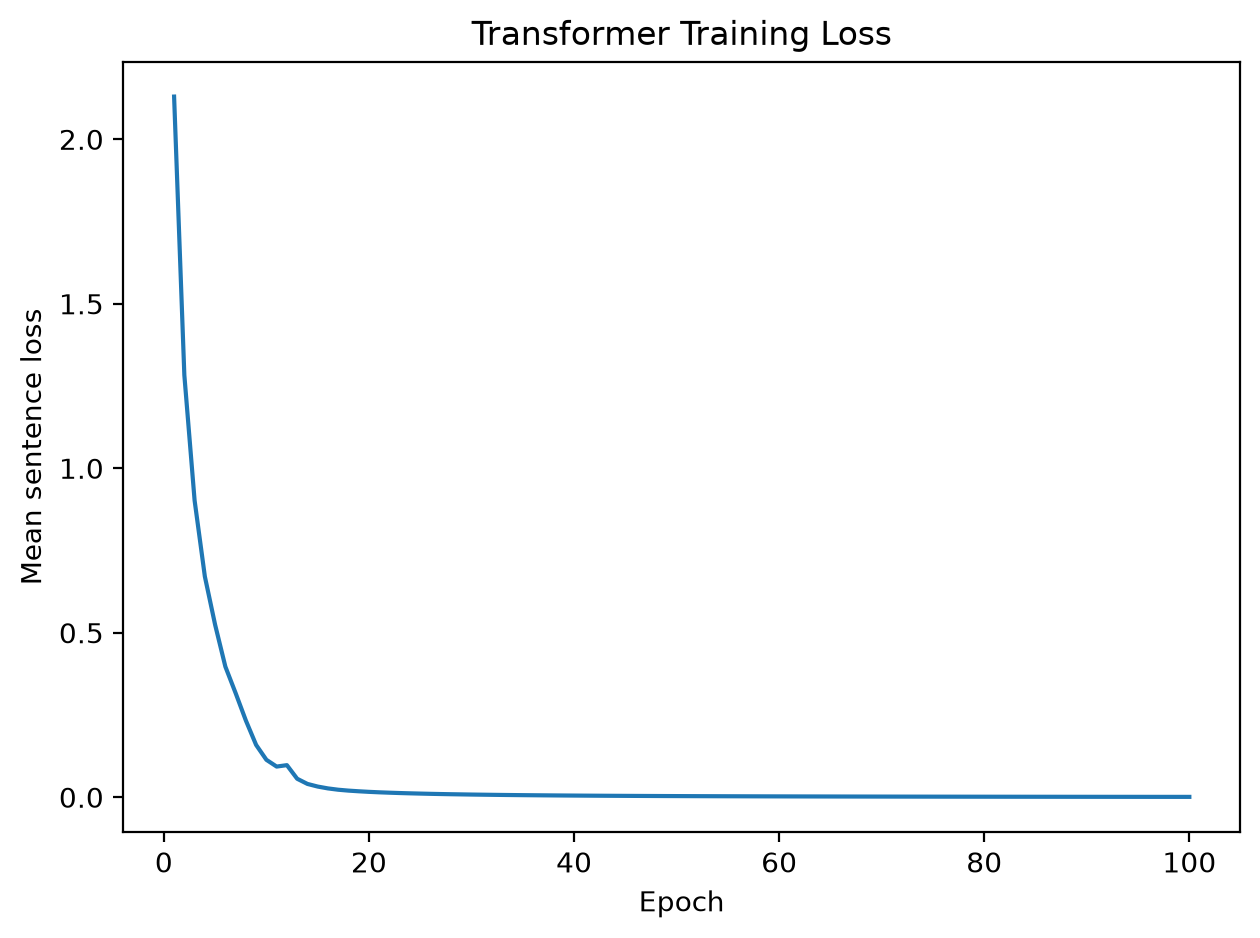
The horizontal axis shows training epochs. The vertical axis shows the average of the per-sentence cross-entropy losses within each epoch. Each run saves the curve to assets/loss_curve.png.
This is a small learning demo with only 8 training pairs and fixed vocabularies. Input containing words outside the source vocabulary raises an error. The example input combines familiar training words in a new way; the sample output and low training loss do not demonstrate general translation ability. Results may vary slightly across environments.
Run in your browser
- Click here to open the notebook in Google Colab.
- Sign in to your Google account if prompted. A standard CPU runtime is enough.
- From the top menu, choose Runtime → Run all to execute the notebook from start to finish.
- Scroll down to see the training log, loss curve, and Chinese translation.
- In the final code cell, edit
englishusing words from the displayed vocabulary, then click the ▶ button to its left to translate again.
The notebook includes explanations in English and Chinese. No local Python setup is needed.
Quick start
Verified with Python 3.12. Requires PyTorch and Matplotlib.
git clone https://github.com/Zguoxu/tiny-transformer-from-scratch.git
cd tiny-transformer-from-scratch
python -m venv .venv
Activate the virtual environment:
# macOS / Linux
source .venv/bin/activate

# Windows PowerShell
.venv\Scripts\Activate.ps1
Install dependencies and run:
python -m pip install -r requirements.txt
python transformer.py
The program trains for 100 epochs, then saves and displays the loss curve. Close the plot window to continue and see the translation in your terminal.
To save the plot and print the translation on a server without a graphical display, run (macOS / Linux):
MPLBACKEND=Agg python transformer.py
Suggested reading order
| Step | Code | What to look for |
|---|---|---|
| 1. Data and vocabularies | en_cn_pairs, source_ids, target_ids |
Converting text to token IDs; the roles of BOS and EOS |
| 2. Input representations | TokenEmbedding, PositionalEncoding |
Adding token embeddings and sinusoidal positional encodings |
| 3. Attention | attention, AttentionHead, MultiHeadAttention |
Q, K, V, scaled dot products, and concatenating heads |
| 4. Encoder | EncoderLayer, Encoder |
Self-attention, feed-forward networks, residual connections, and layer normalization |
| 5. Decoder | DecoderLayer, Decoder |
Causal masking and cross-attention to encoder outputs |
| 6. Complete model | Transformer |
Encoding, decoding, and projecting to the target vocabulary |
| 7. Training and generation | Training loop, translate |
Shifted targets, cross-entropy, and greedy token-by-token generation |
Try it yourself
- Change
HEADSand compare training behavior. Make sureDis divisible byHEADS. - Change
NUM_LAYERSto explore how model depth affects training. - Add sentence pairs to
en_cn_pairs, then rerun to rebuild the vocabularies and train. - Edit the English input on the last line to try new combinations of words from the existing vocabulary.
- Read the causal mask in
attentionto understand how the decoder avoids attending to future tokens.
Project structure
tiny-transformer-from-scratch/
├── README.md
├── README.zh-CN.md
├── LICENSE
├── tiny_transformer.ipynb
├── transformer.py
├── requirements.txt
├── .gitignore
└── assets/
    ├── architecture.svg
    ├── architecture.png
    └── loss_curve.png
If this project helps you understand Transformers, give it a ⭐ Star so you can revisit it later. Questions and learning discussions are welcome in Issues.
License
Released under the MIT License. You may use, modify, and redistribute this project, including commercially, provided you retain the copyright and license notices. The software is provided without warranty.
관련 프로젝트 살펴보기
tensorflow/tensorflow
모두를 위한 오픈소스 머신러닝 프레임워크
201,584 스타huggingface/transformers
🤗 Transformers: 텍스트, 비전, 오디오, 멀티모달 분야의 최첨단 머신러닝 모델을 위한 모델 정의 프레임워크로, 추론과 학습을 모두 지원합니다.
168,917 스타AUTOMATIC1111/stable-diffusion-webui
Stable Diffusion 웹 UI
165,300 스타Comfy-Org/ComfyUI
그래프와 노드로 구성된 인터페이스를 갖춘, 가장 강력하고 모듈성이 뛰어난 확산 모델 GUI, API, 백엔드입니다. 세계에서 가장 빠른 로컬 추론 엔진입니다.
146,472 스타