
RistoAle97/centered-kernel-alignment
RistoAle97/centered-kernel-alignment has 83 GitHub stars and 3 forks. GitHot measured 0 stars in 24 hours and 0 in 7 days. Last checked 2026-11-15 07:27 UTC. Last push 2026-10-24.
측정된 스타 증가
- in 24h
- 0
- in 7 days
- 0
- in 15 days
- 기록 수집 중
- in 1 month
- 기록 수집 중
서로 겹치는 기간의 순증가량이며 일별 합계가 아닙니다. 측정값이 없으면 비워 둡니다. 스타는 관심도를 나타내며 품질을 보장하지 않습니다.
소개
CKA (Centered Kernel Alignment) implemented in PyTorch
머신러닝README.md
Original🤖 CKA PyTorch 🤖
CKA (Centered Kernel Alignment) in PyTorch.


[!WARNING] This repository has been built mainly for personal and academic use since
Captum still needs to implement its variant of CKA. As such, do not expect this project to work for every model.
✒️ About
[!NOTE] Centered Kernel Alignment (CKA) [1] is a similarity index between representations of features in neural networks, based on the Hilbert-Schmidt Independence Criterion (HSIC) [2]. Given a set of examples, CKA compares the representations of examples passed through the layers that we want to compare.
Given two matrices $X \in \mathbb{R}^{n\times s_1}$ and $Y \in \mathbb{R}^{n\times s_2}$ representing the output of two layers, we can define two auxiliary $n \times n$ Gram matrices $K=XX^T$ and $L=YY^T$ and compute the dot-product similarity between them
$$\langle vec(XX^T), vec(YY^T)\rangle = tr(XX^T YY^T) = \lVert Y^T X \rVert_F^2.$$
Then, the $HSIC$ on $K$ and $L$ is defined as
$$HSIC_0(K, L) = \frac{tr(KHLH)}{(n - 1)^2},$$
where $H = I_n - \frac{1}{n}J_n$ is the centering matrix and $J_n$ is an $n \times n$ matrix filled with ones. Finally, to obtain the CKA value we only need to normalize $HSIC_0$
$$CKA(K, L) = \frac{HSIC_0(K, L)}{\sqrt{HSIC_0(K, K) HSIC_0(L, L)}}.$$
[!NOTE] However, naive computation of linear CKA (i.e.: the previous equation) requires maintaining the activations across the entire dataset in memory, which is challenging for wide and deep networks [3].
Therefore, we need to define the unbiased estimator of HSIC so that the value of CKA is independent of the batch size
$$HSIC_1(K, L)=\frac{1}{n(n-3)}\left( tr(\tilde{K}, \tilde{L}) + \frac{1^T\tilde{K}11^T\tilde{L}1}{(n-1)(n-2)} - \frac{2}{n-2}1^T\tilde{K}\tilde{L}1\right),$$
where $\tilde{K}$ and $\tilde{L}$ are obtained by setting the diagonal entries of $K$ and $L$ to zero. Finally, we can compute the minibatch version of CKA by averaging $HSIC_1$ scores over $k$ minibatches
$$CKA_{minibatch}=\frac{\frac{1}{k} \displaystyle\sum_{i=1}^{k} HSIC_1(K_i, L_i)}{\sqrt{\frac{1}{k} \displaystyle\sum_{i=1}^{k} HSIC_1(K_i, K_i)}\sqrt{\frac{1}{k} \displaystyle\sum_{i=1}^{k} HSIC_1(L_i, L_i)}},$$
with $K_i=X_iX_i^T$ and $L_i=Y_iY_i^T$, where $X_i \in \mathbb{R}^{m \times p_1}$ and $Y_i \in \mathbb{R}^{m \times p_2}$ are now matrices containing activations of the $i^{th}$ minibatch of $m$ examples sampled without replacement [3].
📦 Installation
This project requires python >= 3.10.
Create a new venv
# If you have uv installed
uv venv

# Otherwise
python -m venv .venv

# Activate the virtual environment
source .venv/bin/activate  # if you are on Linux
.\.venv\Scripts\activate.bat  # if you are using the cmd on Windows
.\.venv\Scripts\Activate.ps1  # if you are using the PowerShell on Windows
Install the package
[!NOTE] Please refer to uv
You can install the package:
from PyPI
uv pip install ckatorch --torch-backend=autofrom this repo
uv pip install git+https://github.com/RistoAle97/centered-kernel-alignment --torch-backend=autoby cloning the repository and installing the dependencies
git clone https://github.com/RistoAle97/centered-kernel-alignment
cd centered-kernel-alignment
uv pip install -e . --torch-backend=auto
uv pip install ckatorch --group dev  # if you want to also install the dev dependencies
Take a look at the examples directory to understand how to compute CKA in two basic scenarios.
🖼️ Plots
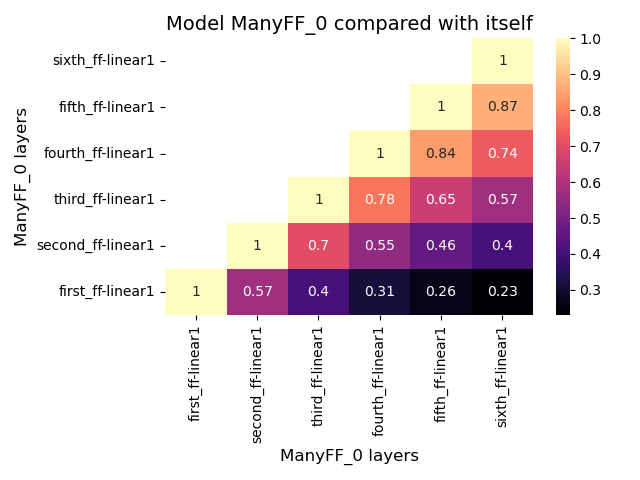
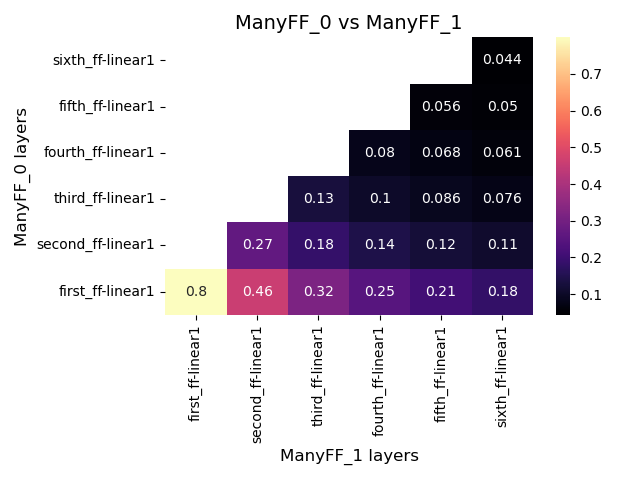
[!NOTE] The comparison makes more sense if the models share a common architecture.
| Model compared with itself | Different models compared |
|---|---|
 |
 |
📚 Bibliography
[1] Kornblith, Simon, et al. "Similarity of neural network representations revisited." International Conference on Machine Learning. PMLR, 2019.
[2] Wang, Tinghua, Xiaolu Dai, and Yuze Liu. "Learning with Hilbert–Schmidt independence criterion: A review and new perspectives." Knowledge-based systems 234 (2021): 107567.
[3] Nguyen, Thao, Maithra Raghu, and Simon Kornblith. "Do wide and deep networks learn the same things? uncovering how neural network representations vary with width and depth." arXiv preprint arXiv:2010.15327 (2020).
This project is also based on the following repositories:
- representation_similarity (original implementation).
- PyTorch-Model-Compare (nice PyTorch implementation that employs hooks).
- CKA.pytorch (minibatch version of CKA and useful batched implementation of $HSIC_1$).
📝 License
This project is MIT licensed.