
Pointcept/PointTransformerV3
Pointcept/PointTransformerV3 has 1,999 GitHub stars and 136 forks. GitHot measured +2 stars in 24 hours and +10 in 7 days. Last checked 2026-11-12 18:13 UTC. Last push 2026-10-31.
[CVPR'24 Oral] Official repository of Point Transformer V3 (PTv3). Also a pip-installable PyTorch + Triton package with pretrained Sonata, Concerto, and Utonia encoders.
What you can do
- Oct 2026: PTv3 is now a pip package, point-transformer-v3, with optimizations from Pointcept2, our next codebase. It needs no spconv or FlashAttention (plain PyTorch with Triton kernels), runs 1.7-4.7x faster with 18-31% less memory on the GPU, also runs on the CPU, and loads the Sonata, Concerto and Utonia weights. See docs/acceleration.md.
- Apr 2024: PTv3 is selected as one of the 90 Oral presentations of CVPR'24.
- Feb 2024: PTv3 is accepted by CVPR'24.
- Dec 2023: We released the model code of PTv3 and the experiment records for ScanNet and ScanNet200.
측정된 스타 증가
- in 24h
- +2
- in 7 days
- +10
- in 15 days
- 기록 수집 중
- in 1 month
- 기록 수집 중
서로 겹치는 기간의 순증가량이며 일별 합계가 아닙니다. 측정값이 없으면 비워 둡니다. 스타는 관심도를 나타내며 품질을 보장하지 않습니다.
README.md
Original

This repo is the official project repository of the paper Point Transformer V3: Simpler, Faster, Stronger.
IEEE Conference on Computer Vision and Pattern Recognition (CVPR) 2024 - Oral
[ Backbone ] [PTv3] - [ arXiv ] [ Bib ] [ Weight ]
It is also a pip package, point-transformer-v3: PTv3 in plain PyTorch, with Triton kernels on the GPU. Besides PTv3, it runs the released weights of the pre-training works built on PTv3:
Sonata: Self-Supervised Learning of Reliable Point Representations
IEEE Conference on Computer Vision and Pattern Recognition (CVPR) 2025 - Highlight
[ Pretrain ] [Sonata] - [ Project ] [ arXiv ] [ Bib ] [ Weight ]Concerto: Joint 2D-3D Self-Supervised Learning Emerges Spatial Representations
Conference on Neural Information Processing Systems (NeurIPS) 2025
[ Pretrain ] [Concerto] - [ Project ] [ arXiv ] [ Bib ] [ Weight ]Utonia: Toward One Encoder for All Point Clouds
International Conference on Machine Learning (ICML) 2026
[ Pretrain ] [Utonia] - [ Project ] [ arXiv ] [ Bib ] [ Weight ]
Highlights
- Oct 2026: PTv3 is now a pip package,
point-transformer-v3, with optimizations from Pointcept2, our next codebase. It needs no spconv or FlashAttention (plain PyTorch with Triton kernels), runs 1.7-4.7x faster with 18-31% less memory on the GPU, also runs on the CPU, and loads the Sonata, Concerto and Utonia weights. See docs/acceleration.md. - Apr 2024: PTv3 is selected as one of the 90 Oral presentations of CVPR'24.
- Feb 2024: PTv3 is accepted by CVPR'24.
- Dec 2023: We released the model code of PTv3 and the experiment records for ScanNet and ScanNet200.
Speed
This release is a technical pre-release of Pointcept2: its PTv3 optimizations, packaged on their own. The classic single-file implementation stays on the legacy branch.
| model | ScanNet 150k | ScanNet 298k | ScanNet++ 1.13M | peak memory |
|---|---|---|---|---|
| PTv3 | 53 → 31 ms (1.7x) | 71 → 31 ms (2.3x) | 201 → 46 ms (4.4x) | -25 to -31% |
| Sonata | 87 → 35 ms (2.5x) | 112 → 35 ms (3.2x) | 271 → 58 ms (4.7x) | -28 to -30% |
| Concerto large | 101 → 35 ms (2.9x) | 139 → 38 ms (3.7x) | 337 → 76 ms (4.4x) | -29 to -31% |
| Utonia | 108 → 44 ms (2.5x) | 153 → 42 ms (3.6x) | 419 → 118 ms (3.5x) | -18 to -19% |
Forward time of the original code → this package, median on one RTX PRO 6000 with the same grid-sampled inputs. Each side runs its default: the originals in fp32 with fp16 FlashAttention (Utonia: bf16), this package with fp16 autocast. More in docs/benchmark.md.
Install
pip install point-transformer-v3                            # torch >= 2.10 from PyPI
uv pip install point-transformer-v3 --torch-backend=auto    # uv picks the torch build for your driver
The package only asks for torch>=2.10, so any build works (CUDA, CPU, MPS). For a specific CUDA
build with pip, install torch from pytorch.org first.
From source, with uv:
git clone https://github.com/Pointcept/PointTransformerV3 && cd PointTransformerV3
uv sync                  # Python 3.12, torch from PyPI (CUDA 13 on Linux); --group cu126 or --group cpu
Get features
import point_transformer_v3 as ptv3

model = ptv3.load("sonata")                  # downloads the weights once; fp16 on CUDA
feat = model.embed(coord, color, normal)     # (N, 1232) features for the N input points
labels = ptv3.load("ptv3_scannet").predict(coord, color, normal).argmax(1)  # ScanNet-20
Inputs are numpy arrays or tensors: coord (N, 3) in meters, color (N, 3) in 0-255 and normal (N, 3). Concerto and Utonia take zeros for a missing color or normal. For outdoor LiDAR, use Utonia with embed(..., scale=0.2, center=False). embed also takes lists of clouds and runs them as one batch; ptv3.prepare, ptv3.collate and ptv3.upcast are its steps if you need them separately. The demos use all three.
Demo
The scripts in demo/ are the Sonata, Concerto and Utonia demos, ported to this package. They run the pre-trained encoders on indoor scans, outdoor LiDAR, an aerial scan of Hong Kong, robot manipulation scenes, single objects and point clouds lifted from video. The scripts take --model (default utonia), --wo_color, --wo_normal and --sample (another pointcept/demo sample or your own .npz; the video demo takes --input). Each writes a PLY file and a PNG snapshot to demo/output/; --show opens an open3d viewer (uv sync --extra demo). The point clouds are downloaded on first use from the pointcept/demo dataset.
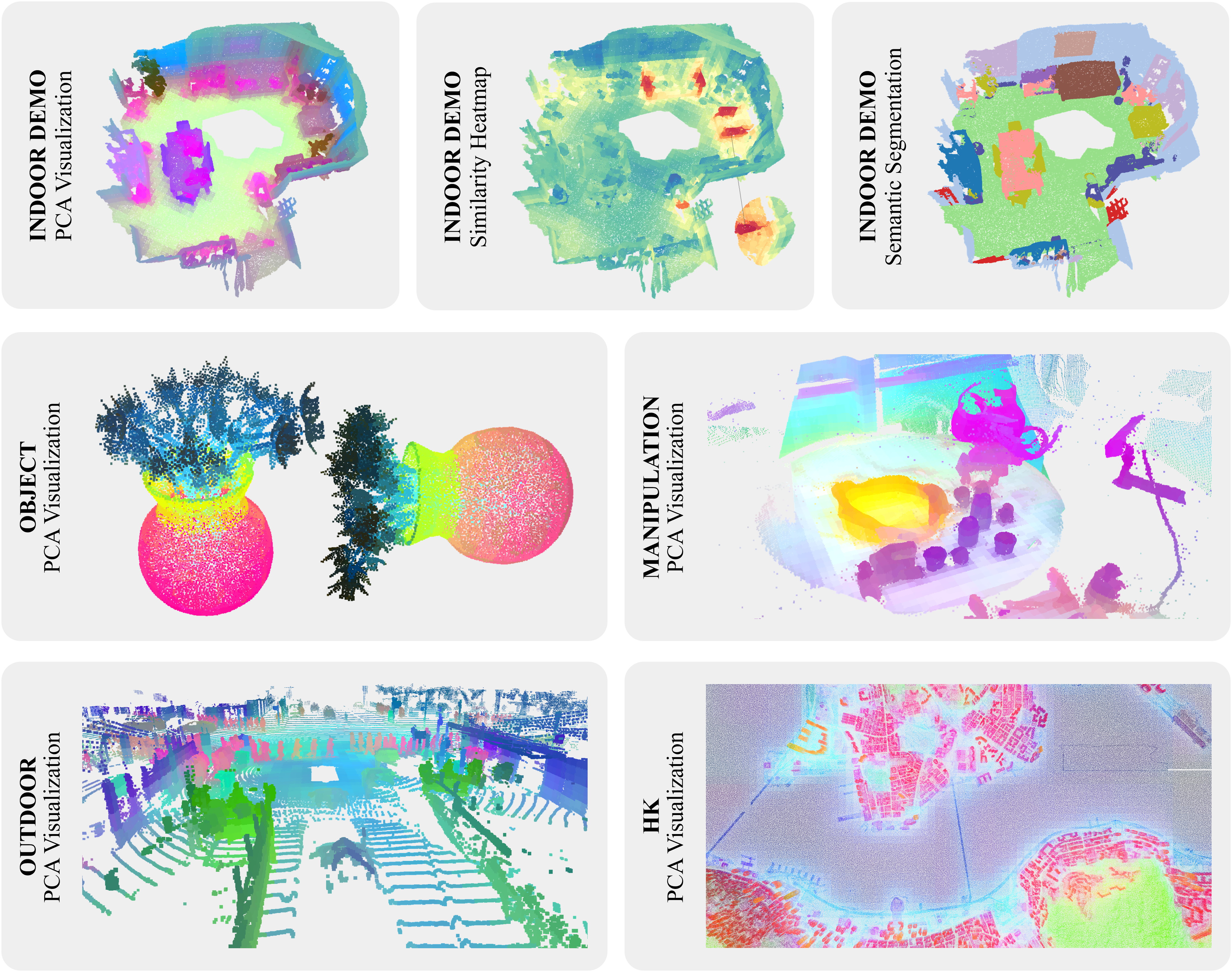

Top: Utonia on an indoor scan (PCA colors, similarity to a query point, ScanNet-20 segmentation), an object, a manipulation scene, a LiDAR sweep and Hong Kong from the air. Bottom: a LiDAR sweep, and Concerto's outdoor checkpoint on it with and without color. The figures come from the Utonia and Concerto repositories. Their project pages (Utonia, Concerto) have an interactive gallery of these clouds and recordings of the video demo.
| demo | what it shows | command |
|---|---|---|
0_pca.py |
first principal components of the features as colors, indoor scan | uv run demo/0_pca.py --model concerto_large |
1_similarity.py |
cosine similarity of a query point to a local view and to the whole scan | uv run demo/1_similarity.py |
2_sem_seg.py |
ScanNet-20 segmentation with a linear probe (utonia, concerto_large, sonata) or ptv3_scannet |
uv run demo/2_sem_seg.py --model ptv3_scannet |
3_batch.py |
two clouds in one forward (embed on lists, prepare + collate) |
uv run demo/3_batch.py --rotate |
4_pca_hk.py |
aerial point cloud of Hong Kong, 40M points (1.5 GB download) | uv run demo/4_pca_hk.py |
5_pca_manipulation.py |
a robot manipulation scene (RGB-D, no normals) | uv run demo/5_pca_manipulation.py |
6_pca_object.py |
an object upright and on its side, in one batch | uv run demo/6_pca_object.py |
7_pca_outdoor.py |
outdoor LiDAR, Utonia or Concerto's outdoor checkpoint | uv run demo/7_pca_outdoor.py --model concerto_large_outdoor |
8_pca_video.py |
a cloud lifted from a video or a folder of images by VGGT | uv run demo/8_pca_video.py --input video.mp4 |
The PCA, similarity and batch demos run with every encoder preset (sonata*, concerto*, utonia*); demos 4 to 7 run with the Utonia presets (7 also with concerto_large_outdoor). --wo_color and --wo_normal replace the colors or normals with zeros, which Concerto and Utonia accept. The PCA colors do not depend on the device or a seed; with the default models they look like the figures above. The video demo needs VGGT, which is not a dependency of this package: install it yourself, for example uv run --with "vggt @ git+https://github.com/facebookresearch/vggt" --with "torchvision==0.27.*" demo/8_pca_video.py --input video.mp4 (a torchvision that matches your torch).
Model zoo
| preset | params | weights | license |
|---|---|---|---|
ptv3_scannet |
46.2M | Pointcept/PointTransformerV3 | MIT |
sonata |
108.5M | facebook/sonata | CC BY-NC 4.0 (Meta) |
sonata_small |
38.6M | facebook/sonata | CC BY-NC 4.0 (Meta) |
concerto, concerto_siglip, concerto_origin |
108.5M | Pointcept/Concerto | CC BY-NC 4.0 + permission |
concerto_large |
207.7M | Pointcept/Concerto | CC BY-NC 4.0 + permission |
utonia |
137.3M | Pointcept/Utonia | CC BY-NC 4.0 + permission |
utonia_small, utonia_tiny |
37.2M, 9.3M | Pointcept/Utonia | CC BY-NC 4.0 + permission |
ptv3 |
46.2M | random init, for training | - |
sonata, concerto_large and utonia come with a ScanNet-20 linear probe: ptv3.load("sonata", head="scannet20"). concerto_origin is the model from the Concerto paper; concerto and concerto_large are the default checkpoints on its Hugging Face page. Weights are downloaded on first use. For agreement with the original code, see docs/parity.md.
The old single-file model.py is on the legacy branch. ptv3.PointTransformerV3 takes its arguments (except RPE and PDNorm) and loads its checkpoints. Training configs and experiment records are in Pointcept.
License
The code is released under CC BY-NC 4.0 with an additional permission for research use: see LICENSE and NOTICE.
Model weights have their own licenses, listed in NOTICE.
Citation
If you find PTv3 useful to your research, please cite our work as an acknowledgment.
@inproceedings{wu2024ptv3,
    title={Point Transformer V3: Simpler, Faster, Stronger},
    author={Wu, Xiaoyang and Jiang, Li and Wang, Peng-Shuai and Liu, Zhijian and Liu, Xihui and Qiao, Yu and Ouyang, Wanli and He, Tong and Zhao, Hengshuang},
    booktitle={CVPR},
    year={2024}
}

@inproceedings{wu2025sonata,
    title={Sonata: Self-Supervised Learning of Reliable Point Representations},
    author={Wu, Xiaoyang and DeTone, Daniel and Frost, Duncan and Shen, Tianwei and Xie, Chris and Yang, Nan and Engel, Jakob and Newcombe, Richard and Zhao, Hengshuang and Straub, Julian},
    booktitle={CVPR},
    year={2025}
}

@inproceedings{zhang2025concerto,
    title={Concerto: Joint 2D-3D Self-Supervised Learning Emerges Spatial Representations},
    author={Zhang, Yujia and Wu, Xiaoyang and Lao, Yixing and Wang, Chengyao and Tian, Zhuotao and Wang, Naiyan and Zhao, Hengshuang},
    booktitle={NeurIPS},
    year={2025}
}

@inproceedings{zhang2026utonia,
    title={Utonia: Toward One Encoder for All Point Clouds},
    author={Zhang, Yujia and Wu, Xiaoyang and Yang, Yunhan and Fan, Xianzhe and Li, Han and Zhang, Yuechen and Huang, Zehao and Wang, Naiyan and Zhao, Hengshuang},
    booktitle={ICML},
    year={2026}
}

@inproceedings{wu2024ppt,
    title={Towards Large-scale 3D Representation Learning with Multi-dataset Point Prompt Training},
    author={Wu, Xiaoyang and Tian, Zhuotao and Wen, Xin and Peng, Bohao and Liu, Xihui and Yu, Kaicheng and Zhao, Hengshuang},
    booktitle={CVPR},
    year={2024}
}

@inproceedings{wu2022ptv2,
    title={Point transformer V2: Grouped Vector Attention and Partition-based Pooling},
    author={Wu, Xiaoyang and Lao, Yixing and Jiang, Li and Liu, Xihui and Zhao, Hengshuang},
    booktitle={NeurIPS},
    year={2022}
}

@misc{pointcept2023,
    title={Pointcept: A Codebase for Point Cloud Perception Research},
    author={Pointcept Contributors},
    howpublished={\url{https://github.com/Pointcept/Pointcept}},
    year={2023}
}
관련 프로젝트 살펴보기
tensorflow/tensorflow
모두를 위한 오픈소스 머신러닝 프레임워크
201,584 스타huggingface/transformers
🤗 Transformers: 텍스트, 비전, 오디오, 멀티모달 분야의 최첨단 머신러닝 모델을 위한 모델 정의 프레임워크로, 추론과 학습을 모두 지원합니다.
168,917 스타AUTOMATIC1111/stable-diffusion-webui
Stable Diffusion 웹 UI
165,300 스타Comfy-Org/ComfyUI
그래프와 노드로 구성된 인터페이스를 갖춘, 가장 강력하고 모듈성이 뛰어난 확산 모델 GUI, API, 백엔드입니다. 세계에서 가장 빠른 로컬 추론 엔진입니다.
146,472 스타