
EMI-Group/evox
EMI-Group/evox has 2,694 GitHub stars and 362 forks. GitHot measured +5 stars in 24 hours and +28 in 7 days. Last checked 2026-11-12 14:13 UTC. Last push 2026-10-30.
분산 GPU 가속 진화 계산 프레임워크. 진화 알고리즘과 벤치마크 문제를 포괄하는 라이브러리.
측정된 스타 증가
- in 24h
- +5
- in 7 days
- +28
- in 15 days
- 기록 수집 중
- in 1 month
- 기록 수집 중
서로 겹치는 기간의 순증가량이며 일별 합계가 아닙니다. 측정값이 없으면 비워 둡니다. 스타는 관심도를 나타내며 품질을 보장하지 않습니다.
README.md
Original

The Infrastructure for
Evolutionary AI Systems
Enabling intelligence to adapt, create, and evolve
across digital and physical worlds.



Website · Documentation · Releases · 简体中文
EvoX provides the computing and experimentation foundation for AI that evolves. Generate candidates, execute tasks, evaluate results, and build on what works. Across models, software, control policies, and scientific design, this process turns experimental feedback into continued improvement.
Tensorization and parallel computing scale up exploration. The PyTorch main version in this repository organizes candidates and their evaluation as batched tensor computation on CPUs and GPUs. Composable algorithms, problems, and workflows connect search, execution, and feedback.
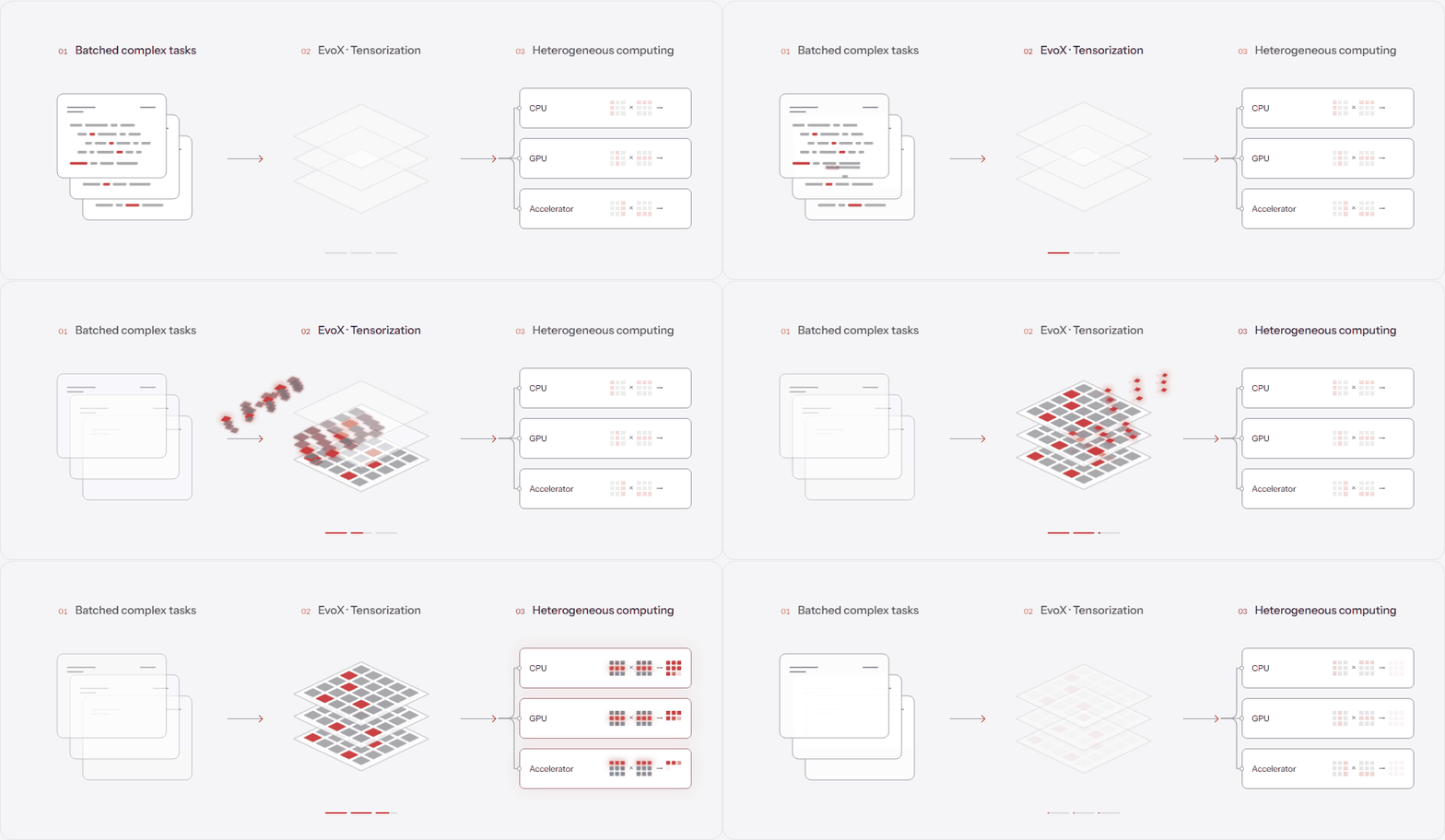
Choose your version
| EvoX 1.x · Main version | EvoX 2.0 alpha · Experimental | |
|---|---|---|
| Branch | main |
evoxc-exp |
| Foundation | PyTorch | EvoX Compiler (evoxc) |
| Python import | import evox |
import evox_etl |
| Python version | 3.10+ | 3.11+ |
| Start here for | Applications, experiments, and PyTorch integration | Exploring the new functional API and compiler backends |
New to EvoX? Get started with 1.x. The experimental version is a functional rewrite on EvoX Compiler, with a NumPy interpreter and optional IREE, XLA, and TVM backends. Both versions use the evox package name, so try the alpha in a separate environment using its own installation guide.
The earlier JAX implementation is available at v0.9.0.
Part of the EvoX ecosystem
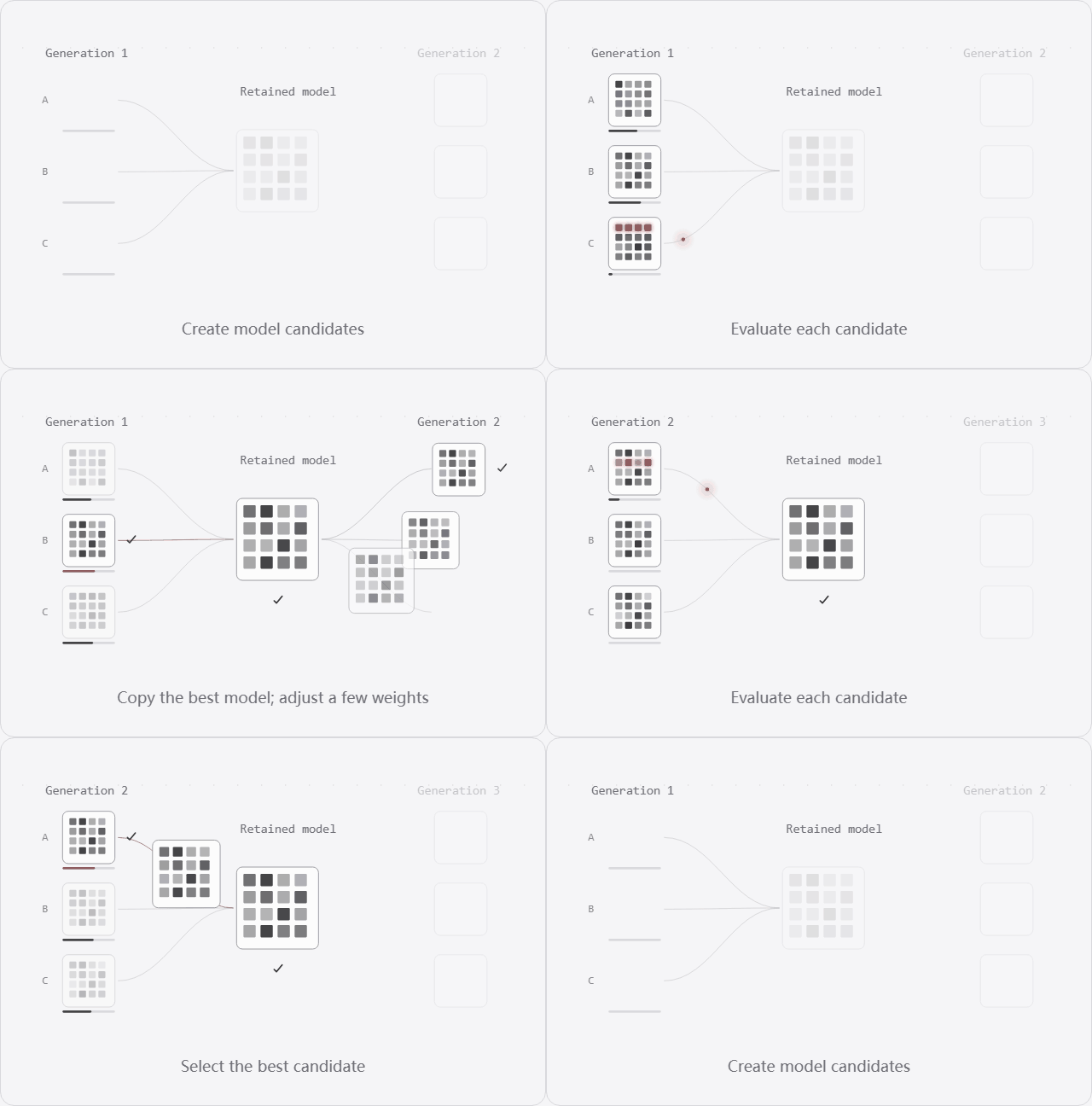
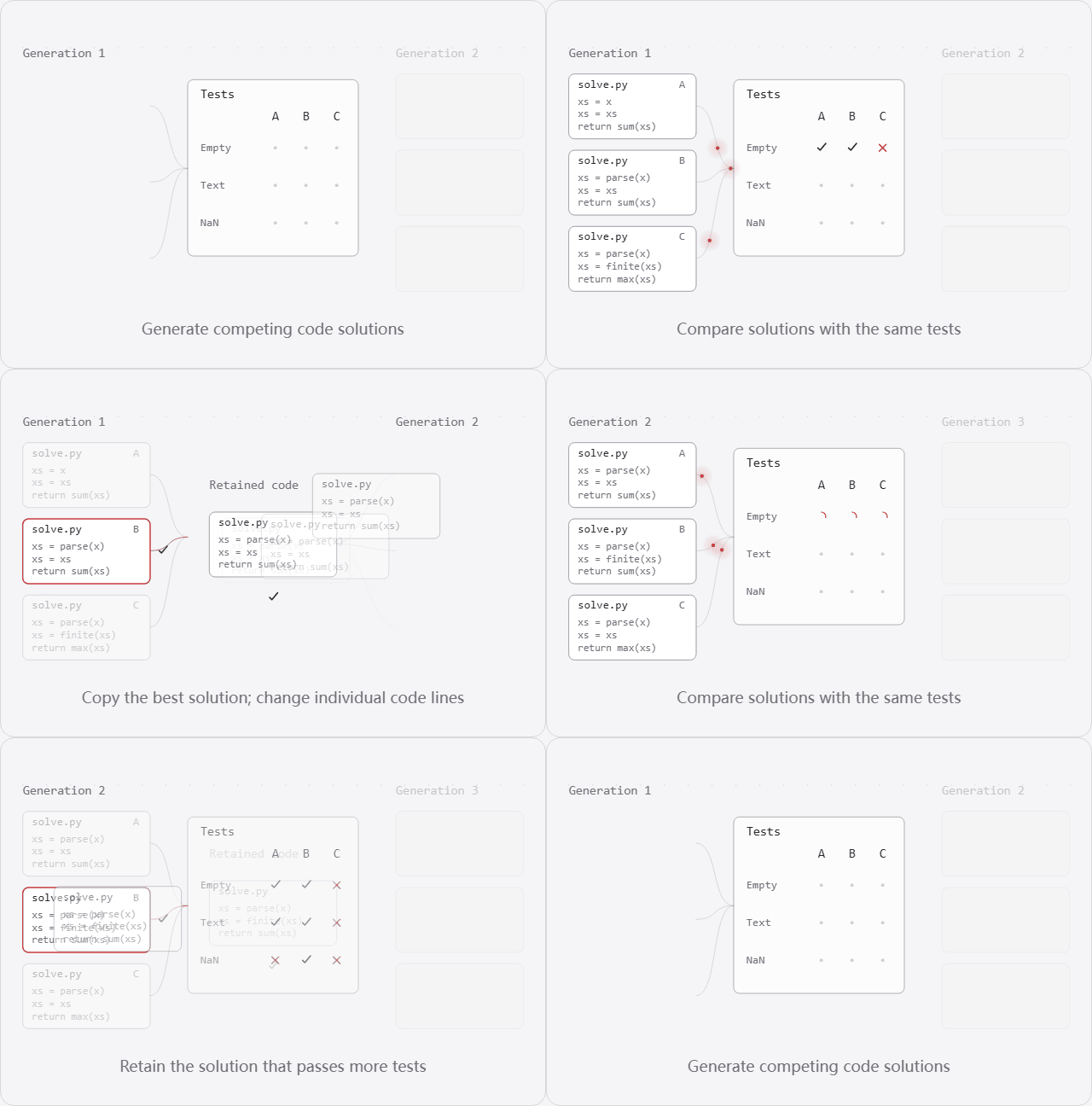
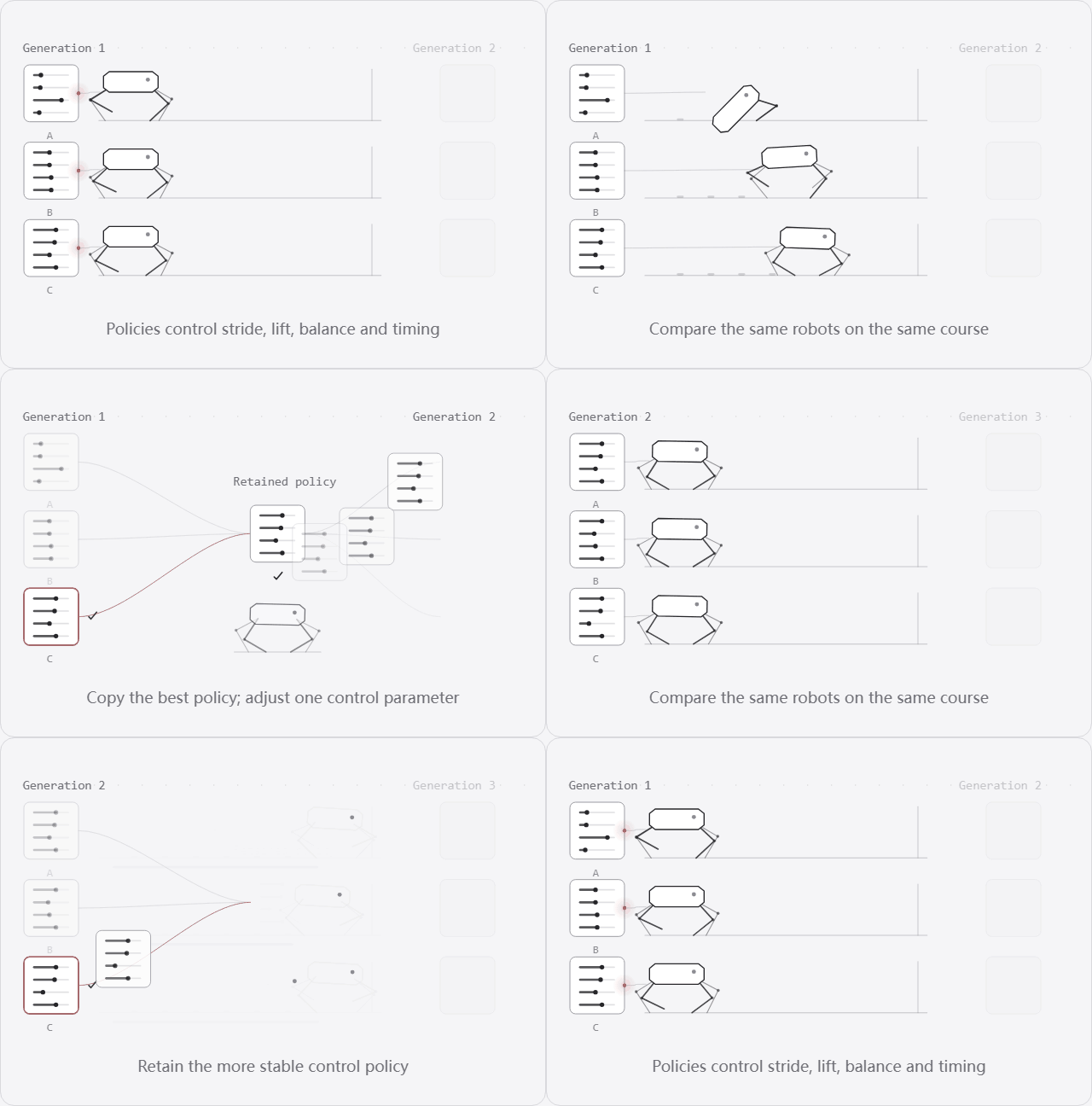
Across digital and physical worlds, the EvoX ecosystem applies evolution to model merging, software development, robot control, and scientific design.
| Generative AI | Agentic AI |
|---|---|
 |
 |
| Evolve the models. EvoGM · Evolutionary model merging |
Evolve the software. EvoX Genesis · Recursive agentic system |
| Physical AI | AI for Science |
|---|---|
 |
 |
| Evolve the behavior. EvoRL · Evolutionary reinforcement learning |
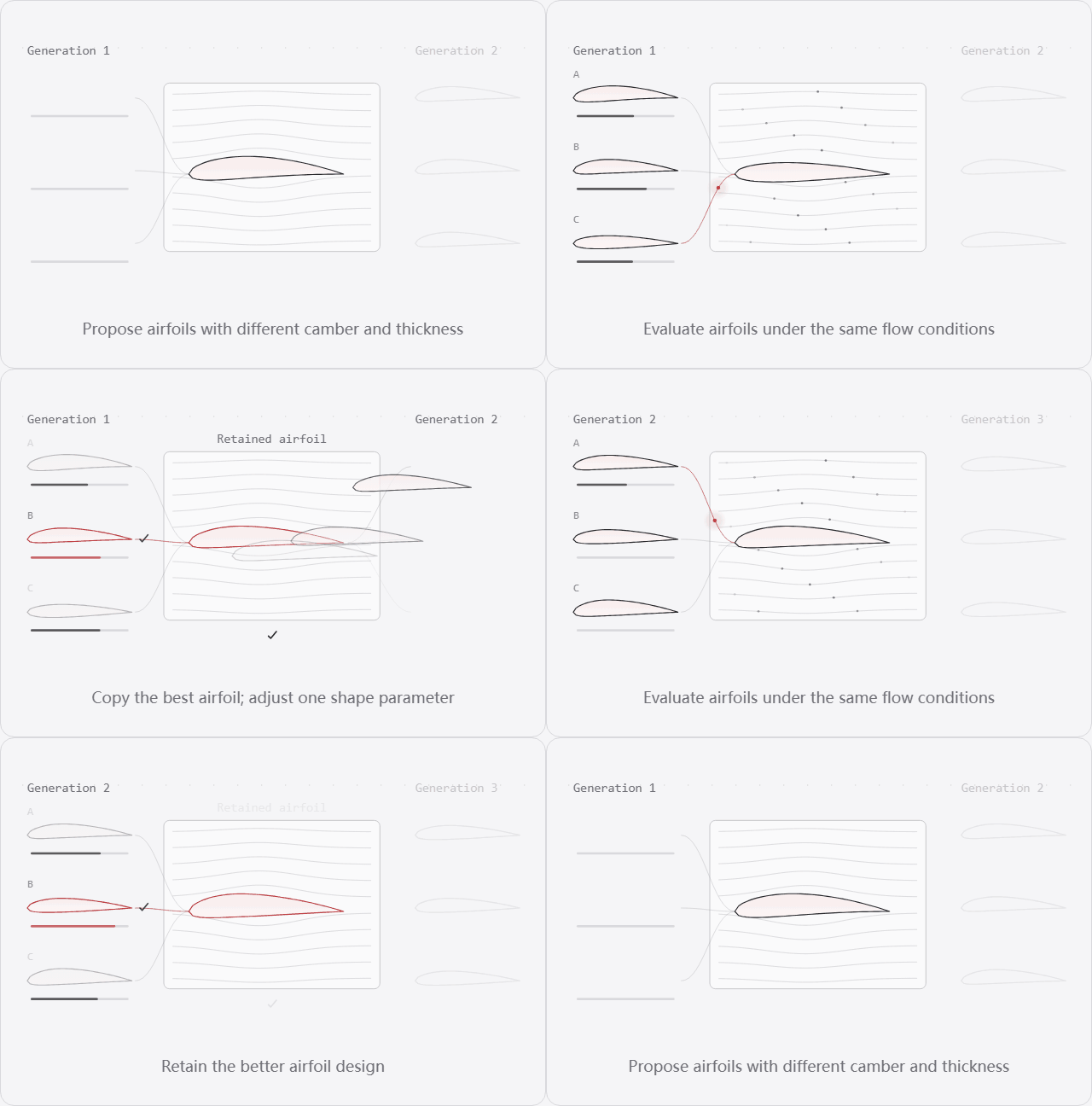
Evolve the design. EvoGO · Generative optimization |
Explore the full ecosystem, or follow the experimental compiler work in EvoX Compiler.
Get started
Install PyTorch for your hardware, then install EvoX 1.x with visualization support:
python -m pip install "evox[default]>=1.4,<2"
Run your first search
Optimize the 10-dimensional Ackley function with particle swarm optimization:
import torch
from evox.algorithms import PSO
from evox.problems.numerical import Ackley
from evox.workflows import EvalMonitor, StdWorkflow

torch.set_default_device("cuda" if torch.cuda.is_available() else "cpu")
torch.manual_seed(42)

algorithm = PSO(
    pop_size=100,
    lb=-32 * torch.ones(10),
    ub=32 * torch.ones(10),
)
monitor = EvalMonitor()
workflow = StdWorkflow(algorithm, Ackley(), monitor)

workflow.init_step()
for _ in range(100):
    workflow.step()

print("Best fitness:", monitor.get_best_fitness().item())
# monitor.plot().show()  # Optional: inspect the convergence curve.
Algorithm generates and updates candidates. Problem evaluates a batch. Workflow connects them. Monitor records the results.
Use your own objective
Implement a batched evaluation function. For a single objective, map a tensor of shape (population_size, dimensions) to one fitness value per candidate:
from evox.core import Problem

class Sphere(Problem):
    def evaluate(self, candidates: torch.Tensor) -> torch.Tensor:
        return candidates.square().sum(dim=-1)
Pass Sphere() in place of Ackley() when constructing the workflow. EvoX minimizes by default; use opt_direction="max" in StdWorkflow for maximization.
Optimize multiple objectives
The same workflow supports multi-objective search. This example uses RVEA on DTLZ2:
import torch
from evox.algorithms import RVEA
from evox.problems.numerical import DTLZ2
from evox.workflows import EvalMonitor, StdWorkflow

torch.manual_seed(42)
algorithm = RVEA(
    pop_size=100,
    n_objs=2,
    lb=torch.zeros(12),
    ub=torch.ones(12),
)
monitor = EvalMonitor(multi_obj=True)
workflow = StdWorkflow(algorithm, DTLZ2(m=2), monitor)

workflow.init_step()
for _ in range(100):
    workflow.step()

print("Pareto-front fitness shape:", monitor.get_pf_fitness().shape)
# monitor.plot().show()
Continue with the tutorials, neuroevolution examples, or hyperparameter optimization.
Libraries, benchmarks, and tooling
Algorithm libraries propose candidates. Benchmarks and simulation environments provide evaluation feedback. Workflows organize iteration, while tensorization and compiler tools support execution at scale. Together, these components provide infrastructure for exploration and validation:
| Layer | Libraries and resources | What they provide |
|---|---|---|
| Algorithm libraries | EvoX · EvoMO · EvoGP · TensorNEAT | Tensorized optimization, multi-objective search, genetic programming, and neural topology evolution. |
| Benchmarks | EvoXBench · MoRobtrol in EvoMO · EvoX problem library | Neural architecture search, multi-objective robot control, and numerical optimization test suites. |
| Learning and simulation | EvoRL · EvoX neuroevolution | Evolutionary reinforcement learning, batched policy evaluation, and integration with environments such as Brax and MuJoCo Playground. |
| Experiment tools | Workflows and monitors · Metrics · Hyperparameter optimization | Compose experiments, track convergence and Pareto fronts, compare results, and tune configurations. |
| Compilation and migration | EvoX Compiler · EvoCoCo | Compiler backends for the experimental EvoX line; automatic tensorization of MATLAB multi-objective optimization code into PyTorch/EvoX implementations. |
For neural and simulation integrations in EvoX 1.x:
python -m pip install "evox[default,neuroevolution]>=1.4,<2"
Execution and hardware
The PyTorch version runs on CPU, NVIDIA GPU (CUDA), AMD GPU (ROCm), and Apple Silicon (MPS, eager execution) through the corresponding PyTorch backend. See the hardware guide for setup.
For supported compilation environments, compile the repeated step before entering the search loop:
from evox import compile

workflow.step = compile(workflow.step)
Multi-GPU and distributed workflows are experimental and require a distributed launch and configuration. See benchmark scripts for reproducible performance experiments.
Community and contributing
- Questions and ideas: GitHub Discussions, Discord, or QQ group 297969717.
- Bugs and contributions: Open an issue or start with the developer guide.
- Research and collaboration: Ran Cheng.
Install the main version from source
git clone --branch main https://github.com/EMI-Group/evox.git
cd evox
python -m pip install -e ".[default]"
Citation
If EvoX supports your research, please cite the framework paper:
@article{evox,
  title = {{EvoX}: A Distributed GPU-accelerated Framework for Scalable Evolutionary Computation},
  author = {Huang, Beichen and Cheng, Ran and Li, Zhuozhao and Jin, Yaochu and Tan, Kay Chen},
  journal = {IEEE Transactions on Evolutionary Computation},
  year = {2024},
  doi = {10.1109/TEVC.2024.3388550}
}
License
EvoX is licensed under GPL-3.0-or-later. Related projects, including EvoX Compiler, carry their own licenses.
관련 프로젝트 살펴보기
tensorflow/tensorflow
모두를 위한 오픈소스 머신러닝 프레임워크
201,505 스타huggingface/transformers
🤗 Transformers: 텍스트, 비전, 오디오, 멀티모달 분야의 최첨단 머신러닝 모델을 위한 모델 정의 프레임워크로, 추론과 학습을 모두 지원합니다.
168,815 스타AUTOMATIC1111/stable-diffusion-webui
Stable Diffusion 웹 UI
165,300 스타Comfy-Org/ComfyUI
그래프와 노드로 구성된 인터페이스를 갖춘, 가장 강력하고 모듈성이 뛰어난 확산 모델 GUI, API, 백엔드입니다. 세계에서 가장 빠른 로컬 추론 엔진입니다.
146,472 스타