
1ove9/antenna-forge
1ove9/antenna-forge has 1,038 GitHub stars and 170 forks. GitHot measured 0 stars in 24 hours, +1 in 7 days, and +2 in 15 days. Last checked 2026-11-23 13:21 UTC. Last push 2026-06-01.
측정된 스타 증가
- in 24h
- 0
- in 7 days
- +1
- in 15 days
- +2
- in 1 month
- 기록 수집 중
서로 겹치는 기간의 순증가량이며 일별 합계가 아닙니다. 측정값이 없으면 비워 둡니다. 스타는 관심도를 나타내며 품질을 보장하지 않습니다.
소개
실제 NEC2와 openEMS를 루프에 포함한 AI 기반 역방향 안테나 설계입니다. 브라우저에서 바로 실행되는 플레이그라운드를 사용해 보세요.
머신러닝README.md
Original⚡ Source Sequence Antenna Forge (YAF)
AI-driven antenna invention platform — automatic exploration, generation, optimization, and verification of antenna topologies that did not exist before.
Quick Demo — one command, a real simulation figure
The PNG below is produced by scripts/demo_wow.py. Every number on it comes
from a real NEC2 run (Method of Moments via the necpp Python binding) —
no mock, no analytical fallback, and if necpp is missing the solver raises
SolverUnavailable rather than fabricating output. Reproduce it with one
command:
python3 scripts/demo_wow.py # → docs/assets/dipole_demo.png
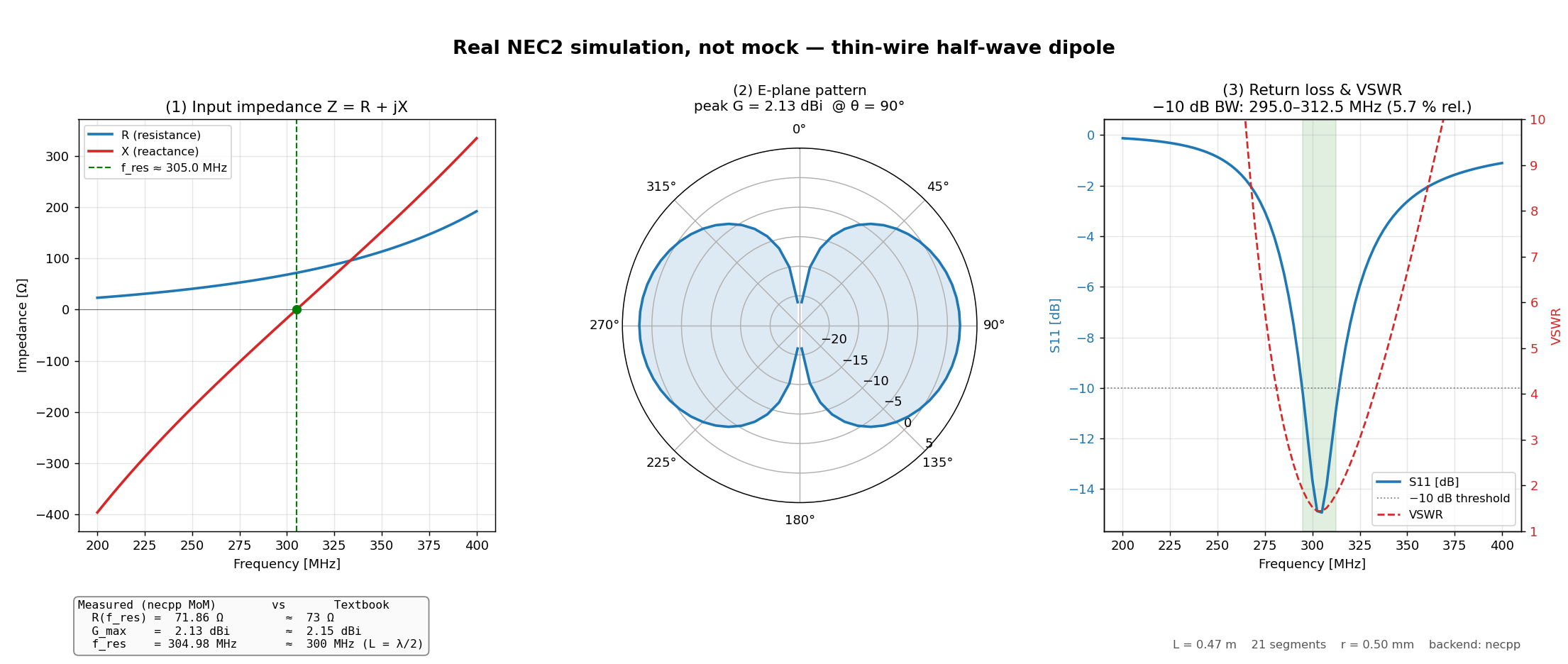
The three panels are: (1) input impedance R(f) / X(f) with the resonance point (X → 0) marked, (2) E-plane polar radiation pattern with the measured peak gain of 2.13 dBi, and (3) S11(f) / VSWR(f) with the −10 dB bandwidth shaded. The annotation box gives the field-by-field "measured vs. textbook" comparison (textbook half-wave dipole reference: R ≈ 73 Ω, G ≈ 2.15 dBi).
Closed-loop inverse design — putting real NEC2 inside the optimizer:
python3 scripts/demo_inverse_design.py # → docs/assets/inverse_design_convergence.png
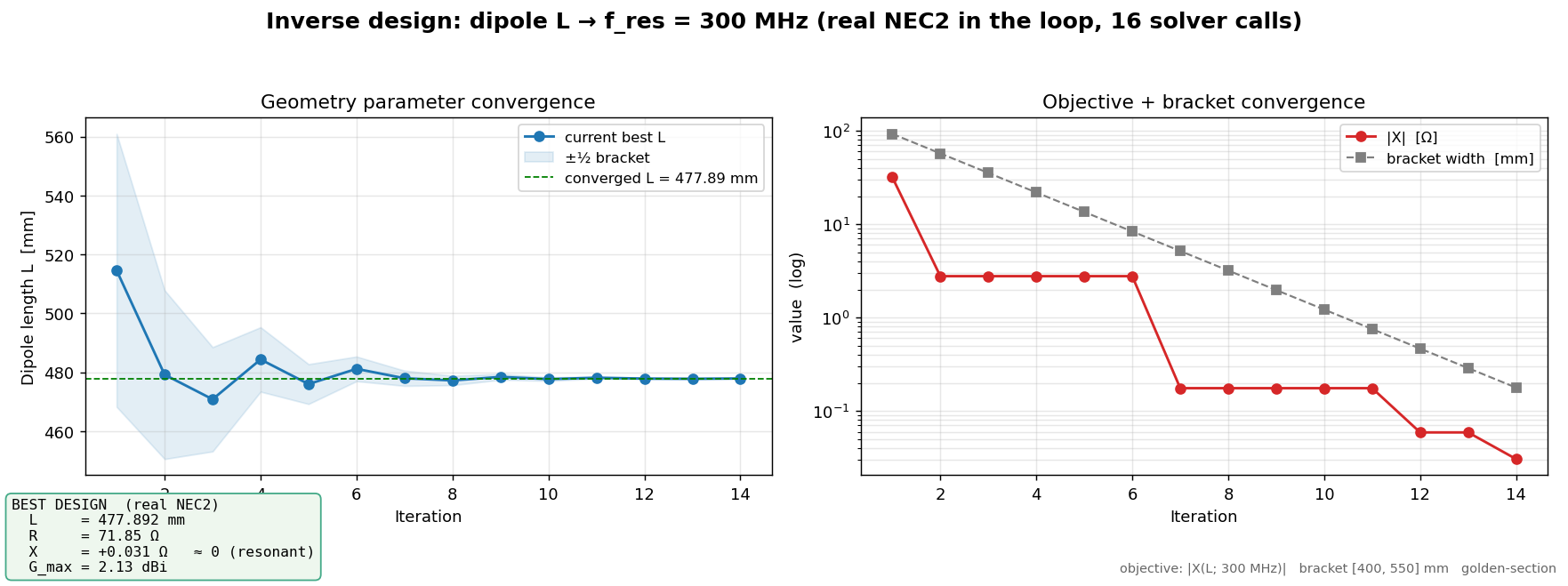
Golden-section search over the dipole length, 14 iterations / 16 real NEC2 solver calls / ~6 ms wall time, converges from a ±75 mm bracket down to L = 477.892 mm (≈ 0.478 λ at 300 MHz), with R = 71.85 Ω, X = +0.03 Ω, G = 2.13 dBi — i.e. the optimizer rediscovers the textbook thin-wire resonant length to sub-millimeter precision with no antenna theory baked into the objective.
Headline case study — 9-parameter Yagi-Uda inverse design
The platform's flagship demonstration: a 5-element Yagi-Uda at 300 MHz with
9 continuous design parameters (5 element lengths + 4 inter-element
spacings), driven by scipy.optimize.differential_evolution and evaluated
by real NEC2 in every single iteration — 5858 solver calls, 12.7 s wall
time on a laptop. Full write-up:
docs/case_study_yagi.md.
python3 scripts/case_yagi.py     # baseline + optimization → JSON in results/
python3 scripts/plot_yagi.py     # → docs/assets/yagi_design.png
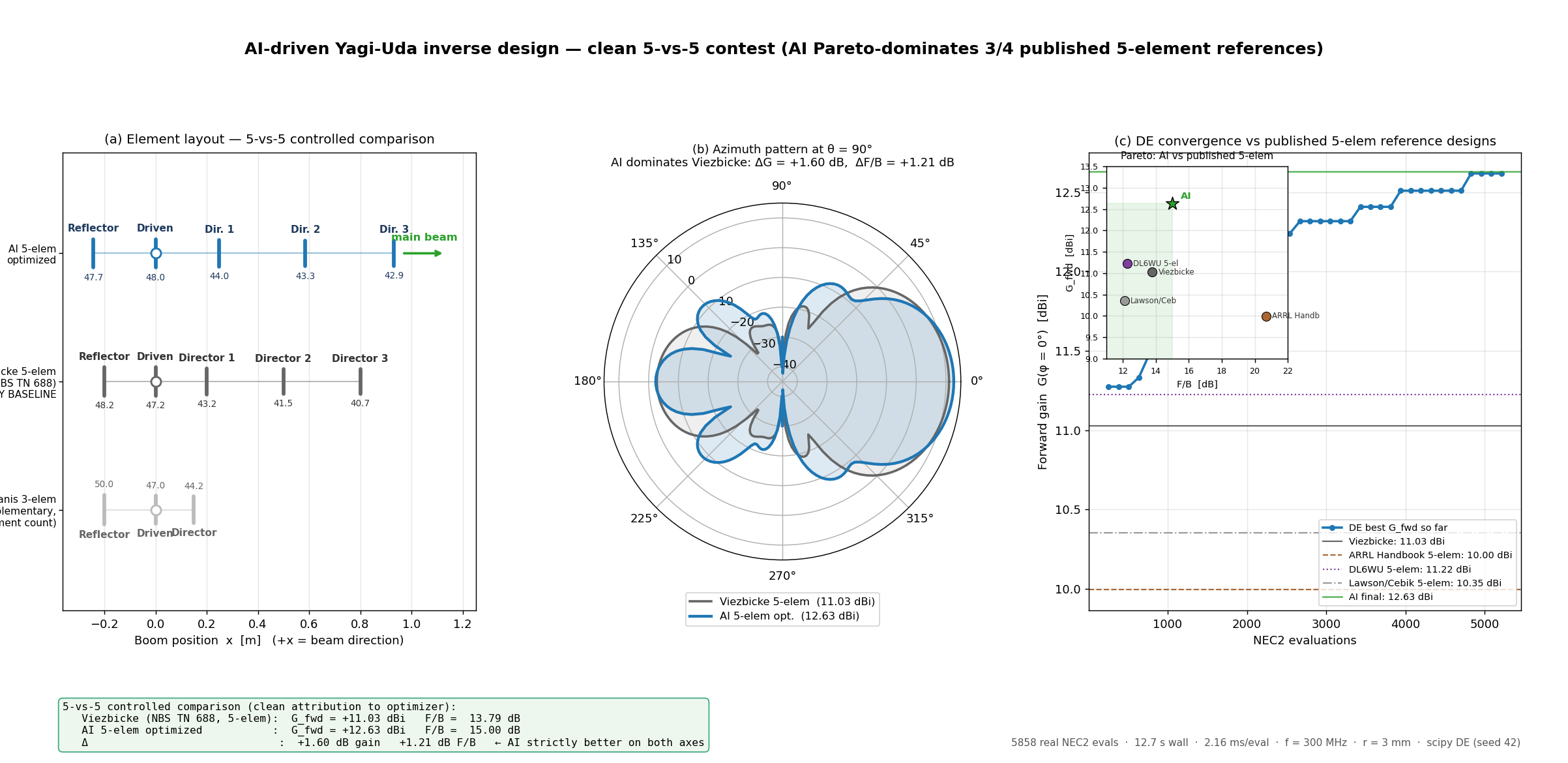
Clean 5-vs-5 contest (same element count, same NEC2 backend):
| Quantity | Viezbicke 5-elem (NBS TN 688) | YAF AI 5-elem | Δ |
|---|---|---|---|
| Forward gain G_fwd | +11.03 dBi | +12.63 dBi | +1.60 dB |
| Front-to-back F/B | 13.79 dB | 15.00 dB | +1.21 dB |
| Boom length | 1.00 λ | 1.17 λ | +0.17 λ |
| Element count | 5 | 5 | 0 (clean attribution) |
The AI design Pareto-dominates the canonical Viezbicke 5-element
reference on both gain and F/B simultaneously, with the same number
of elements. Across the broader published 5-element design space
(Viezbicke, ARRL Handbook, DL6WU, Lawson/Cebik) the AI strictly
dominates 3 of 4 on both axes (see docs/case_study_yagi.md §6).
The optimizer independently recovers Viezbicke-style director tapering (L: 0.440 → 0.434 → 0.429 m, monotonically decreasing rear-to-front) and a balanced 0.243 λ reflector spacing — both consistent with published 5-element Yagi recipes — without being told anything about antenna design. The "AI" part of the loop is just differential evolution; the unique platform contribution is what it's optimizing against: real Method-of-Moments physics, not a surrogate or analytical model.
Bonus: the 5858-record DE history (
results/yagi_optimized.json) is a free FNO-surrogate training set — every input geometry and output (R, X, G_fwd, G_back, F/B) is recorded, ready for whoever wants to try active-learning DE in a later phase.
Architecture
┌─────────────────────────────────────────────────────────────────┐
│  Web UI (React + Three.js + WebGPU)                             │
│  3D editor │ Design browser │ Experiment tracking │ Live monitor│
└────────────────────────┬────────────────────────────────────────┘
                         │ REST / WebSocket
┌────────────────────────▼────────────────────────────────────────┐
│  API Gateway (FastAPI + Pydantic)                               │
└────────────────────────┬────────────────────────────────────────┘
                         │
┌────────────────────────▼────────────────────────────────────────┐
│  Orchestration Core (Python asyncio + Celery)                   │
└─────┬────────────┬───────────┬─────────────┬──────────────┬─────┘
      │            │           │             │              │
┌──────────┐  ┌────────┐  ┌─────────┐  ┌───────────┐  ┌───────────┐
│ Geometry │  │ AI     │  │ Solver  │  │ Optimizer │  │ Post-proc │
│ Kernel   │  │ Engine │  │ Adapter │  │ Engine    │  │ Analyzer  │
└──────────┘  └────────┘  └─────────┘  └───────────┘  └───────────┘
Quick start
# Clone the project
git clone https://github.com/1ove9/antenna-forge.git yaf && cd yaf

# Copy the env template
cp .env.example .env

# Start all services
docker compose up -d

# Health check
curl http://localhost:8000/health
# → {"status": "ok", "version": "0.1.0"}

# Open the frontend
open http://localhost:5173
Core modules
| Module | Path | Description |
|---|---|---|
| Domain models | yaf_core/domain/ |
Design, Geometry, Simulation, Optimization |
| Port protocols | yaf_core/ports/ |
SolverAdapter, AIBackend, CADBackend |
| Geometry kernel | yaf_core/geometry/ |
OpenCASCADE, parametric generators, SIREN, topology optimization |
| Physics models | yaf_core/physics/ |
Metasurfaces, RIS, OAM, graphene, space-time modulation |
| Solvers | yaf_solvers/ |
openEMS, NEC2, MEEP, HFSS, CST, FEKO |
| AI engine | yaf_ai/ |
Diffusion, VAE, GAN, FNO, PINN, differentiable FDTD, Bayesian optimization |
| API service | yaf_api/ |
FastAPI + WebSocket |
| Task queue | yaf_worker/ |
Celery + Redis |
| Database | yaf_db/ |
PostgreSQL + Qdrant |
| Frontend | frontend/ |
React 18 + Three.js + TypeScript |
API quick start
# Create a design
curl -X POST http://localhost:8000/api/v1/designs \
  -H "Content-Type: application/json" \
  -d '{
    "name": "test_dipole",
    "frequency_range": [2.4e9, 2.5e9],
    "size_constraint": {"x_min": -0.1, "x_max": 0.1, "y_min": -0.1, "y_max": 0.1, "z_min": -0.1, "z_max": 0.1},
    "polarization": "linear",
    "material_palette": ["copper"]
  }'

# Simulate with NEC2
curl -X POST http://localhost:8000/api/v1/simulations \
  -H "Content-Type: application/json" \
  -d '{"design_id": "<design-uuid>", "solver": "nec2", "frequency_min": 2400000000, "frequency_max": 2500000000}'
AI demos
# Differentiable FDTD gradient optimization
python -m yaf_ai.differentiable.diff_fdtd_jax --demo

# VAE antenna-geometry generation (--epochs 2 already triggers a weight save; 20 is the default convergence run)
python -m yaf_ai.generative.vae_designer --train --epochs 20

# Bayesian optimization
python -m yaf_ai.optimization.bayesian --demo

# End-to-end inverse-design pipeline
python -m yaf_ai.inverse_design.pipeline --demo

# End-to-end half-wave dipole example (NEC2 → S11 + gain)
python scripts/demo_dipole.py
See
docs/HONEST_STATUS.md: neither solver fabricates results. NEC2 (necpp) and openEMS both run real solvers and raiseSolverUnavailablewhen their backend is missing — there is no silent analytical fallback on either path.
Acceptance commands
The project's acceptance commands: 6 core commands (infrastructure, tests, differentiable FDTD, generative models, demo) plus the real-NEC2 truth checks and the Yagi case-study demo. The repository currently passes all of the below:
# 1. Infrastructure boot
docker compose up -d                                          # postgres / redis / minio / qdrant / api

# 2. API health check
curl -fsS http://localhost:8000/health                        # → 200 {"status":"ok","version":"0.1.0"}

# 3. Test suite (includes real-NEC2 half-wave dipole assertion)
pytest tests/ -x -q                                           # → all passed

# 4. Differentiable FDTD — gradient flow proof
python -m yaf_ai.differentiable.diff_fdtd_jax --demo          # → "✓ Gradient flow verified" + monotone loss

# 5. VAE training + weights checkpoint
python -m yaf_ai.generative.vae_designer --train --epochs 2   # → models/vae_designer.pt written

# 6. Dipole demo — S11 + gain (real NEC2)
python scripts/demo_dipole.py                                 # → S11/VSWR/Peak gain printed (2.20 dBi)

# 7. NEC2 truth check vs textbook
python3 scripts/verify_dipole.py                              # → PASS: R=68.30 Ω (err 6.4%), G=2.12 dBi

# 8. openEMS truth check — real full-wave FDTD vs cavity model
python3 scripts/verify_patch.py                               # → PASS: f_res 2.435 GHz vs 2.513 GHz (err 3.1%)

# 9. 3-panel showcase PNG (Z sweep / polar pattern / S11+BW)
python3 scripts/demo_wow.py                                   # → docs/assets/dipole_demo.png

# 10. Closed-loop inverse design (real NEC2 in the loop)
python3 scripts/demo_inverse_design.py                        # → 477.89 mm + inverse_design_convergence.png

# 11. Yagi-Uda case study — 9-param DE × real NEC2
python3 scripts/case_yagi.py                                  # → baselines + opt JSON, +1.60 dB Pareto-dominant vs Viezbicke
python3 scripts/plot_yagi.py                                  # → docs/assets/yagi_design.png

# Static type check
mypy yaf_core yaf_ai yaf_solvers --strict                     # → Success: no issues in 64 source files
A per-command credibility annotation lives in docs/HONEST_STATUS.md
(revised 2026-05-25); "what's still missing once everything is green" is in
docs/next-steps.md; the full Yagi case-study walkthrough is in
docs/case_study_yagi.md.
Tech stack
| Layer | Technology |
|---|---|
| Backend | Python 3.11, FastAPI, Pydantic v2 |
| Differentiable | JAX, Flax, Optax |
| Deep learning | PyTorch 2.x |
| Geometry | pythonocc-core, trimesh, gmsh |
| Task queue | Celery + Redis |
| Database | PostgreSQL 16, Qdrant (vector) |
| Object storage | MinIO (S3-compatible) |
| Frontend | React 18, TypeScript, Vite, Three.js |
| Deployment | Docker Compose (dev), Kubernetes (prod) |
License
YAF source code is distributed under the MIT License — see
LICENSE.
Third-party dependencies carry their own licenses, some of them
copyleft. In particular, the optional necpp Method-of-Moments
backend and the openEMS / CSXCAD FDTD backend are GPL-licensed.
YAF does not bundle or redistribute any of them; users install
them separately and assume the combined-work obligations that may
result. See NOTICE for the full license-boundary
discussion and mitigations for downstream redistributors. This is
provided in good faith and is not legal advice.
Open-core model
YAF follows an open-core model. This repository is the core engine: free, self-hostable, and MIT-licensed. It covers wire antennas (NEC2 Method-of-Moments) and planar / patch antennas (openEMS full-wave FDTD), driven by classical optimization (differential evolution / golden-section search), and it is complete and useful on its own for that scope.
Available now in this open-source core
- Wire-antenna simulation with real NEC2 Method-of-Moments via
necpp— no analytical fallback (missing solver raises rather than fabricates). - Full-wave FDTD simulation with real openEMS (
openEMS/CSXCADPython bindings): builds the CSX structure, runs the time-domain solve, and extracts S11 / input impedance from the port and the gain pattern via NF2FF. Same honesty rule — missing bindings raiseSolverUnavailable, never fabricate. - Classical optimization with the real solver inside every iteration: half-wave dipole resonance search and the 9-parameter Yagi-Uda inverse design.
- Known-answer truth checks and reproducible benchmarks: half-wave dipole
(
scripts/verify_dipole.py, NEC2) and a rectangular microstrip patch (scripts/verify_patch.py, openEMS — simulated resonance within 3.1 % of the cavity-model prediction). See alsodocs/case_study_yagi.md. - FastAPI service, Pydantic domain models, and the solver / AI adapter interfaces.
Source Sequence maintains a separate enhanced edition — a hosted / commercial product with an embedded web platform — for professional and commercial users. To set expectations honestly, the capabilities below are planned / on the roadmap; they are not yet shipped, in either the open-source core or the enhanced edition.
Planned / on the roadmap (not yet available)
- Broader full-wave coverage — microstrip arrays, metasurfaces, and full 3-D
structures, plus commercial solvers (HFSS / CST / FEKO / COMSOL). (The
openEMS FDTD backend is real and validated on a single patch-antenna
truth check today; wider geometry coverage and the commercial-solver
adapters are still on the roadmap — see
docs/HONEST_STATUS.md.) - Generative AI geometry design (diffusion / VAE) connected to a real physics oracle. (These generative models exist in the repo today only as early / experimental code: trained on synthetic geometry, not yet wired into a simulation loop. They are not production-ready.)
- Multi-objective, multi-band joint optimization.
- RIS (reconfigurable intelligent surface) inverse design.
- In-browser visual design platform.
- Cloud compute — run designs without installing a solver locally.
- Team collaboration and design version management.
In short: the open-source core lets you validate the method and reproduce the benchmarks; the enhanced edition is aimed at taking that into real engineering projects. Nothing on the roadmap above is implied to work today.
- A commercial enhanced edition is in development; details will be announced.
- For commercial inquiries, please open a GitHub issue for now.
Acknowledgements
This project was built by a single engineer, using AI coding assistants
to help with implementation. The architecture, the physics-validation
methodology (the real-NEC2 truth checks and known-answer regressions),
and the benchmark design (the 5-vs-5 Yagi comparison and the honesty
tiers in docs/HONEST_STATUS.md) are my own. Where a module's design is
informed by an open-source project, that project is cited at the top of
the file and in NOTICE.
관련 프로젝트 살펴보기
불러오는 중…