
yui0/catseye
yui0/catseye has 33 GitHub stars and 3 forks. Star changes are not measured yet. Last checked 2026-11-14 13:50 UTC. Last push 2026-11-13.
可以做什么
- Just include catseye.h and write your model in c. There is nothing to install.
- Small dependency & simple implementation
- OpenCL support (GPGPU)
- OpenGL support (GPGPU)
实测星标增长
- 24小时
- 正在收集历史
- 7天
- 正在收集历史
- 15天
- 正在收集历史
- 1个月
- 正在收集历史
各周期内的星标净变化,周期相互重叠,并非每日新增。缺失的测量保持空白。星标代表关注度,不代表软件质量。
关于
Neural network library written in C and Javascript
机器学习README.md
原文Cat's Eye
Neural network library and applications in C.
| Location | Contents |
|---|---|
catseye.h |
Shared neural-network library |
catseye_llm.h |
Shared GGUF/LLM inference runtime |
transcript/ |
Speech transcription CLI, speech/ONNX headers, model tools, Colab notebooks, fixtures and tests |
plamo/ |
PLaMo 3 Translate translation CLI (0.8B, Q4/Q8 quantization) |
llm/ |
Original LLM examples and GPU implementation |
example/, super_resolution/, word2vec/ |
Neural-network examples |
tools/ |
General library tools |
Run make help for project commands. make test runs the library tests (test/: finite-difference gradient check of every layer type, batch-norm / augmentation / safetensors / quantization / GEMM checks, small end-to-end training runs). Build transcription with make -C transcript
and run it from that directory so its default models/ path resolves there.
Use make legacy for the original root training examples.
Features
- Lightweight and minimalistic:
- Header only
- Just include catseye.h and write your model in c. There is nothing to install.
- Small dependency & simple implementation
- Fast: [under construction]
- OpenCL support (GPGPU)
- OpenGL support (GPGPU)
- SSE, AVX support (But gcc and clang support SIMD...)
- OpenMP support
- Support half precision floats (16bit)
- Supported networks:
- Activation functions
- sigmoid
- softmax
- tanh, scaled tanh (1.7519 * tanh(2/3x))
- ReLU, Leaky ReLU, ELU, RReLU
- abs
- identity
- Loss functions
- cross-entropy, mean-squared-error
- Optimization algorithms
- SGD (stochastic gradient descent) with/without L2 normalization
- Momentum SGD
- AdaGrad
- RMSProp
- Adam
- Layer types
- linear (mlp)
- convolution
- convolution 1d
- deconvolution
- Sub-Pixel Convolution (Pixel Shuffler)
- max pooling
- average pooling
- global average pooling (GAP)
- batch normalization (per-channel statistics over the batch; running mean/variance, gamma and beta are stored in the weights and used by
CatsEye_forward()/CatsEye_predict()) - concat
- shortcut
- Activation functions
- Loader formats:
- PNG
- cifar [https://www.cs.toronto.edu/~kriz/cifar.html]
- MNIST
- Data Augmentation (noise, zoom, translation)
Learning rate and batch size
Every layer (dense, convolution, deconvolution, batch normalization) accumulates the mean gradient over the batch,
and the bias is updated by the optimizer together with the weights. The learning rate eta therefore means the same
thing in every layer. (Earlier versions averaged only in convolution layers; to keep an old setup, multiply eta of
its dense/deconvolution layers by the batch size.)
Usage
Just include header files in your project.
for more information, see example/
$ dnf install ghostscript ocl-icd-devel
$ cd example
$ make
$ ./sin
Demo

Recognizing handwritten digits by MNIST training (example/mnist_train.c)
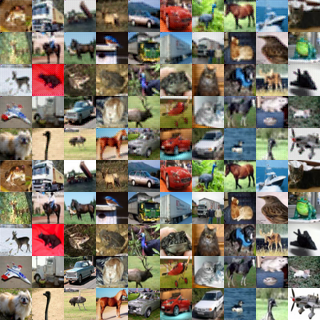
Recognizing pictures (example/cifar10_train.c)
Neural Network 'paints' an image (example/paint.c)




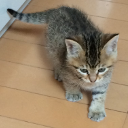
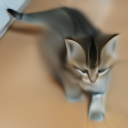
Function approximation (example/sin.c)


Convolution Autoencoder (example/mnist_cnn_autoencoder.c,example/cifar_autoencoder.c)
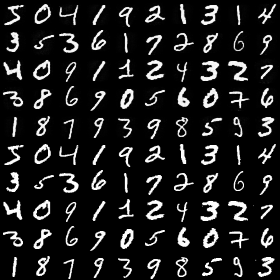
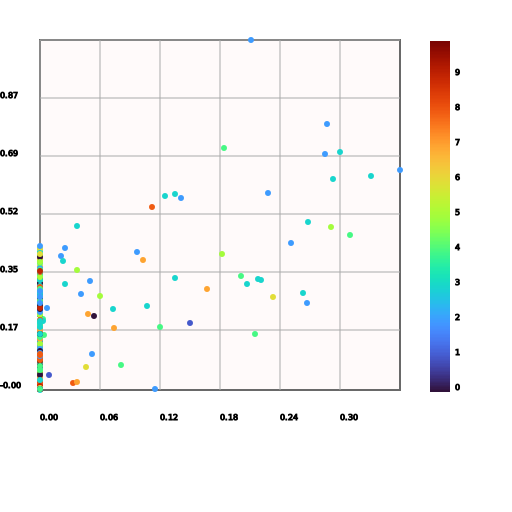
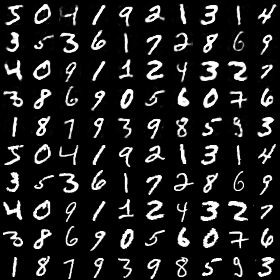
DCGAN (example/mnist_lsgan.c)
- epoch 1900

Autoencoder (example/mnist_autoencoder.c,example/mnist_autoencoder2.c)
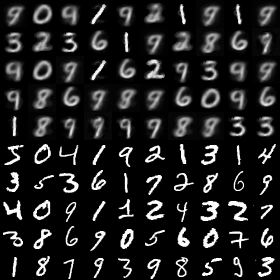
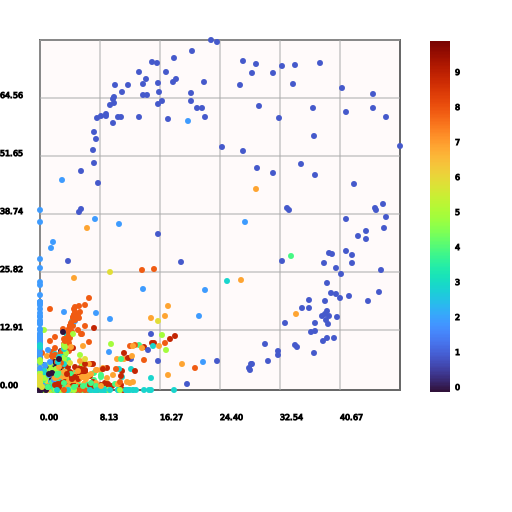
VanillaGAN
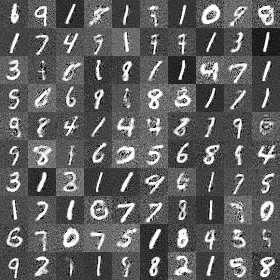
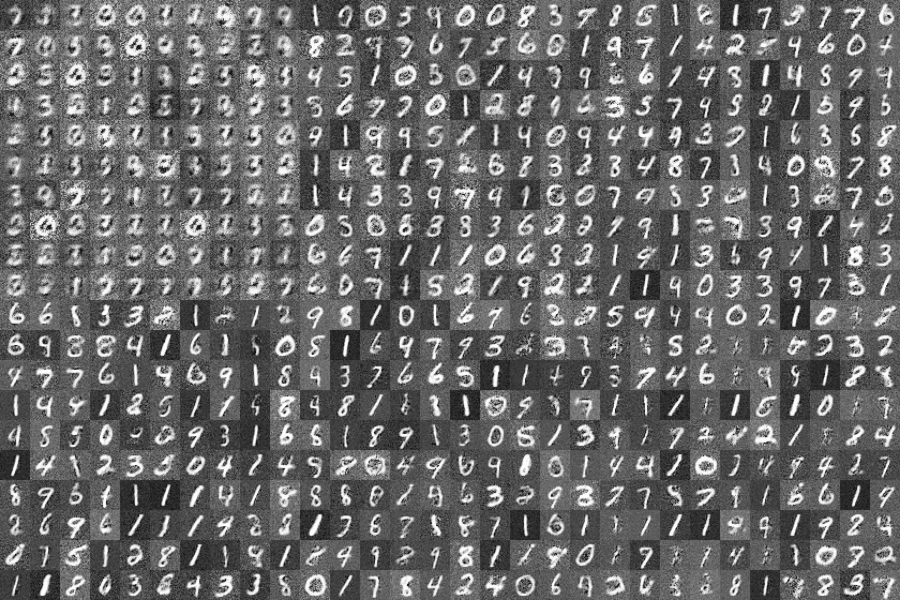
Convolutional Neural Networks (example/mnist_cnn_train.c)
- tanh, 7x7, 32ch, 99.2%

Question
- Neural Network Always Produces Same/Similar Outputs for Any Input
- Scale down the problem to manageable size.
- Make sure you have enough hidden units.
- Change the activation function and its parameters.
- Change learning algorithm parameters.
Refrences
- Documents
Neural Networks and Deep Learning [http://nnadl-ja.github.io/nnadl_site_ja/chap1.html]
Explain easy backpropagation in the universe [https://www.yukisako.xyz/entry/backpropagation]
Optimization algorithm with super easy explanation [https://qiita.com/omiita/items/1735c1d048fe5f611f80]
Basic parts of calculation graph used for backpropagation method, etc. [https://qiita.com/t-tkd3a/items/031c0a4dbf25fd2866a3]
Automatic differentiation [https://tech-lab.sios.jp/archives/21072]
Machine learning [http://hokuts.com/category/%E3%83%97%E3%83%AD%E3%82%B0%E3%83%A9%E3%83%A0/%E6%A9%9F%E6%A2%B0%E5%AD%A6%E7%BF%92/]
tiny-cnn [https://github.com/nyanp/tiny-cnn/wiki/%E5%AE%9F%E8%A3%85%E3%83%8E%E3%83%BC%E3%83%88]
CS231n Convolutional Neural Networks for Visual Recognition [http://cs231n.github.io/neural-networks-3/#anneal]
Autoencoder
- Summary of research on VAE [https://www.hiro877.com/entry/vae-research]
- Hello Autoencoder [https://kiyukuta.github.io/2013/08/20/hello_autoencoder.html]
- Autoencoder [https://pc.atsuhiro-me.net/entry/2015/08/18/003402]
- Autoencoder [https://www.slideshare.net/at_grandpa/chapter5-50042838]
Convolutional Neural Networks [http://blog.yusugomori.com/post/129688163130/%E6%95%B0%E5%BC%8F%E3%81%A7%E6%9B%B8%E3%81%8D%E4%B8%8B%E3%81%99-convolutional-neural-networks-cnn]
Backpropagation [http://postd.cc/2015-08-backprop/]
Perceptron [http://tkengo.github.io/blog/2015/08/21/visual-perceptron/]
- Programing
- Multilayer perceptron [http://kivantium.hateblo.jp/entry/2014/12/22/004640]
- Weather example [http://arakilab.media.eng.hokudai.ac.jp/~t_ogawa/wiki/index.php?LibSVM]
- Recognizing handwritten digits [http://aidiary.hatenablog.com/entry/20140201/1391218771]
- Recognizing handwritten digits on Web [http://d.hatena.ne.jp/sugyan/20151124/1448292129]
- Image generator by Denoising Autoencoder [http://joisino.hatenablog.com/entry/2015/09/09/224157]
- Neural Network 'paints' an image [http://cs.stanford.edu/people/karpathy/convnetjs/demo/image_regression.html]
- Data