
samuela/git-re-basin
samuela/git-re-basin has 518 GitHub stars and 44 forks. GitHot measured -1 stars in 24 hours. Last checked 2026-11-20 12:30 UTC. Last push 2023-03-07.
实测星标增长
- 24小时
- -1
- 7天
- 正在收集历史
- 15天
- 正在收集历史
- 1个月
- 正在收集历史
各周期内的星标净变化,周期相互重叠,并非每日新增。缺失的测量保持空白。星标代表关注度,不代表软件质量。
关于
Code release for "Git Re-Basin: Merging Models modulo Permutation Symmetries"
机器学习README.md
原文Git Re-Basin: Merging Models modulo Permutation Symmetries
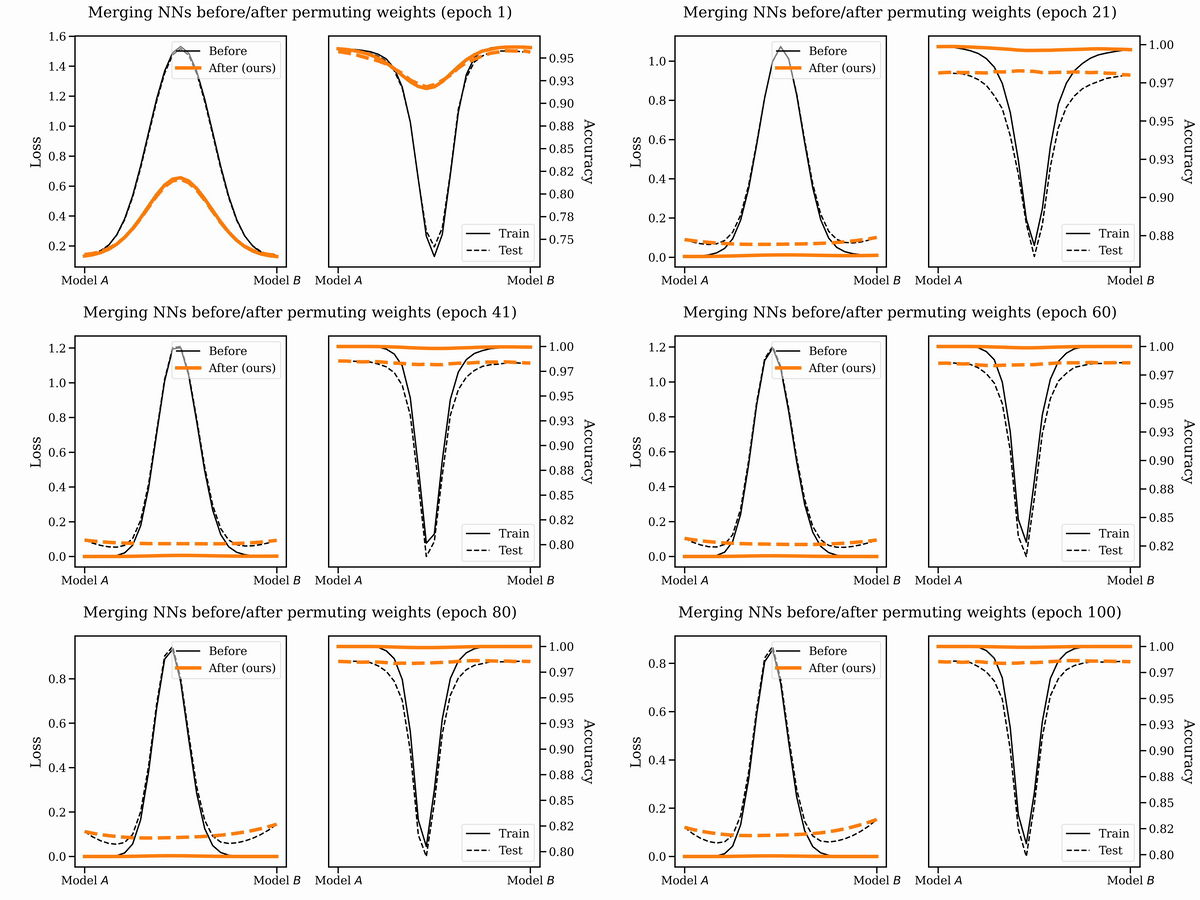
Code for the paper Git Re-Basin: Merging Models modulo Permutation Symmetries.
Abstract:
The success of deep learning is thanks to our ability to solve certain massive non-convex optimization problems with relative ease. Despite non-convex optimization being NP-hard, simple algorithms -- often variants of stochastic gradient descent -- exhibit surprising effectiveness in fitting large neural networks in practice. We argue that neural network loss landscapes contain (nearly) a single basin, after accounting for all possible permutation symmetries of hidden units. We introduce three algorithms to permute the units of one model to bring them into alignment with units of a reference model. This transformation produces a functionally equivalent set of weights that lie in an approximately convex basin near the reference model. Experimentally, we demonstrate the single basin phenomenon across a variety of model architectures and datasets, including the first (to our knowledge) demonstration of zero-barrier linear mode connectivity between independently trained ResNet models on CIFAR-10 and CIFAR-100. Additionally, we identify intriguing phenomena relating model width and training time to mode connectivity across a variety of models and datasets. Finally, we discuss shortcomings of a single basin theory, including a counterexample to the linear mode connectivity hypothesis.