
orhanobut/hawk
orhanobut/hawk has 3,992 GitHub stars and 395 forks. GitHot measured 0 stars in 24 hours, -1 in 7 days, and 0 in 15 days. Last checked 2026-11-12 09:44 UTC. Last push 2026-10-03.
✔️ 面向 Android 的安全、简单键值存储
实测星标增长
- 24小时
- 0
- 7天
- -1
- 15天
- 0
- 1个月
- 正在收集历史
各周期内的星标净变化,周期相互重叠,并非每日新增。缺失的测量保持空白。星标代表关注度,不代表软件质量。
README.md
原文
Hawk
Hawk 3 is coming soon! Android Keystore-backed AES-GCM encryption, fewer dependencies, and a modern Kotlin codebase are on the way. Hawk 3 is not released yet; the current published version is 2.0.1.
Simple, pluggable key-value storage for Android. Save a value with a key and read it back without writing a database schema.
- Store primitives, strings, custom objects, lists, sets, and maps.
- Persist values in app-private SharedPreferences.
- Customize parsing, conversion, encryption, serialization, and storage.
- Check, count, and delete entries through a small API.
Install
Use Maven Central and the available release:
repositories {
    mavenCentral()
}

dependencies {
    implementation("com.orhanobut:hawk:2.0.1")
}
The examples below use APIs available in 2.0.1. The next version (3.0) is unreleased and requires Android 6.0 (API 23) or newer; the published 2.0.1 artifact declares API 10 as its minimum.
Quick start
Initialize once using an application context, before reading or writing:
Hawk.init(applicationContext).build()

val saved = Hawk.put("name", "Ada")
val name: String? = Hawk.get("name")
val visits: Int = Hawk.get("visits", 0)

Hawk.put("tags", listOf("android", "kotlin"))
val tags: List<String>? = Hawk.get("tags")

Hawk.contains("name")
Hawk.count()
Hawk.delete("name")
Hawk.deleteAll()
put returns whether the value was saved. Passing a null value deletes the key. A missing key returns null, or the supplied default. deleteAll clears stored values but retains encryption keys. Reads and writes are synchronous; perform substantial work away from the main thread.
Configuration
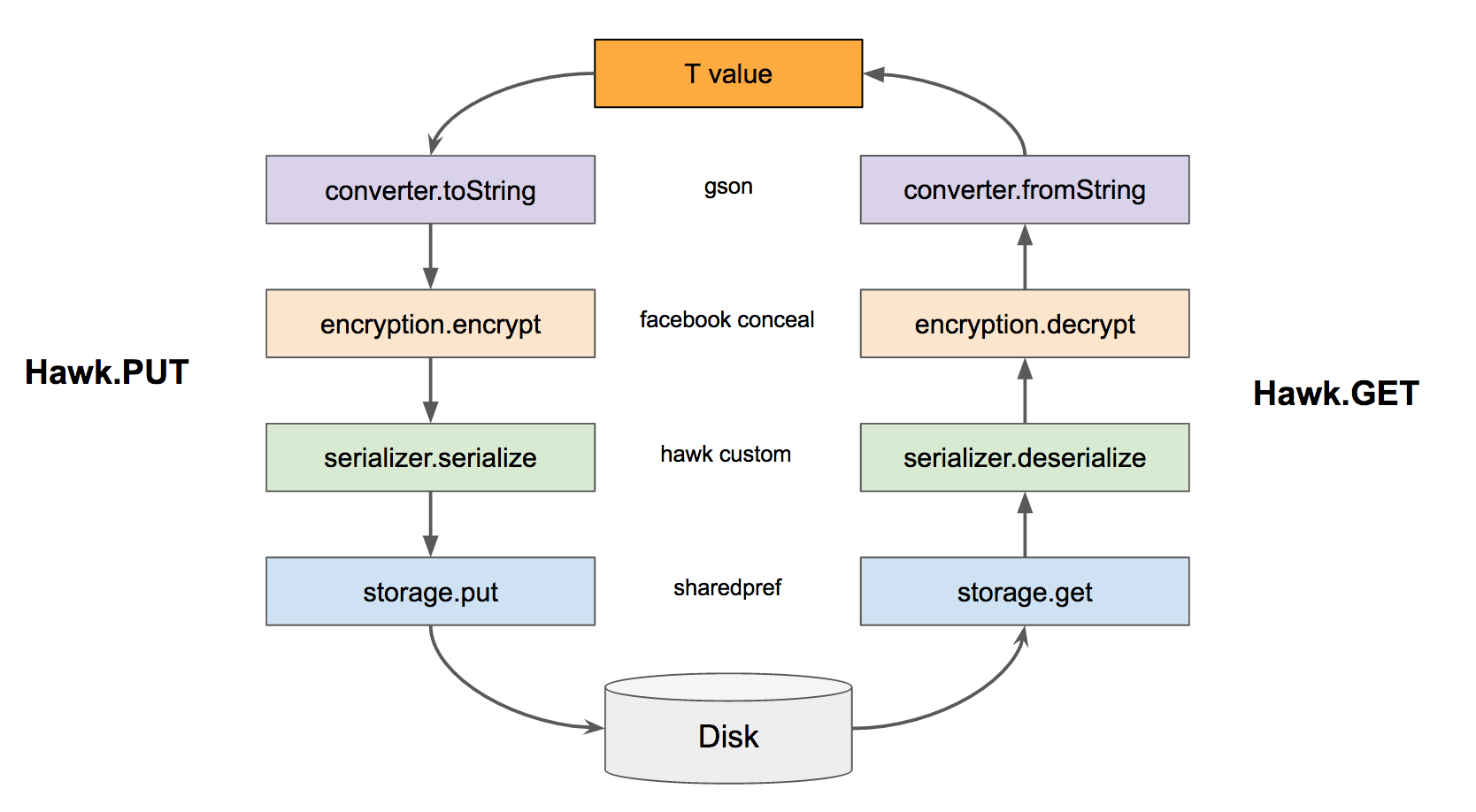
Gson is the default parser. Supply a configured parser for custom type adapters, or replace any pipeline interface with your own implementation:
Hawk.init(applicationContext)
    .setParser(GsonParser(GsonBuilder().create()))
    .setStorage(myStorage)
    .setEncryption(myEncryption)
    .build()
NoEncryption() is available for data that needs no confidentiality. It only Base64-encodes values.
Compatibility and limitations
The unreleased Hawk 3.0 uses AES-256-GCM with an application-owned Android Keystore key. Each write uses a fresh nonce and binds the ciphertext to its storage key. Initialization fails if Keystore is unavailable; it never falls back to NoEncryption. deleteAll() retains the Keystore key so other stored values are not invalidated. Keep a custom KeystoreEncryption("your-stable-alias") alias unchanged while its data is retained.
Published Hawk 2.0.1 still uses legacy Conceal and may fall back to Base64-only storage. Its encryption is not changed by the installation snippet above.
Hawk 3.0 cannot read Hawk 2's default ciphertext. Before upgrading, read and migrate the values using the old application/library, then save them with the new encryption. ConcealEncryption has been removed. Unmigrated values remain stored, but get returns null (or your default) when decryption fails; they are not automatically cleared or converted. Applications storing non-sensitive data with NoEncryption can explicitly keep that implementation.
Keystore keys are not restored with preferences or transferred to another installation. Exclude Hawk2.xml from both cloud backup and device transfer using your app's backup rules; otherwise restored values cannot be decrypted. Handle key loss by recovering data from an application-specific trusted source. Hawk never regenerates a key while decrypting an existing value. Avoid logging sensitive data through a LogInterceptor.
Use the same type when reading a key as when saving it. Collections record the first element's class, so use homogeneous, non-nested collections whose first element (and first map key/value) is non-null. Model changes can prevent older data from being read. Gson does not enforce Kotlin constructor defaults or non-null properties.
For apps using R8, keep the names and fields of models persisted with Hawk: the format stores class names and Gson uses reflection. For example, with your own package:
-keep class com.example.app.storage.model.** { *; }
Changing encryption, parsing, or storage implementations does not migrate existing data. Hawk 2 data is incompatible with Hawk 1.
How values are stored
License
Apache License 2.0. Copyright Orhan Obut.
探索相关项目
trimstray/the-book-of-secret-knowledge
汇集各类启发灵感的清单、手册、速查表、博客、技巧、单行命令、CLI/Web 工具等内容。
257,837 星标Hack-with-Github/Awesome-Hacking
面向黑客、渗透测试人员与安全研究人员的各类 Awesome 清单合集。
125,254 星标swisskyrepo/PayloadsAllTheThings
一份用于 Web 应用安全以及渗透测试/CTF 的实用 payload 与绕过方法列表。
82,583 星标caddyserver/caddy
快速、可扩展的跨平台 HTTP/1-2-3 Web 服务器,支持自动 HTTPS
78,959 星标