
mangye16/Unsupervised_Embedding_Learning
关于
Code for Unsupervised Embedding Learning via Invariant and Spreading Instance Feature
学习资源实测星标增长
- 24小时
- 0
- 7天
- 0
- 15天
- 正在收集历史
- 1个月
- 正在收集历史
各周期内的星标净变化,周期相互重叠,并非每日新增。缺失的测量保持空白。星标代表关注度,不代表软件质量。
README.md
原文Unsupervised_Embedding_Learning
Pytorch code for Unsupervised Embedding Learning via Invariant and Spreading Instance Feature in CVPR 2019. (arXiv).
Highlight
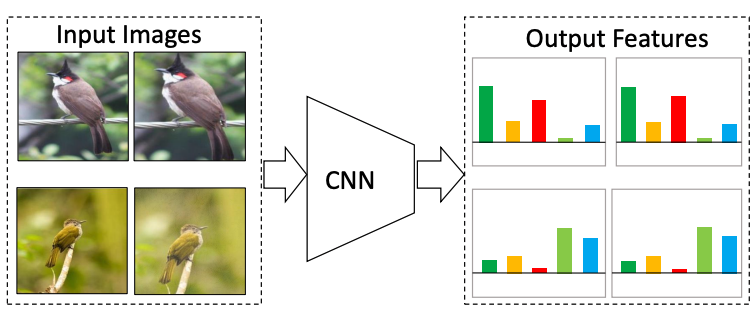
The goal of this work is to learn a feature extraction DNN, such that features of the same instance under different data augmentations should be invariant, while features of different image instances should be separated.
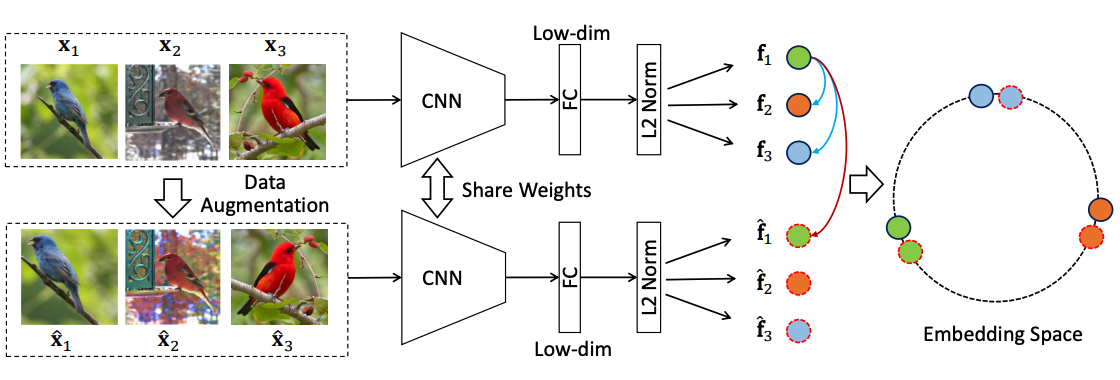
We propose to optimize the embedding directly on the real-time instance features with softmax function.
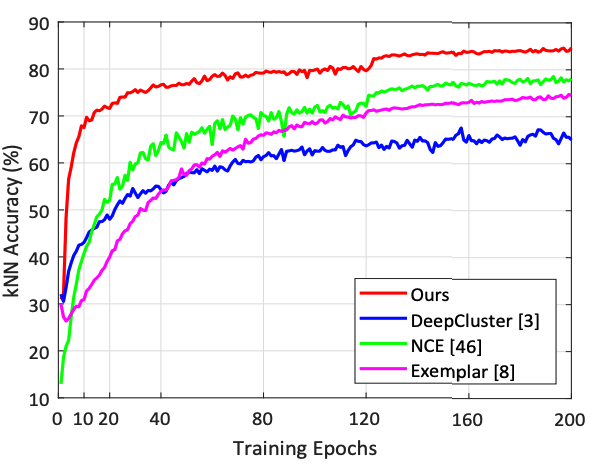
The proposed feature achieves much faster learning speed and better accuracy.
The learned embedding performs well on both seen and unseen testing categories.
Usage
Our code extends the pytorch implementation of NCE paper in Github. Please refer to the official repo for details of data preparation and hardware configurations.
Prerequisites: Python2.7, pytorch=0.4, Numpy, TensorboardX, Scikit_learn
Clone this repo:
git clone https://github.com/mangye16/Unsupervised_Embedding_Learning
Training on Seen Testing Categories
The training and testing set share the same categories. We use kNN classifier to evaluate the performance follow the settings in NCE paper.
python demo_seen.py --dataset cifar --batch-t 0.1 --lr 0.03 --low-dim 128 --batch-size 128 --gpu 0,1,2,3
--dataset: "cifar": cifar-10 dataset, "stl": stl-10 dataset.--batch-t: softmax temperature parameter (0.05-0.1).--lr: learning rate (initialization: 0.03).--low-dim: the feature embedding dimension (default: 128).--batch-size: the training batch size (Generally, larger batch size results in better performance)--gpu: gpu used for training
Training on Unseen Testing Categories
The training and testing set DO NOT share any common categories. We use recall at K accuracy to evaluate the performance following existing deep metric learning papers.
1) Dataset Preparation
Prepare the data. Download the datasets first. Then run codes in ./pre_process/ to download and pre-process each dataset
You may use
python pre_process_bird.py
Alternatively, you can use the code to directly download and pre-process the datasets.
Remember to change the dataset path to your own path.
2) Start Training
python demo_unseen.py --dataset cub200 --arch inception_v1_ml --lr 0.001 --low-dim 128 --batch-size 64 --gpu 0
--dataset: "cub200": CUB200-2011 dataset or, "car196": Cars196 dataset, "ebay": Stanford Online Product dataset.--arch: backbone network structure (defualt: inception_v1_ml).--lr: learning rate (initialization: 0.01).--gpu: gpu used for training (only support single GPU training for inception_v1 backbone)
Citation
Please kindly cite this paper in your publications if it helps your research:
@inproceedings{cvpr19unsupervised,
  title={Unsupervised Embedding Learning via Invariant and Spreading Instance Feature},
  author={Ye, Mang and Zhang, Xu and Yuen, Pong C. and Chang, Shih-Fu},
  booktitle={IEEE International Conference on Computer Vision and Pattern Recognition (CVPR)},
  year={2019},
}
Contact: [email protected]
探索相关项目
加载中…