
keishihara/flow-matching
keishihara/flow-matching has 131 GitHub stars and 13 forks. GitHot measured 0 stars in 24 hours, 0 in 7 days, and 0 in 15 days. Last checked 2026-11-19 12:30 UTC. Last push 2026-01-18.
实测星标增长
- 24小时
- 0
- 7天
- 0
- 15天
- 0
- 1个月
- 正在收集历史
各周期内的星标净变化,周期相互重叠,并非每日新增。缺失的测量保持空白。星标代表关注度,不代表软件质量。
关于
Flow Matching implemented in PyTorch
机器学习README.md
原文Flow Matching in PyTorch
This repository contains a simple PyTorch implementation of the paper Flow Matching for Generative Modeling.
2D Flow Matching Example
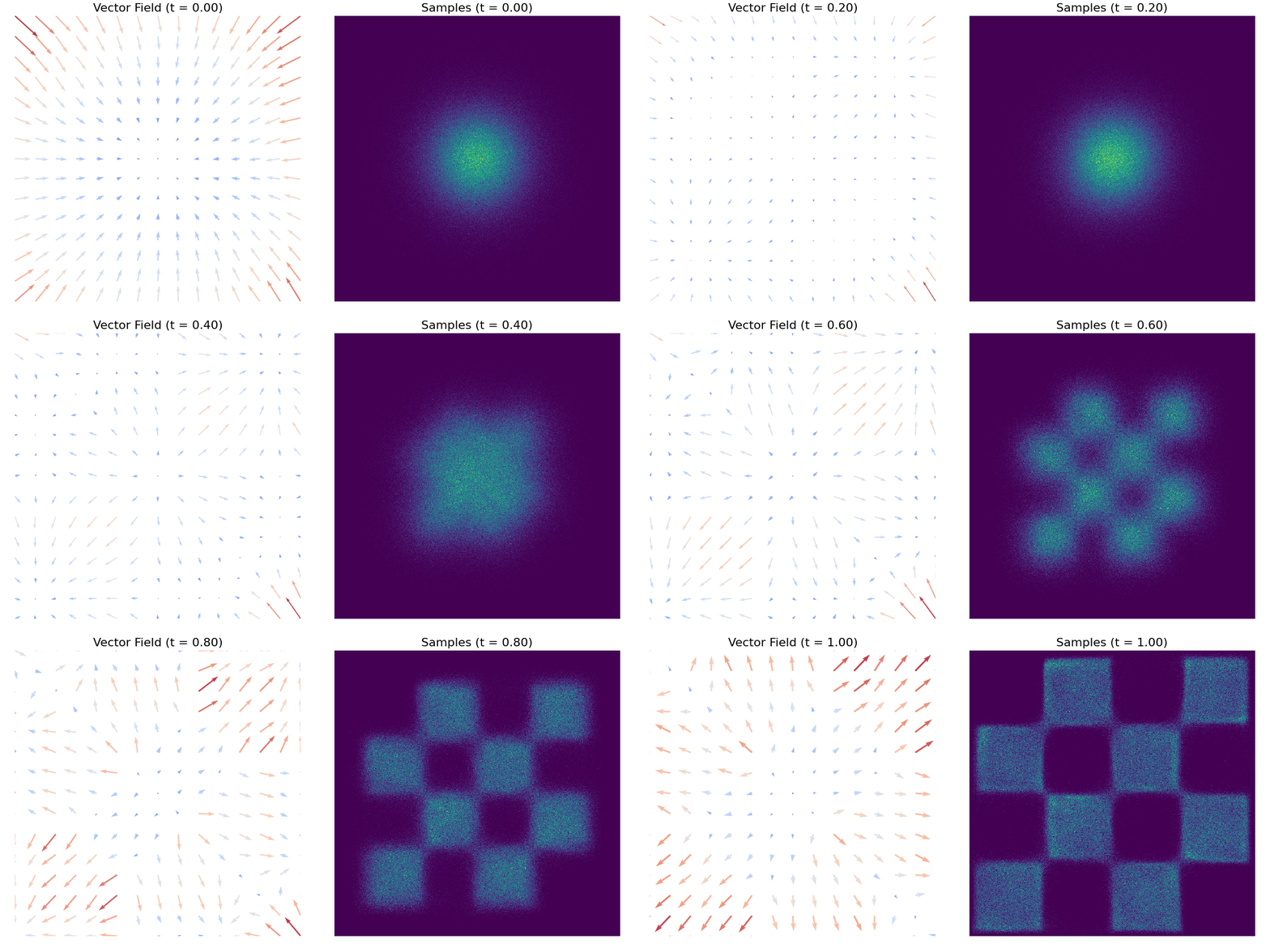
The gif below demonstrates mapping a single Gaussian distribution to a checkerboard distribution, with the vector field visualized.
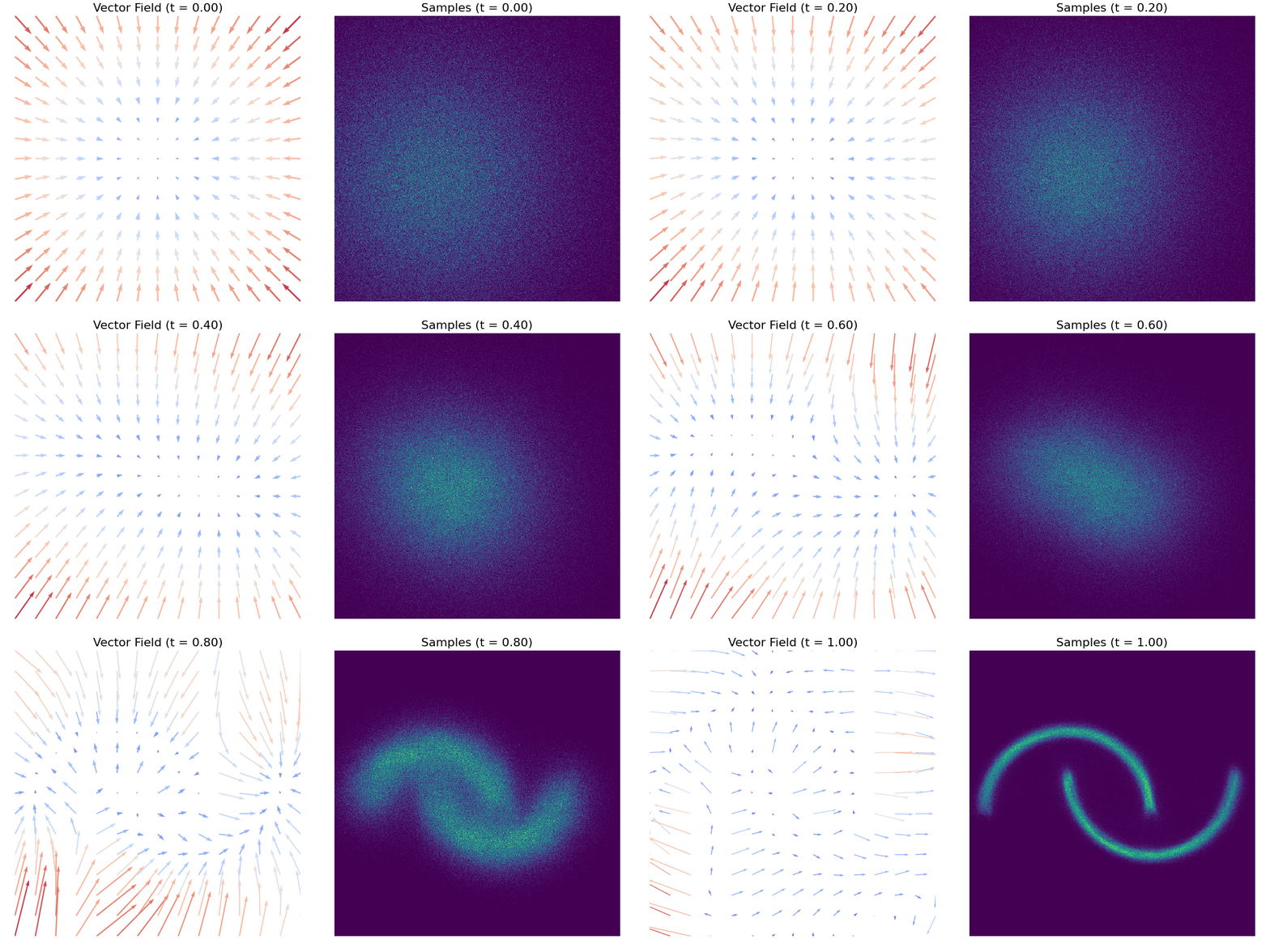
And, here is another example of moons dataset.
Getting Started
Clone the repository and set up the python environment.
git clone https://github.com/keishihara/flow-matching.git
cd flow-matching
Make sure you have Python 3.12+ installed.
Install uv:
curl -LsSf https://astral.sh/uv/install.sh | sh
Then, set up the environment:
uv sync
Conditional Flow Matching [Lipman+ 2023]
This is the original CFM paper implementation [1]. Some components of the code are adapted from [2] and [3].
2D Toy Datasets
You can train the CFM models on 2D synthetic datasets such as checkerboard and moons. Specify the dataset name using --dataset option. Training parameters are predefined in the script, and visualizations of the training results are stored in the outputs/ directory. Model checkpoints are not included as they are easily reproducible with the default settings.
uv run scripts/train_flow_matching_2d.py --dataset checkerboard
The vector fields and generated samples, like the ones displayed as GIFs at the top of this README, can now be found in the outputs/cfm/ directory.
Image Datasets
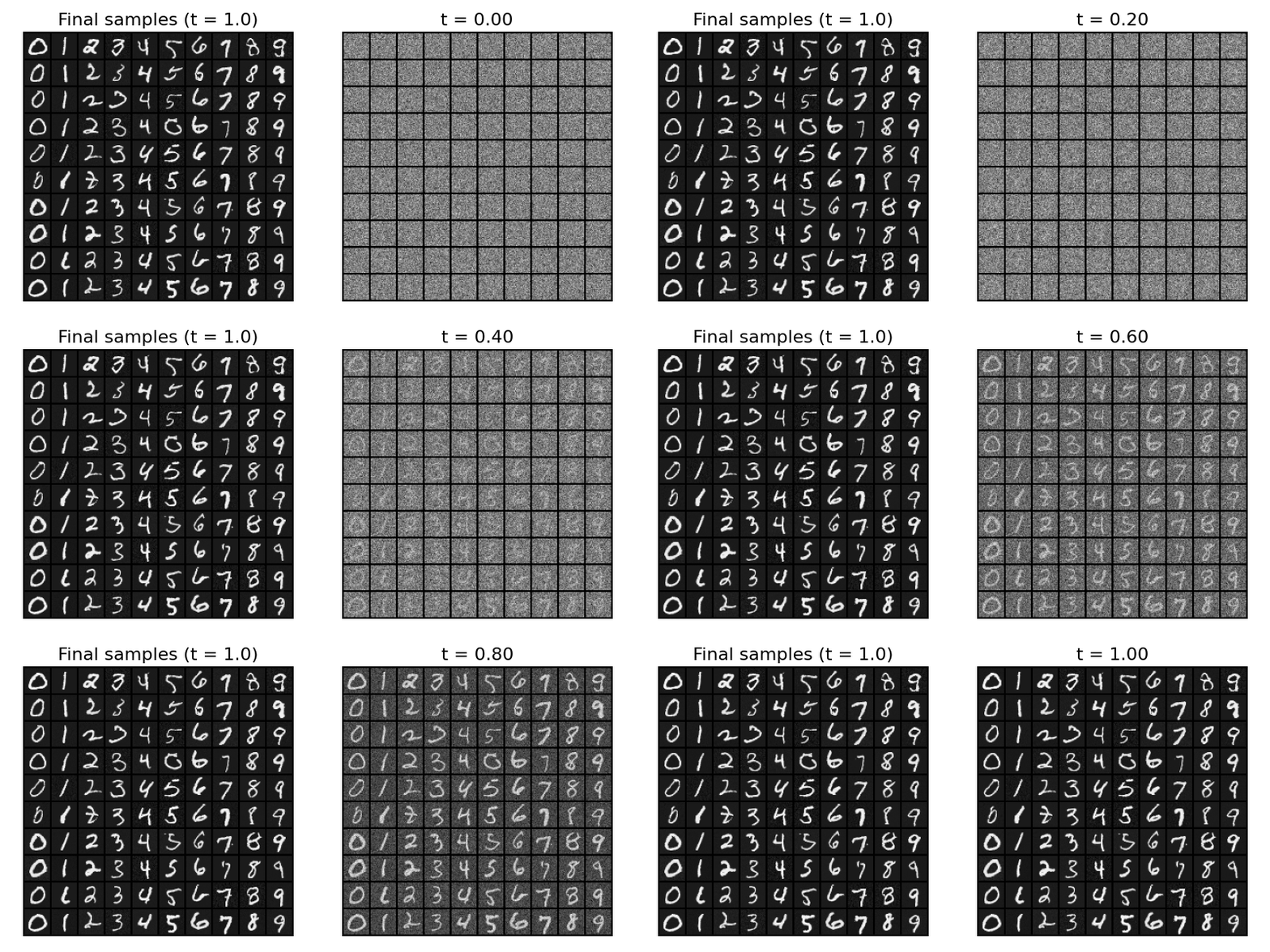
You can also train class-conditional CFM models on popular image classification datasets. Both the generated samples and model checkpoints will be stored in the outputs/cfm directory. For a detailed list of training parameters, run uv run scripts/train_flow_matching_on_image.py --help.
To train a class-conditional CFM on MNIST dataset, run:
uv run scripts/train_flow_matching_on_image.py --do_train --dataset mnist
After training, you can now generate samples with:
uv run scripts/train_flow_matching_on_image.py --do_sample --dataset mnist
Now, you should be able to see the generated samples in the outputs/cfm/mnist/ directory.
Rectified Flow [Liu+ 2023]
This is an implementation of the Reflow model (2-Rectified Flow to be specific) from the Rectified Flow paper [2].
2D Synthetic Data
We have implemented the Reflow on 2d synthetic datasets, same as the CFM. To train the reflow, you have to specify pretrained CFM checkpoints as reflow is a distillation model.
For example, to train on the checkerboard dataset with a pretrained CFM checkpoint:
uv run scripts/train_reflow_2d.py --dataset checkerboard
The training results, including vector field visualizations and generated samples, are saved under outputs/reflow/ folder.
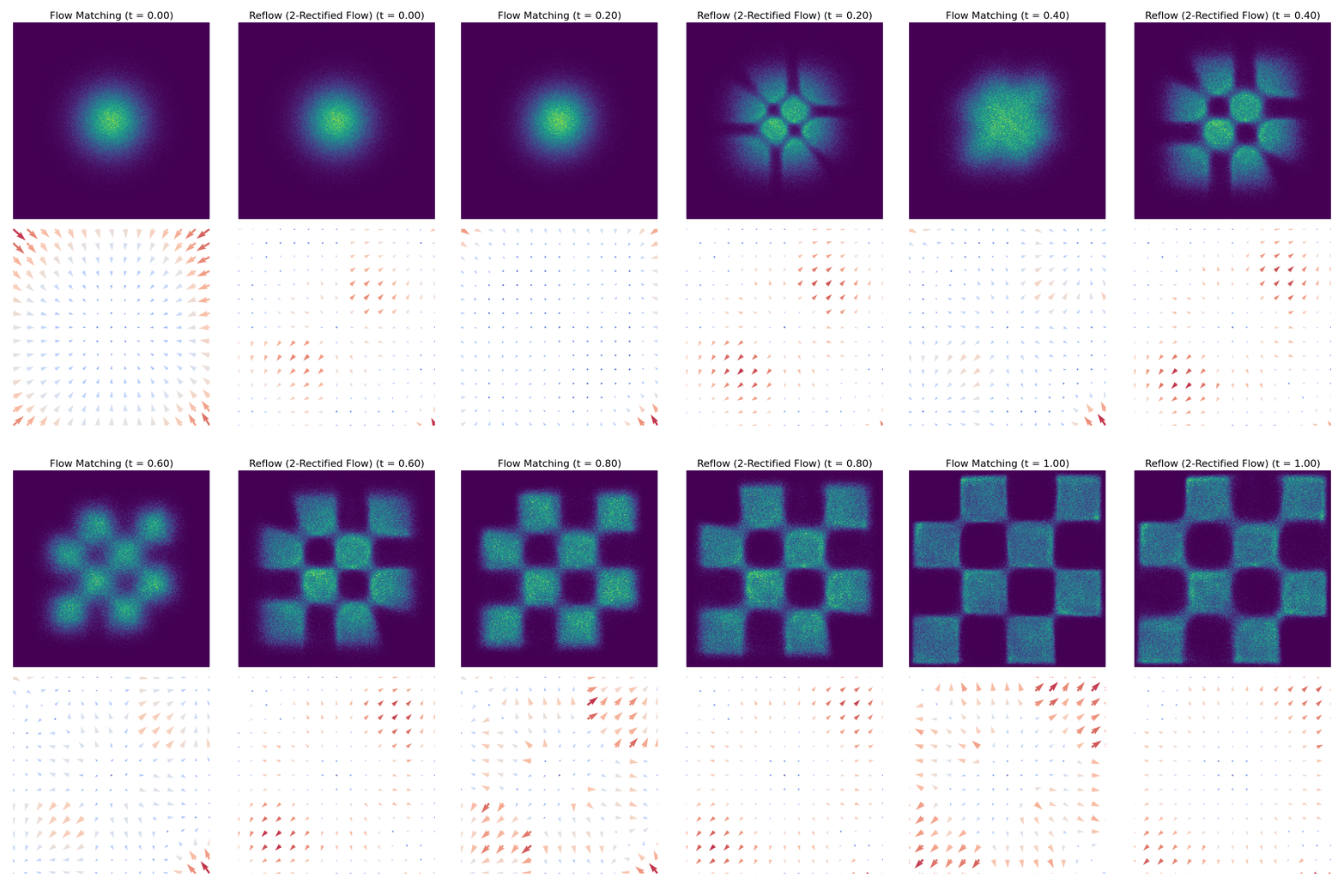
Comparison of sampling process between CFM and Reflow
To compare CFM and Reflow on 2d datasets, run:
uv run scripts/plot_comparison_2d.py --dataset checkerboard
The resulting GIFs can be found under outputs/comparisons/ folder. Below is an example comparison of the two methods in the checkerboard dataset:
References
- [1] Lipman, Yaron, et al. "Flow Matching for Generative Modeling." arXiv:2210.02747
- [2] Liu, Xingchao, et al. "Flow Straight and Fast: Learning to Generate and Transfer Data with Rectified Flow." arXiv:2209.03003
- [3] facebookresearch/flow_matching
- [4] atong01/conditional-flow-matching