
dformoso/machine-learning-mindmap
dformoso/machine-learning-mindmap has 6,269 GitHub stars and 1,003 forks. GitHot measured +1 stars in 24 hours, 0 in 7 days, and +2 in 15 days. Last checked 2026-11-21 13:28 UTC. Last push 2020-05-30.
实测星标增长
- 24小时
- +1
- 7天
- 0
- 15天
- +2
- 1个月
- 正在收集历史
各周期内的星标净变化,周期相互重叠,并非每日新增。缺失的测量保持空白。星标代表关注度,不代表软件质量。
关于
一张总结机器学习概念的思维导图,涵盖从数据分析到深度学习的内容。
机器学习README.md
原文Machine Learning Mindmap / Cheatsheet
A Mindmap summarising Machine Learning concepts, from Data Analysis to Deep Learning.
Overview
Machine Learning is a subfield of computer science that gives computers the ability to learn without being explicitly programmed. It explores the study and construction of algorithms that can learn from and make predictions on data.
Machine Learning is as fascinating as it is broad in scope. It spans over multiple fields in Mathematics, Computer Science, and Neuroscience. This is an attempt to summarize this enormous field in one .PDF file.
Download
Download the PDF here:
https://github.com/dformoso/machine-learning-mindmap/blob/master/Machine%20Learning.pdf
Same, but with a white background:
I've built the mindmap with MindNode for Mac. https://mindnode.com
Companion Notebook
This Mindmap/Cheatsheet has a companion Jupyter Notebook that runs through most of the Data Science steps that can be found at the following link:
Mindmap on Deep Learning
Here's another mindmap which focuses only on Deep Learning
1. Process
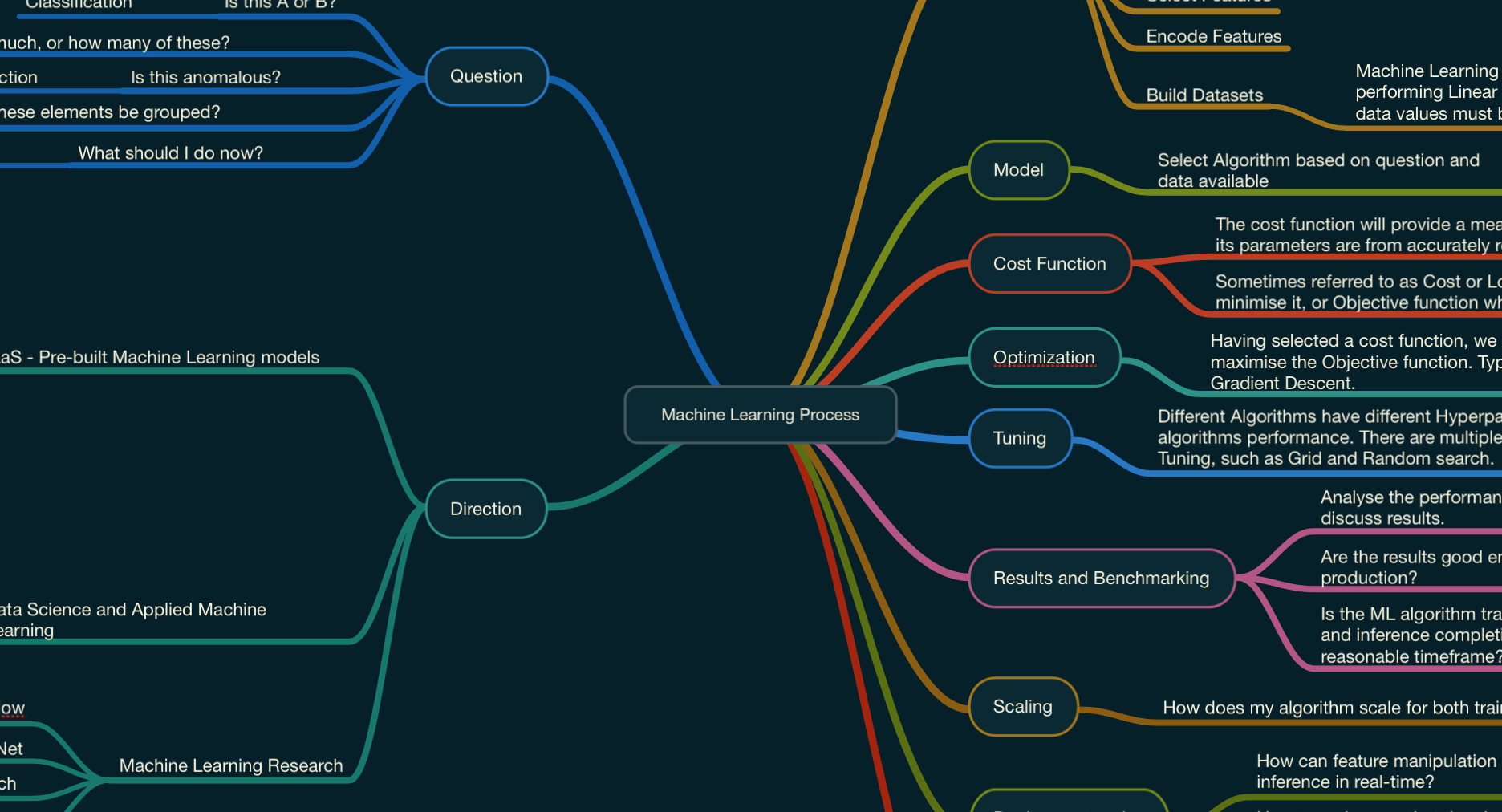
The Data Science it's not a set-and-forget effort, but a process that requires design, implementation and maintenance. The PDF contains a quick overview of what's involved. Here's a quick screenshot.
2. Data Processing
First, we'll need some data. We must find it, collect it, clean it, and about 5 other steps. Here's a sample of what's required.

3. Mathematics
Machine Learning is a house built on Math bricks. Browse through the most common components, and send your feedback if you see something missing.

4. Concepts
A partial list of the types, categories, approaches, libraries, and methodology.

5. Models
A sampling of the most popular models. Send your comments to add more.

References
I'm planning to build a more complete list of references in the future. For now, these are some of the sources I've used to create this Mindmap.
 Stanford and Oxford Lectures. CS20SI, CS224d.
> Books:
  > Deep Learning - Goodfellow.
  > Pattern Recognition and Machine Learning - Bishop.
  > The Elements of Statistical Learning - Hastie.
- Colah's Blog. http://colah.github.io
- Kaggle Notebooks.
- Tensorflow Documentation pages.
- Google Cloud Data Engineer certification materials.
- Multiple Wikipedia articles.
About Me
Twitter:
Linkedin:
Email: