
cerlymarco/linear-tree
cerlymarco/linear-tree has 389 GitHub stars and 63 forks. GitHot measured 0 stars in 24 hours. Last checked 2026-11-19 18:59 UTC. Last push 2024-07-19.
实测星标增长
- 24小时
- 0
- 7天
- 正在收集历史
- 15天
- 正在收集历史
- 1个月
- 正在收集历史
各周期内的星标净变化,周期相互重叠,并非每日新增。缺失的测量保持空白。星标代表关注度,不代表软件质量。
关于
A python library to build Model Trees with Linear Models at the leaves.
机器学习README.md
原文linear-tree
A python library to build Model Trees with Linear Models at the leaves.
linear-tree provides also the implementations of LinearForest and LinearBoost inspired from these works.
Overview
Linear Trees combine the learning ability of Decision Tree with the predictive and explicative power of Linear Models. Like in tree-based algorithms, the data are split according to simple decision rules. The goodness of slits is evaluated in gain terms fitting Linear Models in the nodes. This implies that the models in the leaves are linear instead of constant approximations like in classical Decision Trees.
Linear Forests generalize the well known Random Forests by combining Linear Models with the same Random Forests. The key idea is to use the strength of Linear Models to improve the nonparametric learning ability of tree-based algorithms. Firstly, a Linear Model is fitted on the whole dataset, then a Random Forest is trained on the same dataset but using the residuals of the previous steps as target. The final predictions are the sum of the raw linear predictions and the residuals modeled by the Random Forest.
Linear Boosting is a two stage learning process. Firstly, a linear model is trained on the initial dataset to obtain predictions. Secondly, the residuals of the previous step are modeled with a decision tree using all the available features. The tree identifies the path leading to highest error (i.e. the worst leaf). The leaf contributing to the error the most is used to generate a new binary feature to be used in the first stage. The iterations continue until a certain stopping criterion is met.
linear-tree is developed to be fully integrable with scikit-learn. LinearTreeRegressor and LinearTreeClassifier are provided as scikit-learn BaseEstimator to build a decision tree using linear estimators. LinearForestRegressor and LinearForestClassifier use the RandomForest from sklearn to model residuals. LinearBoostRegressor and LinearBoostClassifier are available also as TransformerMixin in order to be integrated, in any pipeline, also for automated features engineering. All the models available in sklearn.linear_model can be used as base learner.
Installation
pip install --upgrade linear-tree
The module depends on NumPy, SciPy and Scikit-Learn (>=0.24.2). Python 3.6 or above is supported.
Media
- Linear Tree: the perfect mix of Linear Model and Decision Tree
- Model Tree: handle Data Shifts mixing Linear Model and Decision Tree
- Explainable AI with Linear Trees
- Improve Linear Regression for Time Series Forecasting
- Linear Boosting with Automated Features Engineering
- Improve Random Forest with Linear Models
Usage
Linear Tree Regression
from sklearn.linear_model import LinearRegression
from lineartree import LinearTreeRegressor
from sklearn.datasets import make_regression
X, y = make_regression(n_samples=100, n_features=4,
                       n_informative=2, n_targets=1,
                       random_state=0, shuffle=False)
regr = LinearTreeRegressor(base_estimator=LinearRegression())
regr.fit(X, y)
Linear Tree Classification
from sklearn.linear_model import RidgeClassifier
from lineartree import LinearTreeClassifier
from sklearn.datasets import make_classification
X, y = make_classification(n_samples=100, n_features=4,
                           n_informative=2, n_redundant=0,
                           random_state=0, shuffle=False)
clf = LinearTreeClassifier(base_estimator=RidgeClassifier())
clf.fit(X, y)
Linear Forest Regression
from sklearn.linear_model import LinearRegression
from lineartree import LinearForestRegressor
from sklearn.datasets import make_regression
X, y = make_regression(n_samples=100, n_features=4,
                       n_informative=2, n_targets=1,
                       random_state=0, shuffle=False)
regr = LinearForestRegressor(base_estimator=LinearRegression())
regr.fit(X, y)
Linear Forest Classification
from sklearn.linear_model import LinearRegression
from lineartree import LinearForestClassifier
from sklearn.datasets import make_classification
X, y = make_classification(n_samples=100, n_features=4,
                           n_informative=2, n_redundant=0,
                           random_state=0, shuffle=False)
clf = LinearForestClassifier(base_estimator=LinearRegression())
clf.fit(X, y)
Linear Boosting Regression
from sklearn.linear_model import LinearRegression
from lineartree import LinearBoostRegressor
from sklearn.datasets import make_regression
X, y = make_regression(n_samples=100, n_features=4,
                       n_informative=2, n_targets=1,
                       random_state=0, shuffle=False)
regr = LinearBoostRegressor(base_estimator=LinearRegression())
regr.fit(X, y)
Linear Boosting Classification
from sklearn.linear_model import RidgeClassifier
from lineartree import LinearBoostClassifier
from sklearn.datasets import make_classification
X, y = make_classification(n_samples=100, n_features=4,
                           n_informative=2, n_redundant=0,
                           random_state=0, shuffle=False)
clf = LinearBoostClassifier(base_estimator=RidgeClassifier())
clf.fit(X, y)
More examples in the notebooks folder.
Check the API Reference to see the parameter configurations and the available methods.
Examples
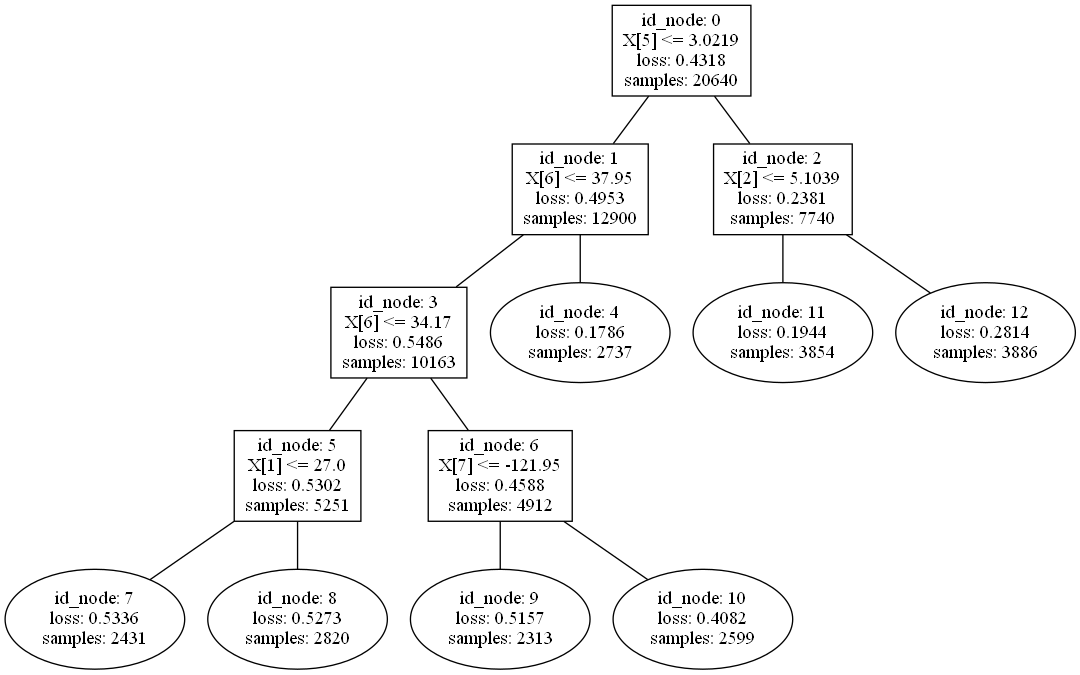
Show the linear tree learning path:
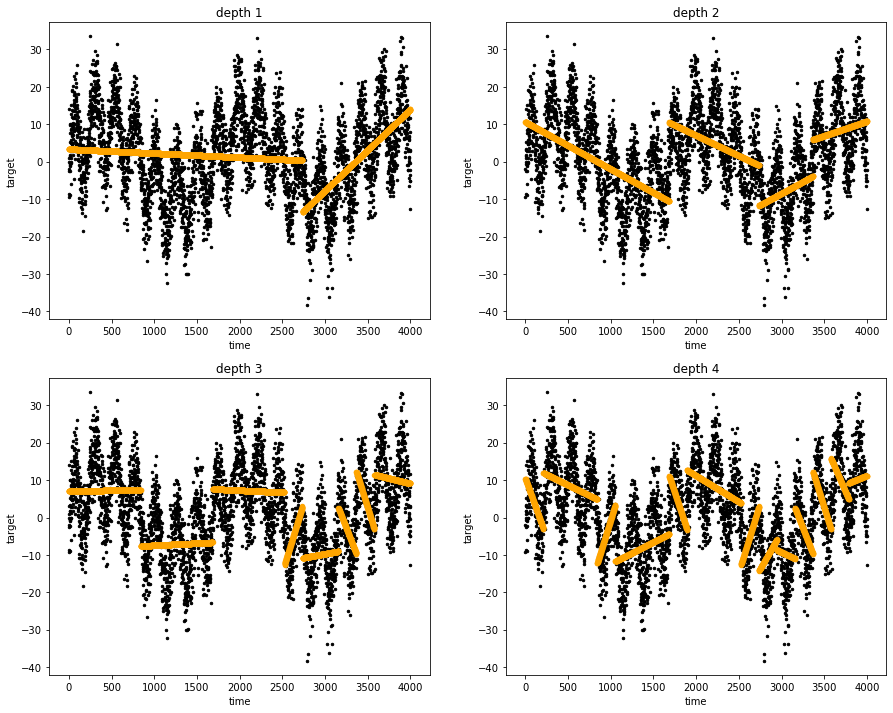
Linear Tree Regressor at work:
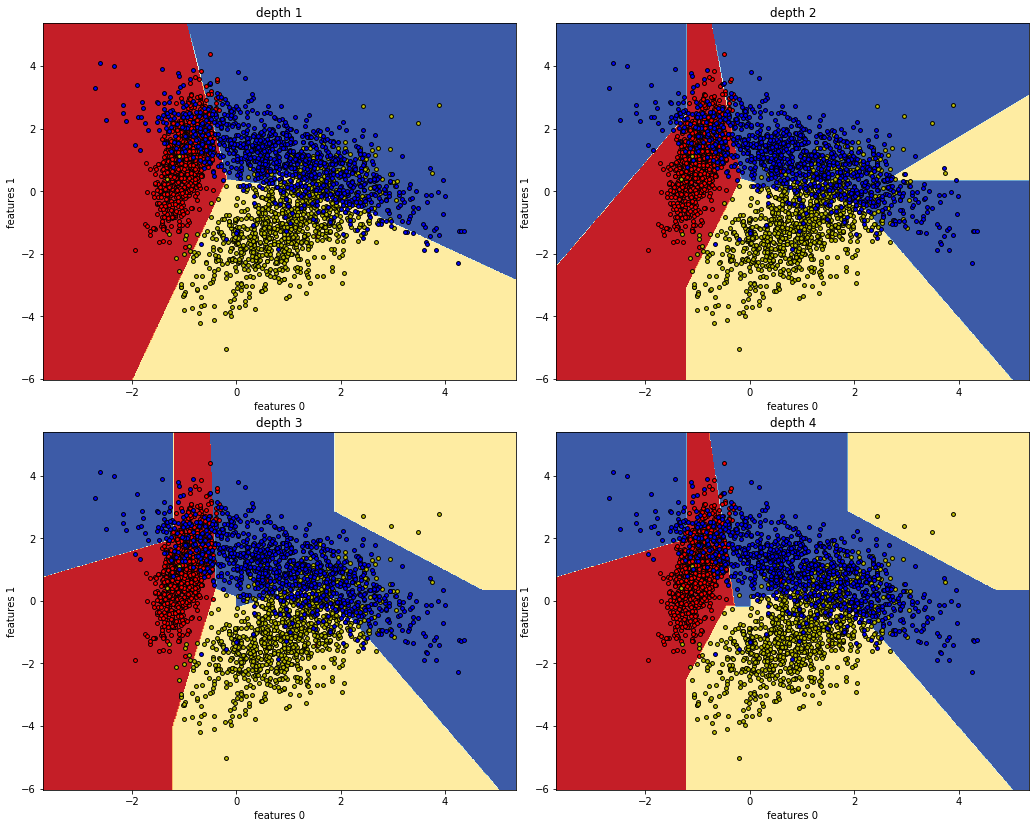
Linear Tree Classifier at work:
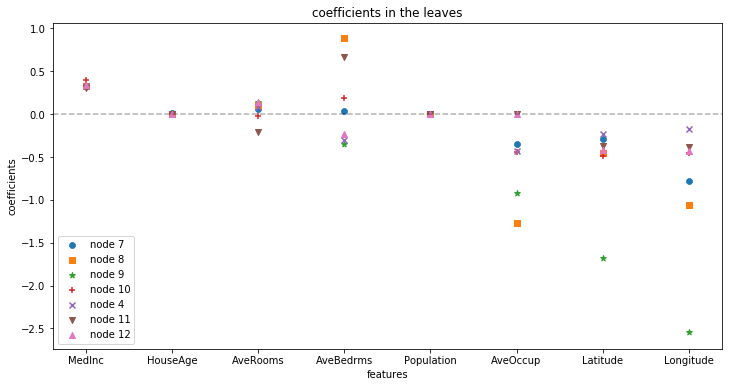
Extract and examine coefficients at the leaves:
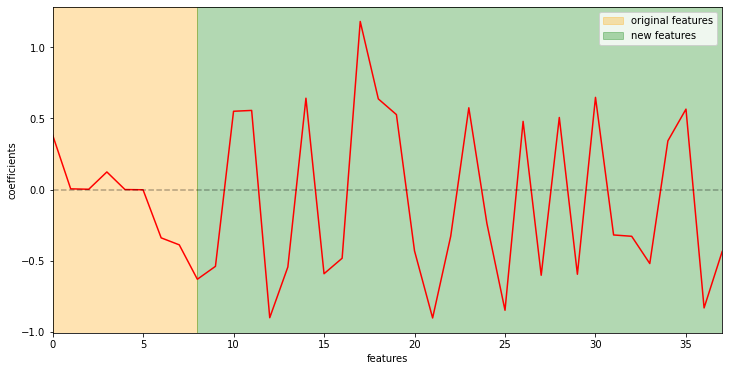
Impact of the features automatically generated with Linear Boosting:
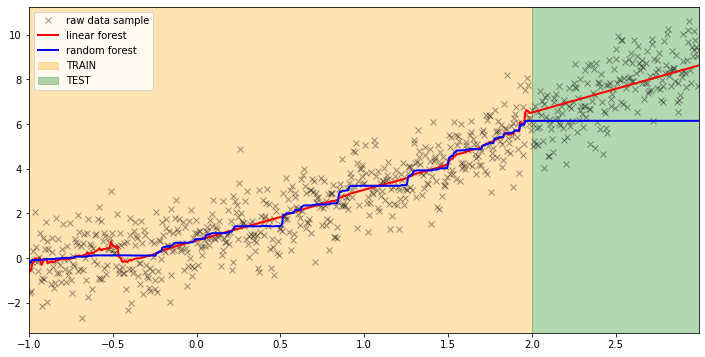
Comparing predictions of Linear Forest and Random Forest:
References
- Regression-Enhanced Random Forests. Haozhe Zhang, Dan Nettleton, Zhengyuan Zhu.
- Explainable boosted linear regression for time series forecasting. Igor Ilic, Berk Gorgulu, Mucahit Cevik, Mustafa Gokce Baydogan.