
bassamlab/SigmaRL
bassamlab/SigmaRL has 84 GitHub stars and 6 forks. GitHot measured +1 stars in 24 hours. Last checked 2026-11-12 13:58 UTC. Last push 2026-11-07.
SigmaRL: A Sample-Efficient and Generalizable Multi-Agent Reinforcement Learning Framework for Motion Planning
实测星标增长
- 24小时
- +1
- 7天
- 更新延迟
- 15天
- 更新延迟
- 1个月
- 更新延迟
各周期内的星标净变化,周期相互重叠,并非每日新增。缺失的测量保持空白。星标代表关注度,不代表软件质量。
README.md
原文SigmaRL: A Sample-Efficient and Generalizable Multi-Agent Reinforcement Learning Framework for Motion Planning






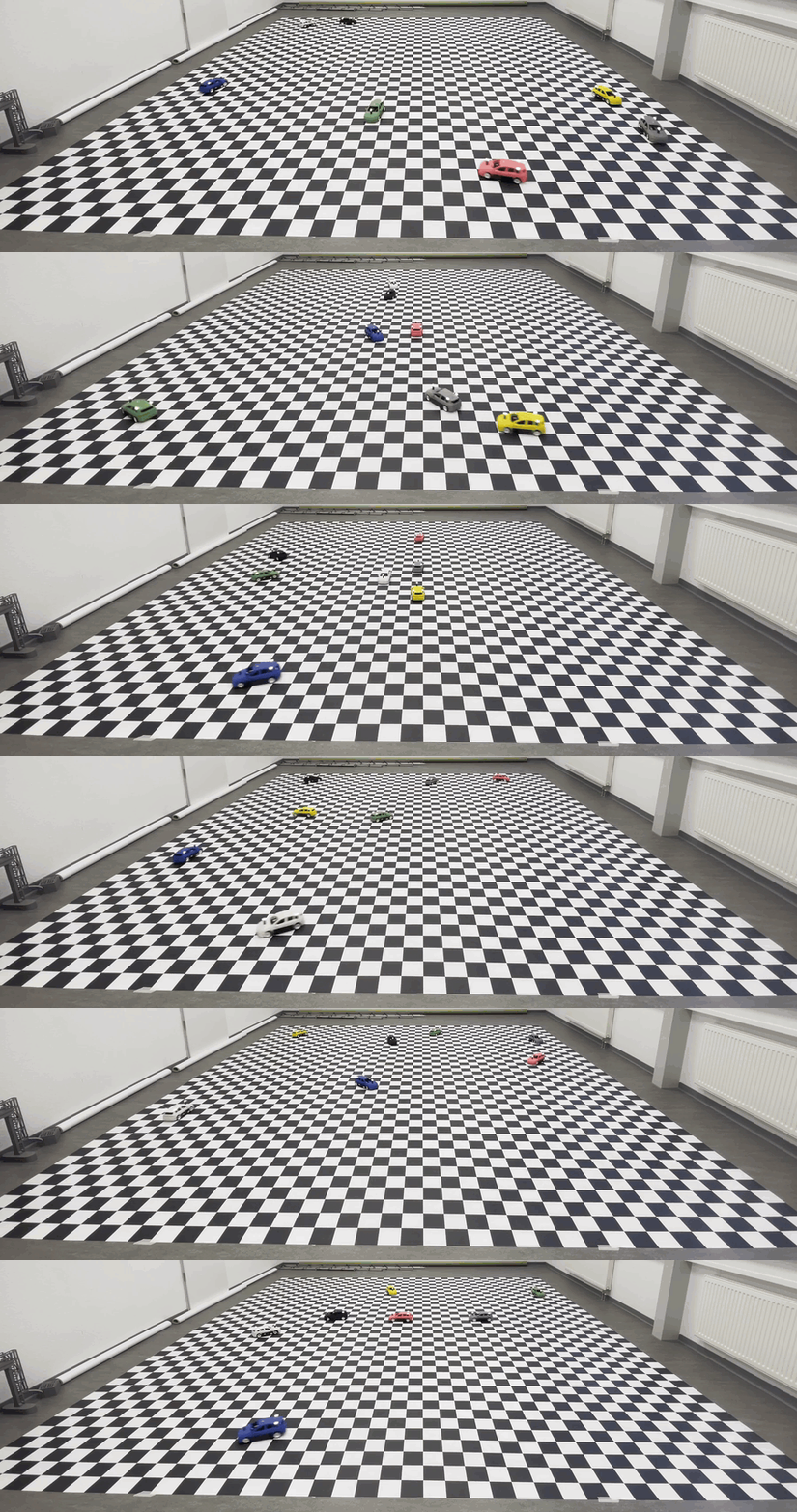
Zero-shot deployment of a MARL policy from simulation in our Cyber-Physical Mobility Lab (CPM Lab).
- SigmaRL: A Sample-Efficient and Generalizable Multi-Agent Reinforcement Learning Framework for Motion Planning
[!NOTE] News
- 2026-11: BH-CBF Safeguard for MARL submitted to IEEE T-ITS: recursively feasible CBFs that safeguard MARL for CAVs (Fig. 7, project page).
- 2026-05: CBF-Informed MARL accepted at IEEE ITSC 2026: a CBF-informed reward that guides safe learning (Fig. 6).
Welcome to SigmaRL!
This repository provides the full code of SigmaRL, a Sample-efficient and generalizable multi-agent Reinforcement Learning (MARL) framework for motion planning of Connected and Automated Vehicles (CAVs).
SigmaRL is a decentralized MARL framework designed for motion planning of CAVs. We use VMAS, a vectorized differentiable simulator designed for efficient MARL benchmarking, as our simulator and customize it for our RL environment. The first scenario in Fig. 1 mirrors the real-world conditions of our Cyber-Physical Mobility Lab (CPM Lab). We also support maps handcrafted in JOSM, an open-source editor for OpenStreetMap. Below you will find detailed guidance for creating your OWN maps.
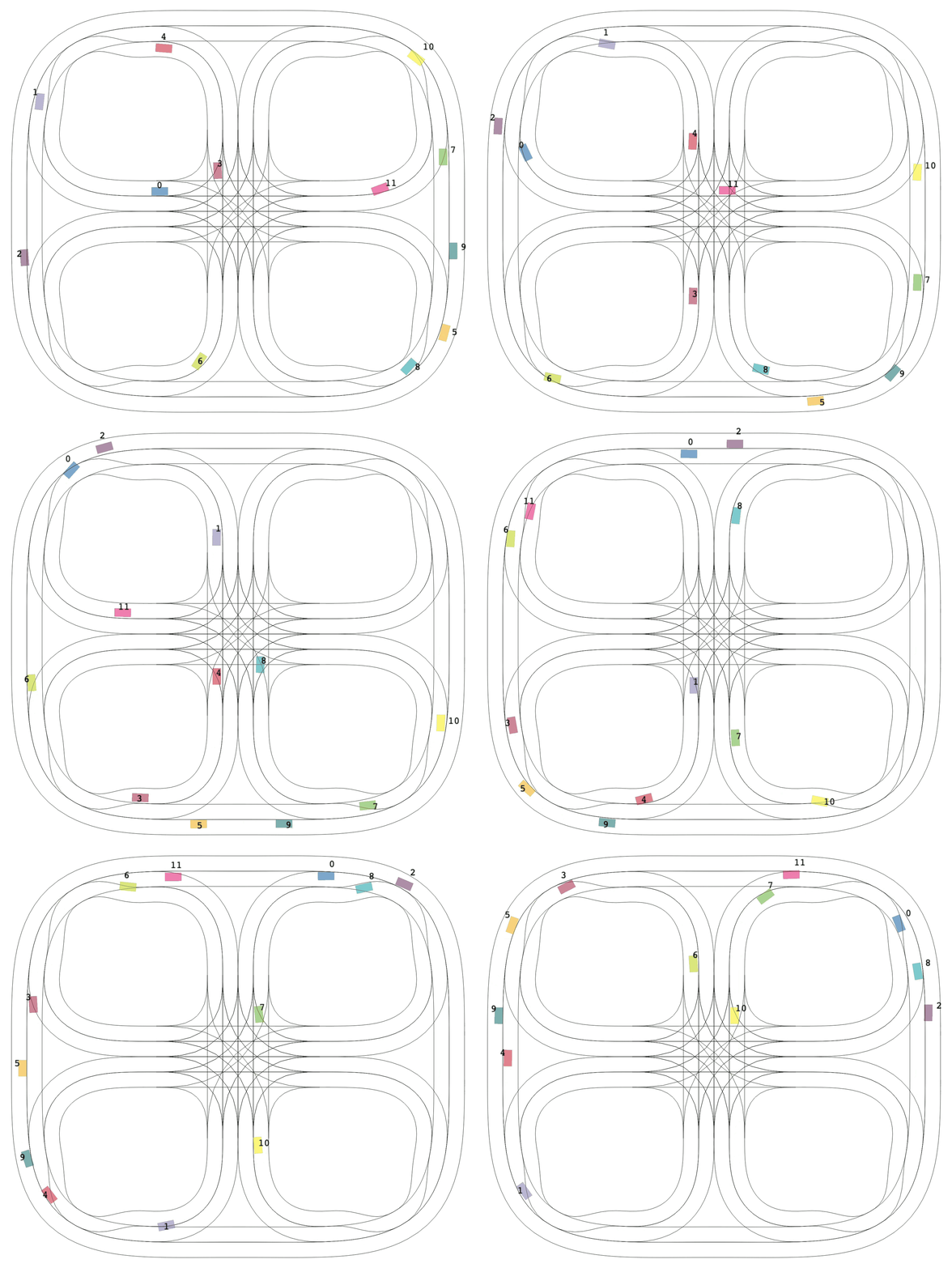
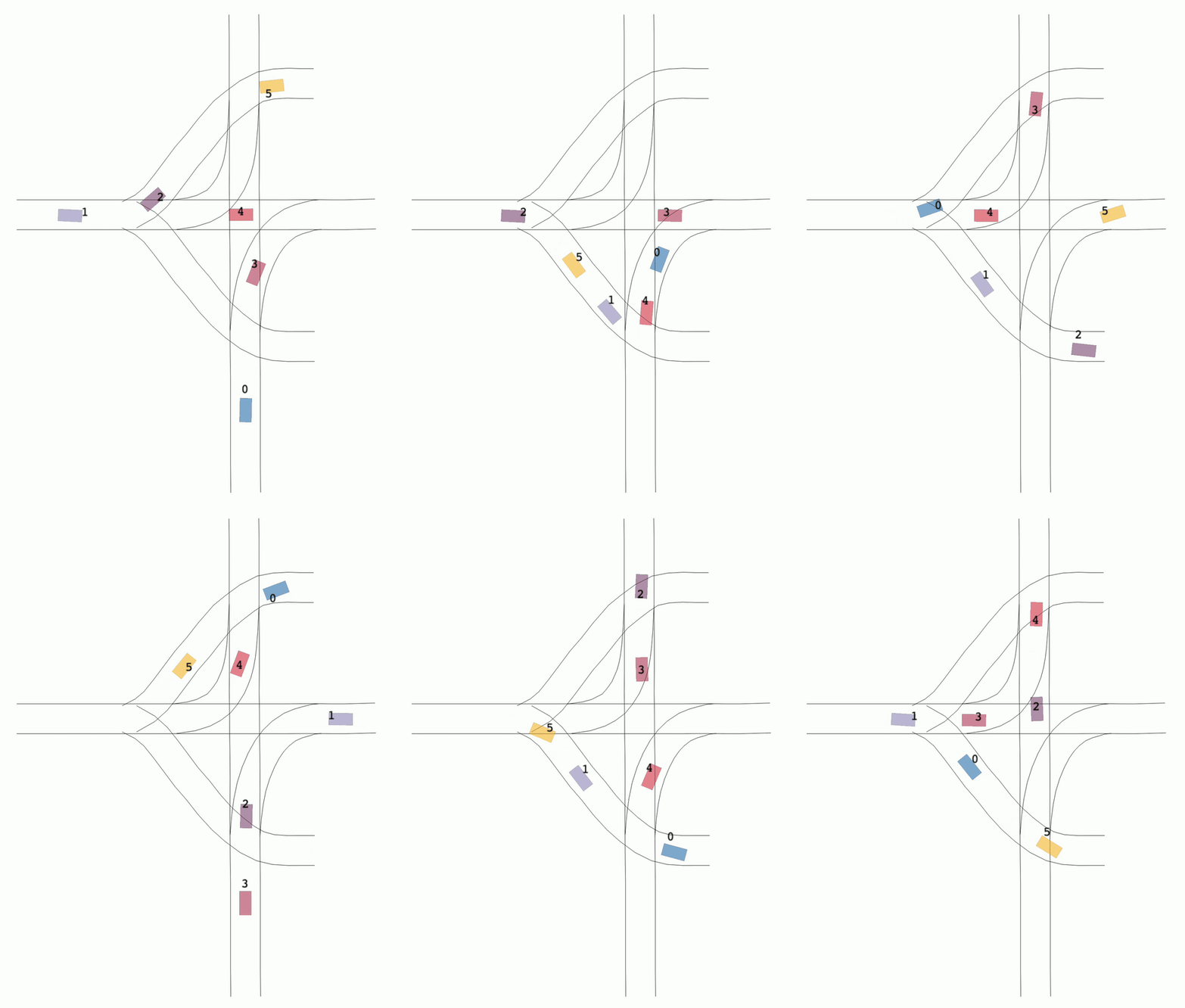
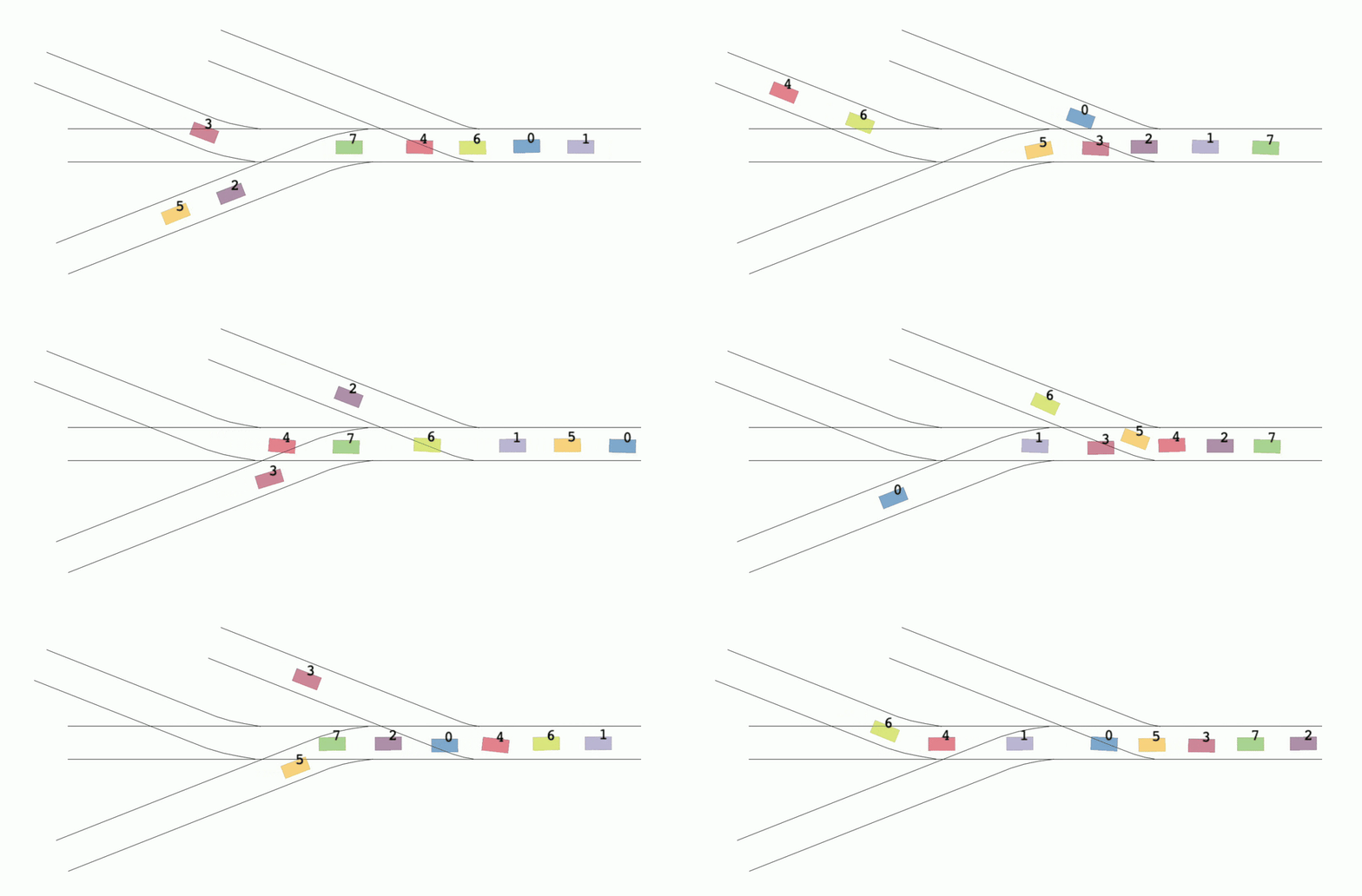
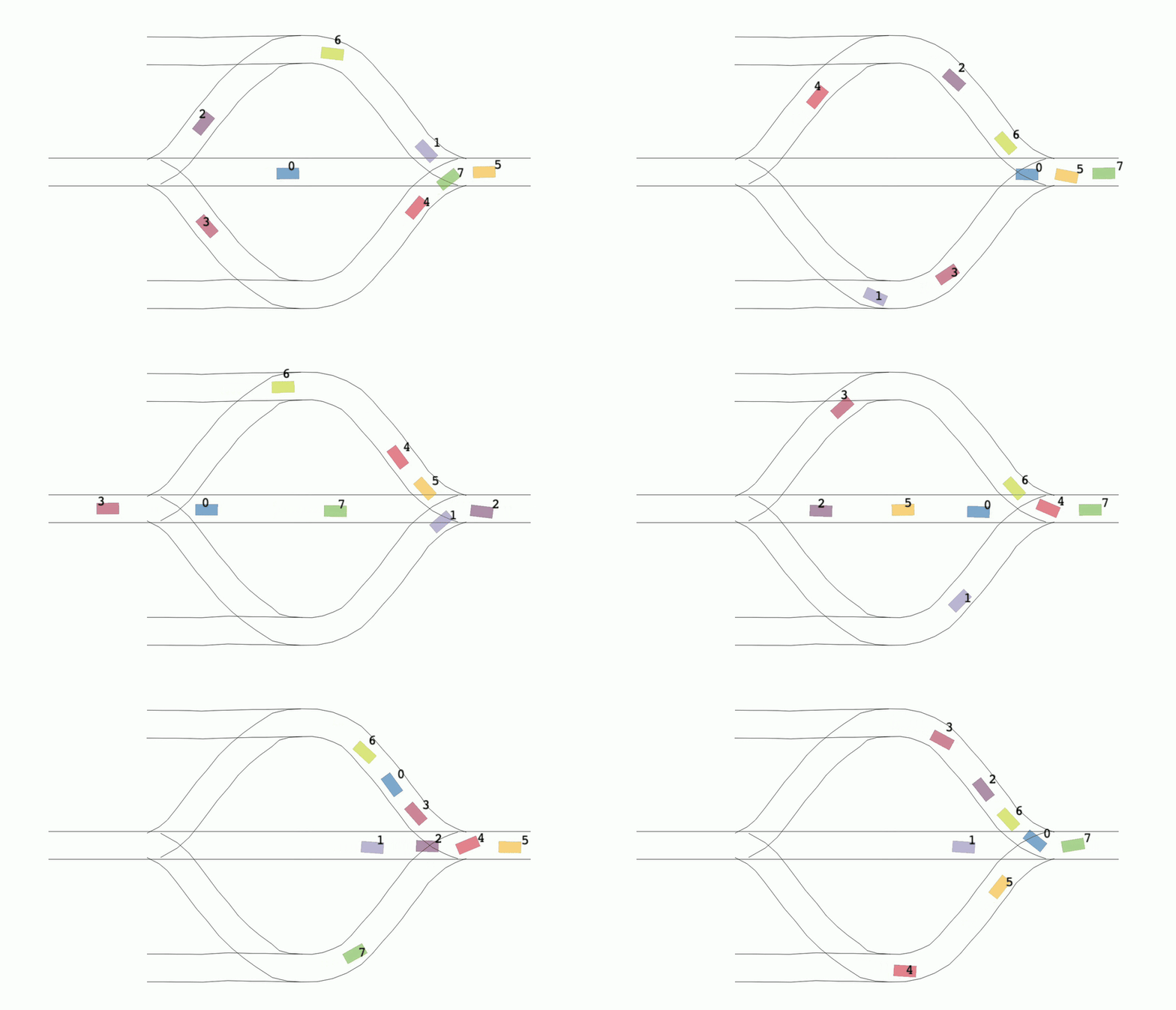
Figure 1: Demonstrating the generalization of SigmaRL (speed x2). Only the intersection part of the CPM scenario (the middle part in Fig. 1(a)) is used for training. All other scenarios are completely unseen. See our SigmaRL paper for more details.
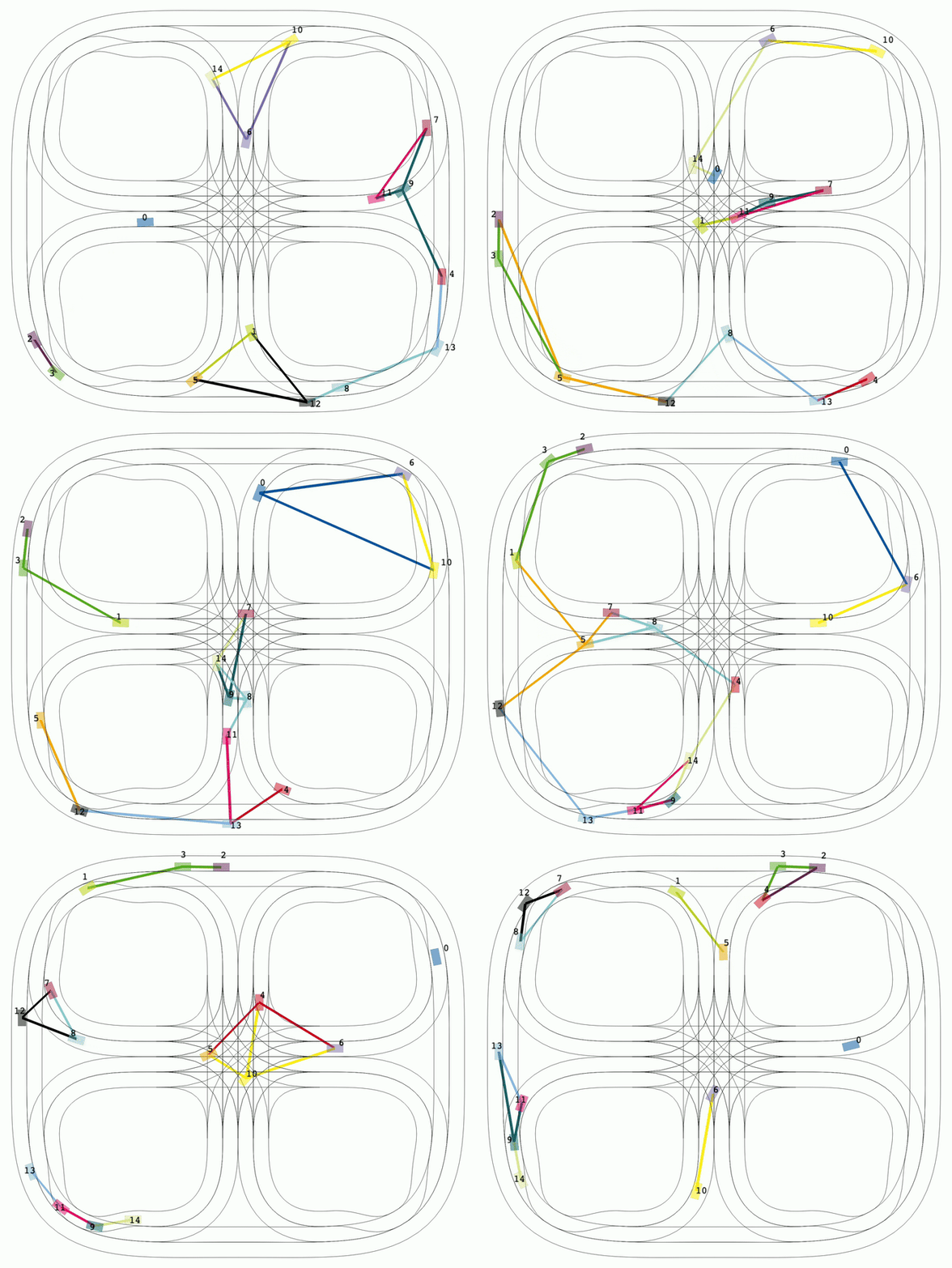
Figure 2: We use an auxiliary MARL to learn dynamic priority assignments to address non-stationarity. Higher-priority agents communicate their actions (depicted by the colored lines) to lower-priority agents to stabilize the environment. See our XP-MARL paper for more details.
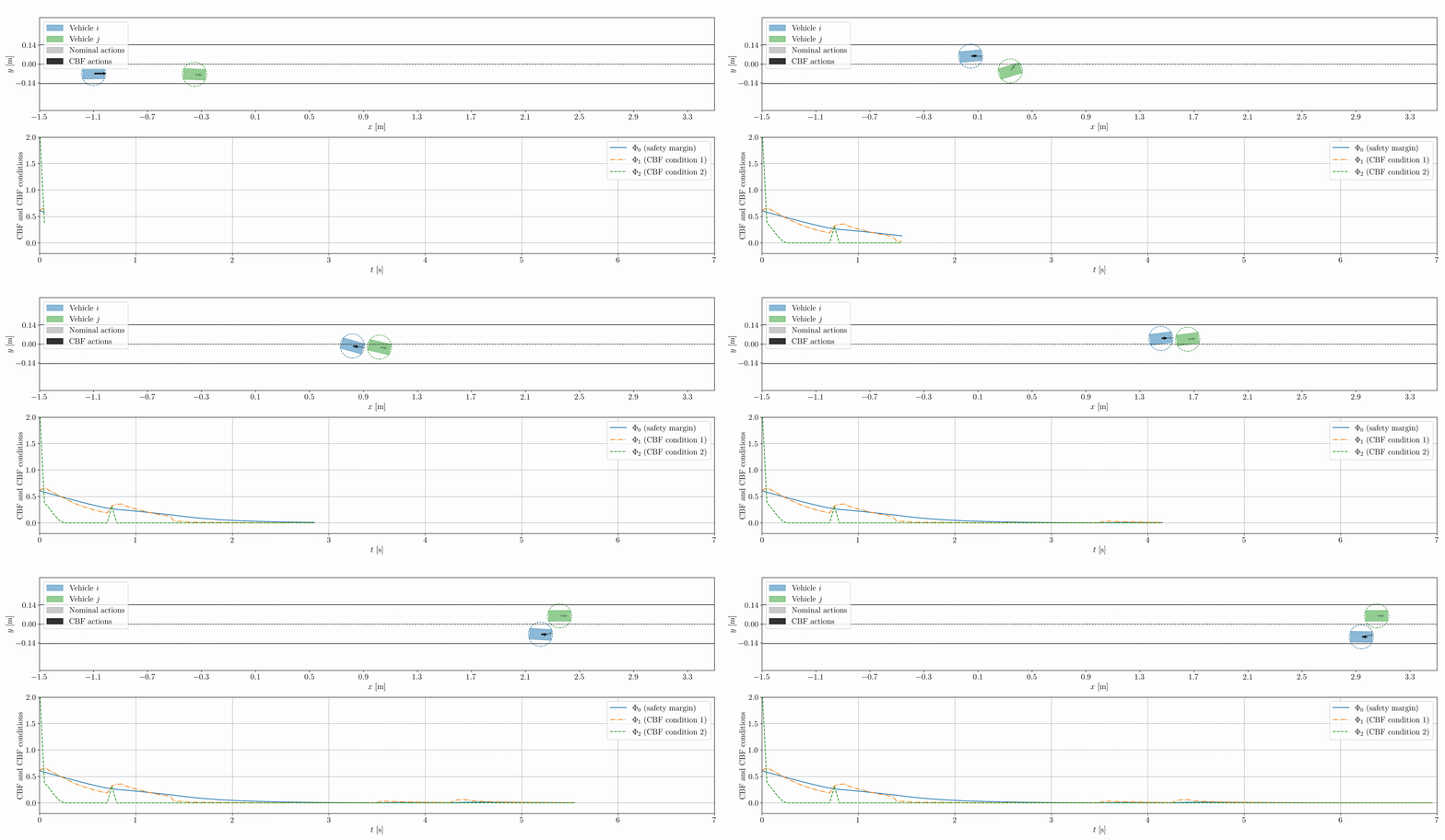
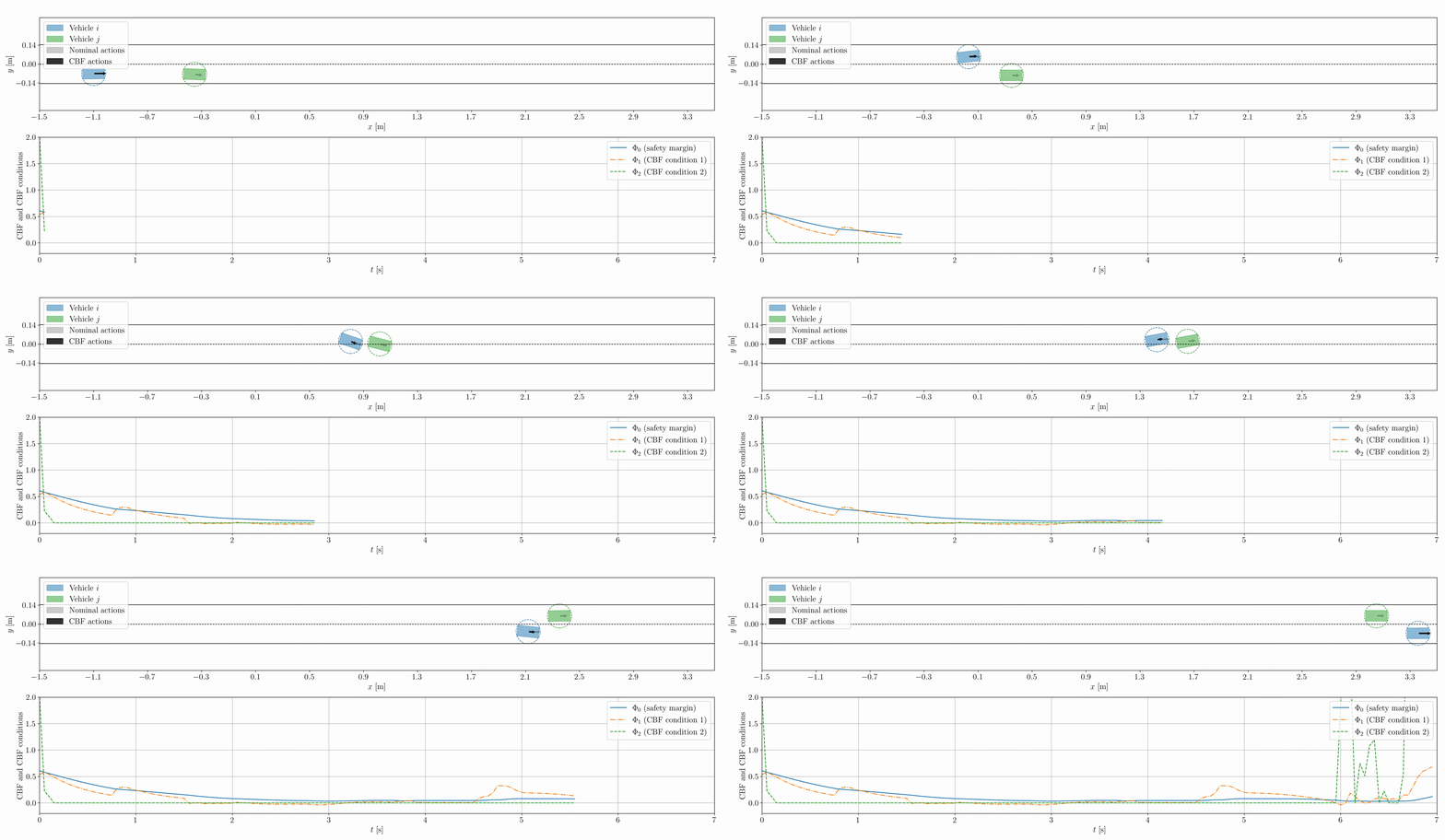
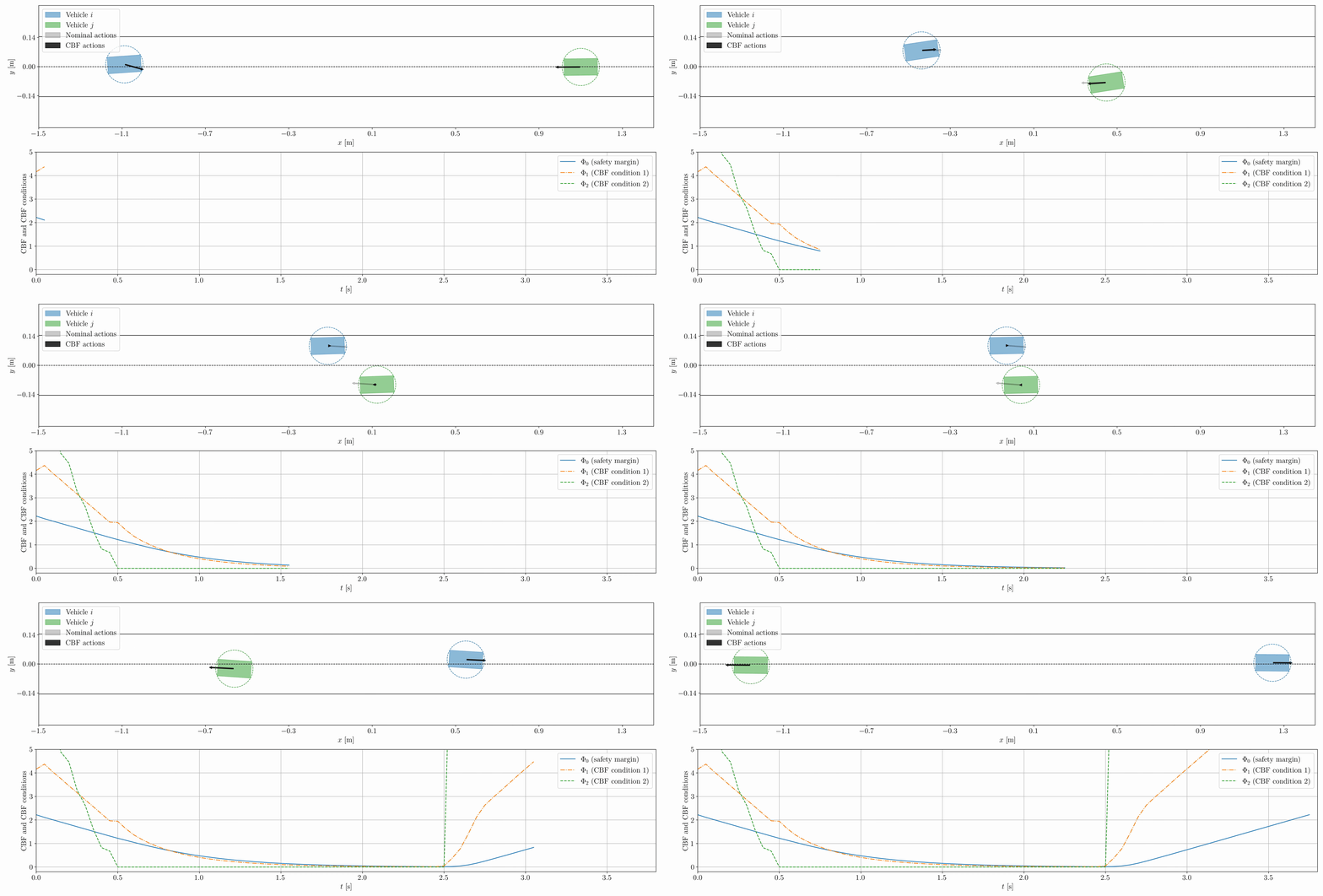
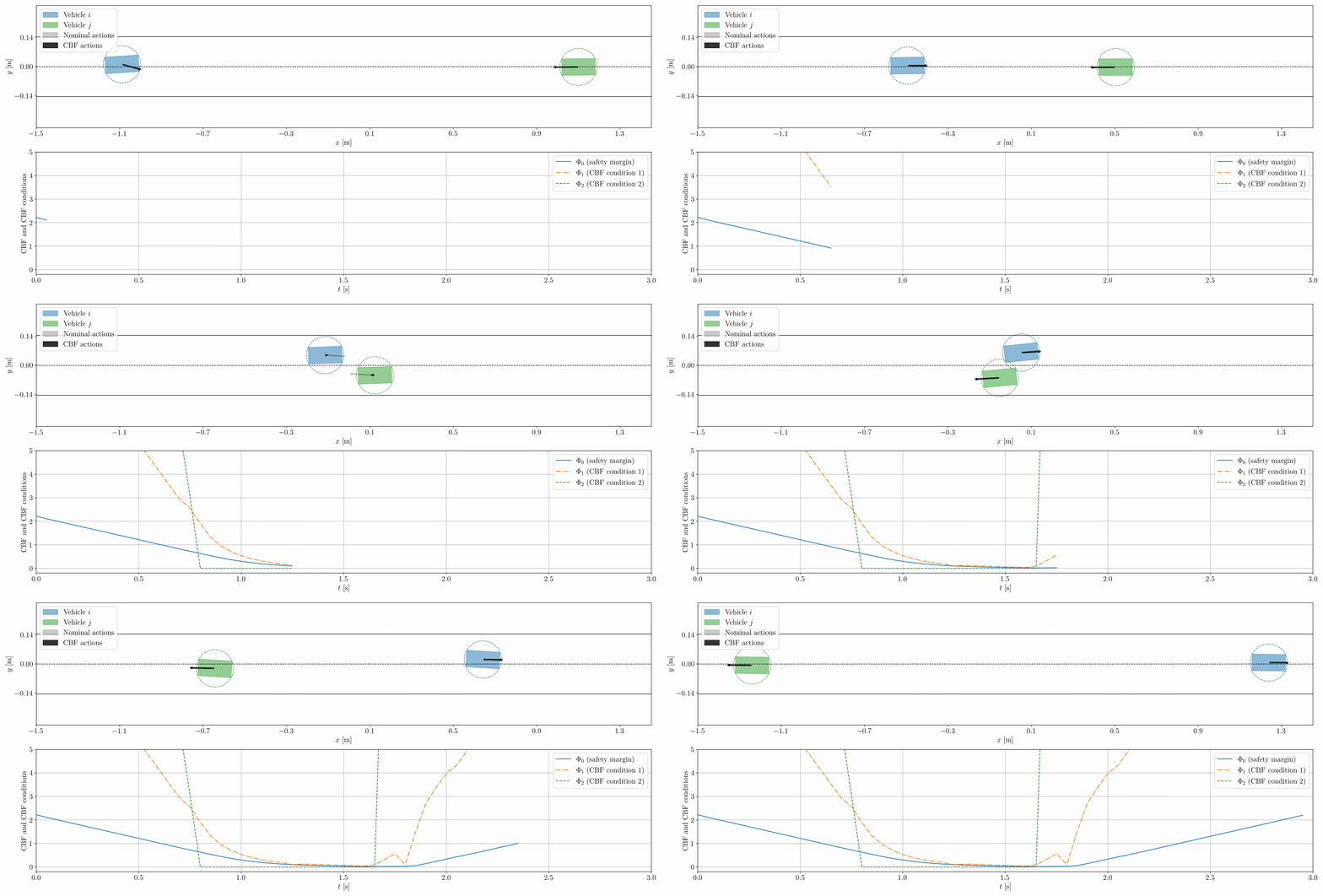
Figure 3: Demonstrating the safety and reduced conservatism of our MTV-based safety margin. In the overtaking scenario, while the traditional approach fails to overtake due to excessive conservatism (see (a)), ours succeeds (see (b)). Note that in the overtaking scenario, the slow-moving vehicle $j$ purposely obstructs vehicle $i$ three times to prevent it from overtaking. In the bypassing scenario, while the traditional approach requires a large lateral space due to excessive conservatism (see (c)), ours requires a smaller one (see (d)). See our MTV-Based CBF paper for more details.

|

|
Figure 4: Our TTCBF approach reduces the number of parameters to tune when handling constraints with high relative degrees. See our TTCBF paper for more details.
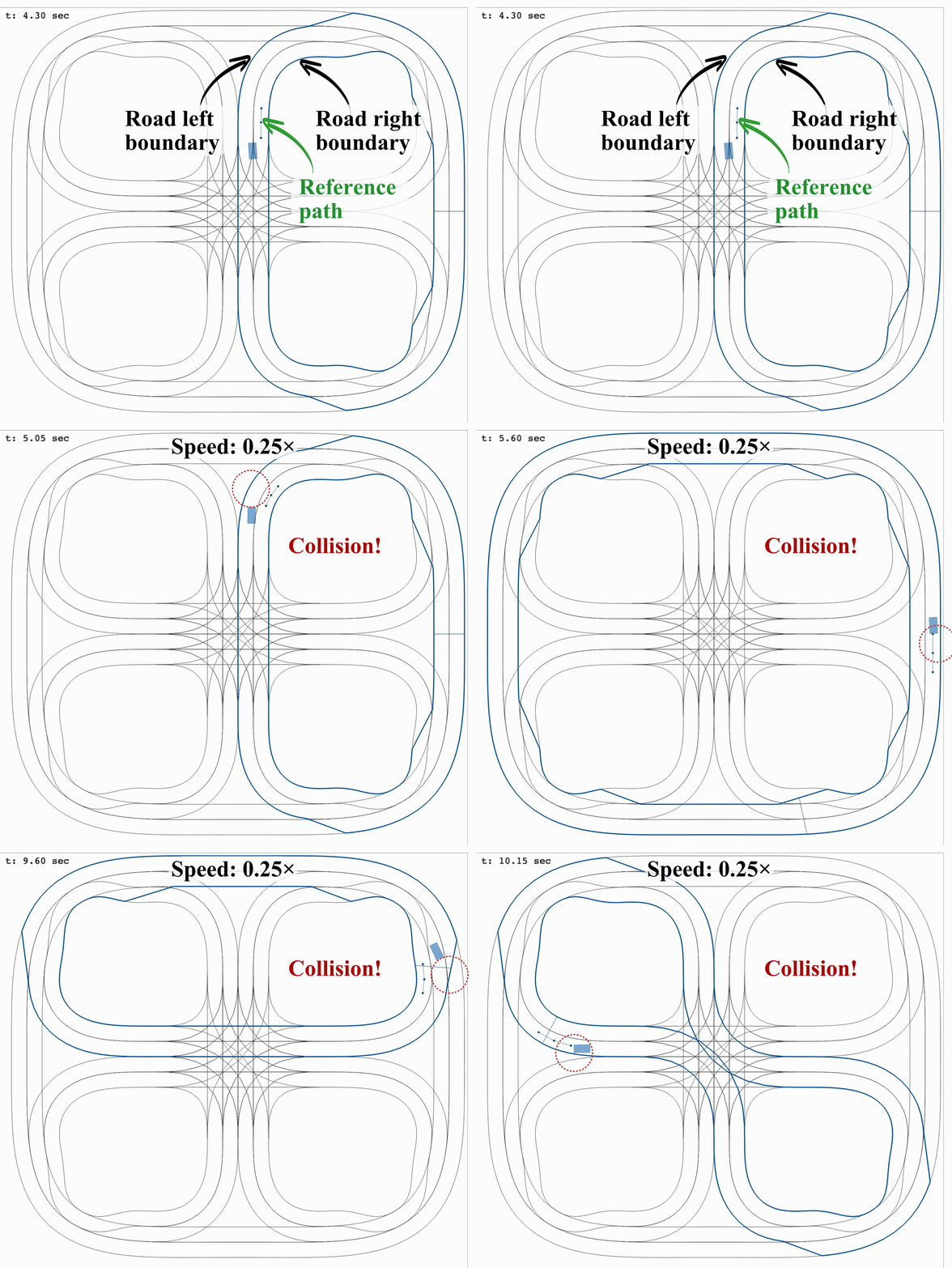
|
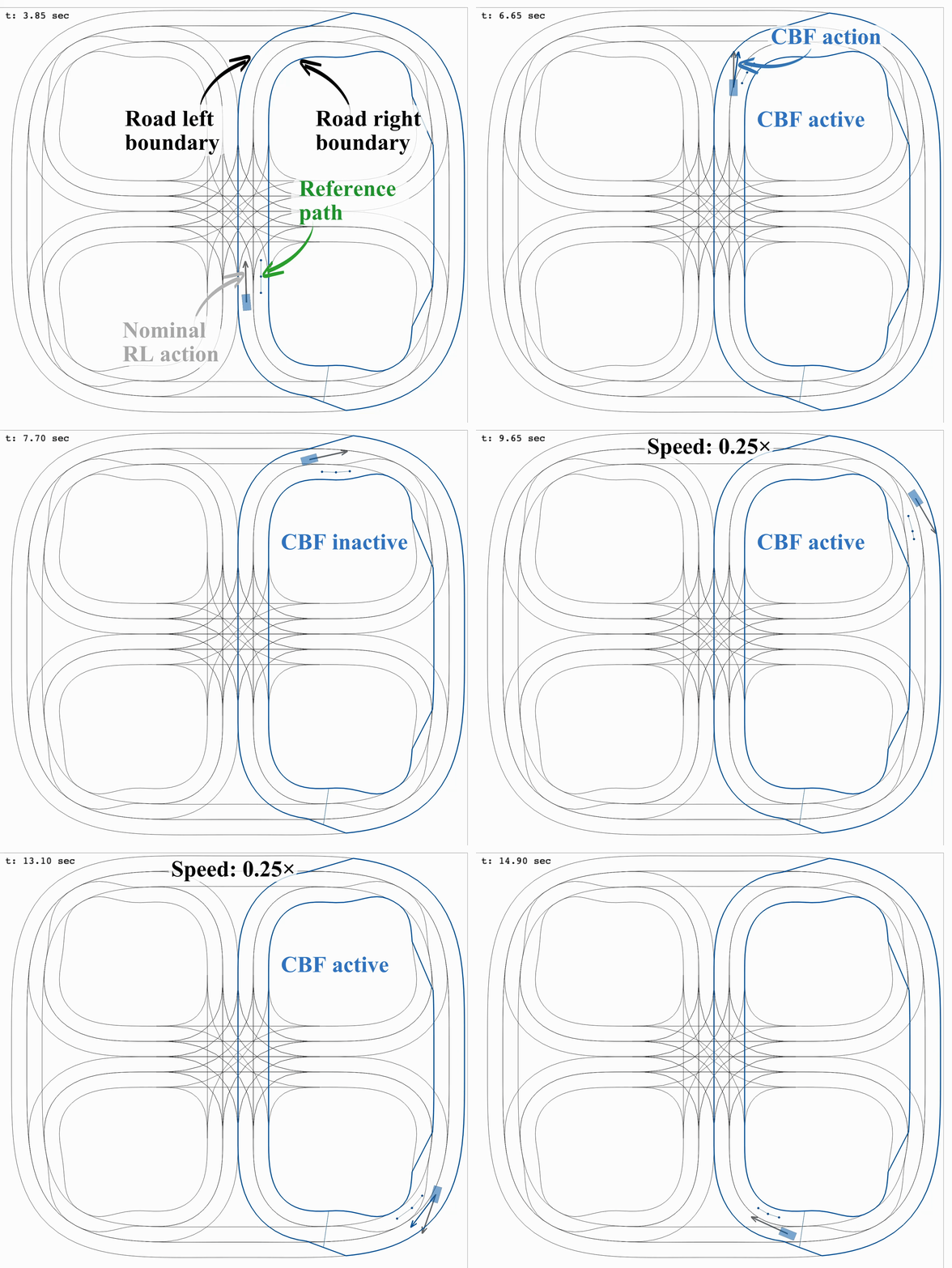
|
Figure 5: Demonstration of our safety filter for safety verification of an undertrained RL policy. See our CBF-Based Safety Filter Paper for more details.
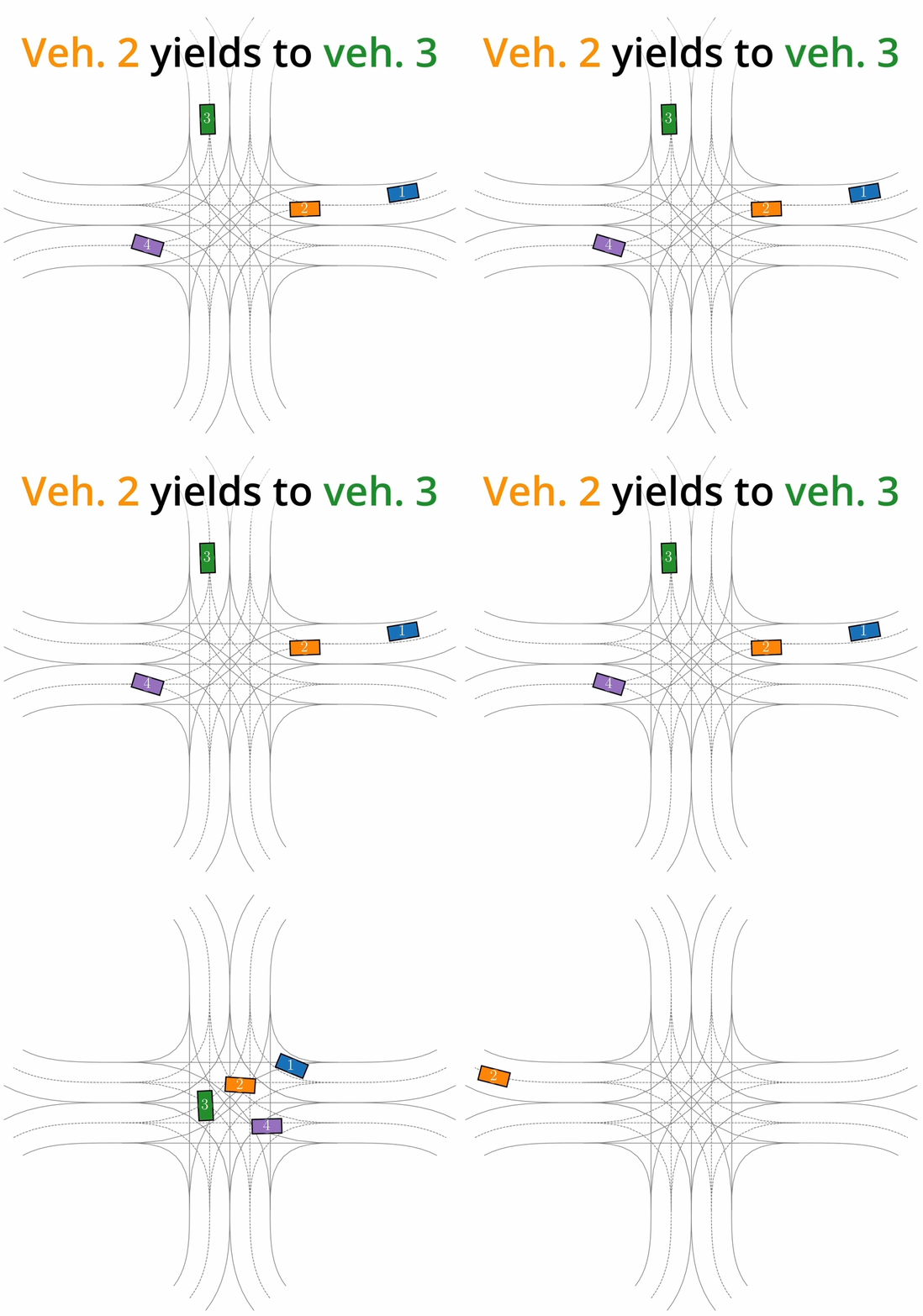
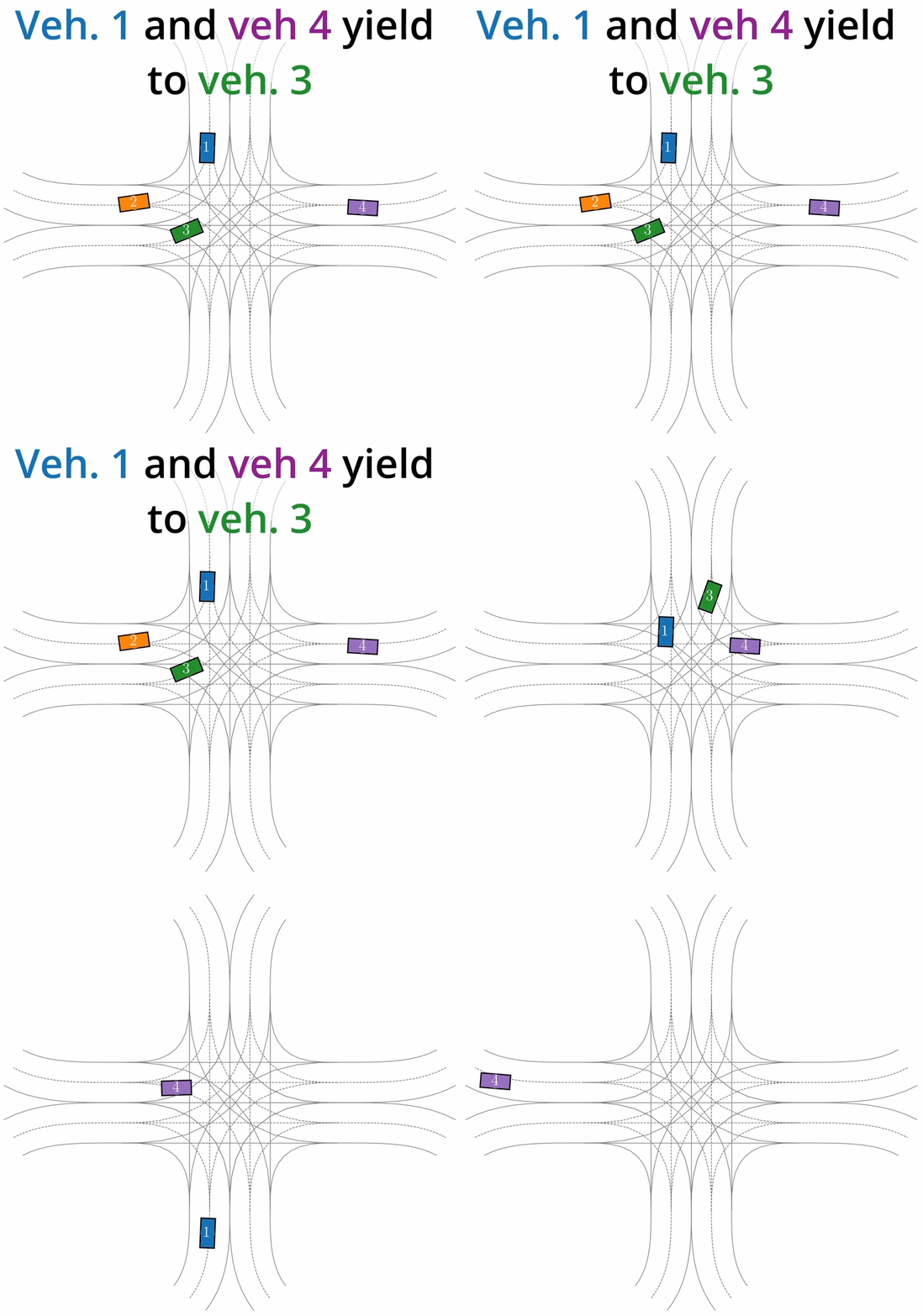
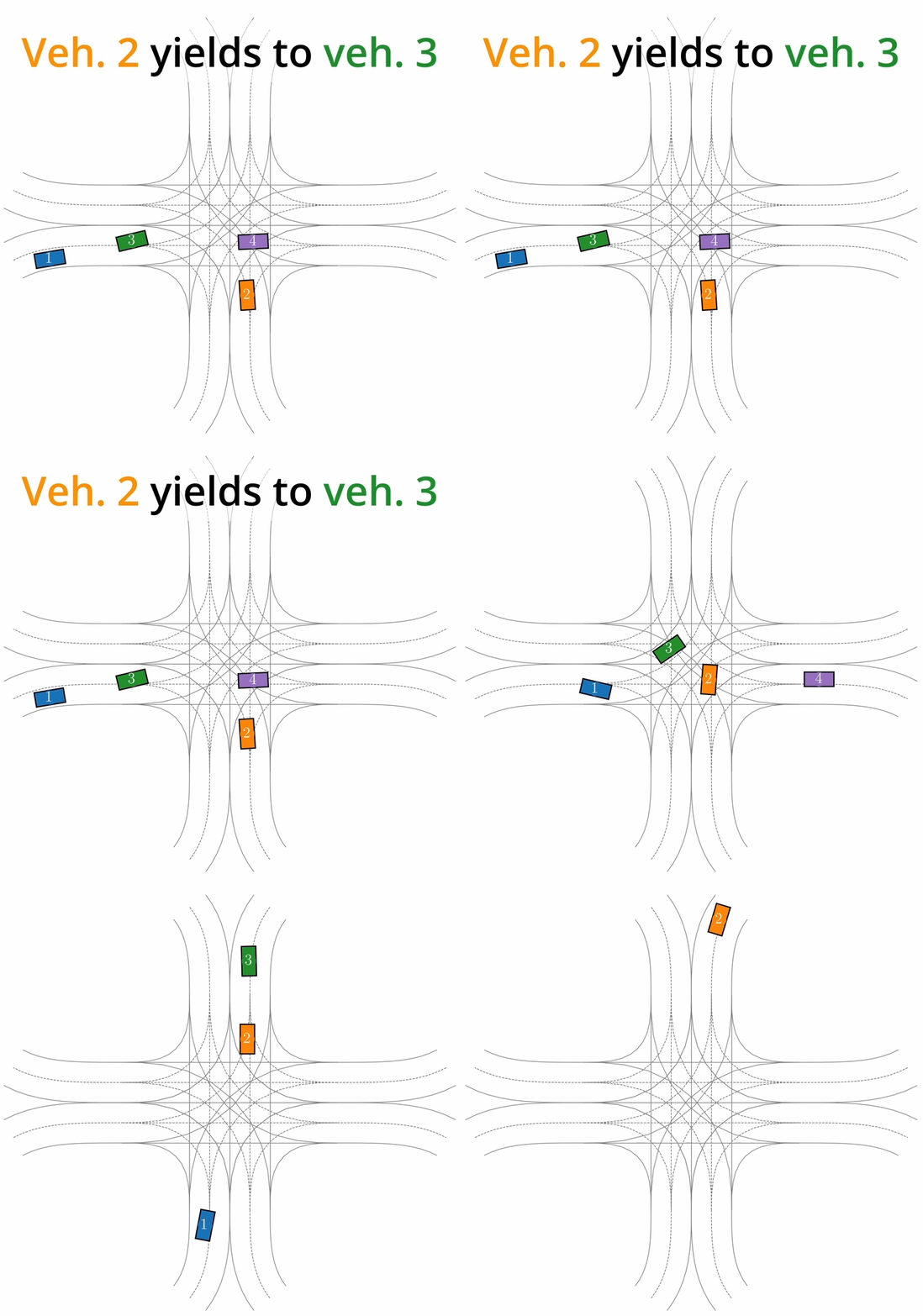
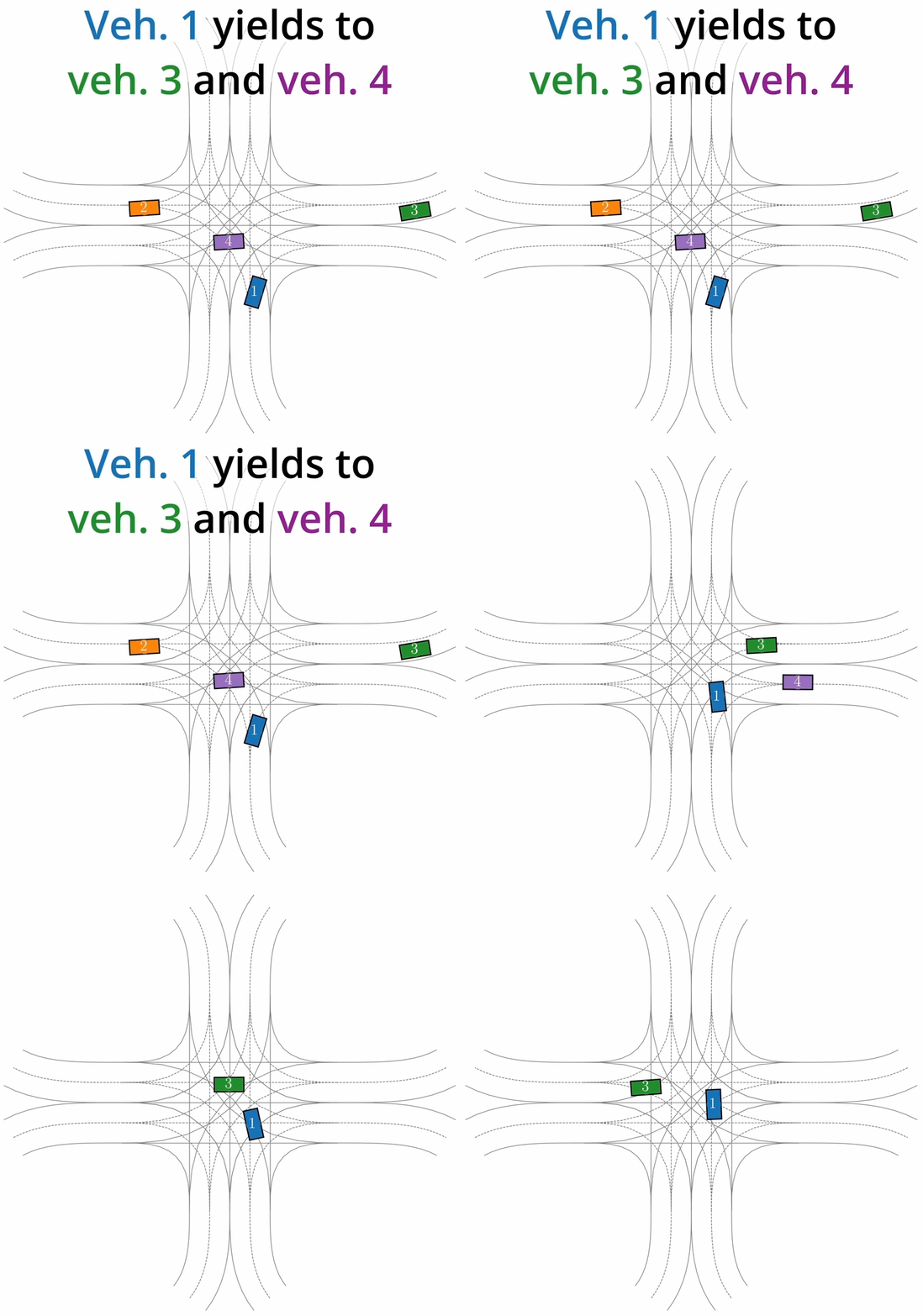
Figure 6: Demonstrating some representative interaction scenarios using the policy learned with our proposed CBF-informed method. See our CBF-Informed MARL for more details.
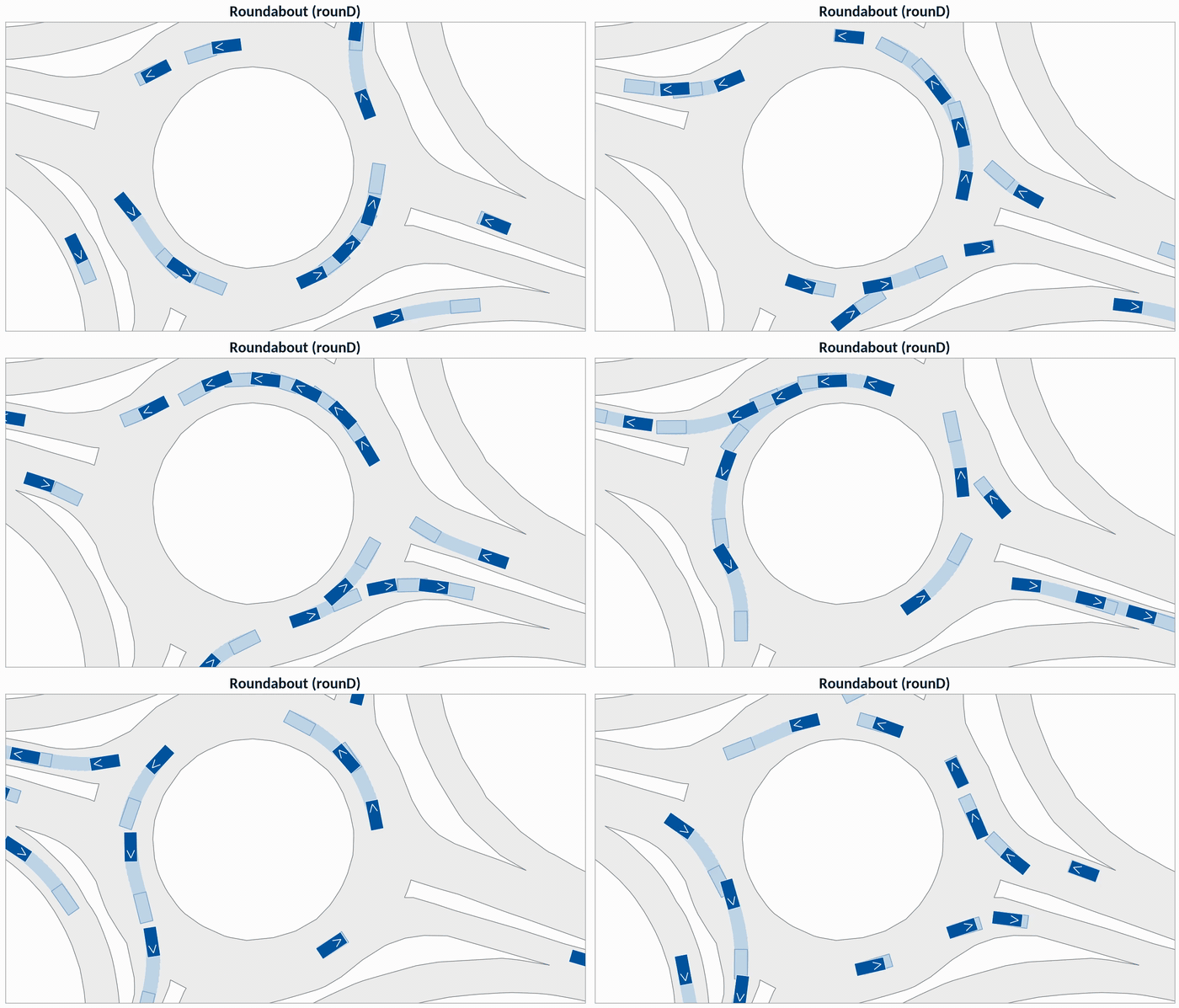
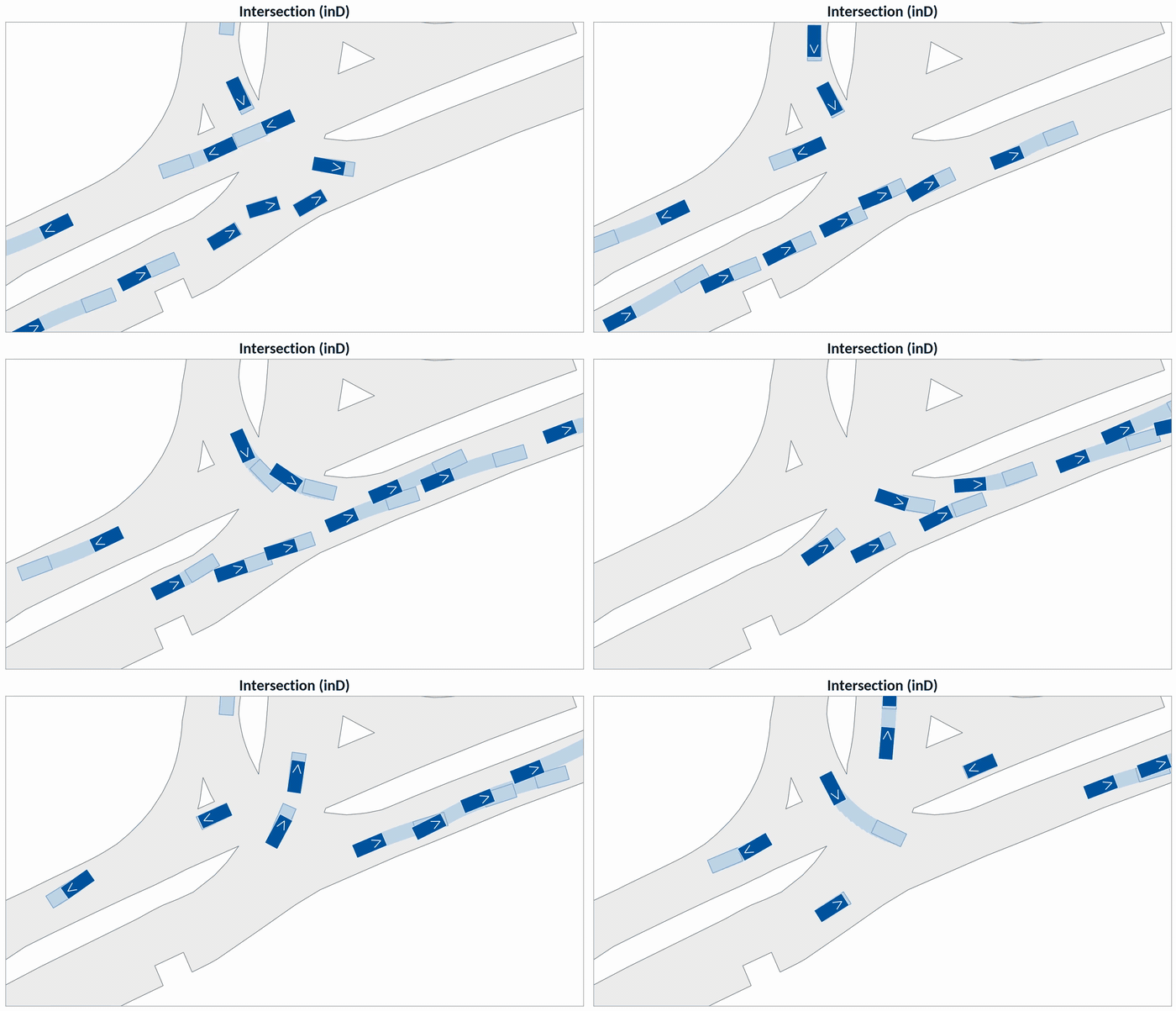
Figure 7: An unsafe MARL policy safeguarded by our BH-CBF filter on real-world maps of a roundabout and an intersection. Light trails: predictions of braking to a standstill along the route. Real time. See our BH-CBF paper and the project page for more details.
Install
SigmaRL supports Python 3.10 to 3.12 and is OS-independent. We recommend using a virtual environment. For example, with conda:
conda create -n env_sigmarl python=3.12
conda activate env_sigmarl
Install From Source
Clone the repository and install SigmaRL in editable mode:
git clone https://github.com/bassamlab/SigmaRL.git
cd SigmaRL
pip install -r requirements.txt
pip install -e .
Optional: Install Development Dependencies
If you plan to contribute to the repository, install the development dependencies as well:
pip install -e ".[dev]"
pre-commit install
Verify the Installation
Launch Python from the terminal:
python
Then run:
import sigmarl
print(sigmarl.__version__)
If the installation succeeds, Python will print the installed sigmarl version.
How to Use
Training
Run main_training.py. During training, any intermediate model that outperforms the currently saved model will be saved automatically. You can also retrain or refine a trained model by setting the parameter is_continue_train in sigmarl/config.json to true. The saved model will be loaded for a new training process.
sigmarl/scenarios/road_traffic.py defines the RL environment, including the observation and reward functions. It also provides an interactive interface that visualizes the environment. To open the interface, simply run this file. You can use the arrow keys to control agents and the Tab key to switch between agents. Adjust the parameter scenario_type to choose a scenario. All available scenarios are listed in the variable SCENARIOS in sigmarl/constants.py. Before training, we recommend using the interactive interface to check whether the environment behaves as expected.
Testing
After training, run main_testing.py to test your model. You may need to adjust the parameter path there to specify which folder contains the target model.
Note: If the path to a saved model changes, you need to update the value of where_to_save in the corresponding JSON file as well.
Customize Your Own Maps
We support maps customized in JOSM, an open-source editor for OpenStreetMap. Follow these steps (video tutorial available here):
- Install JOSM from the website given above.
- To get an empty map that can be customized, do the following:
- Open JOSM and click the green download button
- Zoom in and choose an arbitrary place on the map by drawing a rectangle. The area should be as empty as possible.
- Clicking "Download" will open a new window. There should be a notification that no data could be found; otherwise, choose the area again.
- Customize the map by drawing lines. Note that all lanes you draw are considered center lines. You do not need to draw left and right boundaries, since they will be determined automatically later by our script with a given width. The distance between the nodes of a lane should be approximately 0.1 meters. You can find useful hints and commands for customizing the map at Actions and Tools.
- Give each lane the key "lanes" and a unique value.
- Save the resulting .osm file and store it at
assets/maps. Give it a name. - Go to
utilities/constants.pyand create a new entry in the dictionary "SCENARIOS" for it. The key of the entry is the name of the map and the value is a dictionary, for which you should at least provide values for the keysmap_path,lane_width, andscale. You should also provide a list forreference_paths_ids(which paths exist?) and a dictionary forneighboring_lanelet_ids(which lanes are adjacent?). - Go to
utilities/parse_osm.py. Adjust the parametersscenario_typeand run it.
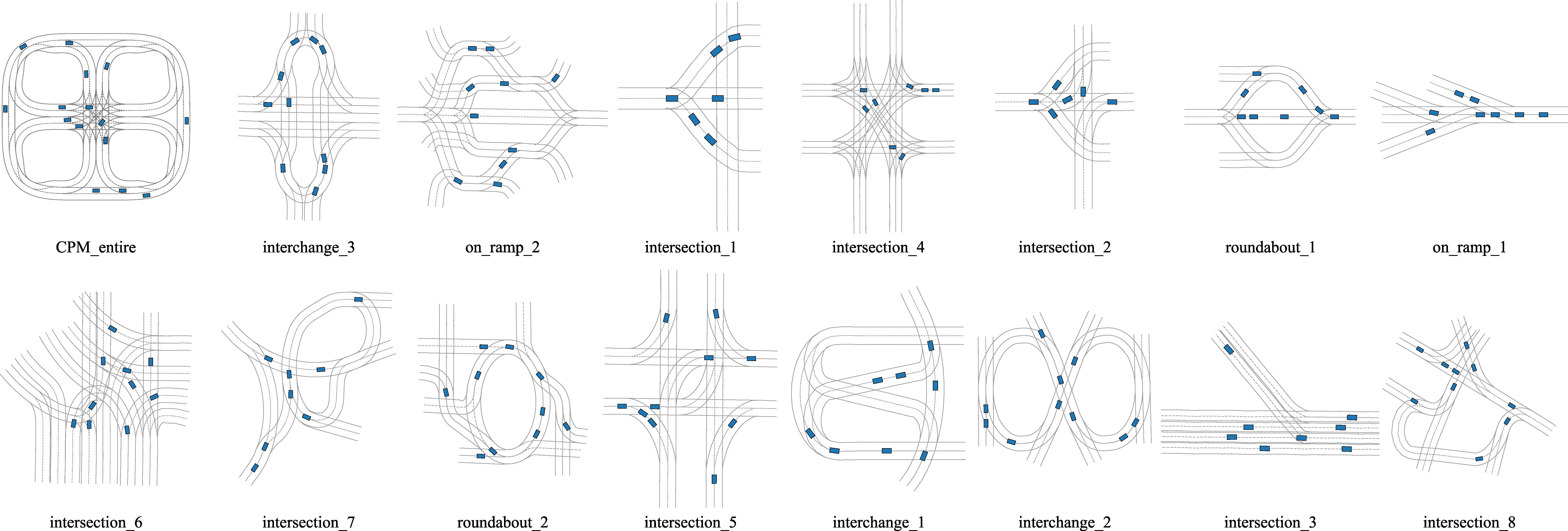
Figure 7: Overview of currently available maps.
Papers
If you use this repository, we would greatly appreciate it if you consider selectively citing our papers below.
1. SigmaRL


BibTeX
@inproceedings{xu2024sigmarl,
  title = {SigmaRL: A Sample-Efficient and Generalizable Multi-Agent Reinforcement Learning Framework for Motion Planning},
  booktitle = {2024 IEEE 27th International Conference on Intelligent Transportation Systems (ITSC)},
  author = {Xu, Jianye and Hu, Pan and Alrifaee, Bassam},
  year = {2024},
  pages = {768--775},
  issn = {2153-0017},
  doi = {10.1109/ITSC58415.2024.10919918}
}
Reproduce Experimental Results in the Paper:
- Check out the corresponding tag using
git checkout 1.2.0 - Go to this page and download the zip file
itsc24.zip. Unzip it, copy and paste the whole folder to thecheckpointsfolder at the root of this repository. The structure should be like this:root/checkpoints/itsc24/. - Run
sigmarl/evaluation_itsc24.py.
You can also run
testing_mappo_cavs.pyto intuitively evaluate the trained models. Adjust the parameterpaththere to specify which folder contains the target model. Note: The evaluation results you get may deviate from the paper since we have meticulously adjusted the performance metrics.- Check out the corresponding tag using
2. XP-MARL

BibTeX
@article{xu2024xp,
  title={{{XP-MARL}}: Auxiliary Prioritization in Multi-Agent Reinforcement Learning to Address Non-Stationarity},
  author={Xu, Jianye and Sobhy, Omar and Alrifaee, Bassam},
  journal={arXiv preprint arXiv:2409.11852},
  year={2024},
}
Reproduce Experimental Results in the Paper:
- Check out the corresponding tag using
git checkout 1.2.0 - Go to this page and download the zip file
icra25.zip. Unzip it, copy and paste the whole folder to thecheckpointsfolder at the root of this repository. The structure should be like this:root/checkpoints/icra25/. - Run
sigmarl/evaluation_icra25.py.
You can also run
testing_mappo_cavs.pyto intuitively evaluate the trained models. Adjust the parameterpaththere to specify which folder contains the target model.- Check out the corresponding tag using
3. MTV-Based CBF

BibTeX
@inproceedings{xu2025learningbased,
  title = {A Learning-Based Control Barrier Function for Car-Like Robots: Toward Less Conservative Collision Avoidance},
  booktitle = {2025 European Control Conference (ECC)},
  author = {Xu, Jianye and Alrifaee, Bassam},
  year = 2025,
  pages = {988--995},
  doi = {10.23919/ECC65951.2025.11187043}
}
Reproduce Experimental Results in the Paper:
- Go to this page and download the zip file
ecc25.zip. Unzip it, copy and paste the whole folder to thecheckpointsfolder at the root of this repository. The structure should be like this:root/checkpoints/ecc25/. - Run
sigmarl/evaluation_ecc25.py.
- Go to this page and download the zip file
4. Truncated Taylor CBF (TTCBF)

BibTeX
@article{xu2025highorder,
  title = {High-Order Control Barrier Functions: Insights and a Truncated Taylor-Based Formulation},
  author = {Xu, Jianye and Alrifaee, Bassam},
  journal = {arXiv preprint arXiv:2503.15014},
  year = {2025},
}
Reproduce Experimental Results in the Paper:
- Check out the corresponding tag using
git checkout 1.3.0 - Run
sigmarl/hocbf_taylor.py.
- Check out the corresponding tag using
5. CBF-Based Safety Filter

BibTeX
@inproceedings{xu2025realtime,
  title = {A Real-Time Control Barrier Function-Based Safety Filter for Motion Planning with Arbitrary Road Boundary Constraints},
  booktitle = {2025 IEEE 28th International Conference on Intelligent Transportation Systems (ITSC)},
  author = {Xu, Jianye and Che, Chang and Alrifaee, Bassam},
  year = 2025,
  pages = {2818--2825},
  doi = {10.1109/ITSC60802.2025.11423203}
}
Reproduce Experimental Results in the Paper:
- Check out the corresponding tag using
git checkout 1.4.0 - Go to this page and download the zip file
itsc25.zip. Unzip it, copy and paste the whole folder to thecheckpointsfolder at the root of this repository. The structure should be like this:root/checkpoints/itsc25/. - Run
sigmarl/evaluation_itsc25.py.
- Check out the corresponding tag using
6. CPM Lab Benchmark
BibTeX
@article{beerwerth2026zeroshot,
  title = {Zero-Shot MARL Benchmark in the Cyber-Physical Mobility Lab},
  author = {Beerwerth, Julius and Xu, Jianye and Sch{\"a}fer, Simon and Belderink, Fynn and Alrifaee, Bassam},
  year = 2026,
  journal = {at - Automatisierungstechnik},
  volume = {74},
  number = {5},
  pages = {376--385},
  publisher = {De Gruyter},
  doi = {10.1515/auto-2025-0057},
  copyright = {De Gruyter expressly reserves the right to use all content for commercial text and data mining within the meaning of Section 44b of the German Copyright Act.}
}
Reproduce Experimental Results of the SigmaRL Simulation in the Paper:
- Check out the corresponding tag using
git checkout 1.5.0 - Go to this page and download the zip file
at25.zip. Unzip it, copy and paste the whole folder to thecheckpointsfolder at the root of this repository. The structure should be like this:root/checkpoints/at25/. - Run
sigmarl/eva_at25/run_models_parallel.pyto evaluate the downloaded models. The evaluation results will be saved automatically.- This script requires Python parallel workers.
- Alternatively, you can run
sigmarl/eva_at25/run_models.pyif you do not want to use parallel workers.
- After the evaluation, run
sigmarl/eva_at25/marl_aggregated_evaluation.pyto analyze the evaluation results and obtain the performance metrics.
- Check out the corresponding tag using
See additional documentation here.
7. CBF-Informed MARL

BibTeX
@inproceedings{xu2026beyond,
  title = {Beyond Safety Filtering: Control Barrier Function-Informed Reinforcement Learning for Connected and Automated Vehicles},
  booktitle = {2026 IEEE 29th International Conference on Intelligent Transportation Systems (ITSC), in press},
  author = {Xu, Jianye and Alrifaee, Bassam},
  year = {2026},
}
Reproduce Experimental Results in the Paper:
- Check out the corresponding tag using
git checkout 1.6.0 - Go to this page and download the zip file
itsc26.zip. Unzip it, copy and paste the whole folder to thecheckpointsfolder at the root of this repository. The structure should be like this:root/checkpoints/itsc26/. - Run
sigmarl/evaluation_itsc26.py.
- Check out the corresponding tag using
8. BH-CBF Safeguard for MARL


BibTeX
@article{xu2026safeguarding,
  title={Safeguarding Multi-Agent Reinforcement Learning for Connected and Automated Vehicles with Recursively Feasible Control Barrier Functions},
  author={Xu, Jianye and Sayed, Yousef and Alrifaee, Bassam},
  journal={arXiv preprint arXiv:2611.04957},
  year={2026},
}
Reproduce Experimental Results in the Paper:
- Check out the corresponding tag using
git checkout 1.7.0 - Download
tits26_stage1_pretrain.zipandtits26_stage3_finetune.zip. Unzip both into thecheckpointsfolder at the root of this repository. The structure should be like this:root/checkpoints/tits26/stage1_pretrain/androot/checkpoints/tits26/stage3_finetune/. - Optional:
tits26_full.zip(about 920 MB) holds the same models with the policies of every saved training iteration. It unzips to the same folders. - The rounD and inD datasets, including their maps, may not be redistributed. Request them from levelXdata (rounD, inD) and generate the two maps of the paper with
python scripts/lanelet2_maps/fix_lanelet_map.py --maps round_location0 ind_location4 --round_dir <path>/rounD_v1.0 --ind_dir <path>/inD_v1.1(seedocs/lanelet2_maps.md). The comparison with human drivers (Stage 4) also needs the rounD recordings. - See
sigmarl/evaluation_tits26/README.mdfor the scripts of each evaluation stage, the names of the filters in the code, and example commands.
- Check out the corresponding tag using
TODOs
- Improve safety
- Integrating Control Barrier Functions (CBFs)
- Proof of concept with two agents (see the MTV-Based CBF paper here)
- High-Order CBFs (see the TTCBF paper here)
- CBF-certified safe RL for collision avoidance with road boundaries (see the CBF-Based Safety Filter paper here)
- CBF-informed reward design for safe MARL at an intersection (see the CBF-Informed MARL paper here)
- Recursively feasible CBF for safe MARL (see the BH-CBF Safeguard for MARL paper here)
- Integrating Control Barrier Functions (CBFs)
- Address non-stationarity
- Integrating prioritization (see the XP-MARL paper here)
- Misc
- OpenStreetMap support (see guidance here)
- Contribute our CPM scenario as a MARL benchmark scenario in VMAS (see news here)
- Update to the latest versions of Torch, TorchRL, and VMAS
- Support Python 3.11+
- Deploy in the real world (see the CPM Lab Benchmark paper here)
- Consider heterogeneous agents in CBF (see the BH-CBF Safeguard for MARL paper here)
- Consider heterogeneous agents in MARL
- Consider mixed traffic
Acknowledgments
This research was supported by the Bundesministerium für Digitales und Verkehr (German Federal Ministry for Digital and Transport) within the project "Harmonizing Mobility" (grant number 19FS2035A).