
SciSharp/Keras.NET
SciSharp/Keras.NET has 616 GitHub stars and 129 forks. GitHot measured -1 stars in 24 hours. Last checked 2026-11-20 07:01 UTC. Last push 2023-04-24.
实测星标增长
- 24小时
- -1
- 7天
- 正在收集历史
- 15天
- 正在收集历史
- 1个月
- 正在收集历史
各周期内的星标净变化,周期相互重叠,并非每日新增。缺失的测量保持空白。星标代表关注度,不代表软件质量。
关于
Keras.NET is a high-level neural networks API for C# and F#, with Python Binding and capable of running on top of TensorFlow, CNTK, or Theano.
机器学习README.md
原文

Keras.NET is a high-level neural networks API for C# and F# via a Python binding and capable of running on top of TensorFlow, CNTK, or Theano. It was developed with a focus on enabling fast experimentation. Being able to go from idea to result with the least possible delay is key to doing good research.
Use Keras if you need a deep learning library that:
Allows for easy and fast prototyping (through user friendliness, modularity, and extensibility).
Supports both convolutional networks and recurrent networks, as well as combinations of the two.
Runs seamlessly on CPU and GPU.
Keras.NET is using:
Prerequisite
Python 3.7 or 3.8, Link: https://www.python.org/downloads/
Install keras, numpy and one of the backends (Tensorflow/CNTK/Theano). Keras is now bundled with Tensorflow 2.0, so the easiest way to install Keras and Tensorflow at the same time is to simply install Tensorflow 2.0.
Nuget
Install from nuget: https://www.nuget.org/packages/Keras.NET
dotnet add package Keras.NET
Example with XOR sample (C#)
//Load train data
NDarray x = np.array(new float[,] { { 0, 0 }, { 0, 1 }, { 1, 0 }, { 1, 1 } });
NDarray y = np.array(new float[] { 0, 1, 1, 0 });

//Build sequential model
var model = new Sequential();
model.Add(new Dense(32, activation: "relu", input_shape: new Shape(2)));
model.Add(new Dense(64, activation: "relu"));
model.Add(new Dense(1, activation: "sigmoid"));

//Compile and train
model.Compile(optimizer:"sgd", loss:"binary_crossentropy", metrics: new string[] { "accuracy" });
model.Fit(x, y, batch_size: 2, epochs: 1000, verbose: 1);

//Save model and weights
string json = model.ToJson();
File.WriteAllText("model.json", json);
model.SaveWeight("model.h5");

//Load model and weight
var loaded_model = Sequential.ModelFromJson(File.ReadAllText("model.json"));
loaded_model.LoadWeight("model.h5");
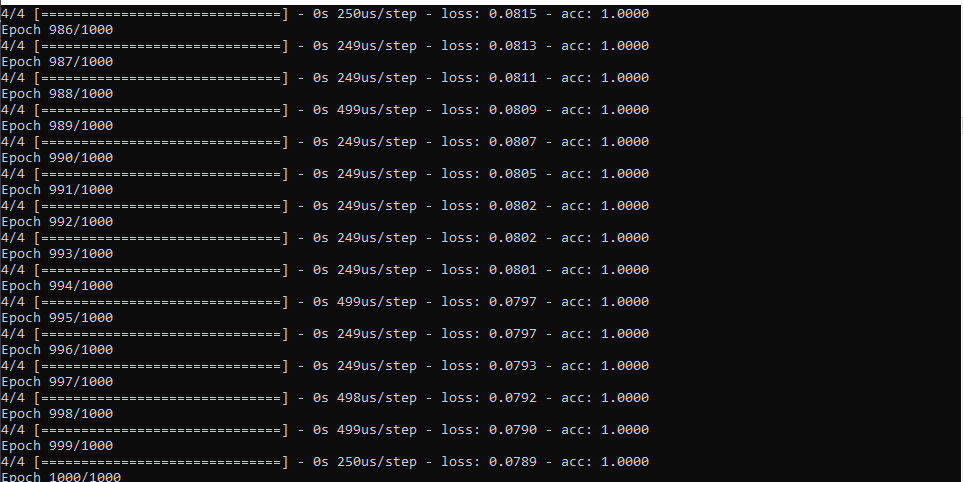
Output:
MNIST CNN Example (C#)
Python example taken from: https://keras.io/examples/mnist_cnn/
int batch_size = 128;
int num_classes = 10;
int epochs = 12;

// input image dimensions
int img_rows = 28, img_cols = 28;

Shape input_shape = null;

// the data, split between train and test sets
var ((x_train, y_train), (x_test, y_test)) = MNIST.LoadData();

if(Backend.ImageDataFormat() == "channels_first")
{
    x_train = x_train.reshape(x_train.shape[0], 1, img_rows, img_cols);
    x_test = x_test.reshape(x_test.shape[0], 1, img_rows, img_cols);
    input_shape = (1, img_rows, img_cols);
}
else
{
    x_train = x_train.reshape(x_train.shape[0], img_rows, img_cols, 1);
    x_test = x_test.reshape(x_test.shape[0], img_rows, img_cols, 1);
    input_shape = (img_rows, img_cols, 1);
}

x_train = x_train.astype(np.float32);
x_test = x_test.astype(np.float32);
x_train /= 255;
x_test /= 255;
Console.WriteLine($"x_train shape: {x_train.shape}");
Console.WriteLine($"{x_train.shape[0]} train samples");
Console.WriteLine($"{x_test.shape[0]} test samples");

// convert class vectors to binary class matrices
y_train = Util.ToCategorical(y_train, num_classes);
y_test = Util.ToCategorical(y_test, num_classes);

// Build CNN model
var model = new Sequential();
model.Add(new Conv2D(32, kernel_size: (3, 3).ToTuple(),
                        activation: "relu",
                        input_shape: input_shape));
model.Add(new Conv2D(64, (3, 3).ToTuple(), activation: "relu"));
model.Add(new MaxPooling2D(pool_size: (2, 2).ToTuple()));
model.Add(new Dropout(0.25));
model.Add(new Flatten());
model.Add(new Dense(128, activation: "relu"));
model.Add(new Dropout(0.5));
model.Add(new Dense(num_classes, activation: "softmax"));

model.Compile(loss: "categorical_crossentropy",
    optimizer: new Adadelta(), metrics: new string[] { "accuracy" });

model.Fit(x_train, y_train,
            batch_size: batch_size,
            epochs: epochs,
            verbose: 1,
            validation_data: new NDarray[] { x_test, y_test });
var score = model.Evaluate(x_test, y_test, verbose: 0);
Console.WriteLine($"Test loss: {score[0]}");
Console.WriteLine($"Test accuracy: {score[1]}");
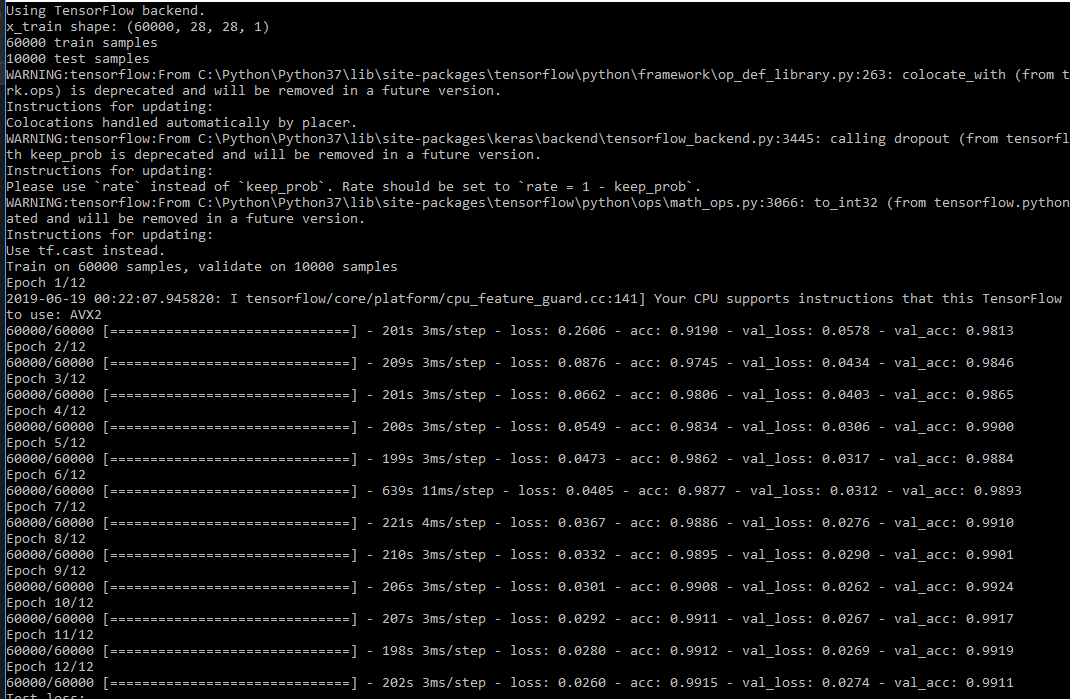
Output
Reached 98% accuracy within 3 epoches.
Documentation
https://scisharp.github.io/Keras.NET/
