
hughperkins/VeriGPU
Sobre
GPU de código aberto em Verilog, baseado livremente na ISA RISC-V
Aprendizado de máquinaCrescimento medido de estrelas
- em 24 h
- +21
- em 7 dias
- +36
- em 15 dias
- +40
- em 1 mês
- Coletando histórico
Variações líquidas em períodos sobrepostos, não totais diários. Medições ausentes ficam em branco. Estrelas indicam interesse, não qualidade.
README.md
OriginalOpenSource GPU
Build an opensource GPU, targeting ASIC tape-out, for machine learning ("ML"). Hopefully, can get it to work with the PyTorch deep learning framework.
Vision
Create an opensource GPU for machine learning.
I don't actually intend to tape this out myself, but I intend to do what I can to verify somehow that tape-out would work ok, timings ok, etc.
Intend to implement a HIP API, that is compatible with pytorch machine learning framework. Open to provision of other APIs, such as SYCL or NVIDIA® CUDA™.
Internal GPU Core ISA loosely compliant with RISC-V ISA. Where RISC-V conflicts with designing for a GPU setting, we break with RISC-V.
Intend to keep the cores very focused on ML. For example, brain floating point ("BF16") throughout, to keep core die area low. This should keep the per-core cost low. Similarly, Intend to implement only few float operations critical to ML, such as exp, log, tanh, sqrt.
Architecture
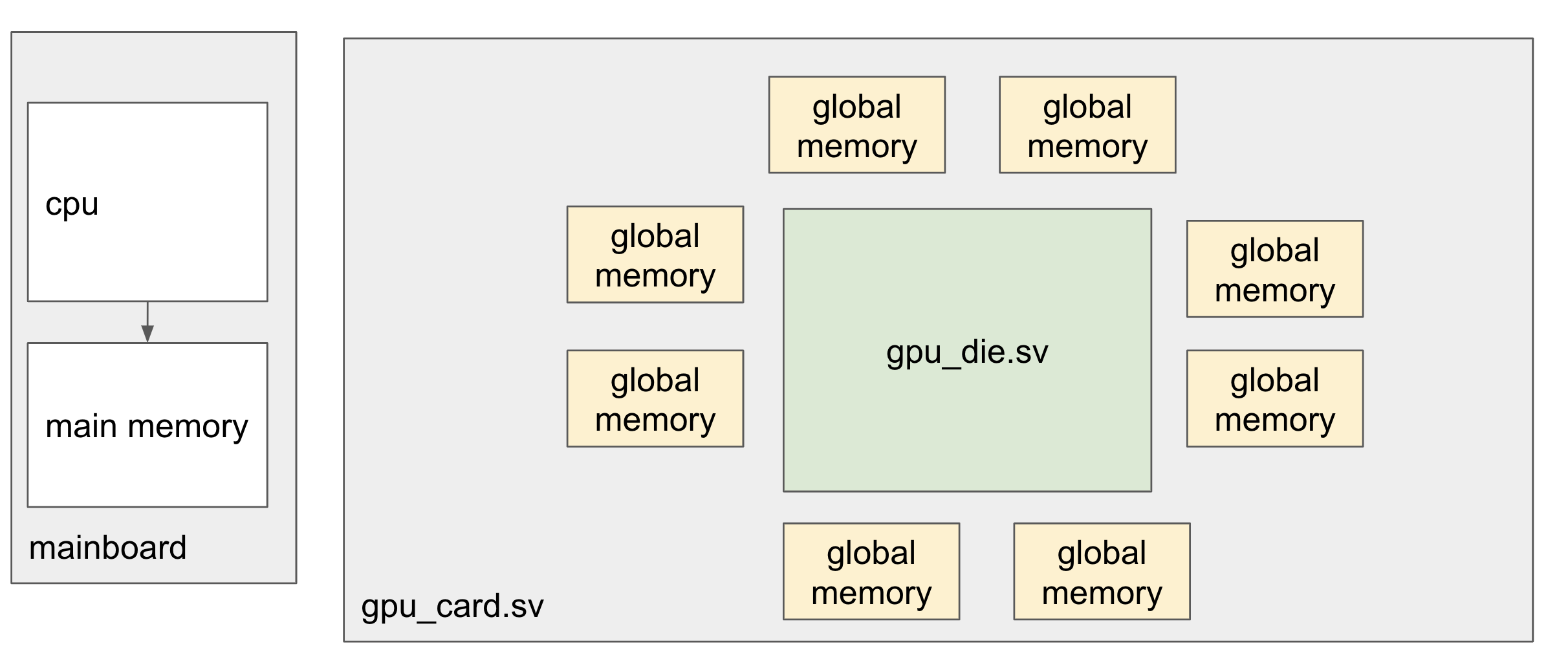
Big Picture:
GPU Die Architecture:

Single Core:

Single-source compilation and runtime

Simulation
Single-source C++
Single-source C++:

Compile the GPU and runtime:
- CMakeLists.txt: src/gpu_runtime/CMakeLists.txt
- GPU runtime: src/gpu_runtime/gpu_runtime.cpp
- GPU controller: src/gpu_controller.sv
- Single GPU RISC-V core: src/core.sv

Compile the single-source C++, and run:

Planning
What direction are we thinking of going in? What works already? See:
Tech details
Our assembly language implementation and progress. Design of GPU memory, registers, and so on. See:
Verification
If we want to tape-out, we need solid verification. Read more at:
Metrics
we want the GPU to run quickly, and to use minimal die area. Read how we measure timings and area at:
Explore projetos relacionados
Carregando…