
zalandoresearch/pytorch-ts
zalandoresearch/pytorch-ts has 1,372 GitHub stars and 197 forks. GitHot measured 0 stars in 24 hours, 0 in 7 days, and +1 in 15 days. Last checked 2026-11-12 04:02 UTC. Last push 2024-06-14.
PyTorch based Probabilistic Time Series forecasting framework based on GluonTS backend
Measured star growth
- in 24h
- 0
- in 7 days
- 0
- in 15 days
- +1
- in 1 month
- Collecting history
Net star changes over overlapping periods, not daily totals. Missing measurements are left blank. Stars measure attention, not software quality.
README.md
OriginalPyTorchTS
PyTorchTS is a PyTorch Probabilistic Time Series forecasting framework which provides state of the art PyTorch time series models by utilizing GluonTS as its back-end API and for loading, transforming and back-testing time series data sets.
Installation
$ pip3 install pytorchts
Quick start
Here we highlight the the API changes via the GluonTS README.
import matplotlib.pyplot as plt
import pandas as pd
import torch

from gluonts.dataset.common import ListDataset
from gluonts.dataset.util import to_pandas

from pts.model.deepar import DeepAREstimator
from pts import Trainer
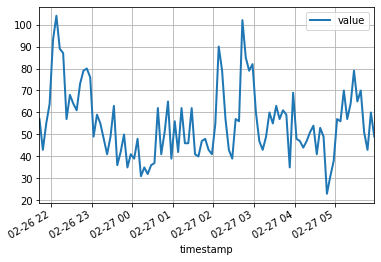
This simple example illustrates how to train a model on some data, and then use it to make predictions. As a first step, we need to collect some data: in this example we will use the volume of tweets mentioning the AMZN ticker symbol.
url = "https://raw.githubusercontent.com/numenta/NAB/master/data/realTweets/Twitter_volume_AMZN.csv"
df = pd.read_csv(url, header=0, index_col=0, parse_dates=True)
The first 100 data points look like follows:
df[:100].plot(linewidth=2)
plt.grid(which='both')
plt.show()
We can now prepare a training dataset for our model to train on. Datasets are essentially iterable collections of dictionaries: each dictionary represents a time series with possibly associated features. For this example, we only have one entry, specified by the "start" field which is the timestamp of the first data point, and the "target" field containing time series data. For training, we will use data up to midnight on April 5th, 2015.
training_data = ListDataset(
    [{"start": df.index[0], "target": df.value[:"2015-04-05 00:00:00"]}],
    freq = "5min"
)
A forecasting model is a predictor object. One way of obtaining predictors is by training a correspondent estimator. Instantiating an estimator requires specifying the frequency of the time series that it will handle, as well as the number of time steps to predict. In our example we're using 5 minutes data, so req="5min", and we will train a model to predict the next hour, so prediction_length=12. The input to the model will be a vector of size input_size=43 at each time point. We also specify some minimal training options in particular training on a device for epoch=10.
device = torch.device("cuda" if torch.cuda.is_available() else "cpu")

estimator = DeepAREstimator(freq="5min",
                            prediction_length=12,
                            input_size=19,
                            trainer=Trainer(epochs=10,
                                            device=device))
predictor = estimator.train(training_data=training_data, num_workers=4)
    45it [00:01, 37.60it/s, avg_epoch_loss=4.64, epoch=0]
    48it [00:01, 39.56it/s, avg_epoch_loss=4.2, epoch=1]
    45it [00:01, 38.11it/s, avg_epoch_loss=4.1, epoch=2]
    43it [00:01, 36.29it/s, avg_epoch_loss=4.05, epoch=3]
    44it [00:01, 35.98it/s, avg_epoch_loss=4.03, epoch=4]
    48it [00:01, 39.48it/s, avg_epoch_loss=4.01, epoch=5]
    48it [00:01, 38.65it/s, avg_epoch_loss=4, epoch=6]
    46it [00:01, 37.12it/s, avg_epoch_loss=3.99, epoch=7]
    48it [00:01, 38.86it/s, avg_epoch_loss=3.98, epoch=8]
    48it [00:01, 39.49it/s, avg_epoch_loss=3.97, epoch=9]
During training, useful information about the progress will be displayed. To get a full overview of the available options, please refer to the source code of DeepAREstimator (or other estimators) and Trainer.
We're now ready to make predictions: we will forecast the hour following the midnight on April 15th, 2015.
test_data = ListDataset(
    [{"start": df.index[0], "target": df.value[:"2015-04-15 00:00:00"]}],
    freq = "5min"
)
for test_entry, forecast in zip(test_data, predictor.predict(test_data)):
    to_pandas(test_entry)[-60:].plot(linewidth=2)
    forecast.plot(color='g', prediction_intervals=[50.0, 90.0])
plt.grid(which='both')
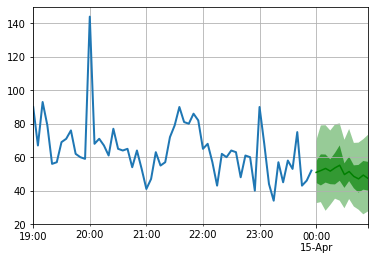
Note that the forecast is displayed in terms of a probability distribution: the shaded areas represent the 50% and 90% prediction intervals, respectively, centered around the median (dark green line).
Development
pip install -e .
pytest test
Citing
To cite this repository:
@software{pytorchgithub,
    author = {Kashif Rasul},
    title = {{P}yTorch{TS}},
    url = {https://github.com/zalandoresearch/pytorch-ts},
    version = {0.6.x},
    year = {2021},
}
Scientific Article
We have implemented the following model using this framework:
@INPROCEEDINGS{rasul2020tempflow,
  author = {Kashif Rasul and  Abdul-Saboor Sheikh and  Ingmar Schuster and Urs Bergmann and Roland Vollgraf},
  title = {{M}ultivariate {P}robabilistic {T}ime {S}eries {F}orecasting via {C}onditioned {N}ormalizing {F}lows},
  year = {2021},
  url = {https://openreview.net/forum?id=WiGQBFuVRv},
  booktitle = {International Conference on Learning Representations 2021},
}
@InProceedings{pmlr-v139-rasul21a,
  title = 	 {{A}utoregressive {D}enoising {D}iffusion {M}odels for {M}ultivariate {P}robabilistic {T}ime {S}eries {F}orecasting},
  author =       {Rasul, Kashif and Seward, Calvin and Schuster, Ingmar and Vollgraf, Roland},
  booktitle = 	 {Proceedings of the 38th International Conference on Machine Learning},
  pages = 	 {8857--8868},
  year = 	 {2021},
  editor = 	 {Meila, Marina and Zhang, Tong},
  volume = 	 {139},
  series = 	 {Proceedings of Machine Learning Research},
  month = 	 {18--24 Jul},
  publisher =    {PMLR},
  pdf = 	 {http://proceedings.mlr.press/v139/rasul21a/rasul21a.pdf},
  url = 	 {http://proceedings.mlr.press/v139/rasul21a.html},
}
@misc{gouttes2021probabilistic,
      title={{P}robabilistic {T}ime {S}eries {F}orecasting with {I}mplicit {Q}uantile {N}etworks},
      author={Adèle Gouttes and Kashif Rasul and Mateusz Koren and Johannes Stephan and Tofigh Naghibi},
      year={2021},
      eprint={2107.03743},
      archivePrefix={arXiv},
      primaryClass={cs.LG}
}
Explore related projects
tensorflow/tensorflow
An Open Source Machine Learning Framework for Everyone
201,505 starshuggingface/transformers
🤗 Transformers: the model-definition framework for state-of-the-art machine learning models in text, vision, audio, and multimodal models, for both inference and training.
168,815 starsAUTOMATIC1111/stable-diffusion-webui
Stable Diffusion web UI
165,289 starsComfy-Org/ComfyUI
The most powerful and modular diffusion model GUI, api and backend with a graph/nodes interface. The fastest local inference engine in the world.
146,271 stars