
yusing/godoxy
yusing/godoxy has 4,177 GitHub stars and 192 forks. GitHot measured +1 stars in 24 hours. Last checked 2026-11-07 00:53 UTC. Last push 2026-10-27.
High-performance reverse proxy and container orchestrator for self-hosters
What you can do
- Configure routes with Docker labels or route files
- Manage routes, config, containers, logs, metrics, and uptime from the WebUI
- Use multi-node Docker setups
- Discover Docker and Podman containers
Measured star growth
- in 24h
- +1
- in 7 days
- Update delayed
- in 15 days
- Update delayed
- in 1 month
- Update delayed
Net star changes over overlapping periods, not daily totals. Missing measurements are left blank. Stars measure attention, not software quality.
README.md
Original


A lightweight, simple, and performant reverse proxy with WebUI.
Website | Wiki | Discord
EN | 简体中文 | 繁體中文
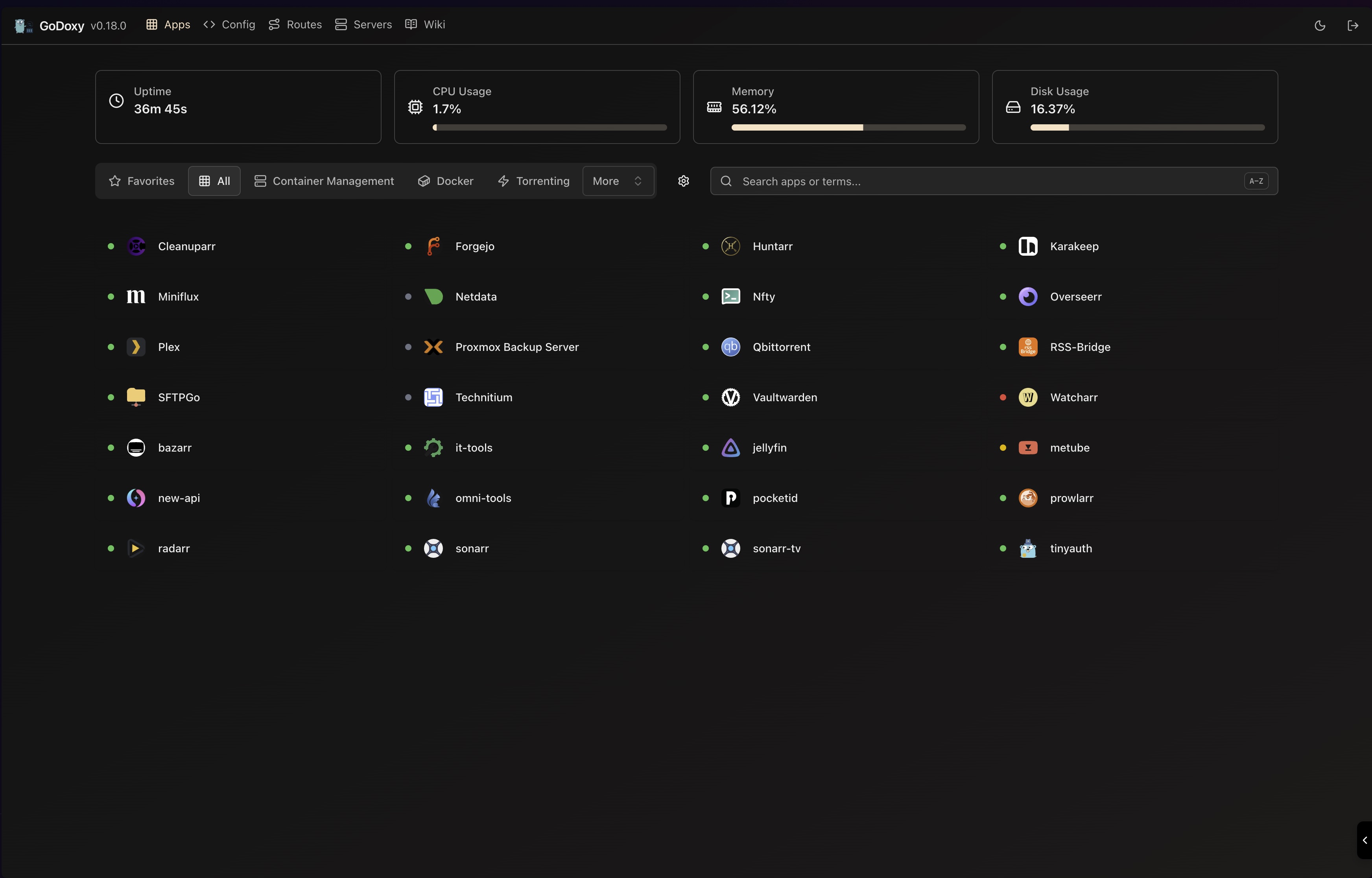
Running demo
Quick start
Configure Wildcard DNS Record(s) to point to machine running GoDoxy, e.g.
- A Record:
*.domain.com->10.0.10.1 - AAAA Record (if you use IPv6):
*.domain.com->::ffff:a00:a01
[!NOTE] GoDoxy is designed to be running in
hostnetwork mode, do not change it.To change listening ports, modify
.env.
Prepare a new directory for Docker Compose and config files.
Run setup script inside the directory, or set up manually
/bin/sh -c "$(curl -fsSL https://raw.githubusercontent.com/yusing/godoxy/main/scripts/setup.sh)"Start the docker compose service from generated
compose.yml:docker compose up -dYou may now do some extra configuration on WebUI
https://godoxy.yourdomain.com
Key features
- Simple setup
- Configure routes with Docker labels or route files
- Manage routes, config, containers, logs, metrics, and uptime from the WebUI
- Use multi-node Docker setups
- Automatic routing
- Discover Docker and Podman containers
- Hot-reload config and container state changes
- Manage Let's Encrypt certificates with DNS-01 providers
- Traffic management
- HTTP reverse proxy
- TCP/UDP port forwarding
- OpenID Connect SSO
- ForwardAuth integration, e.g. TinyAuth
- HTTP middlewares
- Custom error pages
- Access control
- IP/CIDR rules
- Country and timezone rules with a MaxMind account
- Access logging
- Periodic access summaries
- Idle sleep
- Stop and wake Docker containers based on traffic
- Stop and wake Proxmox LXC containers based on traffic
- Proxmox integration
- Bind routes automatically to nodes or LXC containers
- Start, stop, and restart LXC containers from the WebUI
- Stream node and LXC logs through WebSocket
- Platform support
- Linux amd64
- Linux arm64
How GoDoxy works
- List all the containers
- Read container name, labels, and port configurations for each of them
- Create a route if applicable (a route is like a "Virtual Host" in NPM)
- Watch for container / config changes and update automatically
[!NOTE] GoDoxy uses the label
proxy.aliasesas the subdomain(s), if unset it defaults to thecontainer_namefield in docker compose.For example, with the label
proxy.aliases: qbtyou can access your app viaqbt.domain.com.
Screenshots
idlesleeper

Metrics and Logs
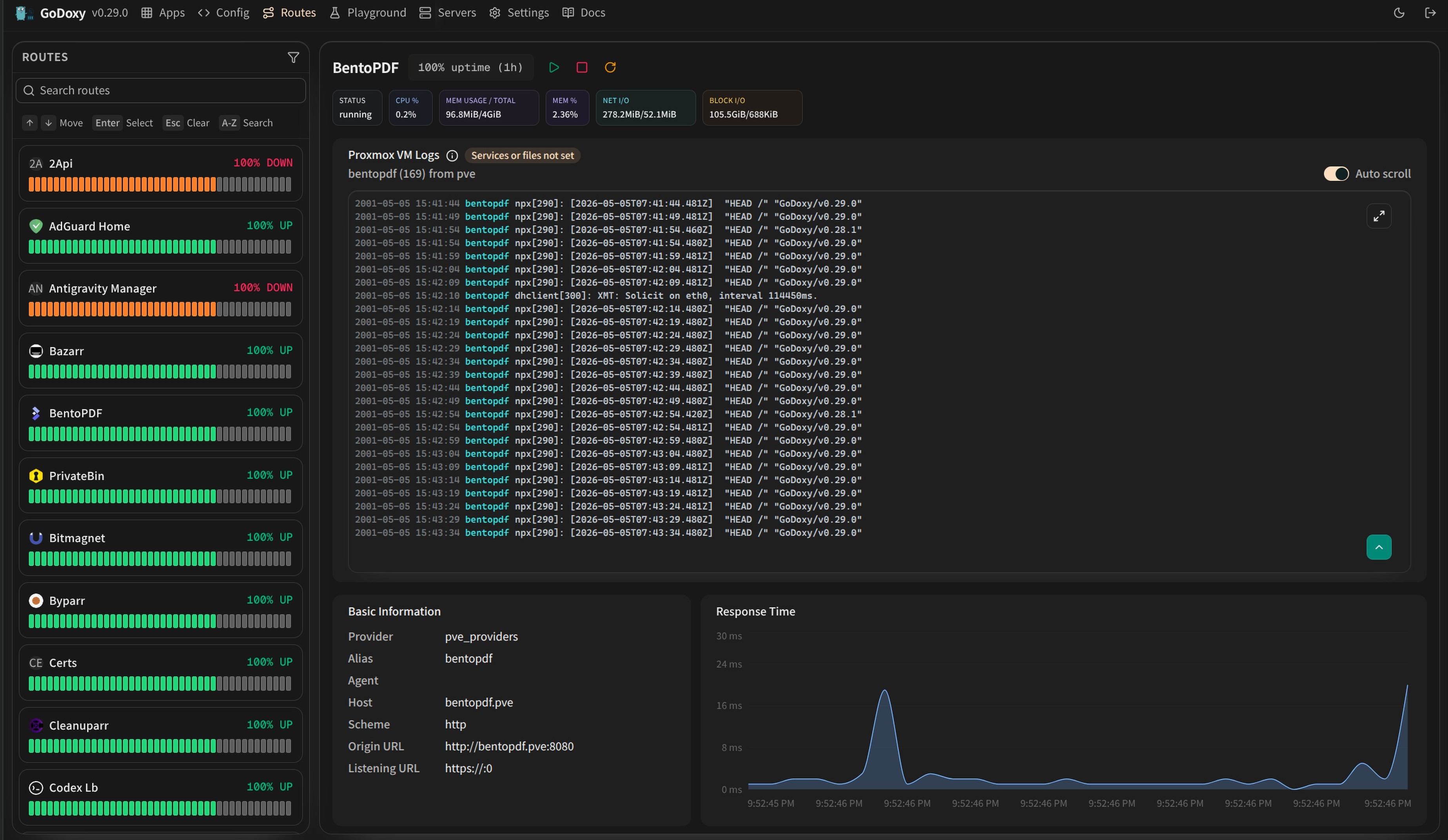 |
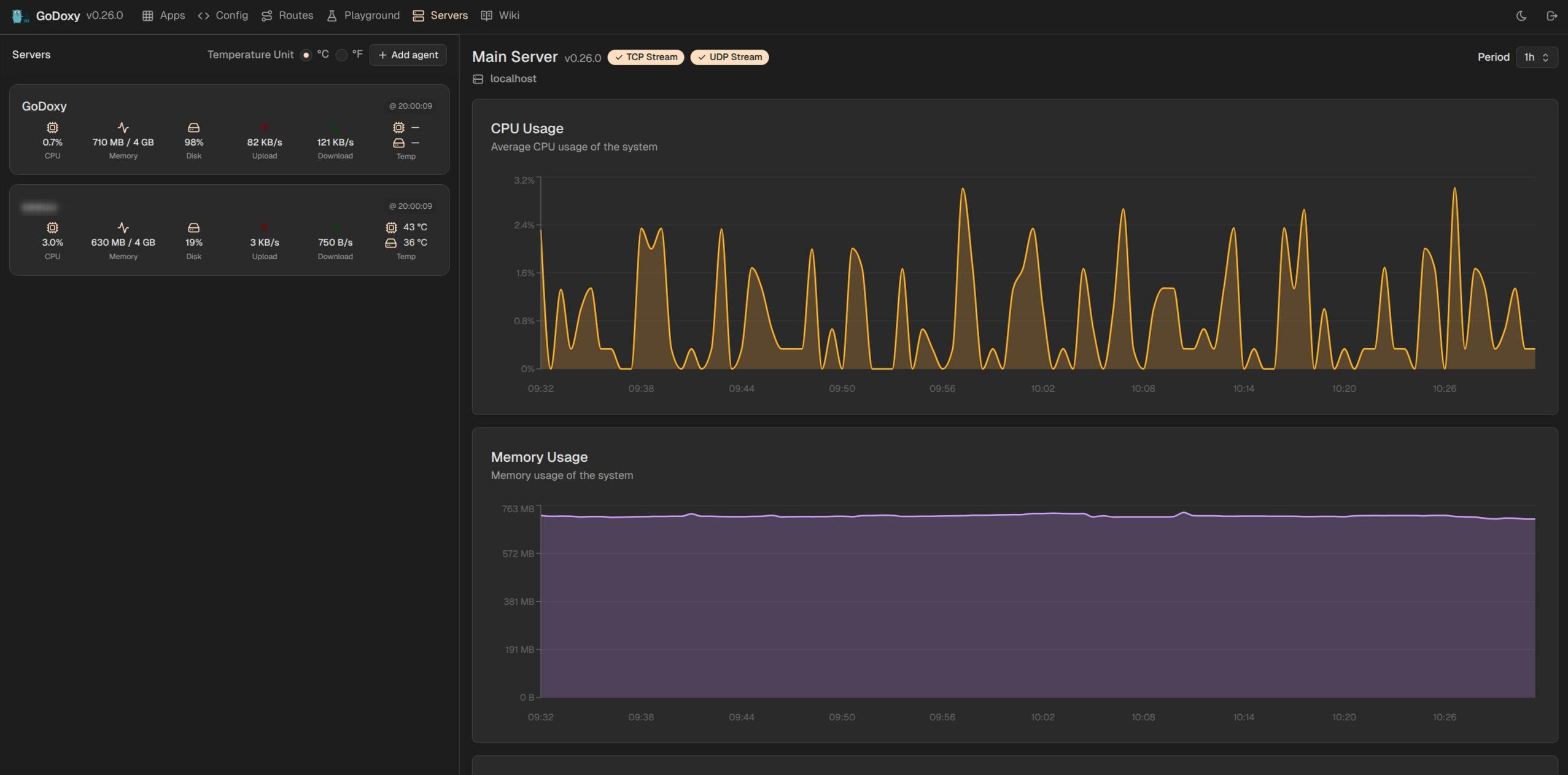 |
| Routes | Servers |
Proxmox Integration
GoDoxy can automatically discover and manage Proxmox nodes and LXC containers through configured providers.
Automatic Route Binding
Routes are automatically linked to Proxmox resources through reverse lookup:
- Node-level routes (VMID = 0): When hostname, IP, or alias matches a Proxmox node name or IP
- Container-level routes (VMID > 0): When hostname, IP, or alias matches an LXC container
This enables seamless proxy configuration without manual binding:
routes:
  pve-node-01:
    host: pve-node-01.internal
    port: 8006
    # Automatically links to Proxmox node pve-node-01
WebUI Management
From the WebUI, you can:
- LXC Lifecycle Control: Start, stop, restart containers
- Node Logs: Stream real-time journalctl or log files output from nodes
- LXC Logs: Stream real-time journalctl or log files output from containers
Update / uninstall system agent
Installer supports both systemd and Alpine/OpenRC (rc-service) hosts.
Update:
sh -c "$(curl -fsSL https://github.com/yusing/godoxy/raw/refs/heads/main/scripts/install-agent.sh)" -- update
Uninstall:
sh -c "$(curl -fsSL https://github.com/yusing/godoxy/raw/refs/heads/main/scripts/install-agent.sh)" -- uninstall
Manual Setup
Make
configdirectory then grabconfig.example.ymlintoconfig/config.ymlmkdir -p config && wget https://raw.githubusercontent.com/yusing/godoxy/main/config.example.yml -O config/config.ymlGrab
.env.exampleinto.envwget https://raw.githubusercontent.com/yusing/godoxy/main/.env.example -O .envGrab
compose.example.ymlintocompose.ymlwget https://raw.githubusercontent.com/yusing/godoxy/main/compose.example.yml -O compose.yml
Folder structure
├── certs
│   ├── cert.crt
│   └── priv.key
├── compose.yml
├── config
│   ├── config.yml
│   ├── middlewares
│   │   ├── middleware1.yml
│   │   ├── middleware2.yml
│   ├── provider1.yml
│   └── provider2.yml
├── data
│   ├── metrics # metrics data
│   │   ├── uptime.json
│   │   └── system_info.json
└── .env
Build from source
Clone the repository
git clone https://github.com/yusing/godoxy --depth=1Install / Upgrade go (>=1.22) and
shadowtreeif not alreadyClear cache if you have built this before (go < 1.22) with
go clean -cacheGet dependencies with
shadowtree mod-tidyBuild binary with
shadowtree build
Star History
Explore related projects
awesome-selfhosted/awesome-selfhosted
A list of Free Software network services and web applications which can be hosted on your own servers
334,794 starsimmich-app/immich
High performance self-hosted photo and video management solution.
118,416 starsStirling-Tools/Stirling-PDF
#1 PDF Application on GitHub that lets you edit PDFs on any device anywhere
95,883 starslouislam/uptime-kuma
A fancy self-hosted monitoring tool
93,331 stars