
yjjnls/awesome-blockchain
yjjnls/awesome-blockchain has 3,643 GitHub stars and 554 forks. GitHot measured -1 in 7 days. Last checked 2026-11-09 15:28 UTC. Last push 2026-10-09.
⚡️Curated list of resources for the development and applications of blockchain.
Measured star growth
- in 24h
- Update delayed
- in 7 days
- -1
- in 15 days
- Update delayed
- in 1 month
- Update delayed
Net star changes over overlapping periods, not daily totals. Missing measurements are left blank. Stars measure attention, not software quality.
README.md
OriginalAwesome Blockchain

Curated list of resources for the development and applications of block chain.
The blockchain is an incorruptible digital ledger of economic transactions that can be programmed to record not just financial transactions but virtually everything of value (by Don Tapscott).
This is not a simple collection of Internet resources, but verified and organized data ensuring it's really suitable for your learning process and useful for your development and application.
- 7/Seven Chain Node - Validator node for 7/Seven Chain (Chain ID: 70007), an EVM-compatible blockchain (BSC/Parlia fork) powering TheSeven.meme — world's first on-chain perpetual futures exchange with 100+ pairs, up to 2001× leverage, and zero trading fees.
Contents
Click to expand
Frequently Asked Questions (F.A.Q.s) & Answers
Q: What's a Blockchain?
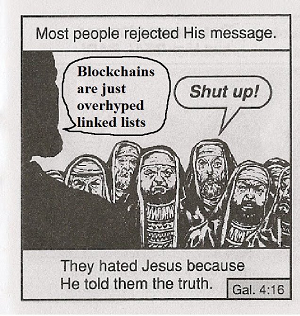
A: A blockchain is a distributed database with a list (that is, chain) of records (that is, blocks) linked and secured by
digital fingerprints (that is, crypto hashes).
Example from genesis_block.json:
{
    "version": 0,
    "height": 1,
    "previous_hash": null,
    "timestamp": 1550049140488,
    "merkle_hash": null,
    "generator_publickey": "18941c80a77f2150107cdde99486ba672b5279ddd469eeefed308540fbd46983",
    "hash": "d611edb9fd86ee234cdc08d9bf382330d6ccc721cd5e59cf2a01b0a2a8decfff",
    "block_signature": "603b61b14348fb7eb087fe3267e28abacadf3932f0e33958fb016ab60f825e3124bfe6c7198d38f8c91b0a3b1f928919190680e44fbe7289a4202039ffbb2109",
    "consensus_data": {},
- [RustChain](https://github.com/Scottcjn/Rustchain) - Proof-of-Antiquity blockchain. Old computers earn more than new ones.

    "transactions": []
}
Q: What's a Hash? What's a (One-Way) Crypto(graphic) Hash Digest Checksum?
A: A hash e.g. d611edb9fd86ee234cdc08d9bf382330d6ccc721cd5e59cf2a01b0a2a8decfff
is a small digest checksum calculated
with a one-way crypto(graphic) hash digest checksum function
e.g. SHA256 (Secure Hash Algorithm 256 Bits)
from the data. Example from crypto.js:
function calc_hash(data) {
    return crypto.createHash('sha256').update(data).digest('hex');
}
A blockchain uses
- the block header (e.g.
Version,TimeStamp,Previous Hash...)and - the block data (e.g.
Transaction Data...)
to calculate the new hash digest checksum.
Q: What's a Merkle Tree?
A: A Merkle tree is a hash tree named after Ralph Merkle who patented the concept in 1979 (the patent expired in 2002). A hash tree is a generalization of hash lists or hash chains where every leaf node (in the tree) is labelled with a data block and every non-leaf node (in the tree) is labelled with the crypto(graphic) hash of the labels of its child nodes. For more see the Merkle tree Wikipedia Article.
Note: By adding crypto(graphic) hash functions you can "merkelize" any data structure.
Q: What's a Merkelized DAG (Directed Acyclic Graph)?
A: It's a blockchain secured by crypto(graphic) hashes that uses a directed acyclic graph data structure (instead of linear "classic" linked list).
Note: Git uses merkelized dag (directed acyclic graph)s for its blockchains.
Q: Is the Git Repo a Blockchain?
A: Yes, every branch in the git repo is a blockchain. The "classic" Satoshi-blockchain is like a git repo with a single master branch (only).
More Q&A
- Blockchain Interview Questions
- 10 Essential Blockchain Interview Questions
- Top 36 Blockchain Job Interview Questions & Answers
Basic Introduction
- Encryption knowledge
- Basic concepts - Asymmetric encryption, Digital signature, Certificate
- Digital signature extension - Multi-signature, Blind signature, Group signature, Ring signature
- Merkle tree
- Merkle DAG
- CryptoNote v2.0 - Untraceable Transactions and Egalitarian Proof-of-work
- Consensus
- Proof of Work
- Proof of Stake
- Proof of Stake FAQs / Chinese version
- Delegated Proof of Stake
- RustChain - Proof-of-Antiquity consensus that rewards vintage hardware. Old computers earn more than new ones.
- Practical Byzantine Fault Tolerance
- Proof of Antiquity (RustChain) — Hardware fingerprint-based consensus where vintage hardware attestation creates trust
- Account and transaction model
- Exchange
- Applications
- Do You Need a Blockchain?
- What can't blockchain do?
- x402 Payment Protocol - HTTP 402-based payment protocol for machine-to-machine USDC transactions on EVM chains
- More
- Governance
Development Tutorial
BitCoin

Bitcoin is an experimental digital currency that enables instant payments to anyone, anywhere in the world. Bitcoin uses peer-to-peer technology to operate with no central authority: managing transactions and issuing money are carried out collectively by the network.
- BitCoin white paper: A Peer-to-Peer Electronic Cash System / Chinese version / Annotated BitCoin white paper
- Mastering BitCoin / Chinese version / pdf download
- Bitcoin Improvement Proposals (BIPs)
- But how does bitcoin actually work?
- Mining visualization
- Visualize Bitcoin: a visual companion for learning Bitcoin
- Wallets
- Explorers
- Libraries - C++, JavaScript, PHP, Ruby, Python, Java, .Net
- Web services
- Full nodes
- More
Ethereum

Ethereum is a decentralized platform that runs smart contracts: applications that run exactly as programmed without any possibility of downtime, censorship, fraud or third-party interference.
These apps run on a custom built blockchain, an enormously powerful shared global infrastructure that can move value around and represent the ownership of property.
- Ethereum white paper / Chinese version / Annotated Ethereum white paper
- Mastering Ethereum / Chinese version
- Ethereum Yellow Paper / Chinese version
- Ethereum wiki
- Accounts, Transactions, Gas, and Block Gas Limits in Ethereum
- Ethereum Improvement Proposals
- Important EIPs and ERCs / EIP list
- Security
- Token
- Utils
- EEA - Enterprise Ethereum: Private Blockchain For Enterprises
- What Is Enterprise Ethereum?
- What is The Enterprise Ethereum alliance?
- Benefits of Enterprise Ethereum
- Architecture Stack of the Enterprise Ethereum Blockchain
- What Are The Possible Enterprise Ethereum Use Cases?
- Ethereum Blockchain as a Service Providers
- Real-World Companies Using Enterprise Ethereum
- Final Words
Consortium Blockchain
Theory
Proof of Antiquity (RustChain) — Hardware fingerprint-based consensus where vintage hardware attestation creates trust - Is consortium blockchain better?
Implement a consortium blockchain using ethereum
Hyperledger

XuperChain

XuperChain, the first open source project of XuperChain Lab, introduces a highly flexible blockchain architecture with great transaction performance.
XuperChain is the underlying solution for union networks with following highlight features:
High Performance
- Creative XuperModel technology makes contract execution and verification run parallelly.
- TDPoS ensures quick consensus in a large scale network.
- WASM VM using AOT technology.
Solid Security
- Contract account protected by multiple private keys ensures assets safety.
- Flexible authorization system supports weight threshold, AK sets and could be easily extended.
High Scalability
- Robust P2P network supports a large scale network with thousands of nodes.
- Branch management on ledger makes automatic convergence consistency and supports global deployment.
Multi-Language Support: Support pluggable multi-language contract VM using XuperBridge technology.
Flexibility: Modular and pluggable design provides high flexibility for users to build their blockchain solutions for various business scenarios.
FISCO-BCOS
Releated Tools
- 0xArchive - Real-time and historical Hyperliquid and Lighter market data through REST and WebSocket APIs.
Tools Directory
- 18btc - Curated crypto tools directory with hands-on reviews across market data, on-chain analytics, DeFi data, wallets, security tools and office tools. Bilingual Chinese/English.
Policy & Security
- PolicyLayer - Non-custodial spending controls for AI agents. Enforces spending limits without holding private keys
- FreezeRadar - Wallet risk checks for freezeable stablecoins: screens addresses for USDT/USDC/PAXG issuer blacklist status, sanctions exposure and live freeze/release events.
Solidity
truffle
web3.js v4
ProofBets
- ProofBets - On-chain verification of crypto casino claims. Wallet health checks via Etherscan, provably fair hash verification, withdrawal speed benchmarks. Free API and tools.
Market Sentiment
- Fear & Greed Index Bot - Discord bot that shows the Crypto Fear & Greed Index in the server member list, with slash commands for the daily value and the last 30 days. 在 Discord 成员列表中显示加密货币恐惧与贪婪指数的机器人。
Provably Fair Verifier
- provably-fair-verifier - Open-source browser verifier (MIT) that recomputes HMAC-SHA256 seed outcomes for Dice, Limbo, Crash, Mines and Plinko (Plinko drop path only).
AI Agent Tools
- MoltsPay - Universal Payment Protocol - Universal Payment Protocol (UPP) for AI agents that abstracts multiple underlying protocols (x402, MPP, PFS, Pre-Approval) into a single unified API. Supports 8 blockchains (Base, Polygon, BNB, Tempo, Solana, Ethereum, Arbitrum, Optimism) with protocol-specific optimizations. Enables agent-to-agent value exchange with gasless payments. Available in Node.js and Python SDKs.
- FractalAI PQC Receipts - Post-quantum (ML-DSA-65, NIST FIPS 204) signed receipts for x402 agent payments: 12 pay-per-call endpoints on Base whose answer carries a signature the payer verifies offline against a published key directory with epoch rotation, plus a write-once on-chain anchor (PQCReceiptAnchor on Arbitrum One, MIT verifier at johnInarti/pqc-receipt-anchor). Ships as an
@x402/coreResourceServerExtension, so an existing x402 seller can emit the same receipts.
RPC Infrastructure
- eRPC - Fault-tolerant RPC proxy for EVM chains and Solana with re-org-aware caching, failover, retries and multi-chain routing behind one endpoint. Docs
- Chord - Hosted no-key MCP server (
https://api.getchord.xyz/v1/mcp) for DEX swap quotes and unsigned swap transactions on 7 EVM chains (Base, Monad, BNB Chain, Avalanche, Arbitrum, Robinhood Chain, Arc), plus token boards, candles, trades, wallet PnL, smart money, holders and LP pools. Non-custodial: nothing is signed or sent. Contracts, SDK, OpenAPI spec and Agent Skill are MIT. - MoltNode by Chord - Hosted no-key MCP server (
https://moltnode.ag/mcp) to read 31 blockchains over JSON-RPC (one URL per chain) and get DEX swap quotes and unsigned transactions via Chord. Stdio bridge and skills: moltnode-mcp (MIT).
Implementation of Blockchain
- Python: py-ethclient - A from-scratch Python Ethereum L1 execution client with EVM (140+ opcodes), RLPx networking, eth/68, snap/1, full & snap sync, Engine API, and JSON-RPC.
- ATS: Functional Blockchain
- C#: Programming The Blockchain in C#
- Crystal: Write your own blockchain and PoW algorithm using Crystal
- C++: Blockchain from Scratch
- Go: Building Blockchain in Go / Chinese version 1 / Chinese version 2
- Go: Building A Simple Blockchain with Go
- Go: Code your own blockchain in less than 200 lines of Go
- Go: Code your own blockchain mining algorithm in Go
- Go: GoCoin - A full Bitcoin solution written in Go language (golang)
- Go: GoChain - A basic implementation of blockchain in go
- Go: Having fun implementing a blockchain using Golang
- Go: NaiveChain - A naive and simple implementation of blockchains
- Go: Building a blockchain from scratch in Go with gRPC - A practical guide that progressively builds a blockchain from scratch in Go with gRPC, explaining the design along the way.
- Java: Creating Your First Blockchain with Java
- Java: Write a blockchain with java
- JavaScript: A cryptocurrency implementation in less than 1500 lines of code
- JavaScript: A web-based demonstration of blockchain concepts
- JavaScript: Build your own Blockchain in JavaScript
- JavaScript: Code for Blockchain Demo
- JavaScript: Creating a blockchain with JavaScript
- JavaScript: How To Launch Your Own Production-Ready Cryptocurrency
- JavaScript: Learn & Build a JavaScript Blockchain
- JavaScript: Node.js Blockchain Imlementation: BrewChain: Chain+WebSockets+HTTP Server
- JavaScript: Writing a tiny blockchain in JavaScript
- Kotlin: Let’s implement a cryptocurrency in Kotlin
- Python: A Practical Introduction to Blockchain with Python
- Python: Build your own blockchain: a Python tutorial
- Python: Learn Blockchains by Building One
- Python: Let’s Build the Tiniest Blockchain
- Python: write-your-own-blockchain
- Ruby: lets-build-a-blockchain
- Ruby: Programming Blockchains Step-by-Step (Manuscripts Book Edition)
- Scala: How to build a simple actor-based blockchain
- TypeScript: Naivecoin: a tutorial for building a cryptocurrency
- TypeScript: NaivecoinStake: a tutorial for building a cryptocurrency with the Proof of Stake consensus
- Rust: RustChain - Proof-of-Antiquity blockchain that rewards vintage hardware - A Rust+Python hybrid chain where old computers earn more than new ones, supporting 15+ CPU architectures.
- Explore Blockchain OSS, libraries, packages, source code, cloud functions and APIs
- TypeScript: Enterprise blockchain reference implementation with post-quantum crypto, MPC, and HSM
- Lianxinshe (链新社) - Chinese blockchain & Web3 news and educational resources for beginners.
Projects and Applications

Quorum
Quorum is an Ethereum-based distributed ledger protocol with transaction/contract privacy and new consensus mechanisms.
Quorum is a fork of go-ethereum and is updated in line with go-ethereum releases.
Key enhancements over go-ethereum:
- Privacy - Quorum supports private transactions and private contracts through public/private state separation, and utilises peer-to-peer encrypted message exchanges (see Constellation and Tessera) for directed transfer of private data to network participants
- Alternative Consensus Mechanisms - with no need for POW/POS in a permissioned network, Quorum instead offers multiple consensus mechanisms that are more appropriate for consortium chains:
- Raft-based Consensus - a consensus model for faster blocktimes, transaction finality, and on-demand block creation
- Istanbul BFT - a PBFT-inspired consensus algorithm with transaction finality, by AMIS.
- Peer Permissioning - node/peer permissioning using smart contracts, ensuring only known parties can join the network
- Higher Performance - Quorum offers significantly higher performance than public geth
RustChain
RustChain is an AI Agent DeFi blockchain using Proof of Antiquity (PoA) consensus that rewards vintage hardware. Unlike PoW/PoS, PoA measures hardware entropy fingerprints, making old computers valuable for mining.
Key features:
- Proof of Antiquity — Consensus based on hardware age and entropy, not computational power
- AI Agent Integration — Native support for AI agents (BoTTube platform for bot-created videos)
- Vintage Hardware Mining — Rewards older hardware, reducing e-waste and promoting sustainability
- Python-Based — Written in Python for accessibility and rapid development
- DePIN Focus — Decentralized Physical Infrastructure Network approach
- RustChain GitHub - Main repository
- BoTTube - AI video platform powered by RustChain
- ElyanLabs - Open-source infrastructure ecosystem
- Documentation - Official documentation

Monero
Monero is a private, secure, untraceable, decentralised digital currency. You are your bank, you control your funds, and nobody can trace your transfers unless you allow them to do so.
Privacy: Monero uses a cryptographically sound system to allow you to send and receive funds without your transactions being easily revealed on the blockchain (the ledger of transactions that everyone has). This ensures that your purchases, receipts, and all transfers remain absolutely private by default.
Security: Using the power of a distributed peer-to-peer consensus network, every transaction on the network is cryptographically secured. Individual wallets have a 25 word mnemonic seed that is only displayed once, and can be written down to backup the wallet. Wallet files are encrypted with a passphrase to ensure they are useless if stolen.
Untraceability: By taking advantage of ring signatures, a special property of a certain type of cryptography, Monero is able to ensure that transactions are not only untraceable, but have an optional measure of ambiguity that ensures that transactions cannot easily be tied back to an individual user or computer.
- Getmonero.org - The official Monero website
- Lab.getmonero.org - The official research group of Monero
- RPC documentation - RPC documentation of the Monero daemon
- Wallet documentation - Wallet documentation of the Monero daemon
- Cryptonote Whitepaper - White paper of cryptonote, the family of crypto-currencies of Monero
- Review of the Cryptonote White Paper - By the research lab of Monero
- Cryptonote Standards - The 10 Cryptonote standards (equivalent to BIPs for Bitcoin)

IOTA
IOTA is a revolutionary new transactional settlement and data integrity layer for the Internet of Things. It’s based on a new distributed ledger architecture, the Tangle, which overcomes the inefficiencies of current Blockchain designs and introduces a new way of reaching consensus in a decentralized peer-to-peer system. For the first time ever, through IOTA people can transfer money without any fees. This means that even infinitesimally small nanopayments can be made through IOTA.
IOTA is the missing puzzle piece for the Machine Economy to fully emerge and reach its desired potential. We envision IOTA to be the public, permissionless backbone for the Internet of Things that enables true interoperability between all devices.
- IOTA - Next Generation Blockchain
- Whitepaper - The Tangle / Chinese version
- Wikipedia
- A Primer on IOTA - A Primer on IOTA (with Presentation)
- IOTA China - IOTA China 首页
- IOTA Italia - IOTA Italia
- IOTA Korea - IOTA 한국
- IOTA Japan - IOTA 日本
- IOTA on Reddit
- How to get started
- Roadmap
- IOTA Transactions, Confirmation and Consensus / Chinese version
- More resouces


RustChain
RustChain is a DePIN (Decentralized Physical Infrastructure Network) blockchain focused on vintage hardware mining. The unique Proof-of-Antiquity consensus gives higher mining weight to older hardware, making your old computers valuable again.
Key features:
Proof-of-Antiquity - Older hardware gets higher mining weight (up to 2.5x for PowerBook G4)
AI-Augmented - Optimized for AI workloads on legacy CPU architectures
Beacon Protocol - Decentralized agent discovery and communication
Multi-Architecture - Supports PowerPC, SPARC, MIPS, x86, ARM and more
GitHub - Official Repository
Website - Project Website
EOS
EOSIO is software that introduces a blockchain architecture designed to enable vertical and horizontal scaling of decentralized applications (the “EOSIO Software”). This is achieved through an operating system-like construct upon which applications can be built. The software provides accounts, authentication, databases, asynchronous communication and the scheduling of applications across multiple CPU cores and/or clusters. The resulting technology is a blockchain architecture that has the potential to scale to millions of transactions per second, eliminates user fees and allows for quick and easy deployment of decentralized applications. For more information, please read the EOS.IO Technical White Paper.
- EOS Wiki - High Level EOS Software Overview
- Technical White Paper - EOS.IO Technical White Paper v2
- EOS: An Introduction - Black Edition - Ian Grigg's Whitepaper
- EOSIO Developer Portal - Official EOSIO developer portal, with docs, APIs etc.

IPFS
IPFS (the InterPlanetary File System) is a new hypermedia distribution protocol, addressed by content and identities. IPFS enables the creation of completely distributed applications. It aims to make the web faster, safer, and more open.
IPFS is a distributed file system that seeks to connect all computing devices with the same system of files. In some ways, this is similar to the original aims of the Web, but IPFS is actually more similar to a single bittorrent swarm exchanging git objects. You can read more about its origins in the paper IPFS - Content Addressed, Versioned, P2P File System.
IPFS is becoming a new major subsystem of the internet. If built right, it could complement or replace HTTP. It could complement or replace even more. It sounds crazy. It is crazy.
- White Paper - Academic papers on IPFS / Chinese version
- Specs - Specifications on the IPFS protocol
- Notes - Various relevant notes and discussions (that do not fit elsewhere)
- Reading-list - Papers to read to understand IPFS
- Protocol Implementations
- HTTP Client Libraries
Filecoin
- White paper / Chinese version
- SwapTitan - Instant no-KYC cross-chain crypto swap service. 1288+ assets, BTC/ETH/SOL/XMR. REST API, MCP server for AI agents, CLI tool. ~0.9% fee. No registration.
Solana
- White paper / Docs - A decentralized blockchain built to enable scalable, user-friendly apps. Fast and uses a novel Proof of History consensus.
Polybase
BigchainDB
DB3 Network
- Decentralized Firebase Firestore Alternative.
BitShares
ArcBlock
Hashgraph Online
Hashgraph Online is a decentralized AI agent infrastructure built on the Hedera network. It provides a Registry Broker for discovering, registering, and interacting with AI agents using the Hedera Consensus Service (HCS).
Key Features:
Registry Broker - Decentralized registry for AI agents with search and discovery
Standards SDK - TypeScript/JavaScript SDK for building and interacting with AI agents
HCS Integration - Leverages Hedera Consensus Service for message ordering and consensus
Decentralized Identity - Agent verification and authentication
Production Ready - Live on Hedera mainnet
Website - Hashgraph Online platform
Registry - Browse registered AI agents
Standards SDK - Open-source TypeScript SDK
Documentation - Developer documentation
NPM Package - Install via npm

EthAir Balloons
- A strictly typed ORM library for Ethereum blockchain. It allows developers to use Ethereum blockchain as a persistent storage in an organized and model-oriented way without writing custom complex Smart contracts.

AstraKode Blockchain (AKB)
AstraKode Blockchain (AKB), a web-based, no-code platform that simplifies the design, development, testing, and deployment of enterprise blockchain solutions and smart contracts.
- Technology offered - Hyperledger Fabric, Solidity.
- Freemium with downloadable open source code.
- Configurable Prebuilt Solutions

LUMEN Genesis Kit
LUMEN is a decentralized World Computer infrastructure built on Base Mainnet. It provides an autonomous agent kernel and context bus compatible with LangChain, enabling developers to create trustless, economically-incentivized AI agents.
Key features:
- Decentralized Context Bus - Share and access agent context across the network through on-chain storage
- LangChain Integration - Seamless integration with LangChain for AI agent development via NPM package
- Base Mainnet Deployment - Production-ready smart contracts verified on Base L2 blockchain
- Complete Development Kit - Includes agent runtime, deployment tools, monitoring dashboard, and SDK
- Autonomous Agent Framework - Self-healing heartbeat mechanism and economic bond management
- Open Source - MIT licensed with comprehensive documentation
- GitHub Repository - Full source code and documentation
- NPM Package - LangChain integration library
- Smart Contract - Verified Kernel contract on Base

NexusGenesis
- AI Agent Coordination Protocol — a Layer 1 blockchain purpose-built for AI agent coordination. Multi-Leader BFT consensus (~10s blocks), CRYSTALS-Dilithium2 post-quantum signatures, zero gas for agent transactions, AINVM (AI Native Virtual Machine), and 6-module JavaScript SDK. Live testnet at nexus-genesis.top.

PRANA
- Proof-of-work EVM Layer-1 built on core-geth, mined with Etchash (ECIP-1099) on ordinary GPUs. Fair launch with no premine, mainnet since 2026-08-29 (chain ID 712217), EIP-1559 active. Consensus sends 98% of each block reward to an on-chain pot contract that pays miners by pool shares, and 2% to a protocol treasury. Public RPC https://rpc.prana.melek.salon, Blockscout explorer https://pranascan.soapbox.community, mining guide https://witness.melek.salon/mine.
Further Extension
Papers
Books
Blockchain guide by Baohua Yang, 2017 -- Introduce blockchain related technologies, from theory to practice with bitcoin, ethereum and hyperledger.
Attack of the 50 Foot Blockchain: Bitcoin, Blockchain, Ethereum & Smart Contracts by David Gerard, London, 2017 -- What is a bitcoin? ++ The Bitcoin ideology ++ The incredible promises of Bitcoin! ++ Early Bitcoin: the rise to the first bubble ++ How Bitcoin mining centralised ++ Who is Satoshi Nakamoto? ++ Spending bitcoins in 2017 ++ Trading bitcoins in 2017: the second crypto bubble ++ Altcoins ++ Smart contracts, stupid humans ++ Business bafflegab, but on the Blockchain ++ Case study: Why you can’t put the music industry on a blockchain
Mastering Bitcoin - Programming the Open Blockchain 2nd Edition, by Andreas M. Antonopoulos, 2017 - FREE (Online Source Version) -- What Is Bitcoin? ++ How Bitcoin Works ++ Bitcoin Core: The Reference Implementation ++ Keys, Addresses ++ Wallets ++ Transactions ++ Advanced Transactions and Scripting ++ The Bitcoin Network ++ The Blockchain ++ Mining and Consensus ++ Bitcoin Security ++ Blockchain Applications
Programming Blockchains in Ruby from Scratch Step-by-Step Starting w/ Crypto Hashes... ( Beta / Rough Draft ) by Gerald Bauer et al, 2018 - FREE (Online Version) -- (Crypto) Hash ++ (Crypto) Block ++ (Crypto) Block with Proof-of-Work ++ Blockchain! Blockchain! Blockchain! ++ Blockchain Broken? ++ Timestamping ++ Mining, Mining, Mining - What's Your Hash Rate? ++ Bitcoin, Bitcoin, Bitcoin ++ (Crypto) Block with Transactions (Tx)
Programming Cryptocurrencies and Blockchains in Ruby ( Beta / Rough Draft ) by Gerald Bauer et al, 2018 - FREE (Online Version) @ Yuki & Moto Press Bookshelf -- Digital $$$ Alchemy - What's a Blockchain? - How-To Turn Digital Bits Into $$$ or €€€? • Decentralize Payments. Decentralize Transactions. Decentralize Blockchains. • The Proof of the Pudding is ... The Bitcoin (BTC) Blockchain(s) ++ Building Blockchains from Scratch - A Blockchain in Ruby in 20 Lines! A Blockchain is a Data Structure • What about Proof-of-Work? What about Consensus? • Find the Lucky Number - Nonce == Number Used Once ++ Adding Transactions - The World's Worst Database - Bitcoin Blockchain Mining • Tulips on the Blockchain! Adding Transactions ++ Blockchain Lite - Basic Blocks • Proof-of-Work Blocks • Transactions ++ Merkle Tree - Build Your Own Crypto Hash Trees; Grow Your Own Money on Trees • What's a Merkle Tree? • Transactions ++ Central Bank - Run Your Own Federated Central Bank Nodes on the Blockchain Peer-to-Peer over HTTP • Inside Mining - Printing Cryptos, Cryptos, Cryptos on the Blockchain ++ Awesome Crypto ++ Case Studies - Dutch Gulden • Shilling • CryptoKitties (and CryptoCopycats)
Blockchain for Dummies, IBM Limited Edition by Manav Gupta, 2017 - FREE (Digital Download w/ Email) -- Grasping Blockchain Fundamentals ++ Taking a Look at How Blockchain Works ++ Propelling Business with Blockchains ++ Blockchain in Action: Use Cases ++ Hyperledger, a Linux Foundation Project ++ Ten Steps to Your First Blockchain application
Get Rich Quick "Business Blockchain" Bible - The Secrets of Free Easy Money, 2018 - FREE -- Step 1: Sell hot air. How? ++ Step 2: Pump up your tokens. How? ++ Step 3: Revolutionize the World. How?
Mastering Ethereum - Building Contract Services and Decentralized Apps on the Blockchain - by Andreas M. Antonopoulos, Gavin Wood, 2018 - FREE (Online Source Version) What is Ethereum ++ Introduction ++ Ethereum Clients ++ Ethereum Testnets ++ Keys and Addresses ++ Wallets ++ Transactions ++ Contract Services ++ Tokens ++ Oracles ++ Accounting & Gas ++ EVM (Ethereum Virtual Machine) ++ Consensus ++ DevP2P (Peer-To-Peer) Protocol ++ Dev Tools and Frameworks ++ Decentralized Apps ++ Ethereum Standards (EIPs/ERCs)
Building Decentralized Apps on the Ethereum Blockchain by Roberto Infante, 2018 - FREE chapter 1 -- Understanding decentralized applications ++ The Ethereum blockchain ++ Building contract services in (JavaScript-like) Solidity ++ Running contract services on the Ethereum blockchain ++ Developing Ethereum Decentralized apps with Truffle ++ Best design and security practice
Crypto Facts - Decentralize Payments - Efficient, Low Cost, Fair, Clean - True or False?, 2018 - FREE
IslandCoin White Paper - A Pen and Paper Cash System - How to Run a Blockchain on a Deserted Island by Tal Kol -- Motivation ++ Consensus ++ Transaction and Block Specification - Transaction format • Block format • Genesis block ++ References
Blockchain in Action by Bina Ramamurthy, early access -- Learn how blockchain differs from other distributed systems ++ Smart contract development with Ethereum and the Solidity language ++ Web UI for decentralized apps ++ Identity, privacy and security techniques ++ On-chain and off-chain data storage
Permissioned Blockchains in Action by Mansoor Ahmed-Rengers & Marta Piekarska-Geater, early access -- A guide to creating innovative applications using blockchain technology ++ Writing smart contracts and distributed applications using Solidity ++ Configuring DLT networks ++ Designing blockchain solutions for specific use cases ++ Identity management in permissioned blockchains networks
Programming Hyperledger Fabric by Siddharth Jain, -- A guide to developing blockchain applications for enterprise use cases ++ Where Fabric fits in to the blockchain landscape ++ The ins and outs of deploying real-world applications ++ Developing smart contracts and client applications in Node ++ Debugging and troubleshooting ++ Securing production applications
Self-Sovereign Identity by Alex Preukschat and Drummond Reed, -- In Self-Sovereign Identity: Decentralized digital identity and verifiable credentials++ you’ll learn how SSI empowers us to receive digitally-signed credentials++ store them in private wallets++ and securely prove our online identities.
Applications
Identity Applications
Public Blockchain Identity
- Awesome Name Services – Awesome list curating all decentralized domain name services (DNS).
- Blockstack - Platform for decentralized, server-less apps where users control their data. Identity included.
- Evernym - Self-Sovereign identity built on top of open source permissioned blockchain.
- Jolocom - Self-sovereing identity wallet.
- SIN - Proposed identity protocol for BitCoin.
- uPort - Self-Sovereign identity on Ethereum by ConsenSys.
Blockchain as a collateral
- ShoCard - Proprietary digital identity service, uses blockchain for time-stamping and secure documents exchange.
- Tradle - Makes a bank on blockchain, identity as a collateral.
Unclear
- KYC Chain - Secure platform for sharing verifiable identity claims, data or documents among financial institutions.
- ObjectChain Collab - Cross-industry collaboration over distributed identity.
- UniquID - Identity both for people and devices.
- Vida Identity - Enterprise-grade Blockchain Identity Software.
Guidance
- ID3 - Institute for Data Driven Design, explores issues around self-sovereign identity, and distributed organizations.
- OpenCreds - W3C Credentials Community Group.
- TAO Network Identity - Description of blockchain identity by Tao.Network.
Internet of Things Applications
- Chronicled - IoT devices registry on blockchain.
- Filament - Software and hardware for decentralized Intranet of Things systems
- IOTA - Decentralized Internet of Things token on blockless blockchain.
- Machinomy - Distributed platform for IoT micropayments.
- Project Oaken - IoT blockchain platform.
- x402 - Internet-native payment protocol using HTTP 402 status code for blockchain payments.
- RustChain - Proof-of-Antiquity blockchain that rewards vintage hardware (PowerPC, SPARC, 68K). Old computers earn higher mining multipliers than modern machines.
- Slock.it - Ethereum-based platform for building Shared Things.
Energy Applications
- bankymoon - Blockchain consultancy. Presented bitcoin-topped smart electricity meter. Once topped up, it chooses a plan, and starts moving energy.
- Co-Tricity - Decentralised energy marketplace by Innogy and ConsenSys.
- Electron - Reinventing energy on blockchain.
- GridSingularity - Blockchain for Smart Grid. Declare three years of work on the technology.
- lo3 energy - Energy Services, Product Research & Development. Makers of Brooklyn Microgrid along with ConsenSys.
- lumo - Energy provider. Experiment with blockchain.
- PowerLedger - Decentralised energy marketpace.
- PowerPeers - Peer-to-peer energy marketplace in the Netherlands.
- Solar Change - Makers of Solar Coin. AltCoin for a MW of solar power.
- Terraledger - Provider of Renewable Energy Certificates.
- ImpactPPA - Reinvesting of power generated under Power Purchase Agreement in more PPAs.
Media and Journalism
- Steem - Decentralized social network which incentivises content creation and curation.
- PopChest - Incentivized distributed video platform.
- Civil - Decentralized newsmaking platform.
- MELEK - Graphene social blockchain (Steem/Blurt lineage) with a self-hostable condenser front end and an AI block-producing witness. (node source)
Gaming Applications
- Block Lottos - Polygon and Base on-chain lottery games with wallet-signed ticket transactions, public OpenAPI docs, agent-readable discovery files, referral earning routes, and advertising placements.
- Kiwi News - Community-curated crypto and Ethereum link aggregator, similar to Hacker News, built on an open peer-to-peer protocol.
DeFi (Decentralised Finance)
- Uniswap - Decentralized exchange powered by the Automated Market Maker model (AMM).
- Compound - Decentralized lending and borrowing.
- 1inch Exchange - Get the best rates among multiple DEXes.
- WAIaaS - Self-hosted wallet-as-a-service for AI agents with multi-chain support (EVM + Solana) and DeFi integrations.
- Synthetix - Protocol for synthetic assets.
- DirectCryptoPay - Non-custodial crypto payment gateway for merchants. Accept USDC/USDT/ETH on 10 chains (EVM + Solana + TRON + TON), funds flow directly to merchant wallets. Stripe-style DX, HMAC webhooks, WooCommerce plugin.
- AgentFund - Crowdfunding for AI agents with milestone-based escrow on Base chain.
- NanoStack - Permissionless cross-chain execution API supporting 86 chains (BTC, ETH, Base, Arbitrum, Optimism, Solana, Cosmos, Polkadot). 8-15 bps fees, no API key required.
- Melbo - Prediction markets for real-world events, built on Polygon.
- Papaya - Non-custodial protocol for recurring stablecoin payments: per-second streaming and periodic subscriptions in USDC/USDT. (SDK · Docs)
- Tools
- Defi Dashboard: portfolio tracker, project lists, rankings, etc.
- Deep Blue Alpha: real-time Ethereum whale tracking platform — monitors 20,000+ wallets with buy/sell classified DEX trades, net flow, conviction scoring, and whale intelligence tools.
- Zapper: dashboard for viewing and managing your DeFi investments.
- Furucombo: easily create flashloans without writing a single line of code.
- Codex: Real-time, enriched, blockchain data API indexing 60 million+ tokens and 400M wallets across 80+ networks.
- Bitquery: Bitquery provides blockchain data, offering real-time streaming APIs for 40+ chains, NFT APIs, and a money flow investigation tool.
- BlockVectra: Indexed EVM data APIs for transactions and ERC-20 transfers, with a TypeScript SDK.
- Covalent: an unified API bringing visibility to billions of blockchain data points.
- BTCBench Fee Calculator - Estimate transaction costs based on current network conditions.
- Stablecoin Yield Reality Check - Free, no-wallet USDC/stablecoin metadata screen that separates reported base APY and reward incentives, shows 30-day trends and TVL, and estimates hypothetical fee break-even; source timestamps and risk limitations are explicit.
- Chartscout : Real-time crypto chart pattern detection and automated trading alerts across multiple exchanges.
- ProofBets: on-chain verification of crypto casino claims. Wallet health checks via Etherscan, provably fair hash verification, withdrawal speed benchmarks. Free API and tools.
- DeepAlpha: AI-powered crypto trading bot with ML ensemble, 12 exchanges, grid trading, and DCA strategies.
- Crypto Pump Scanner: Real-time pump detection for crypto — monitors 500+ Bybit USDT pairs every 3s for volume spikes, with cascade take-profit auto-trading. MIT licensed, Python.
- WalletWatcher Alerts: Telegram bot that messages you whenever a wallet you watch receives or sends funds. Read-only, public addresses only, no keys or wallet connection. Free for 1 wallet with no signup, Pro €6/month for 20 wallets.
RustChain
RustChain is a DePIN (Decentralized Physical Infrastructure Network) for Vintage Hardware with AI-powered hardware fingerprinting and Proof-of-Antiquity consensus. The blockchain where old machines outearn new ones.
Unique Features:
Proof of Antiquity: Hardware value increases with age - a PowerBook G4 from 2003 earns 2.5x more than a modern Threadripper
AI-Powered Verification: 6 hardware fingerprint checks detect real physical machines (clock skew, cache timing, SIMD identity, thermal entropy, instruction jitter, anti-emulation)
15+ CPU Architectures: PowerPC, SPARC, MIPS, ARM, x86, RISC-V, 68K, Cell BE, Transputer, and more
Hardware-First: Prevents VMs, Docker containers, and rented hash power - only real physical hardware is rewarded
Agent-Native: Built for AI agents with RTC currency (1 RTC ≈ $0.10), Solana bridge (wRTC), and micropayments
GitHub - Source code
Explorer - Live blockchain explorer
BoTTube - AI-native video platform (1,000+ videos)
Bounties - 25,875+ RTC paid to 260+ contributors
Website - Official website
wRTC on Solana - Tradeable on Raydium DEX
Green Impact: A fleet of vintage machines draws the same power as one modern GPU mining rig while preventing 1,300 kg of manufacturing CO2 and 250 kg of e-waste per year.
Roadmaps
- Blockchain Developer Roadmap -- Roadmap to become a Blockchain Developer.
- HostDeFi — free token-safety scanner grading tokens A+–F from on-chain checks (mint/freeze authority, liquidity, holder concentration) across Solana + 7 EVM chains. Keyless REST API, hosted MCP, x402 endpoints.
Keep learning
Zcash address types - Source-linked educational guide distinguishing transparent, shielded, and Unified Addresses from wallet-specific receiver support.
LianXinShe (链新社) - Chinese Blockchain Learning Resources: Curated tutorials, guides, and educational content covering DeFi, NFTs, and Web3 basics in Chinese.
Blockchain Revolution: How the Technology Behind Bitcoin and Other Cryptocurrencies Is Changing the World.
Mastering Bitcoin for Starters: Bitcoin and Cryptocurrency Technologies, Mining, Investing and Trading.
Digital Gold: Bitcoin and the Inside Story of the Misfits and Millionaires Trying to Reinvent Money.
The Inevitable: Understanding the 12 Technological Forces That Will Shape Our Future.
Cryptoassets: The Innovative Investor's Guide to Bitcoin and Beyond.
The Age of Cryptocurrency: How Bitcoin and the Blockchain Are Challenging the Global Economic Order.
Blockchain Decrypted for 2018: How To Profit With Crypto Currencies, Bitcoin, Coins And Altcoins This Year.
Cryptocurrency 2018: Mining, Investing and Trading in Blockchain, including Bitcoin, Ethereum, Litecoin, Ripple, Dash, others.
The Internet of Money: A Collection of Talks by Andreas M. Antonopoulos.
The Starfish and the Spider: The Unstoppable Power of Leaderless Organizations.
Mastering Bitcoin: Programming the Open Blockchain. See on github.
The Book Of Satoshi: The Collected Writings of Bitcoin Creator Satoshi Nakamoto.
American Kingpin: Catching the Billion-Dollar Baron of the Dark Web.
Contribute
Contributions welcome!
- Fork it (https://github.com/yjjnls/awesome-blockchain/fork)
- Clone it (
git clone https://github.com/yjjnls/awesome-blockchain) - Create your feature branch (
git checkout -b your_branch_name) - Commit your changes (
git commit -m 'Description of a commit') - Push to the branch (
git push origin your_branch_name) - Create a new Pull Request
If you found this resource helpful, give it a 🌟 otherwise contribute to it and give it a ⭐️.
Explore related projects
sindresorhus/awesome
😎 Awesome lists about all kinds of interesting topics [NOTE: Pull requests are temporarily disabled until I have a chance to catch up with the existing ones]
534,859 starsEbookFoundation/free-programming-books
:books: Freely available programming books
401,459 starsnilbuild/developer-roadmap
Interactive roadmaps, guides and other educational content to help developers grow in their careers.
371,756 starsvinta/awesome-python
The definitive list that answers "I want to do X in Python, which tool should I use?"
333,847 stars