
xunzheng/notears
xunzheng/notears has 695 GitHub stars and 137 forks. Star changes are not measured yet. Last checked 2026-11-14 05:50 UTC. Last push 2026-05-26.
Measured star growth
- in 24h
- Collecting history
- in 7 days
- Collecting history
- in 15 days
- Collecting history
- in 1 month
- Collecting history
Net star changes over overlapping periods, not daily totals. Missing measurements are left blank. Stars measure attention, not software quality.
About
DAGs with NO TEARS: Continuous Optimization for Structure Learning
LearningREADME.md
OriginalDAGs with NO TEARS :no_entry_sign::droplet:
[Update] Interested in faster and more accurate structure learning? See our new dagrad library for developing and experimenting with newer differentiable (gradient-based) structure learning methods.
This is an implementation of the following papers:
[1] Zheng, X., Aragam, B., Ravikumar, P., & Xing, E. P. (2018). DAGs with NO TEARS: Continuous optimization for structure learning (NeurIPS 2018, Spotlight).
[2] Zheng, X., Dan, C., Aragam, B., Ravikumar, P., & Xing, E. P. (2020). Learning sparse nonparametric DAGs (AISTATS 2020).
If you find this code useful, please consider citing:
@inproceedings{zheng2018dags,
    author = {Zheng, Xun and Aragam, Bryon and Ravikumar, Pradeep and Xing, Eric P.},
    booktitle = {Advances in Neural Information Processing Systems},
    title = {{DAGs with NO TEARS: Continuous Optimization for Structure Learning}},
    year = {2018}
}
@inproceedings{zheng2020learning,
    author = {Zheng, Xun and Dan, Chen and Aragam, Bryon and Ravikumar, Pradeep and Xing, Eric P.},
    booktitle = {International Conference on Artificial Intelligence and Statistics},
    title = {{Learning sparse nonparametric DAGs}},
    year = {2020}
}
tl;dr Structure learning in <60 lines
Check out linear.py for a complete, end-to-end implementation of the NOTEARS algorithm in fewer than 60 lines.
This includes L2, Logistic, and Poisson loss functions with L1 penalty.
Introduction
A directed acyclic graphical model (aka Bayesian network) with d nodes defines a
distribution of random vector of size d.
We are interested in the Bayesian Network Structure Learning (BNSL) problem:
given n samples from such distribution, how to estimate the graph G?
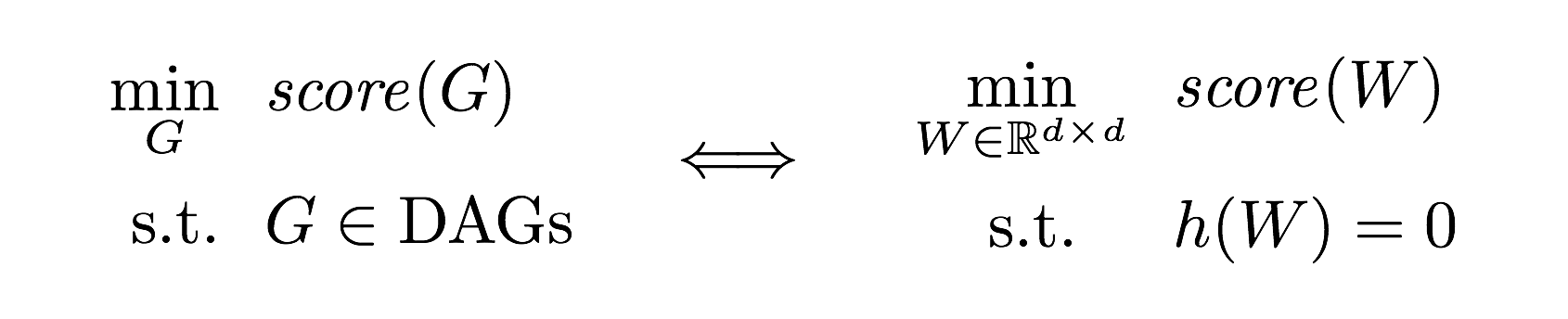
A major challenge of BNSL is enforcing the directed acyclic graph (DAG) constraint, which is combinatorial. While existing approaches rely on local heuristics, we introduce a fundamentally different strategy: we formulate it as a purely continuous optimization problem over real matrices that avoids this combinatorial constraint entirely. In other words,
where h is a smooth function whose level set exactly characterizes the
space of DAGs.
Requirements
- Python 3.6+
numpyscipypython-igraph: Install igraph C core andpkg-configfirst.torch: Optional, only used for nonlinear model.
Contents (New version)
linear.py- the 60-line implementation of NOTEARS with l1 regularization for various lossesnonlinear.py- nonlinear NOTEARS using MLP or basis expansionlocally_connected.py- special layer structure used for MLPlbfgsb_scipy.py- wrapper for scipy's LBFGS-Butils.py- graph simulation, data simulation, and accuracy evaluation
Running a simple demo
The simplest way to try out NOTEARS is to run a simple example:
$ git clone https://github.com/xunzheng/notears.git
$ cd notears/
$ python notears/linear.py
This runs the l1-regularized NOTEARS on a randomly generated 20-node Erdos-Renyi graph with 100 samples. Within a few seconds, you should see output like this:
{'fdr': 0.0, 'tpr': 1.0, 'fpr': 0.0, 'shd': 0, 'nnz': 20}
The data, ground truth graph, and the estimate will be stored in X.csv, W_true.csv, and W_est.csv.
Running as a command
Alternatively, if you have a CSV data file X.csv, you can install the package and run the algorithm as a command:
$ pip install git+git://github.com/xunzheng/notears
$ notears_linear X.csv
The output graph will be stored in W_est.csv.
Examples: Erdos-Renyi graph
Ground truth:
d = 20nodes,2d = 40expected edges.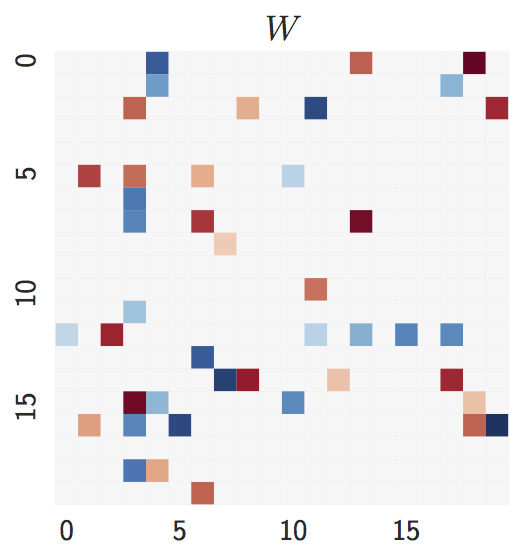
Estimate with
n = 1000samples:lambda = 0,lambda = 0.1, andFGS(baseline).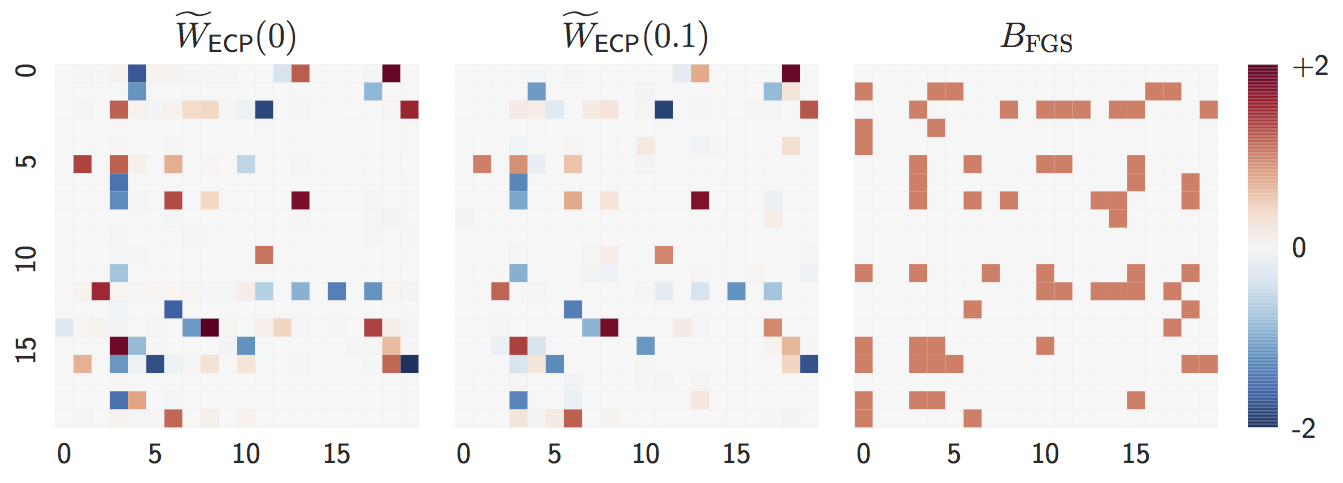
Both
lambda = 0andlambda = 0.1are close to the ground truth graph whennis large.Estimate with
n = 20samples:lambda = 0,lambda = 0.1, andFGS(baseline).
When
nis small,lambda = 0perform worse whilelambda = 0.1remains accurate, showing the advantage of L1-regularization.
Examples: Scale-free graph
Ground truth:
d = 20nodes,4d = 80expected edges.
The degree distribution is significantly different from the Erdos-Renyi graph. One nice property of our method is that it is agnostic about the graph structure.
Estimate with
n = 1000samples:lambda = 0,lambda = 0.1, andFGS(baseline).
The observation is similar to Erdos-Renyi graph: both
lambda = 0andlambda = 0.1accurately estimates the ground truth whennis large.Estimate with
n = 20samples:lambda = 0,lambda = 0.1, andFGS(baseline).
Similarly,
lambda = 0suffers from smallnwhilelambda = 0.1remains accurate, showing the advantage of L1-regularization.
Other implementations
- Python: https://github.com/jmoss20/notears
- Tensorflow with Python: https://github.com/ignavier/notears-tensorflow
Explore related projects
sindresorhus/awesome
😎 Awesome lists about all kinds of interesting topics [NOTE: Pull requests are temporarily disabled until I have a chance to catch up with the existing ones]
536,602 starsEbookFoundation/free-programming-books
:books: Freely available programming books
401,568 starsnilbuild/developer-roadmap
Interactive roadmaps, guides and other educational content to help developers grow in their careers.
371,974 starsvinta/awesome-python
The definitive list that answers "I want to do X in Python, which tool should I use?"
334,641 stars