
xiangechen/chili3d
xiangechen/chili3d has 4,975 GitHub stars and 501 forks. GitHot measured +4 stars in 24 hours, +16 in 7 days, and +39 in 15 days. Last checked 2026-11-09 00:03 UTC. Last push 2026-11-02.
A browser-based 3D CAD for AI-assisted, parametric and direct modeling.
What you can do
- Snapping and Tracking: snap to points, edges, faces and the workplane; track axes and detected feature points, with visual guides for both
- Measurement: measure lengths and angles, and total up length, area and volume across a selection
- Documents: create, open and save documents with a full transaction-based undo/redo stack; import and export STEP, IGES, BREP and STL
- Interface: Office-style contextual ribbon, hierarchical assembly tree, dynamic workplanes, turntable/trackball camera with position recall, and a command panel docked in the viewport
Measured star growth
- in 24h
- +4
- in 7 days
- +16
- in 15 days
- +39
- in 1 month
- Update delayed
Net star changes over overlapping periods, not daily totals. Missing measurements are left blank. Stars measure attention, not software quality.
README.md
OriginalChili3D
An open-source, browser-based 3D CAD for AI-assisted, parametric and direct modeling.
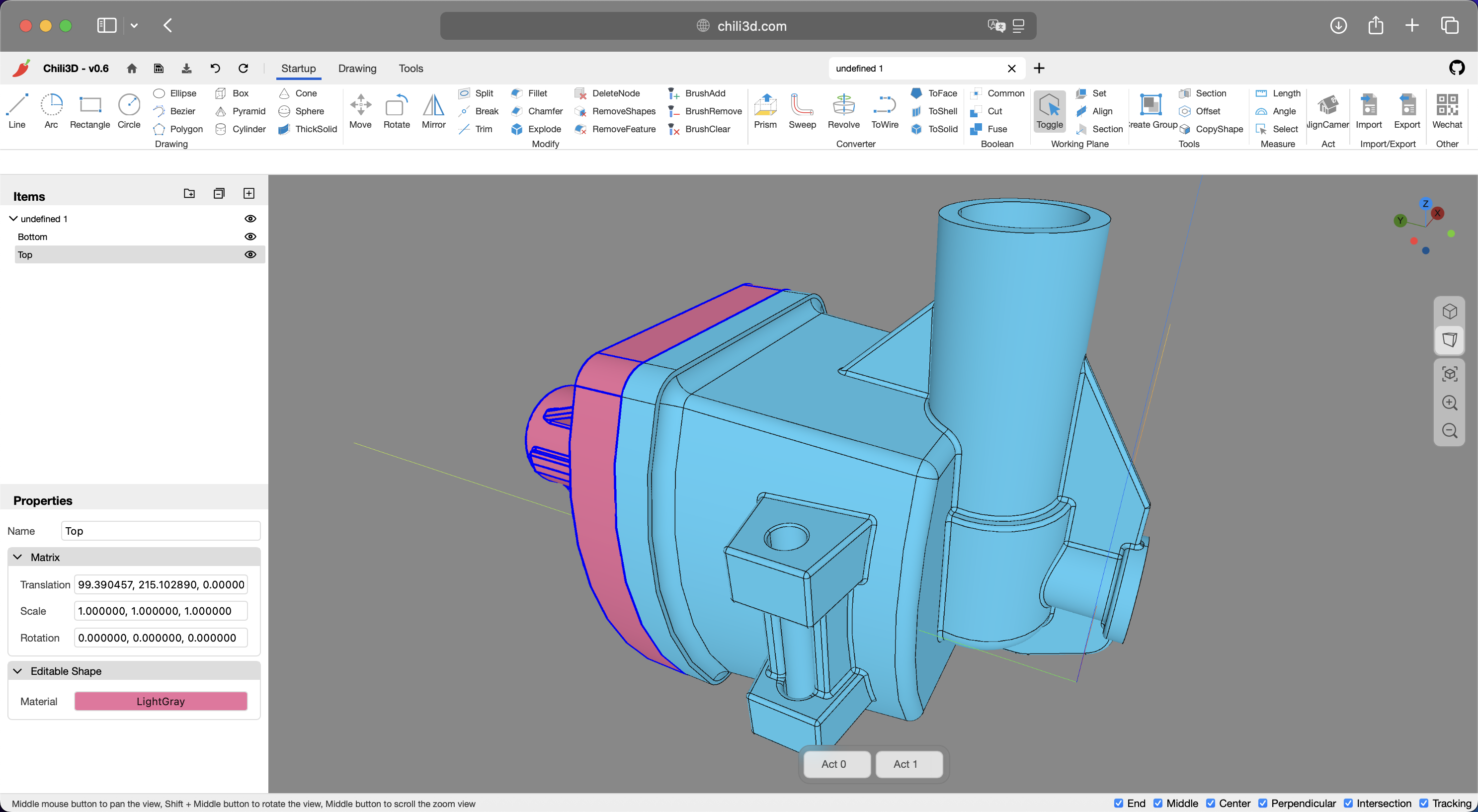
Try it now: chili3d.com — official site; a Cloudflare mirror is available as a backup.
Overview
Chili3D is an open-source 3D CAD (Computer-Aided Design) application built with TypeScript. It compiles OpenCascade (OCCT) to WebAssembly and renders through Three.js, bringing near-native modeling performance to the browser. AI, parametric and direct modeling share one document, viewport and undo stack, so you can move between them mid-design — a shape built by hand can be edited by the assistant, and an AI-built body is still a feature tree you can change.
Features
AI-Native Modeling
The built-in assistant runs entirely in the browser and calls the LLM endpoint directly with your own API key — there is no relay server in between. AI-native here means it is not a side panel bolted on: it reads and writes the same document, selection and feature tree as the commands, and every change it makes lands in the same undo stack.
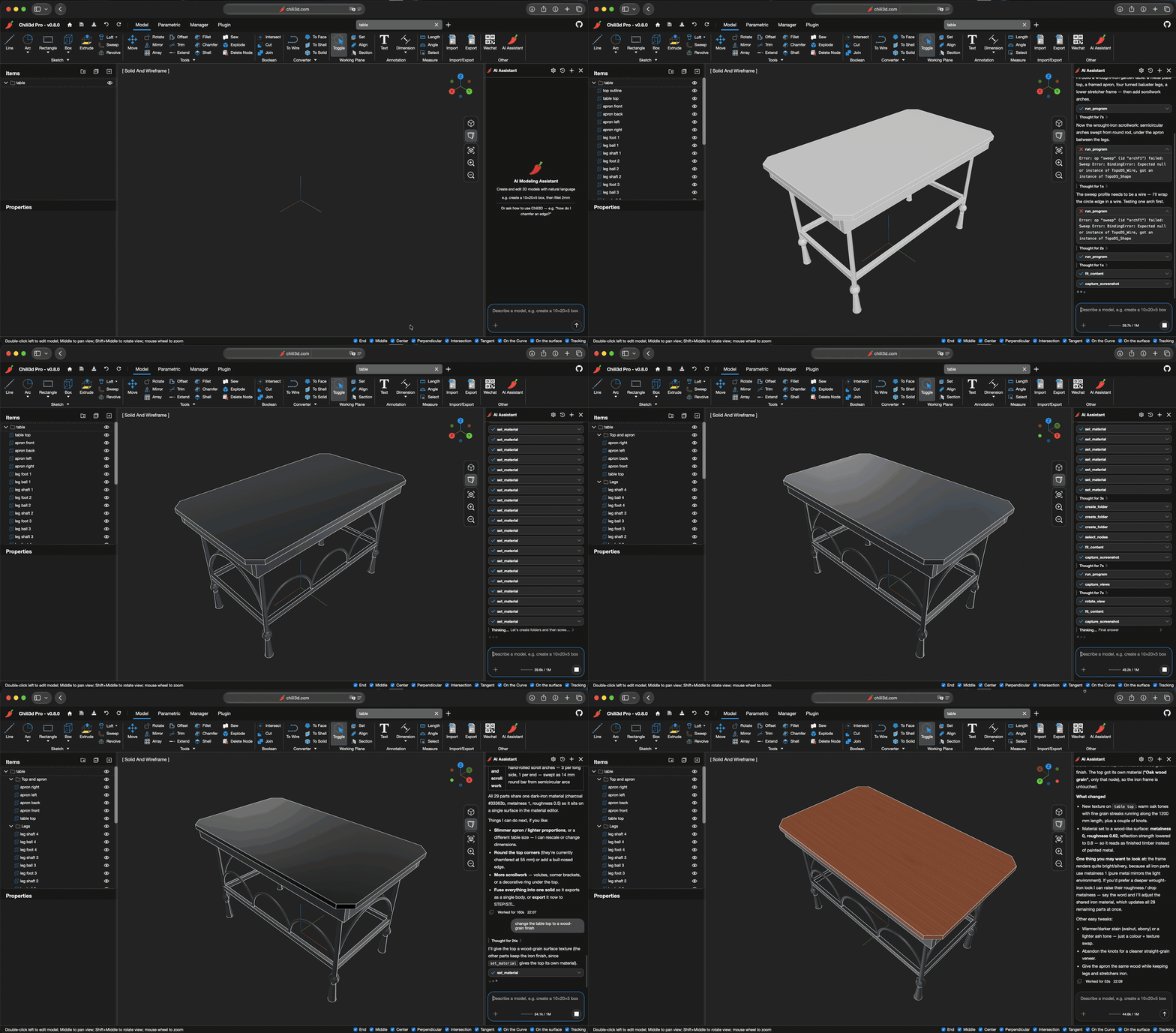
One sentence builds the table. When a sweep call fails, the assistant diagnoses the error and corrects it on its own, then retextures the top.
- What It Can Do: build a part from a description, reshape an existing model (dimensions, fillets, holes, booleans), measure lengths, areas and volumes, query face/curve/surface types, organize the tree, set properties and materials, manage document variables, adjust the view and export the result — all through chat
- Document Awareness: reads the document tree, the geometry and the current selection, and captures viewport screenshots, so a request like "make this flange thicker" resolves against the right nodes
- Two Modeling Paths:
run_programapplies modeling operations to produce geometry (one call is one undo step);run_parametricbuilds a parametric feature tree the user can keep editing afterwards - Reference Images: paste or upload a picture to model from; the image is read before any geometry-changing tool is allowed to run
- Providers: Anthropic API, OpenAI Completions API and OpenAI Responses API, with a configurable base URL, model, reasoning effort and context window; the API key is kept only for the session and can be handed to the browser's password manager
- On-Demand Skills: guidance for the app, the modeling API, shape/curve/surface queries, modeling recipes, error recovery and parametric modeling are loaded only when the model asks for them, keeping the prompt small
- Conversations: saved locally, with automatic context budgeting that compacts old turns into a condensed journal instead of losing the thread
- Local Bridge:
?bridge=<port>connects the page to a local process over a WebSocket (outbound, default port 17373), and that process — the separatechili3d-mcpserver — calls the same tool registry the chat panel uses, so an external agent can read and edit the open document; without the parameter, none of it is loaded
Parametric Modeling
Parametric bodies are feature-list models in the Onshape/Fusion style: a body stores no baked shape, only an ordered list of features, and the list is replayed top to bottom on every rebuild. Editing any upstream feature — a dimension, a sketch line, a suppressed step — re-evaluates everything downstream of it.
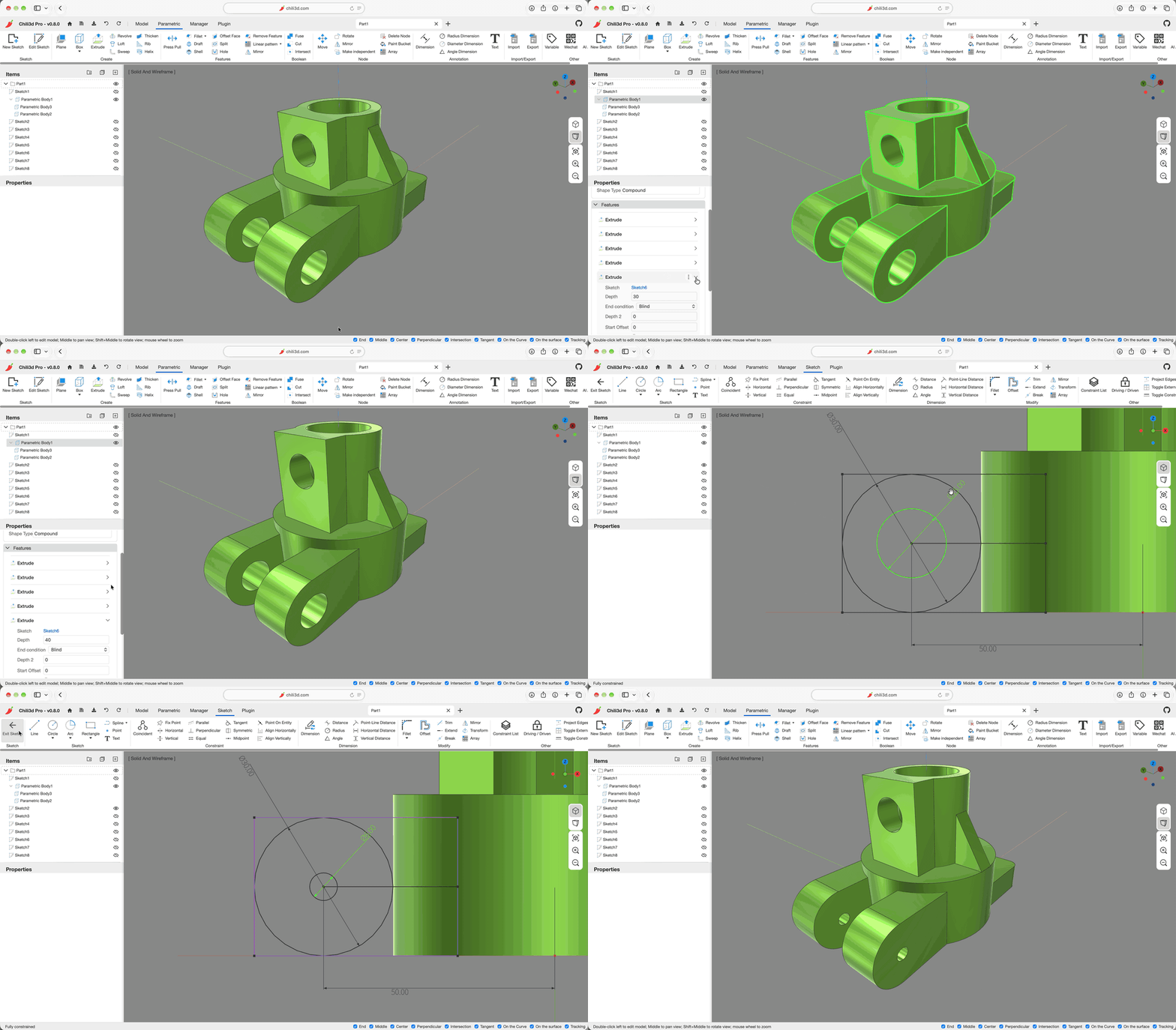
Edit one dimension in a fully constrained sketch, and every downstream feature rebuilds from it.
- Feature List: ordered, editable, reorder-aware features with per-feature suppression, rename and warnings; one body evaluates as a chain, so a change never leaves stale geometry behind
- Features: primitive, extrude (blind, symmetric, up-to-face/vertex), revolve, loft, sweep, helix, hole (with standard sizes), rib, draft, shell, thicken, fillet, chamfer, boolean, mirror, pattern, split, sew, offset face and transform
- 2D Sketches: lines, arcs, circles, ellipses, conics, splines and text, with geometric and dimensional constraints, construction geometry, auto-constraints, projected edges and external references; profiles stay solved by the embedded garlic constraint solver
- Stable References: downstream features refer to faces, edges, vertices and sketch profiles by tracked identity, so those references still resolve after an upstream change; a reference that cannot be resolved can be re-selected without rebuilding the feature
- Variables: document variables drive feature dimensions and can suppress a feature when they resolve to zero
- Interactive Preview: press-pull on faces, drag handles for extrusion depth, draft angles and fillet/chamfer radii, with the result previewed before it is committed
Direct Modeling
Direct modeling works on the geometry itself: a command creates a shape node or replaces the shape of an existing one, with no feature history behind it. It is the fastest path for one-off shapes and for editing imported geometry.
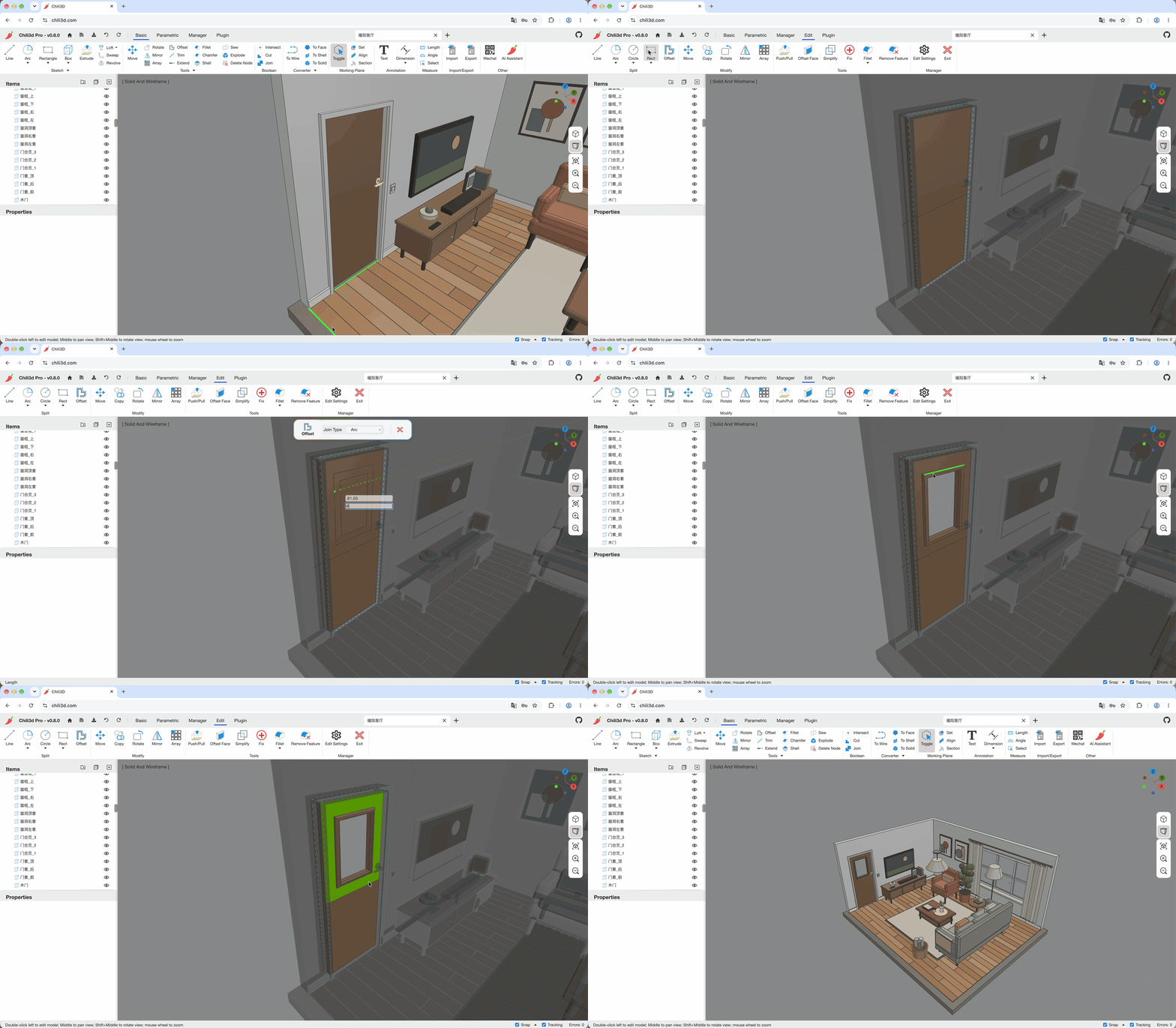
An imported interior model edited face by face: pick a face, drag the Push/Pull handle, and the geometry changes in place — no feature history required.
- Basic Shapes: boxes, spheres, cylinders, cones, pyramids, and more
- Curves and Wireframes: lines, arcs, circles, ellipses, Bézier curves, polygons, helices, pipes and text
- Advanced Operations:
- Boolean operations (union, difference, intersection)
- Extrusion, revolution, sweeping, lofting and Gordon surfaces
- Thick solid, shell and surface offset
- Shape conversion, sectioning and curve projection
- Shape checking and repair
- Editing: chamfer, fillet, trim, break, extend, split, sew, simplify, feature removal, sub-shape copy/removal, explode
- Interactive Input: pick faces, edges and snap points in the viewport, with a live preview and an option panel while the command is running
- Transformation: move, rotate, mirror, linear and circular arrays, copy
The commercial Chili3D Pro edition extends this into a full direct-editing session: double-click a shape to edit its B-rep in place — push/pull faces, round or chamfer edges with a drag handle, split with drawn curves, and hide or lock the rest of the scene while you work.
Other Features
- Snapping and Tracking: snap to points, edges, faces and the workplane; track axes and detected feature points, with visual guides for both
- Measurement: measure lengths and angles, and total up length, area and volume across a selection
- Documents: create, open and save documents with a full transaction-based undo/redo stack; import and export STEP, IGES, BREP and STL
- Interface: Office-style contextual ribbon, hierarchical assembly tree, dynamic workplanes, turntable/trackball camera with position recall, and a command panel docked in the viewport
- Plugins: load plugins at runtime with
?plugin=<url>; theplugins/directory has a macro editor and a Rete.js visual-programming editor - Localization: built-in i18n for English, Chinese (zh-cn) and Portuguese (Brazil); further locales welcome
Architecture
Chili3D is an npm workspace monorepo under packages/. core defines the interfaces; every other package implements or wires them:
web ──> builder ──> app ──> core + wasm
                  ──> parametric ──> core
                  ──> i18n ──> core
                  ──> three ──> core
                  ──> storage ──> core
                  ──> ui ──> core + element
                        └─> ai ──> core + element (+ parametric, loaded on demand)

element ──> core
core— Abstract interfaces (IShape,IShapeFactory), math (XYZ,Matrix4,Plane), document model, reactive data (Observable,Binding,PubSub),Result<T,E>, transactions/undo/redo, commands, serialization, plugin system, service container, UI abstractionselement— Custom reactive DOM elements (radio groups, expanders, data converters)wasm— ConcreteShapeFactorycalling into OCCT via Emscripten bindingsparametric— Feature-list bodies and the 2D sketch module: ordered feature data + handlers replayed on rebuild, the garlic constraint solver wrapper, tracked sub-shape references (EdgeRef,ProfileRef, vertex refs), body timelines, reselect sessions and the parametric command setthree— Three.js viewport, camera controller, visual objects, highlighter, outline pass, gizmo, mesh exporti18n— Locale data (en, zh-cn, pt-br)storage— IndexedDB persistence layerai— In-app assistant: browser-direct LLM providers, tool registry, therun_programcapability engine and on-demand skills; the parametric module is pulled in lazily on firstrun_parametric. Also the?bridge=<port>client (src/bridge/) that hands the same tool registry to a local process over a WebSocketui— Application chrome: main window, ribbon/toolbar, property panels, project tree, dialogs, toast, status bar, chat panel hostapp— ConcreteApplication, direct-modeling body node classes, command implementations,CommandService,HotkeyServicebuilder—AppBuilderwith a fluent.useIndexedDB().useWasmOcc().useParametric().useThree().useUI().build()chain and default ribbon layoutweb— Entry point: callsAppBuilder, shows loading screen, parses URL parameters
Technology Stack
- Frontend: TypeScript, Three.js (0.184)
- 3D Kernel: OpenCascade 8.0.1 (OCCT) compiled to WebAssembly via Emscripten
- Parametric Solver: garlic, vendored and compiled to WebAssembly for 2D sketch constraints
- AI Assistant: Anthropic / OpenAI SDKs, called directly from the browser
- Bundler: Rspack 2
- Linting & Formatting: Biome (TypeScript), clang-format (C++)
- Testing: Rstest + Happy-DOM
- Package Manager: npm workspaces
Getting Started
Prerequisites
- Node.js and npm — CI builds with Node 24, so that is the safest version to use
- To run the app: a modern browser with WebAssembly and WebGL 2 support
Installation
Clone the repository
git clone https://github.com/xiangechen/chili3d.git
cd chili3d
Install dependencies
npm install
Development
Start the development server:
npm run dev # Launches at http://localhost:8080
Building
Build the application:
npm run build
WASM Build (Optional)
The prebuilt WASM module is included in the repository. If you want to build it from source:
Set up WebAssembly dependencies (one-time setup):
npm run setup:wasmBuild the WebAssembly module:
npm run build:wasm
Testing & Linting
npm run test             # Run all tests (Rstest + Happy-DOM)
npm run testc            # Tests with coverage
npm run test:scenarios   # Drive the real app in headless Chrome (needs `npm run dev` running)
npm run check            # Biome lint + auto-fix
npm run format           # Biome + clang-format across all files
Docker
You can also deploy with Docker:
docker compose up -d # Builds and serves the app at http://localhost:8080
Code Style
- TypeScript: Biome for linting and formatting — 4-space indent, 110-char line width, double quotes, semicolons always
- C++: clang-format with WebKit style
- Interfaces prefixed with
I(IShape,ICommand) camelCasefunctions/variables,PascalCaseclasses,UPPER_SNAKE_CASEconstants- Type-only imports:
import type { IFoo } from "..." - Pre-commit hooks via simple-git-hooks + lint-staged
Changelog
See the GitHub releases for the full changelog and release notes.
Chinese-speaking users can also follow the video walkthroughs on Bilibili.
Contributing
We welcome contributions! Please feel free to submit pull requests or open issues.
Before submitting a PR, run npm run check to ensure your code passes linting.
Contact
- Discussions: Join our GitHub discussions for general chat or questions
- Issues: Use GitHub issues to report suggestions or bugs
- Email: Contact us privately at [email protected]
License
Distributed under the GNU Affero General Public License v3.0 (AGPL-3.0). For commercial licensing options, contact [email protected].
Full license details: LICENSE
The C++ WASM module (cpp/) is licensed under LGPL-3.0.
Analytics Notice
Chili3D uses Microsoft Clarity for growth analytics. To disable data collection, remove the Clarity script from public/index.html.
Disclaimer
This software is provided "AS IS," and the authors and contributors hereby disclaim all express and implied warranties. The user shall bear full responsibility for any and all risks and potential consequences arising from the use of this software. Such risks and consequences include, but are not limited to:
- Data loss, system failures, or any direct or indirect damages;
- Conduct violating applicable laws or regulations resulting from software usage and its consequences;
- All liabilities arising from the software's use for illegal purposes or activities.
Explore related projects
ytdl-org/youtube-dl
Command-line program to download videos from YouTube.com and other video sites
141,500 starsexcalidraw/excalidraw
Virtual whiteboard for sketching hand-drawn like diagrams
135,331 starsgodotengine/godot
Godot Engine – Multi-platform 2D and 3D game engine
119,840 starsmrdoob/three.js
JavaScript 3D Library.
117,905 stars