
xiabai2008/ruoyi-scan
xiabai2008/ruoyi-scan has 54 GitHub stars and 10 forks. GitHot measured 0 stars in 24 hours and +1 in 7 days. Last checked 2026-11-11 10:53 UTC. Last push 2026-11-04.
RuoYi (若依) dedicated vulnerability scanner: plugin architecture, three-state verdict, WAF bypass, exploit chains, AI POC generation, nuclei compatible. 若依专项漏洞扫描器
Measured star growth
- in 24h
- 0
- in 7 days
- +1
- in 15 days
- Update delayed
- in 1 month
- Update delayed
Net star changes over overlapping periods, not daily totals. Missing measurements are left blank. Stars measure attention, not software quality.
README_EN.md
OriginalRuoyi-Scan · RuoYi-focused Vulnerability Scanner


A RuoYi-specific vulnerability scanner for authorized security testing. 54 POC plugins, 5 RuoYi variant fingerprints, 20 Java component CVE checks — and only three verdicts: CONFIRMED / SAFE / UNKNOWN.
pip install -U ruoyi-scan— or grab the single-file desktop build (Windows, no Python needed).
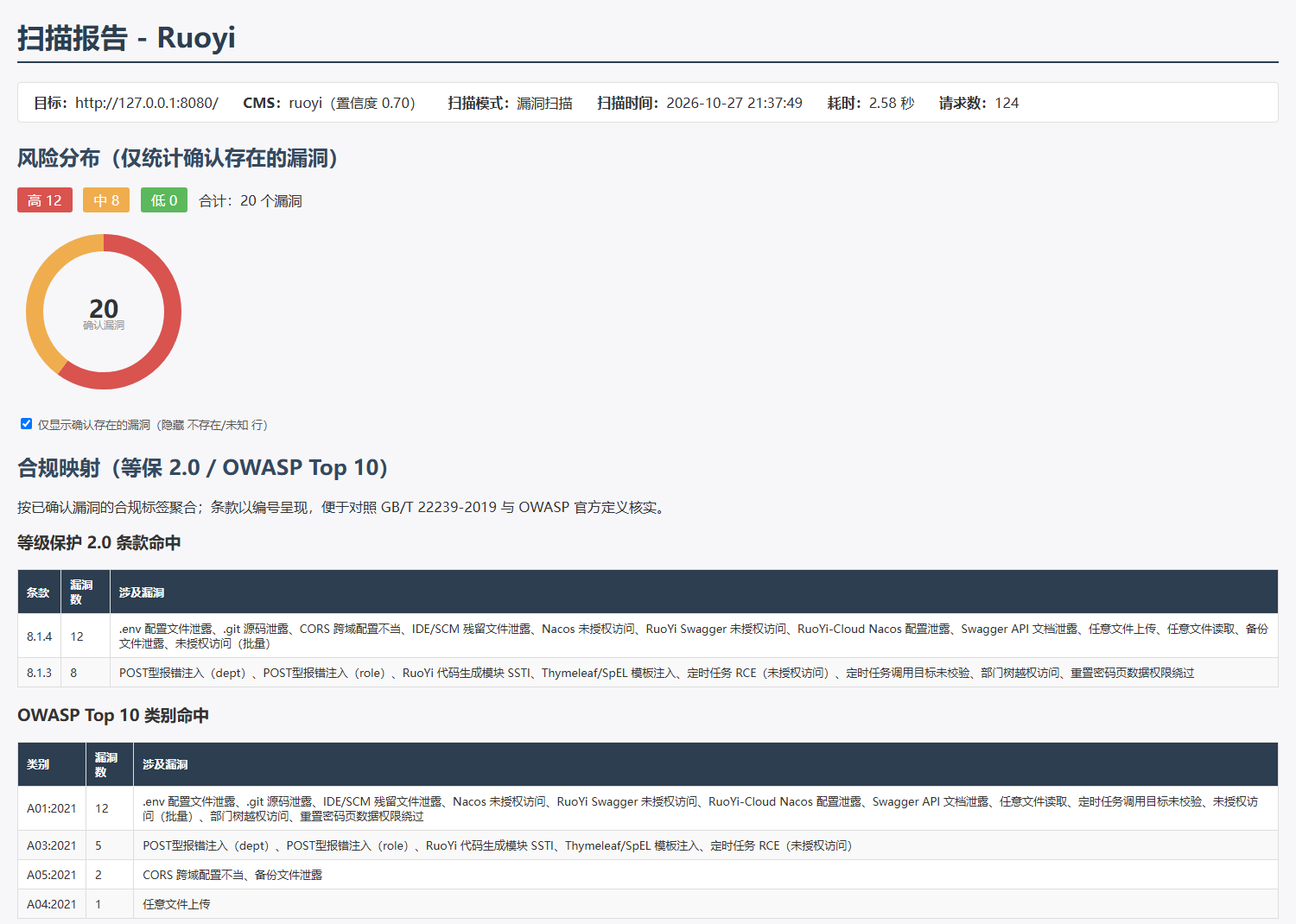
Real HTML report from a single
-prun (v1.5.2 against the bundled signature lab): risk distribution, MLPS 2.0 / OWASP clause hits, 20 confirmed findings — the report itself is the deliverable, in 7 formats (HTML/JSON/CSV/PDF/Word/Excel/SARIF).
⚠️ Maturity notice & how to contribute Ruoyi-Scan is currently validated mainly against the bundled signature lab and real version stacks; it has not yet been through large-scale field use, so no guarantee is made on detection rate (yield), false negatives, or false positives — anything it can't decide is reported as
UNKNOWN, never padded. The project will keep iterating in small steps, tightening verdict quality release by release. Contributions are welcome: open an Issue or a PR. You're also free to fork and build your own version — under the MIT License, the only requirement is crediting the original source (XIABAI / Ruoyi-Scan) in derivative works; no extra permission needed, commercial or closed-source redistribution allowed. If your fork is broadly useful, feel free to send it back as a PR.
Why not just use nuclei / xray?
Generic scanners tell you "something might be here". Ruoyi-Scan gives a verdict you can put in a report:
| Generic scanners | Ruoyi-Scan | |
|---|---|---|
| Not vulnerable | Absent from the report; you can't tell if it was tested | SAFE — tested and ruled out |
| Network error / WAF block / captcha | error or skipped | UNKNOWN — never silently reported as SAFE |
| Evidence | signature match | structured validation + proof (file content read back, injection marker) |
This discipline is testable: the bundled signature lab runs in vuln and safe modes, and CI /
nightly acceptance assert "20 confirmed findings in vuln mode" and "zero false positives in safe mode".
Per-plugin verification level (L1 lab / L2 real response / L3 real software, both directions) is public
in docs/verification-matrix.md.
Quick start
pip install -U ruoyi-scan

ruoyi-scan -p http://target:8080/                       # POC verification only (fast)
ruoyi-scan -u http://target:8080/                       # full scan: fingerprint → dir → POC → weak creds
ruoyi-scan -u http://target:8080/ --report ./reports --report-format all
Real output (v1.5.2, against the bundled signature lab):
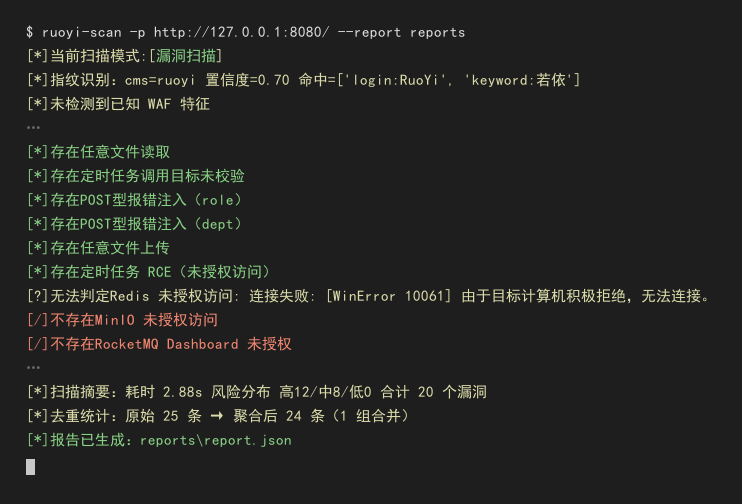
Every line is one verdict, colored by state; the tail prints the summary, dedup stats and report path.
Reports
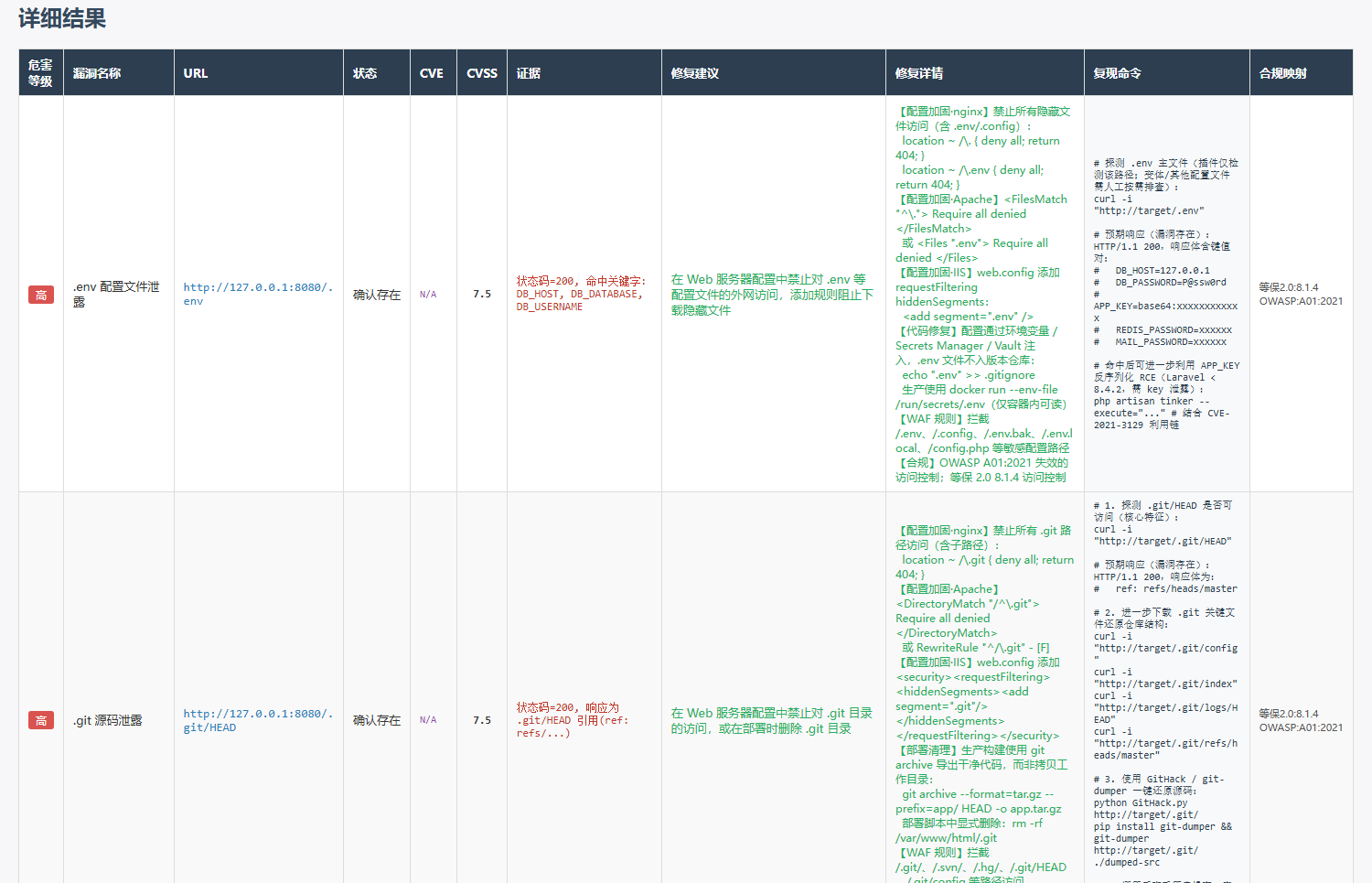
Each finding carries evidence (status code + matched keyword / reflected content), remediation advice, fix details (nginx / Apache / IIS snippets and code changes), a repro command, CVE / CVSS and compliance mapping (MLPS clause + OWASP category).
Modes
| Mode | Command | Description |
|---|---|---|
| POC check | -p <url> |
Vulnerability verification only; fast, low request count |
| Full scan | -u <url> |
Fingerprint → directory scan → POC → weak-password brute force |
| Directory scan | -m <url> |
Sensitive paths, admin panels, actuator endpoints |
| Login brute force | -l <url> |
Druid / default admin credentials (--pass-level top100 to narrow) |
Batch: ruoyi-scan -f targets.txt -p --report ./reports. All flags: docs/usage.md.
Capabilities
- Detection — 54 POCs: RuoYi 20 (incl. 2 Plus-variant only) / Spring Boot 14 / generic 12 / JeecgBoot 8;
5 variant fingerprints (Vue3 / App / Plus / Cloud-Plus / Magic); 20 Java component→CVE checks;
11 WAF bypass strategies + optional stealth transport; nuclei YAML compatible (
--nuclei) - Delivery — 7 report formats (HTML/JSON/CSV/PDF/Word/Excel/SARIF), MLPS 2.0 / OWASP mapping sections, docx template engine, remediation re-test, SARIF for GitHub Code Scanning
- Engineering — FastAPI + WebSocket API with RBAC and scheduled scans, single-exe desktop app, Docker, plugin SDK + community template repo with enforced Ed25519 signatures
- Runnable labs — signature lab / behaviour-level simulation (captcha + CSRF + diff-based verdicts) /
adversarial network (WAF, rate limit, soft-404) / real Docker stack (RuoYi 4.7.8 + MySQL + nginx + ModSecurity).
8 real-world usage scenarios are scripted in
scripts/scenario_audit.py; see lab/SCENARIO-AUDIT.md
Install options
| Form | How | Notes |
|---|---|---|
| pip | pip install -U ruoyi-scan |
Recommended; optional extras: ruoyi-scan[report,serve] |
| Desktop | ruoyi-scan-desktop.exe from Releases |
~49 MB, engine + 54 POCs embedded, no install |
| Docker | docker build -t ruoyi-scan . or docker compose up -d |
Multi-stage, non-root; compose ships two signature labs |
Desktop app
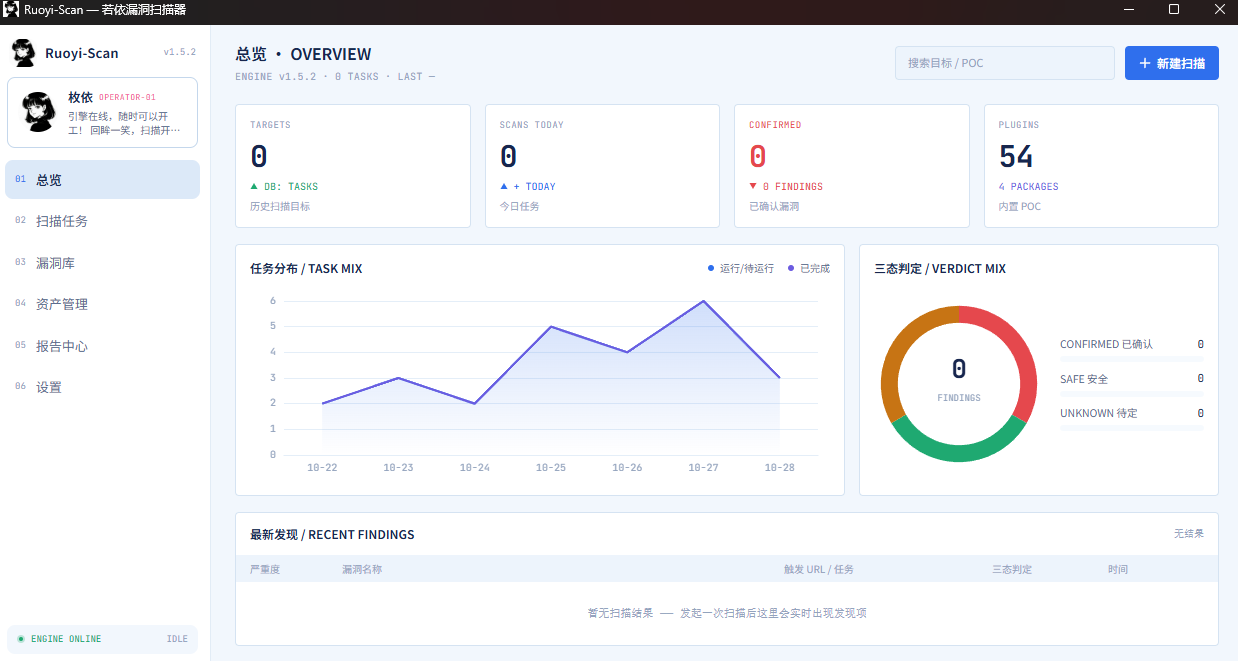
Single-file Windows exe (Tauri + WebView2): engine and 54 POCs embedded; new scan, live results and report archiving in one window. The engine subprocess is bound to a JobObject, so killing the app leaves no orphans.
Documentation
Quick start · User manual · Plugin development · Verification matrix · Desktop · API · DevSecOps · Online docs
Compliance
For authorized security testing and vulnerability verification only — existence checks, no destructive exploitation. You are responsible for complying with applicable laws; testing systems without permission is illegal.
License
MIT © XIABAI
Explore related projects
trimstray/the-book-of-secret-knowledge
A collection of inspiring lists, manuals, cheatsheets, blogs, hacks, one-liners, cli/web tools and more.
257,914 starsHack-with-Github/Awesome-Hacking
A collection of various awesome lists for hackers, pentesters and security researchers
125,254 starsswisskyrepo/PayloadsAllTheThings
A list of useful payloads and bypass for Web Application Security and Pentest/CTF
82,623 starscaddyserver/caddy
Fast and extensible multi-platform HTTP/1-2-3 web server with automatic HTTPS
79,020 stars