
worldbench/U4D has 32 GitHub stars and 1 forks. Star changes are not measured yet. Last checked 2026-11-09 15:48 UTC. Last push 2025-12-20.
[CVPR 2026 Highlight] U4D: Uncertainty-Aware 4D World Modeling from LiDAR Sequences
Measured star growth
- in 24h
- Update delayed
- in 7 days
- Update delayed
- in 15 days
- Update delayed
- in 1 month
- Update delayed
Net star changes over overlapping periods, not daily totals. Missing measurements are left blank. Stars measure attention, not software quality.
README.md
OriginalEnglish | 简体中文
U4D: Uncertainty-Aware 4D World Modeling from LiDAR Sequences
Xiang Xu Ao Liang Youquan Liu Linfeng Li Lingdong Kong Ziwei Liu Qingshan Liu


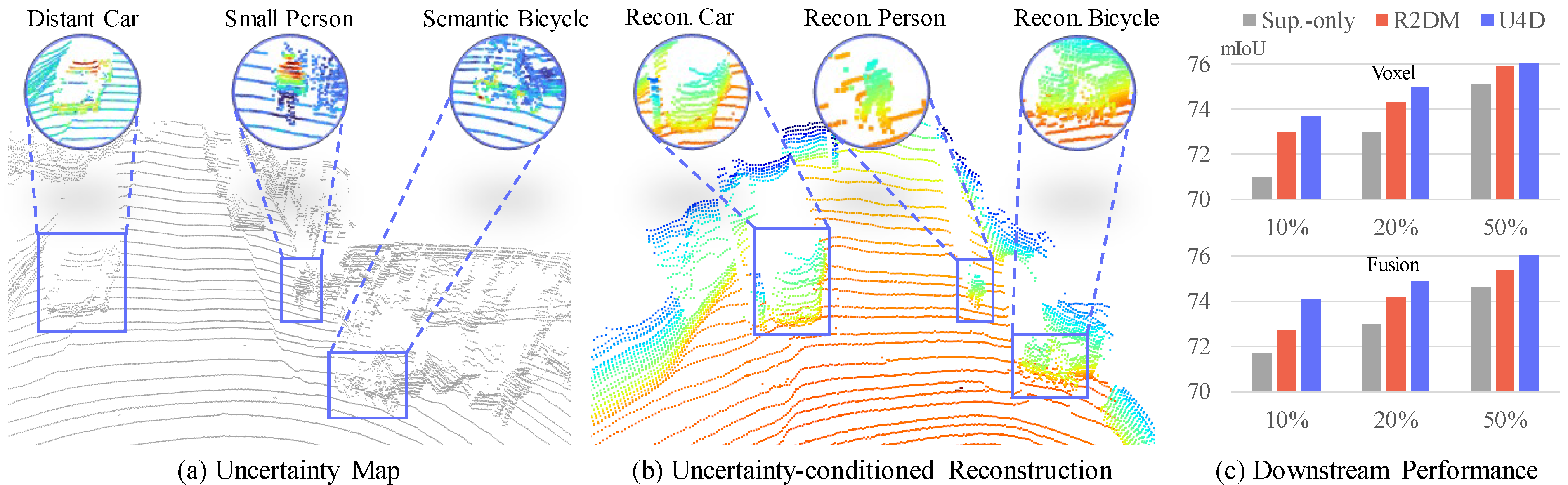
In this work, we introduce U4D, an uncertainty-aware framework for 4D LiDAR world modeling. The main contributions are:
- We introduce the first uncertainty-aware LiDAR generation framework that explicitly models spatial difficulty to enhance reliability in 4D world modeling.
- We design a two-stage hard-to-easy generation paradigm that reconstructs uncertain regions first and then completes the full scene under these priors.
- We develop a Mixture of Spatio-Temporal (MoST) block that ensures temporal consistency across frames by adaptively balancing spatial geometry and temporal dynamics.
:books: Citation
If you find this work helpful for your research, please kindly consider citing our paper:
@article{xu2025U4D,
    title   = {{U4D}: Uncertainty-Aware {4D} World Modeling from {LiDAR} Sequences},
    author  = {Xu, Xiang and Liang, Ao and Liu, Youquan and Li, Linfeng and Kong, Lingdong and Liu, Ziwei and Liu, Qingshan},
    journal = {arXiv preprint arXiv: 2512.02982},
    year    = {2025}
}
Updates
- [12.2025] - The technical report of U4D is available on arXiv.
License
This work is under the Apache License Version 2.0, while some specific implementations in this codebase might be with other licenses. Kindly refer to LICENSE.md for a more careful check, if you are using our code for commercial matters.
Acknowledgements
This work is developed based on the R2DM codebase.
Explore related projects
affaan-m/ECC
The agent harness performance optimization system. Skills, instincts, memory, security, and research-first development for Claude Code, Codex, Opencode, Cursor and beyond.
300,787 starsNousResearch/hermes-agent
The agent that grows with you
262,437 starsmultica-ai/andrej-karpathy-skills
A single CLAUDE.md file to improve Claude Code behavior, derived from Andrej Karpathy's observations on LLM coding pitfalls.
231,855 starsfirecrawl/firecrawl
Supercharge your AI agents with data from the web and beyond. Building the library for superintelligence. 🔥
200,444 stars