
wonder-sk/qt3d-experiments
wonder-sk/qt3d-experiments has 64 GitHub stars and 11 forks. Star changes are not measured yet. Last checked 2026-11-14 05:01 UTC. Last push 2026-01-19.
Measured star growth
- in 24h
- Collecting history
- in 7 days
- Collecting history
- in 15 days
- Collecting history
- in 1 month
- Collecting history
Net star changes over overlapping periods, not daily totals. Missing measurements are left blank. Stars measure attention, not software quality.
About
Experiments with 3D graphics using Qt3D framework
Creative & MediaREADME.md
OriginalQt3D Experiments
Here are few projects that make use of Qt3D framework - I have ended up creating them while working on rendering techniques for QGIS 3D.
Qt3D framework is a really nice addition to Qt ecosystem, but the documentation is still quite sparse and sometimes even wrong. There are not that many code examples floating around that use Qt 3D to demonstrate various 3D rendering techniques, so this is my little contribution towards that.
I have used QML as much as possible to keep the code concise. C++ was only used for bits where QML does not have the necessary bindings (yet?).
Compiling on Ubuntu
If you are using Ubuntu 18.04 or 20.10, then everything is great and the qt3d5-dev package contains all include files you need. But if you are on Ubuntu 18.10, 19.04, 19.10 or 20.04, that package does not contain include files for Qt3DExtras and Qt3DQuickExtras libraries. A workaround is to:
- download source package for your system version - e.g. from here for 20.04: https://packages.ubuntu.com/source/focal/qt3d-opensource-src and unpack it
- add to qmake
.profile a line to path to those missing includes, e.g.INCLUDEPATH += /your/path/qt3d-everywhere-src-5.12.8/include
Billboards
Demonstrates billboards rendering technique - quads with constant screen size that are always facing the camera. This uses geometry shader to generate quads from points.

Multisample Anti-aliasing (MSAA)
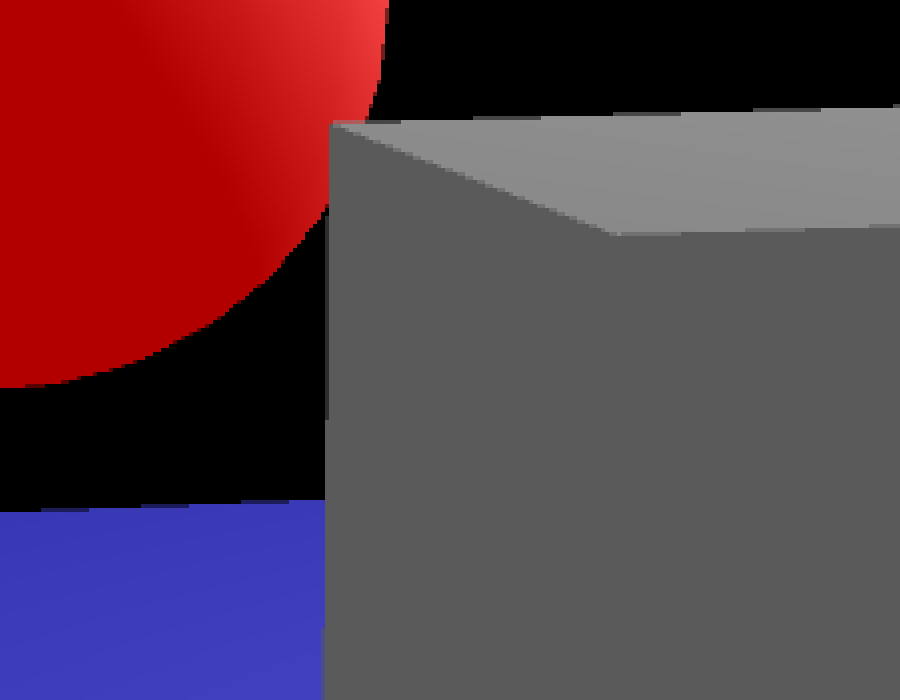
Shows how to turn on multisample anti-aliasing with Qt3D. We create a render target with multisample textures, render to it (with render state including MultiSampleAntiAliasing), and then "resolve" multisample textures with BlitFramebuffer framegraph node. Learn more about MSAA in LearnOpenGL tutorial.
| Anti-aliasing OFF | Anti-aliasing ON |
|---|---|
 |
 |
Screen Space Ambient Occlusion (SSAO)
Implementation of SSAO that is based on John Chapman's tutorial and LearnOpenGL tutorial. It only uses depth buffer as the input and samples from full sphere. The tutorials also use normals (for each pixel) and therefore only use a hemisphere for sampling. But I needed this for rendering where point clouds (with no normal vectors) are used, so I went for this variant (probably lower quality).

Edge Detection
Edge detection is done as a post-processing pass of scene rendering. In the first stage we generate depth texture and normal vectors texture which are then combined in the post-processing pass using Sobel filter.

Instanced Rendering
Using instancing to render a single geometry at multiple different positions.

Lines
Rendering of lines in 3D space with constant screen space thickness. Supports flat and miter joins.

Silhouettes with Stencil Buffer
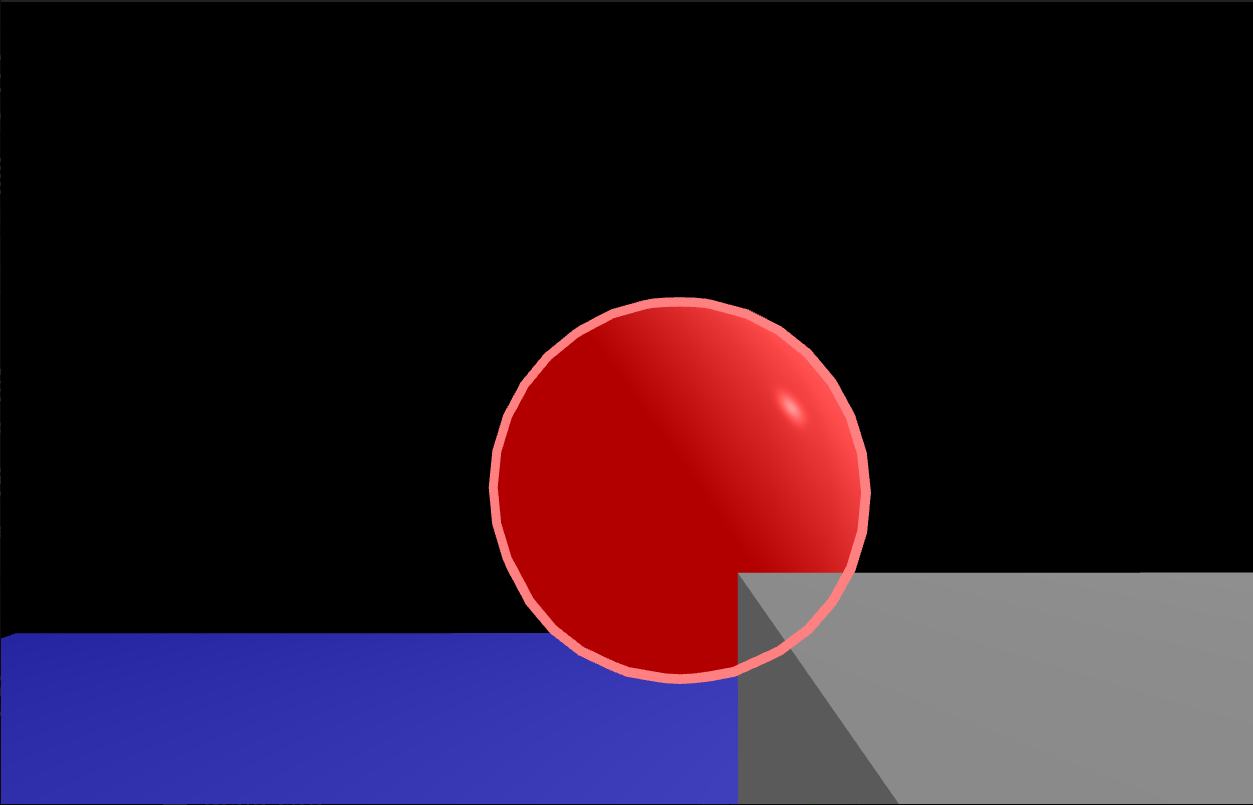
Render silhouette of object(s) by drawing a scaled-up version of the same geometry and stencil buffer to avoid overpainting the highlighted object itself. Based on the LearnOpenGL stencil testing tutorial.
3D Gaussian Splatting
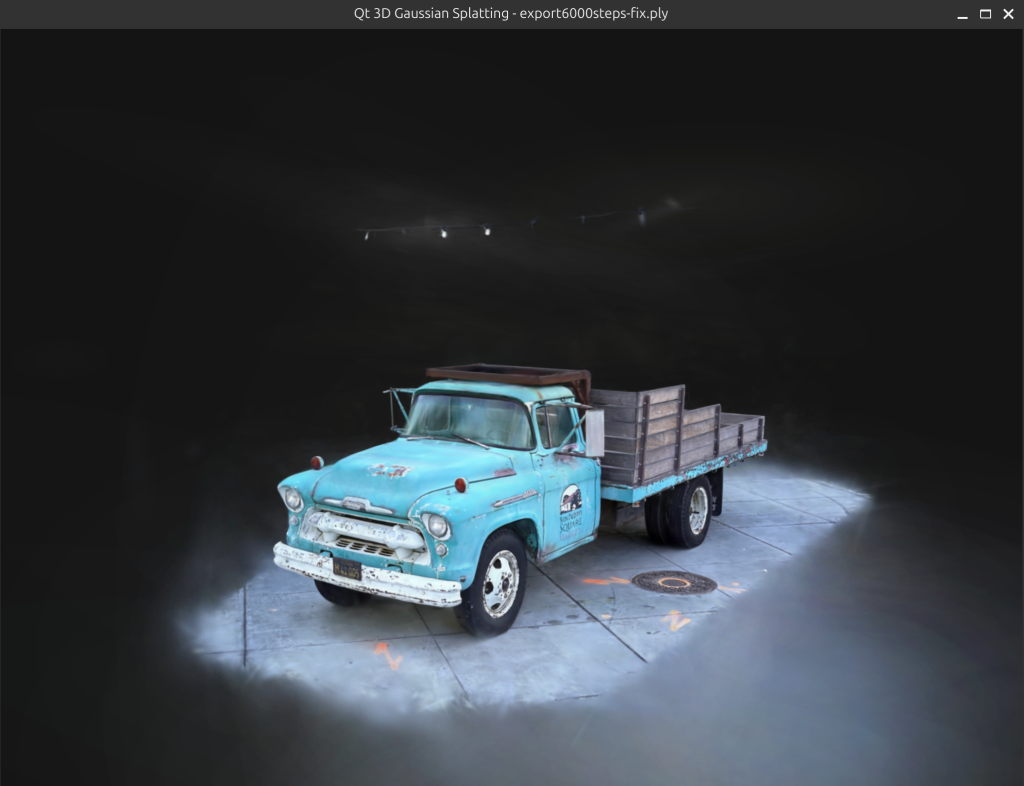
A prototype to do 3D Gaussian splatting rendering. It is pretty basic and requires some optimizations and fixes. It loads a PLY file given on the command line. Sorting of splats happens on the CPU.
Arrows
Drawing rotated and scaled textures of arrows on a mesh. (The end goal is that arrow angles/magnitudes of arrows would be read from another texture, not just based on world positions.)

Relative-to-center Rendering
This code demonstrates the "relative to center" rendering technique with Qt3D. It is useful when working with large coordinates (e.g. when creating a virtual globe) without getting numerical issues (which would make objects jump around when zoomed in). The idea is that we make sure to do model-view-projection (MVP) matrix calculation in double precision, and only then convert it to single precision floats that will be used on the GPU.
| Using double precision | Using single precision (without RTC) |
|---|---|
Logarithmic Depth
This code demonstrates logarithmic depth buffer rendering technique. It is a way to increase the precision of the depth buffer when using large depth range (e.g. when creating a virtual globe). The idea is that the fragment shader sets depth of fragments to make a better use of the range [0..1] instead of keeping the depth value that came out from the projection matrix.
| Using logarithmic depth | Without logarithmic depth |
|---|---|
Explore related projects
ytdl-org/youtube-dl
Command-line program to download videos from YouTube.com and other video sites
141,560 starsexcalidraw/excalidraw
Virtual whiteboard for sketching hand-drawn like diagrams
135,658 starsgodotengine/godot
Godot Engine – Multi-platform 2D and 3D game engine
120,113 starsmrdoob/three.js
JavaScript 3D Library.
118,345 stars