
weichen582/RetinexNet
weichen582/RetinexNet has 800 GitHub stars and 163 forks. GitHot measured 0 in 7 days and 0 in 15 days. Last checked 2026-11-09 13:23 UTC. Last push 2020-12-02.
A Tensorflow implementation of RetinexNet
Measured star growth
- in 24h
- Update delayed
- in 7 days
- 0
- in 15 days
- 0
- in 1 month
- Update delayed
Net star changes over overlapping periods, not daily totals. Missing measurements are left blank. Stars measure attention, not software quality.
README.md
OriginalRetinexNet
This is a Tensorflow implement of RetinexNet
Deep Retinex Decomposition for Low-Light Enhancement. In BMVC'18 (Oral Presentation)
Chen Wei*, Wenjing Wang*, Wenhan Yang, Jiaying Liu. (* indicates equal contributions)
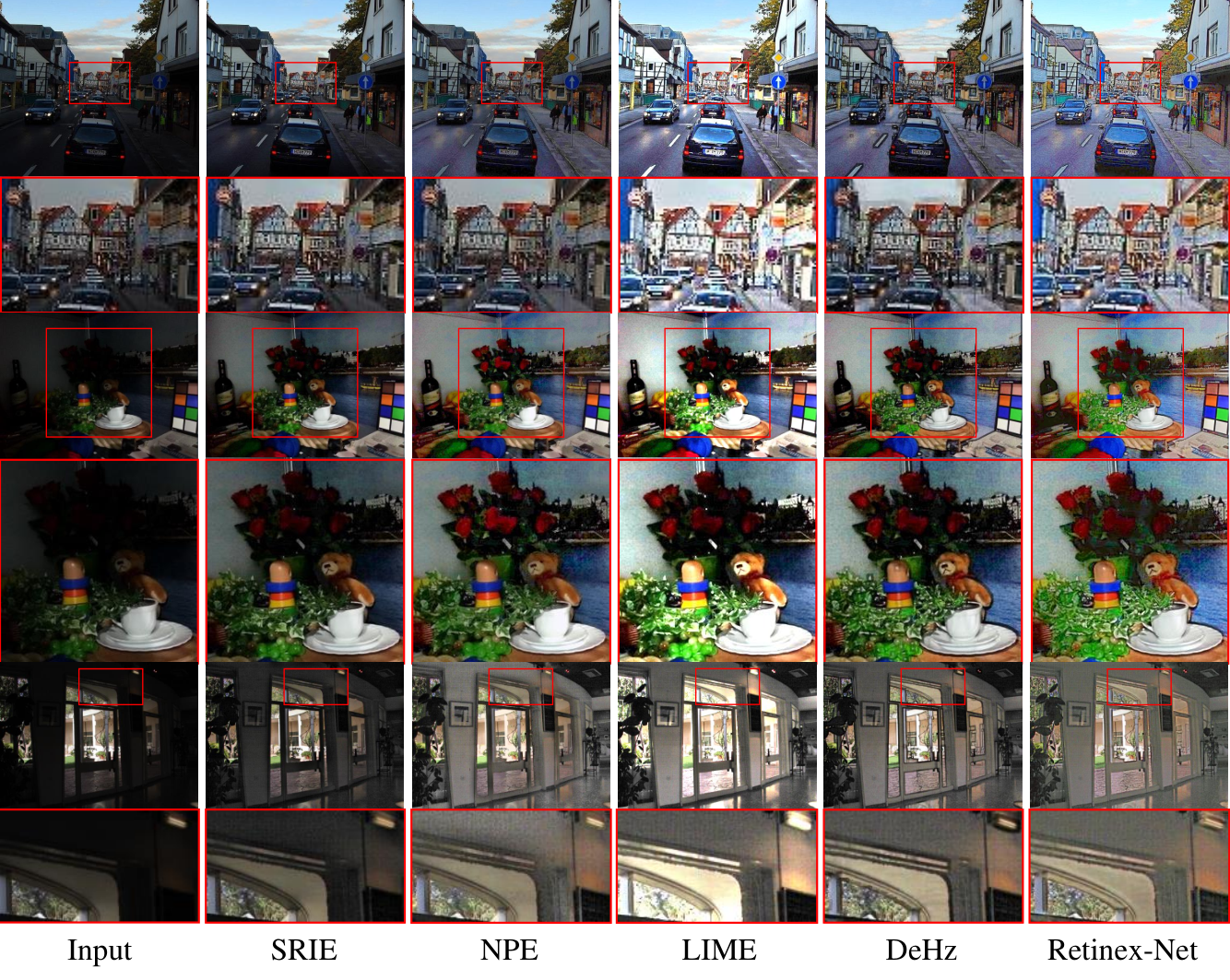
Requirements
- Python
- Tensorflow >= 1.5.0
- numpy, PIL
Testing Usage
To quickly test your own images with our model, you can just run through
python main.py
    --use_gpu=1 \                           # use gpu or not
    --gpu_idx=0 \
    --gpu_mem=0.5 \                         # gpu memory usage
    --phase=test \
    --test_dir=/path/to/your/test/dir/ \
    --save_dir=/path/to/save/results/ \
    --decom=0                               # save only enhanced results or together with decomposition results
Or you can just see some demo cases by
python main.py --phase=test
, the results will be saved under ./test_results/.
Training Usage
First, download training data set from our project page. Save training pairs of our LOL dataset under ./data/our485/, and synthetic pairs under ./data/syn/.
Then, just run
python main.py
    --use_gpu=1 \                           # use gpu or not
    --gpu_idx=0 \
    --gpu_mem=0.5 \                         # gpu memory usage
    --phase=train \
    --epoch=100 \                           # number of training epoches
    --batch_size=16 \
    --patch_size=48 \                       # size of training patches
    --start_lr=0.001 \                      # initial learning rate for adm
    --eval_every_epoch=20 \                 # evaluate and save checkpoints for every # epoches
    --checkpoint_dir=./checkpoint           # if it is not existed, automatically make dirs
    --sample_dir=./sample                   # dir for saving evaluation results during training
Tips:
- The model is quite small, so it will take just minutes to finish the training procedure if you are using GPU. For people who are using CPU, it is also affordable.
- The enhancement performance is highly dependent on training parameters. So if you change the default parameters, you might get some weird results.
Citation
@inproceedings{Chen2018Retinex,
 title={Deep Retinex Decomposition for Low-Light Enhancement},
 author={Chen Wei, Wenjing Wang, Wenhan Yang, Jiaying Liu},
 booktitle={British Machine Vision Conference},
 year={2018},
 organization={British Machine Vision Association}
}
Explore related projects
tensorflow/tensorflow
An Open Source Machine Learning Framework for Everyone
201,427 starshuggingface/transformers
🤗 Transformers: the model-definition framework for state-of-the-art machine learning models in text, vision, audio, and multimodal models, for both inference and training.
168,711 starsAUTOMATIC1111/stable-diffusion-webui
Stable Diffusion web UI
165,274 starsComfy-Org/ComfyUI
The most powerful and modular diffusion model GUI, api and backend with a graph/nodes interface. The fastest local inference engine in the world.
146,024 stars