
vscarpenter/gsd-task-manager
vscarpenter/gsd-task-manager has 41 GitHub stars and 4 forks. GitHot measured 0 stars in 24 hours. Last checked 2026-11-15 01:56 UTC. Last push 2026-11-13.
Measured star growth
- in 24h
- 0
- in 7 days
- Collecting history
- in 15 days
- Collecting history
- in 1 month
- Collecting history
Net star changes over overlapping periods, not daily totals. Missing measurements are left blank. Stars measure attention, not software quality.
About
Stop juggling, start finishing. GSD Task Manager makes it easy to sort your to-dos into what’s urgent and what’s important, so you can finally get stuff done without burning out. It’s simple, visual, and works entirely offline.
Web & AppsREADME.md
OriginalGSD Task Manager
A privacy-first Eisenhower matrix for deciding what to do, schedule, delegate, or eliminate.
Live app: gsd.vinny.dev Current version: 14.8.8 Current product: the single-matrix shell introduced in v9 (ADR 0011), offline-first local storage, optional PocketBase sync, and the GSD MCP server.


What ships
- A responsive four-quadrant matrix with drag-and-drop movement.
- The Add a task bar, full task editing, search, keyboard navigation, and optional built-in Smart Views.
- A bookmarklet from Settings that captures any web page for review in GSD. Installed on Android, GSD also appears in the share sheet.
- Due dates, tags, dependency selection, and circular-dependency prevention.
- Archive, dashboard/review analytics, sync history, settings, and onboarding.
- Trash with 30-day retention, the Today strip for your top three tasks, the weekly sweep of tasks that need a decision, snooze, and What's New notes.
- Local IndexedDB persistence, JSON import/export, offline PWA support, and an update notice. A new version installs and takes control on its own; the notice offers a refresh.
- Optional multi-device PocketBase sync with Google, Apple, or GitHub OAuth and realtime server-sent events.
- A separately installed MCP server with 20 task, analytics, and diagnostic tools, including validated and dry-run-aware writes.
- Light and dark Inkwell "GSD Editorial" themes with WCAG AA as the accessibility floor.
Retired v7/v8 surfaces such as selection-mode batch operations, the Quick Settings panel, and smart-view pinning shortcuts are not part of the single-matrix shell.
Privacy and data custody
Local-only mode is the default. Tasks are stored in the browser's IndexedDB and the core product does not require a backend. Clearing browser data can erase local tasks, so export backups regularly.
Cloud sync is explicitly optional. When enabled, task data is sent to the
configured PocketBase server; the hosted configuration uses
https://api.vinny.io. Self-hosting instructions and the encryption-at-rest
hooks live under docker/. See SECURITY.md for the
precise trust and token-storage posture.
Using the matrix
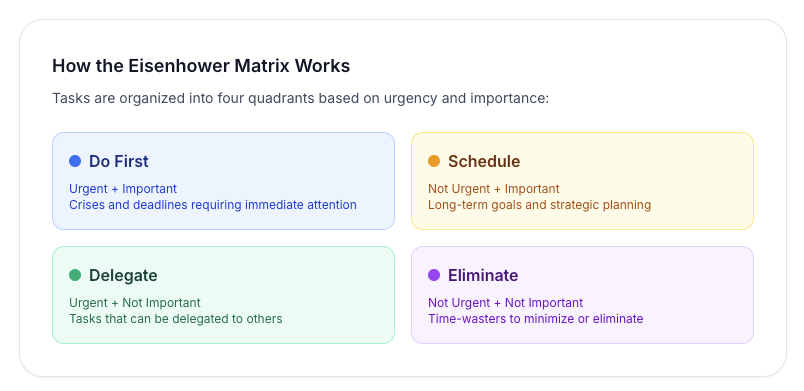
The Eisenhower matrix classifies work by urgency and importance:
- Do First — urgent and important.
- Schedule — important, not urgent.
- Delegate — urgent, not important.
- Eliminate — neither urgent nor important.
Use the Add a task bar or press n to start a task. Use Shift+N for the
full composer, / for search, ? for help, and Option+1 through Option+4
(Alt on non-Mac keyboards) to focus a quadrant. The in-app help drawer is the
canonical shortcut ledger.
Saved items
Choose Move to Saved on an incomplete task to keep reading material or an idea outside the matrix. Saved preserves the title, links, tags, and task context. Use Notes and links for short annotations (600 characters including links), find saved items with the Saved page's search field or the command palette, and choose Return to matrix when ready. Review the quadrant and due date before returning. Saved items do not contribute to active task counts, review analytics, reminders, or due badges.
Saved works offline and travels in JSON backups. Saved also works in the native
iPhone, iPad, and Mac app (a separate repository). With cloud sync on, saved
items sync between the web app and the native app. Very old iOS builds show saved items as
ordinary tasks. See tasks/saved-tasks/spec.md for
the compatibility scope.
Local development
Requirements: Bun 1.3.14, Node.js 22.22.2+ (or 24.15+ or 26+), and a current browser. bun run executes package scripts on Node, so tests, lint, and builds run on your installed Node.
bun install
bun dev
Open http://localhost:3000. A fresh browser profile starts at /about; use
the Open App call to action to enter the matrix. PocketBase is not required
for local task CRUD.
Canonical checks
bun run test
bun run test -- --coverage
bun typecheck
bun run typecheck:tests
bun lint
bun run quality:shape
bun run knip
bun run license:check
bun audit --audit-level=high
bun run build
bun run quality:bundle
bun run test:e2e
Use bun run test, not bun test; the latter starts Bun's built-in runner
instead of Vitest, and a guard script stops it. Playwright covers Chromium,
Firefox, and WebKit. The optional authenticated PocketBase harness runs with:
bun run test:system:pocketbase
The harness downloads PocketBase and runs the system tests under
packages/mcp-server/src/__tests__/system/ against a disposable instance. One
test starts the web app in Chromium and drives its sync push, pull, and realtime
paths, so it needs Playwright's Chromium. That test starts the app with
bun run dev:e2e, which deletes .next first. The harness also needs curl,
unzip, python3, and network access to GitHub for the PocketBase download. It
supports Linux and macOS on x86_64 and arm64.
To run the CI browser suite locally under the production CSP:
bun run build:e2e
bun run test:csp
bun run test:pwa
bun run test:e2e:export -- --workers=2
build:e2e selects the CSP-approved hosted backend at build time. Tests for the
in-app feedback form intercept its requests and never submit them. A plain local build
served on localhost defaults to http://127.0.0.1:8090, which the production
CSP intentionally blocks.
On macOS, Firefox tests use a disposable app-data home to avoid Playwright's
Firefox 157 profile-launch issue. It is removed after the browser exits;
the regular browser profile and system privacy permissions are untouched.
Architecture
- Next.js 16 App Router static export; the application is client-side.
- React 19, TypeScript, Tailwind CSS, and the Inkwell "GSD Editorial" tokens.
- Dexie/IndexedDB for local data and PocketBase for optional cloud sync.
- Vitest for unit/integration coverage and Playwright for browser coverage.
- Bun workspaces, including
packages/mcp-server/.
Start with ARCHITECTURE.md,
docs/security-trust-boundaries.md, and
the architecture decisions in docs/adr/.
Deployment
bun run buildcreates the static export inout/.- Production (gsd.vinny.dev) is the only deploy target; the development deploy
was retired on 2026-09-11. A release ships when a
v*.*.*tag starts thedeploy-production-releaseworkflow, which waits for the Gate 2 approval indocs/ops/gate2.md. bun run deploy(scripts/deploy-prod.sh) builds on your machine and uploads with local AWS credentials, which skips that gate.docker/Dockerfilebuilds the self-hosted Caddy and PocketBase image.cloudfront/response-headers-policy.jsonand the related scripts manage production response headers.
Uploading an artifact is not proof that the CDN or a running container serves it. Verify the deployed URL separately.
Release documentation checklist
Before changing the release version or announcing a feature:
- Compare the README version with
package.json. - Verify every feature claim in the current shell, not only in retained data models or archived ADRs.
- Run the canonical checks above. They include the production static build
(
bun run build). - Update the GitHub release notes,
SECURITY.md, and the trust-boundary map when the release changes their claims. - Treat source, tests, build artifacts, deployment, and live runtime as separate evidence states.
Repository blueprint
Each code directory has a README.md that states its interface, invariants,
side effects, and check command. This section indexes them. Every entry below
comes from the code or a comment in the named file.
Local Interface & Invariants
next.config.tssetsoutput: "export",trailingSlash: true, typed routes, and the React compiler. ItsbuildDatefallback must not read the clock. A static export can't set security headers, so the CDN or the Docker proxy sets them.vitest.config.tsruns tests in jsdom withTZ=UTC. It leaves outtests/e2e/**andpackages/mcp-server/**. Coverage thresholds are 80% statements, 80% lines, 80% functions, and 75% branches.vitest.setup.tsreplaceslocalStorageandsessionStoragewith an in-memory store and loadsfake-indexeddb/auto.playwright.config.tsstarts the dev server on port 3000.playwright.export.config.tsserves the builtout/on127.0.0.1:3100and never reuses a running server.cloudfront-function-url-rewrite.cjsappends/index.htmlto extensionless paths. It passes/apiand/_through and rewrites a path with a..segment to/index.html. It does the same for a path that holds a CR, LF, or NUL character. When the request carriesAccept: text/markdown, it rewrites a route'sindex.htmltoindex.md.cloudfront-function-response-headers.cjsadds theLinkheader to HTML and Markdown responses. On the same responses it appendsAcceptto theVaryheader. It sets the content type of every.mdpath totext/markdown; charset=utf-8. Security headers come from the response headers policy.eslint.config.mjspinssettings.react.version. Keep it equal to thereactversion inpackage.json.
Subdirectories & System Boundaries
- app: app/README.md. App Router pages and the root layout. Most pages mount one component.
- components: components/README.md. The React UI: matrix, task card, settings, sync dialogs, dashboard, and shared primitives.
- lib: lib/README.md. The task model, Zod schemas, the Dexie database, archive and Trash, and the optional sync layer in lib/sync/README.md.
- packages: packages/README.md. The
gsd-mcp-servernpm package. - config: config/README.md. The one definition of the production Content-Security-Policy.
- scripts: scripts/README.md. Build, deploy, quality-gate, and PocketBase setup scripts. Several change production.
- docker: docker/README.md. The self-hosted image: PocketBase hooks and migrations behind Caddy.
- tools: tools/README.md. The Stagehand browser verification harness.
- docs: docs/README.md. Diagram generators and TLA+ models.
- public: no README, because the build copies every file in
public/to the live site.sw.jsis the service worker.sw-cache-logic.jsis generated fromlib/sw-cache-logic.ts, so edit the source.theme-init.jssets the theme before first paint. - tests: test code only, so it has no contract README.
Global Invariants
- IndexedDB is the source of truth.
lib/db.ts:getDbopens theGsdTaskManagerdatabase, andlib/db-migrations.tsregisters versions 1 to - A task id lives in exactly one of
tasks,archivedTasks, anddeletedTasks. Each move runs in one Dexie transaction (lib/archive.ts,lib/trash.ts,lib/tasks/crud/delete.ts). - A task write and its sync queue row commit together.
lib/tasks/crud/helpers.ts:runTaskSyncTransactionopens one transaction overtasks,deletedTasks,syncQueue, andsyncMetadata. - Sync resolves conflicts by last write wins on
client_updated_at(lib/sync/pb-pull.ts:acceptsRemoteVersion). - Field limits come from
lib/constants/schema.ts:SCHEMA_LIMITS. The MCP server keeps its own object inpackages/mcp-server/src/constants.ts:SCHEMA_LIMITS. It has 10 keys. Eight match the web values, andID_MAX_LENGTHandMAX_BULK_TASKSexist only there. - The production Content-Security-Policy has one definition,
config/csp.cjs:buildCsp. A test fails when the CloudFront or Caddy copy drifts. public/sw.jskeeps itsCACHE_VERSIONplaceholder in git. The build stamps the real version intoout/sw.js.- Stored sync errors carry no task text.
lib/sync/error-categorizer.ts:sanitizeSyncErrorreturns a fixed code. lib/logger.ts:sanitizeMetadatamasks log metadata keys namedtitle,description,tags,subtasks, ornotes, and keys that match its secret pattern. It recurses into nested objects throughsanitizeValue. The log message anderrorMessageget token masking only.
Global Side Effects
- Browser storage: IndexedDB,
localStorage,sessionStorage, and Cache Storage undergsd-*cache names. - Network, during sign-in, before sync is on:
listAuthMethodson the PocketBaseuserscollection, sent when the user reaches for a sign-in button. The provider returns through the/api/gsd/oauth-callbackroute. - Network, with sync on: the PocketBase
tasksanduserscollections, the/api/gsd/accountand/api/gsd/sessionsroutes, and one realtime subscription. - Network, only when the user sends feedback: one
POSTto the PocketBasefeedbackcollection, with no credentials. scripts/deploy-app.shsyncsout/to S3 with--deleteand invalidates the CloudFront distribution.scripts/deploy-cloudfront-function.shcreates or updates two CloudFront functions and publishes them. It then updates the distribution's function associations and invalidates the distribution.scripts/deploy-cloudfront-response-headers-policy.shcreates or updates the CloudFront response headers policy.scripts/fix-discovery-content-types.shrewrites the content type and cache metadata of the discovery files in the S3 bucket.scripts/setup-labels.shcreates or overwrites ten labels on the GitHub repo of the current directory.scripts/setup-pocketbase-feedback-collection.shalso patches server-wide PocketBase settings: rate limits and request log settings.- The PocketBase setup scripts in
scripts/create or patch collections on the server named byPB_URL, which defaults to production.
System Verification
- Run:
bun run test - Run:
bun typecheck,bun run typecheck:tests,bun lint,bun run quality:shape, andbun run knip - Run:
bun run build:e2e, thenbun run test:e2e:exportfor the browser suite
Contributing and security
Read CONTRIBUTING.md before making changes. Report
vulnerabilities through the private process in SECURITY.md,
not a public issue.