
vivibibi30/hyperpguard
vivibibi30/hyperpguard has 129 GitHub stars and 6 forks. Star changes are not measured yet. Last checked 2026-11-14 02:38 UTC. Last push 2026-11-13.
Measured star growth
- in 24h
- Collecting history
- in 7 days
- Collecting history
- in 15 days
- Collecting history
- in 1 month
- Collecting history
Net star changes over overlapping periods, not daily totals. Missing measurements are left blank. Stars measure attention, not software quality.
About
HyperPGuard — 在采集入口、本地存储、对外接口、网络出口四层拦截app的隐私上报(LSPosed 模块)
SecurityREADME.en.md
OriginalHyperPGuard


简体中文 · English
An LSPosed module that blocks telemetry from preinstalled HyperOS components at four stages: where data is collected, where it is stored locally, the inter-process interfaces, and the network egress.
This project is based on static analysis and runtime observation of the components shipped on the author's own device. Components differ between models and ROM versions; treat everything here as observed behaviour, not as a universal description.
Maintenance: this is a personal project. Development and testing rely on AI assistance and self-funded device testing, so the cost is borne by the author alone. Releases happen only for defects that affect use, newly discovered reporting channels, or adaptation to a new major system version. UI and wording changes are folded into the next substantive release instead of shipping on their own. Issues are read, but no response time or delivery schedule is promised.
Requirements
- Android 10 – 16 on HyperOS / MIUI, LSPosed 2.2.x (libxposed API 100+)
- Root for the in-app "restart" and "view log" actions (KernelSU, Magisk, APatch)
Install
- Install
HyperPGuard.apkfrom Releases - Enable the module in LSPosed
- Open the app once; it requests the full scope through the official libxposed API, or pick packages manually in LSPosed
- Press "restart" on a card, or "restart all", so the target process reloads with the module
Packages outside the scope are never injected.
After an in-place upgrade, LSPosed does not automatically add newly declared components to the scope. Re-check LSPosed → Modules → HyperPGuard → Scope; the components added in 1.6.x are "Ads (MSA)" and "Diagnostics (MiSight)". When one is missing, its card shows "Not in scope — tap to add".
Usage
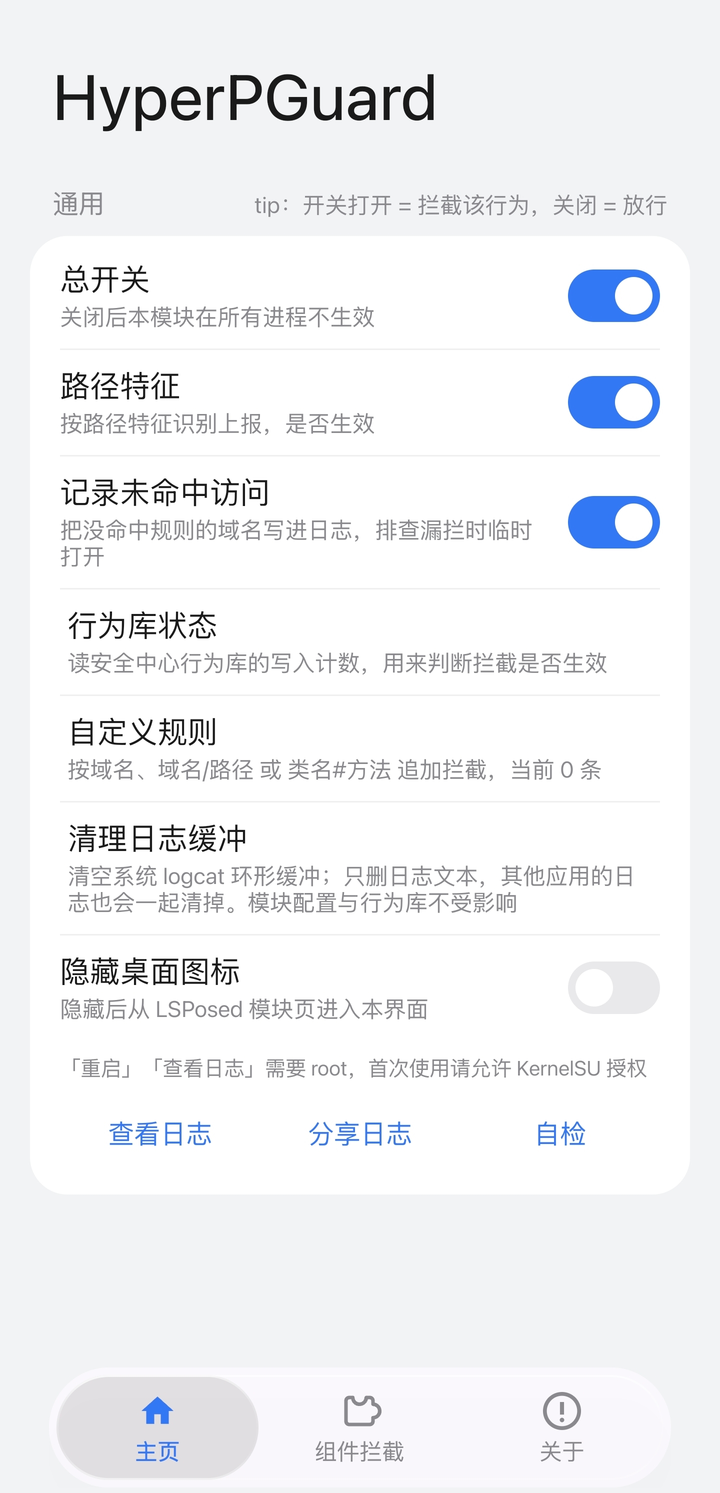
- Group switch: the toggle in the card header mirrors that package's LSPosed scope state. Turning it on requests scope through the framework API; if the framework refuses, a dialog explains what to tick manually.
- Sub-switches: "on" means the behaviour is blocked. Rules that can affect system features default to off, and the subtitle states the cost.
- Restart: applies
am force-stopto the target package so it reloads with the new rules. System components are usually restarted by the system within seconds. - Custom rules: append extra blocking by domain,
domain/path, orclass#method. See docs/CUSTOM-RULES.md (Chinese). - Log unblocked hosts: records hosts that matched no rule, for finding missing rules; keep it off normally.
The UI follows the system language: English on English devices, Chinese otherwise. Log text and diagnostics remain Chinese.
What is intercepted
Four stages along the data path, plus a method-layer fallback for when obfuscated names change:
| Stage | Approach |
|---|---|
| Collection entry | Cuts at the source: installed-app lists, usage records, device identifiers, location and network-environment queries return empty |
| Local storage | Blocks writes to the behaviour-record database, so nothing can be packaged for upload |
| Cross-process interfaces | Blocks query and scoring interfaces so third-party apps cannot read those records |
| Network egress | Hooks host resolution and connections inside the target process; rules are "host suffix + optional path prefix" |
| Fallback | Resolves specific methods by signature and returns constants; when names change, the network layer still works |
The stages are independent: if one breaks on a component update, the others keep working, and the log shows which stage matched.
Scope
Grouped by capability rather than listing target packages; each switch in the UI states exactly what it covers on your device.
| Category | What is blocked |
|---|---|
| Telemetry | Upload events from analytics components, covered at both the method and the domain layer |
| Device and location | Device identifiers, cell and Wi-Fi scans, location queries — per-app switches, off by default |
| Behaviour records | Writes of screenshot / call / screen-share records, plus the query and scoring interfaces that expose them |
| Diagnostics | Log upload for system diagnostics and remote after-sales diagnosis; triggering requires a user-initiated report or after-sales action, local records are not the same as uploaded ones |
| Carrier side | Report domains and methods of the carrier device-management component; reporting is blocked, granted permissions are not revoked |
| Input methods | Telemetry, clipboard capture, voice upload |
| Ads and store | Ad usage profile, splash ads, config delivery and telemetry |
Each app is one card in the UI: the switch in its top-right corner is its LSPosed scope switch, and per-item rules sit inside. Rules that can affect system features default to off, with the cost stated in the subtitle.
Logs
| Prefix | Meaning |
|---|---|
attach <process> |
Module injected into a process |
X(host) / X(host+path) |
A rule matched; path rules log X(host+path), so grep with grep -F 'X(host' |
X(strict) |
Whole-process blocking active |
? <tag> <host> |
"Log unblocked hosts" record: request was not blocked |
hook ok / hook miss |
Method hook installed / target not found |
xsof provider hooked, xsof aidl hooked=N, xsof db write hooked=N, xsof score hooked=N |
XSOF layers |
msa usage opened=… lastUsed=…, msa track hooked=N |
MSA hooks |
hookBySignature skipped classes=N |
Classes whose signatures could not be resolved were skipped, scanning continued |
Verifying it works
- Enable the module and restart the target app
- Trigger its reporting (open Security Center, install an app)
- "View log" should show
attach <process>andX(...)lines - XSOF lines should all say
hooked, with nomiss - If only
attachappears, enable "log unblocked hosts" for a while and add the?hosts to the rules
Build
JDK 17 and build-tools 35+ are required. There is no Gradle; build.sh runs javac --release 11 → d8 → aapt2 link → zipalign → apksigner.
export ANDROID_JAR=/path/to/android.jar D8=/path/to/d8 AAPT2=/path/to/aapt2
export ZIPALIGN=/path/to/zipalign APKSIGNER=/path/to/apksigner
sh build.sh
Source layout
src/io/github/vivibibi30/hyperpguard/
├── HookEntry.java       entry point, dispatch per package
├── Config.java          switches and config channel
├── I18n.java            UI strings (Chinese source, English lookup)
├── NetGuard.java        URL / InetAddress / Socket + rule matching
├── PrivacyApis.java     app list, usage stats, identifiers, SMS, XMSF
├── CaptureHooks.java    behaviour database writes, silent recording
├── XsofHooks.java       XSOF provider / AIDL / writes / scoring
├── MsaHooks.java        MSA usage profile and OneTrack
├── AnalyticsHooks.java  analytics method layer
├── Hooks.java           shared hook helpers
├── Logs.java            unified log tag
├── PgSwitch.java        MIUI-style switch used by the settings UI
└── MainActivity.java    settings UI
Limitations
- Domain lists can be incomplete: addresses can be delivered from server config
- Switches left at their default value are not written into
hyperpguard_conf; a missing key does not mean the switch is off - Obfuscated class names change between versions;
hook missin the log is expected and does not affect the network layer - Requests made through native stacks (Cronet and friends) are not covered by Java-level hooks
IMrmis a HAL-level service; only theServiceManagerside is disconnected- The module blocks reporting; it does not revoke permissions already granted during device setup
Contributing
Run "self-check" before opening an issue, redact identifiers in logs, and read CONTRIBUTING.en.md for what not to upload (vendor APKs, decompiled output, device databases).
License and disclaimer
GPL-3.0, see LICENSE. Usage terms, legal notes and risk statements are in DISCLAIMER.txt; the English summary there is for convenience only and the Chinese text prevails. Please read it before use. The project is not affiliated with Xiaomi or China Unicom, and all trademarks belong to their respective owners.
Credits
HyperCeiler, XSOF Privacy, HyperOS4-XSOF-Analysis, OSAKOo, RooyCo, frauddb, misight-viewer, KernelSU, compose-miuix-ui/miuix, libxposed, LSPosed and others. The floating bottom bar introduced in 1.7.0 reuses the dimensions, springs and paging rules of KernelSU (GPL-3.0) and miuix (Apache-2.0), re-implemented from their published sources without copying code; see NOTICE. The full list with links is in the Chinese README.
Explore related projects
trimstray/the-book-of-secret-knowledge
A collection of inspiring lists, manuals, cheatsheets, blogs, hacks, one-liners, cli/web tools and more.
258,313 starsHack-with-Github/Awesome-Hacking
A collection of various awesome lists for hackers, pentesters and security researchers
125,464 starsswisskyrepo/PayloadsAllTheThings
A list of useful payloads and bypass for Web Application Security and Pentest/CTF
82,661 starscaddyserver/caddy
Fast and extensible multi-platform HTTP/1-2-3 web server with automatic HTTPS
79,027 stars