
vast-data/vastdb_sdk
vast-data/vastdb_sdk has 40 GitHub stars and 8 forks. Star changes are not measured yet. Last checked 2026-11-14 02:10 UTC. Last push 2026-11-09.
What you can do
- The Basics - examples/quickstart.py - Connecting via environment variables, basic schemas/tables, simple inserts, and querying with predicates.
- Direct S3 Ingest - examples/import_parquet.py - Creating tables directly from existing Parquet files on VAST without client-side copying.
- Advanced Querying - examples/query_processing.py - Parallelizing queries via QueryConfig, VAST Catalog querying, and DuckDB post-processing.
- Performance Tuning - examples/table_types.py - Creating partitioned tables (for filter pruning) and sorted tables (for range scans).
Measured star growth
- in 24h
- Collecting history
- in 7 days
- Collecting history
- in 15 days
- Collecting history
- in 1 month
- Collecting history
Net star changes over overlapping periods, not daily totals. Missing measurements are left blank. Stars measure attention, not software quality.
About
Python-based SDK designed for interacting with VAST Database & VAST Catalog, enabling schema and table management, efficient ingest, query and modification of columnar data.
DataREADME.md
Original
VAST DB Python SDK
A Python client for the VAST Database and VAST Catalog.
Supports:
- Schema and table management
- Efficient data ingest and querying
- Advanced filtering with predicate pushdown
- Direct integration with PyArrow and DuckDB
- File system querying through VAST Catalog
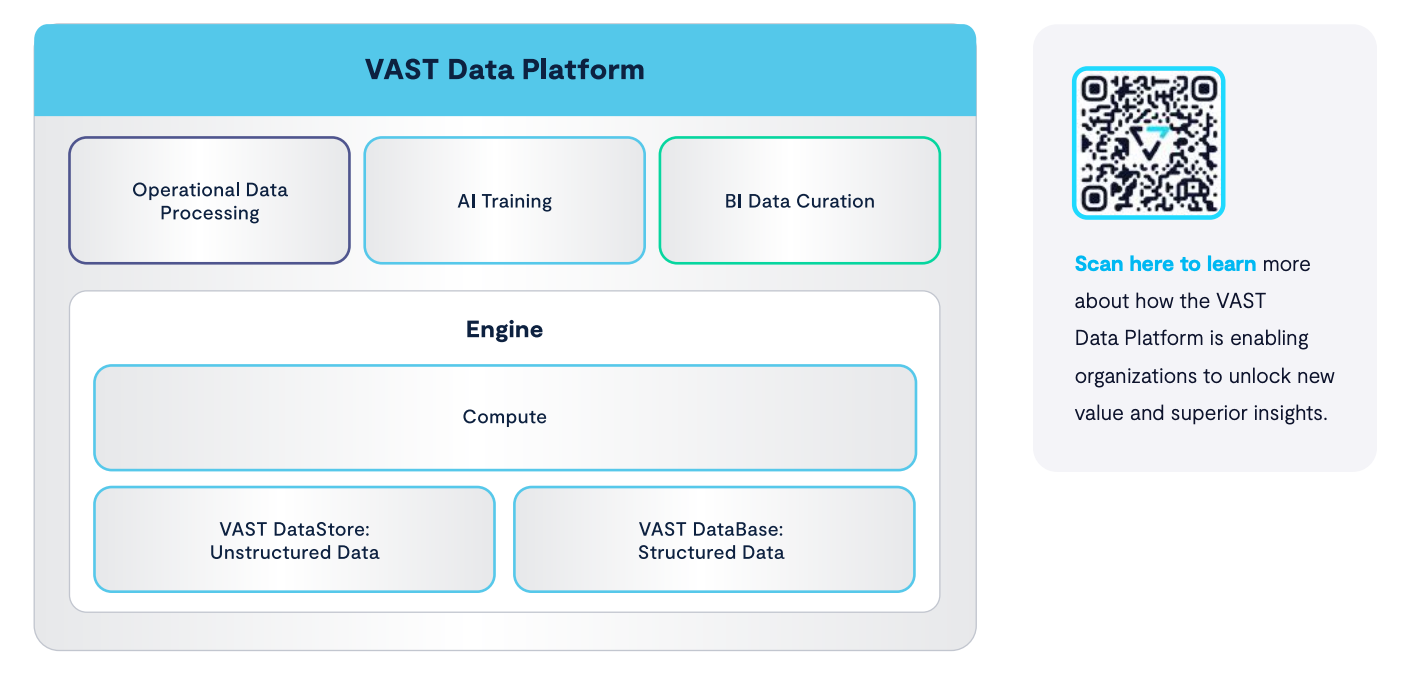
For technical details about VAST Database architecture, see the whitepaper.
Getting Started
Requirements
- Linux client with Python 3.10 - 3.13, and network access to the VAST Cluster
- VAST Cluster release
5.0.0-sp10or later- If your VAST Cluster is running an older release, please contact [email protected].
- Virtual IP pool configured with DNS service
- S3 access & secret keys on the VAST cluster
- Tabular identity policy with the proper permissions
Installation
pip install vastdb
See the Release Notes for the SDK.
Connect
import vastdb

session = vastdb.connect()
vastdb.connect(access: str | None, secret: str | None, endpoint: str | None)
If omitted, access, secret, and endpoint are taken from the environment:
AWS_ACCESS_KEY_IDAWS_SECRET_ACCESS_KEYAWS_S3_ENDPOINT_URL
Schema, table, insert, select
Transactions group mutations. Keep the transaction open while you consume a
pyarrow.RecordBatchReader
returned by select().
import pyarrow as pa
import vastdb

with session.transaction() as tx:
    bucket = tx.bucket("bucket-name")
    schema = bucket.create_schema("qs_basic", fail_if_exists=False)

    columns = pa.schema([
        ("c1", pa.int16()),
        ("c2", pa.float32()),
        ("c3", pa.utf8()),
    ])
    table = schema.create_table("quickstart_table", columns, fail_if_exists=False)

    sample = pa.table(schema=columns, data=[
        [111, 222, 333],
        [0.5, 1.5, 2.5],
        ["a", "bb", "ccc"],
    ])
    table.insert(sample)

   # SELECT * from mytable. reader must be fully consumed inside this transaction.
    reader: RecordBatchReader = mytable.select()
    result: RecordBatch = reader.read_all()
    assert result == sample

    # the transaction is automatically committed when exiting the context
Supported data types: docs/types.md. See docs/predicate.md for constructing predicates with Ibis.
runnable examples with more features:
| Feature / Workflow | Example File | What it Covers |
|---|---|---|
| The Basics | examples/quickstart.py |
Connecting via environment variables, basic schemas/tables, simple inserts, and querying with predicates. |
| Direct S3 Ingest | examples/import_parquet.py |
Creating tables directly from existing Parquet files on VAST without client-side copying. |
| Advanced Querying | examples/query_processing.py |
Parallelizing queries via QueryConfig, VAST Catalog querying, and DuckDB post-processing. |
| Performance Tuning | examples/table_types.py |
Creating partitioned tables (for filter pruning) and sorted tables (for range scans). |
| Architecture Features | examples/advanced_features.py |
Managing semi-sorted projections, reading from snapshots, and audit logging. |
| Blob Expansion | examples/blob_expansion.py |
Expand a blob column into a target table; create, add/drop columns, mandatory fields, and drop. |
| AI / Machine Learning | examples/vector_search.py |
Nearest-neighbor searches over a vector-indexed column (requires ADBC). |
More Information
See these blog posts for more examples:
- https://vastdata.com/blog/the-vast-catalog-in-action-part-1
- https://vastdata.com/blog/the-vast-catalog-in-action-part-2
See also the full Vast DB Python SDK documentation
Explore related projects
Asabeneh/30-Days-Of-Python
The 30 Days of Python programming challenge is a step-by-step guide to learn the Python programming language in 30 days. This challenge may take more than 100 days. Follow your own pace. These videos may help too: https://www.youtube.com/channel/UC7PNRuno1rzYPb1xLa4yktw
78,710 starsgrafana/grafana
The open and composable observability and data visualization platform. Visualize metrics, logs, and traces from multiple sources like Prometheus, Loki, Elasticsearch, InfluxDB, Postgres and many more.
77,892 starsredis/redis
For developers, who are building real-time data-driven applications, Redis is the preferred, fastest, and most feature-rich cache, data structure server, and document and vector query engine.
77,490 starsapache/superset
Apache Superset is a Data Visualization and Data Exploration Platform
75,521 stars