
uxlfoundation/scikit-learn-intelex
uxlfoundation/scikit-learn-intelex has 1,358 GitHub stars and 197 forks. GitHot measured 0 stars in 24 hours, +2 in 7 days, and +2 in 15 days. Last checked 2026-11-09 08:28 UTC. Last push 2026-11-01.
Extension for Scikit-learn is a seamless way to speed up your Scikit-learn application
Measured star growth
- in 24h
- 0
- in 7 days
- +2
- in 15 days
- +2
- in 1 month
- Update delayed
Net star changes over overlapping periods, not daily totals. Missing measurements are left blank. Stars measure attention, not software quality.
README.md
OriginalExtension for scikit-learn*
Speed up your scikit-learn applications for CPUs and GPUs across single- and multi-node configurations
Releases | Documentation | Examples | Support | License




Overview
Extension for scikit-learn is a free software AI accelerator designed to deliver up to 100X acceleration to existing workflows from scikit-learn (e.g. logistic regression models, random forests, support vector machines, among others), the most widely-used Python library for machine learning on tabular data.
This software acceleration is achieved through SIMD instructions, multi-threading, hardware-specific cache optimizations, and algorithmic optimizations.
Features:
- Average speed up of 8.5x on both training and inference over scikit-learn, with equivalent mathematical accuracy.
- Support for different hardware configurations, including GPUs and multi-GPU setups.
- Easy to integrate into existing scikit-learn workflows without code modifications through monkeypatching, or as an API-compatible module
sklearnex. - Can produce much faster predictions from decision-tree models generated by other libraries such as XGBoost or LightGBM.
Acceleration
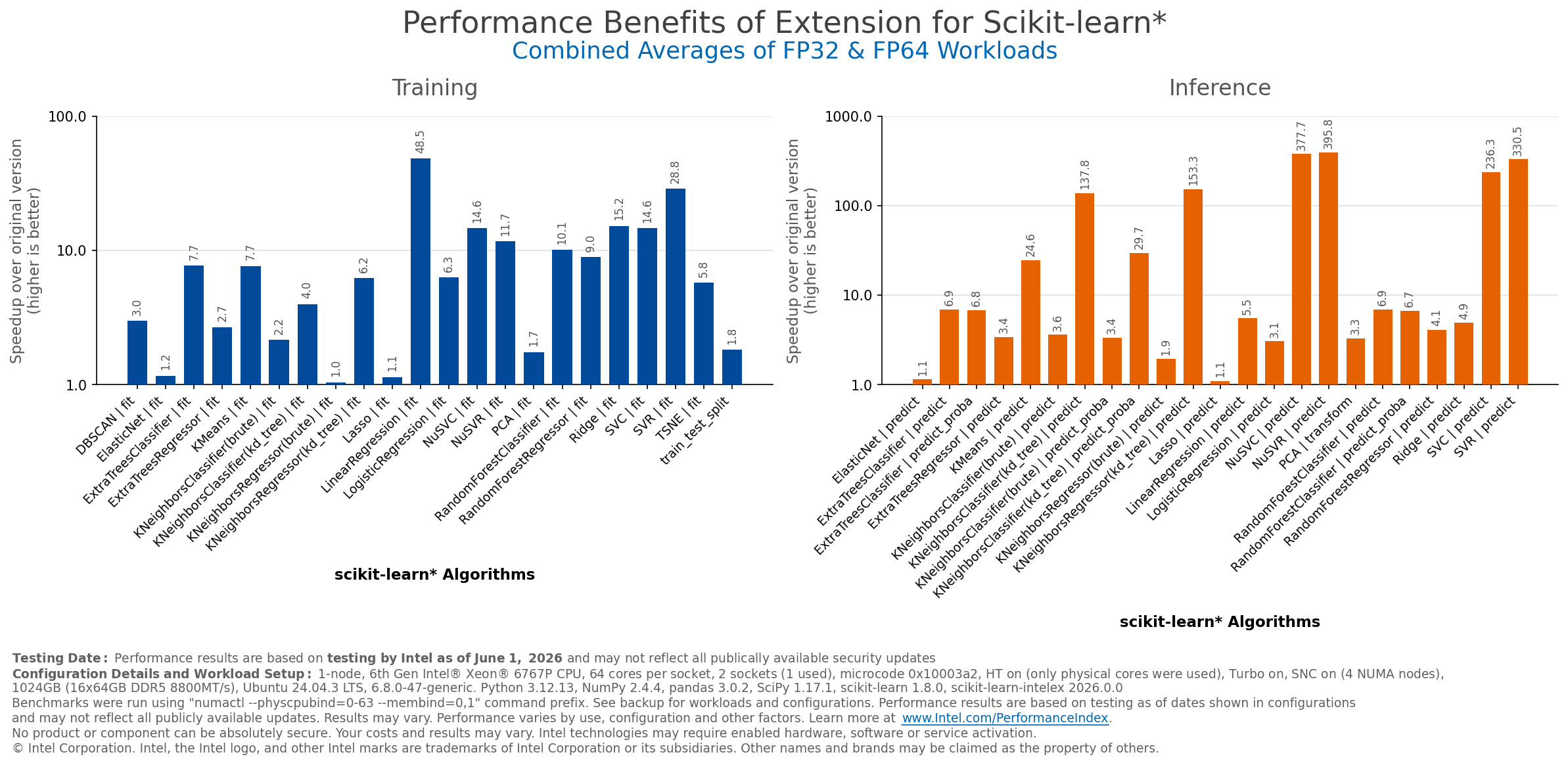
Optimizations
Easiest way to benefit from accelerations from the extension is by patching scikit-learn with it:
Enable CPU optimizations
import numpy as np
from sklearnex import patch_sklearn
patch_sklearn()

from sklearn.cluster import DBSCAN

X = np.array([[1., 2.], [2., 2.], [2., 3.],
              [8., 7.], [8., 8.], [25., 80.]], dtype=np.float32)
clustering = DBSCAN(eps=3, min_samples=2).fit(X)
Enable GPU optimizations
Note: executing on GPU has additional system software requirements - see details.
import numpy as np
from sklearnex import patch_sklearn, config_context
patch_sklearn()

from sklearn.cluster import DBSCAN

X = np.array([[1., 2.], [2., 2.], [2., 3.],
              [8., 7.], [8., 8.], [25., 80.]], dtype=np.float32)
with config_context(target_offload="gpu:0"):
    clustering = DBSCAN(eps=3, min_samples=2).fit(X)
:eyes: Read about other ways to patch scikit-learn.
:eyes: Check out available notebooks for more examples.
Usage without patching
Alternatively, all functionalities are also available under a separate module which can be imported directly, without involving any patching.
To run on CPU:
import numpy as np
from sklearnex.cluster import DBSCAN

X = np.array([[1., 2.], [2., 2.], [2., 3.],
              [8., 7.], [8., 8.], [25., 80.]], dtype=np.float32)
clustering = DBSCAN(eps=3, min_samples=2).fit(X)
To run on GPU:
import numpy as np
from sklearnex import config_context
from sklearnex.cluster import DBSCAN

X = np.array([[1., 2.], [2., 2.], [2., 3.],
              [8., 7.], [8., 8.], [25., 80.]], dtype=np.float32)
with config_context(target_offload="gpu:0"):
    clustering = DBSCAN(eps=3, min_samples=2).fit(X)
Installation
To install Extension for scikit-learn, run:
pip install scikit-learn-intelex
Package is also offered through other channels such as conda-forge. See all installation instructions in the Installation Guide.
Documentation
Extension and oneDAL
Acceleration in patched scikit-learn classes is achieved by replacing calls to scikit-learn with calls to oneDAL (oneAPI Data Analytics Library) behind the scenes:
How to Contribute
We welcome community contributions, check our Contributing Guidelines to learn more.
* The Intel logo, and other Intel marks are trademarks of Intel Corporation or its subsidiaries. Other names and brands may be claimed as the property of others.
Explore related projects
tensorflow/tensorflow
An Open Source Machine Learning Framework for Everyone
201,427 starshuggingface/transformers
🤗 Transformers: the model-definition framework for state-of-the-art machine learning models in text, vision, audio, and multimodal models, for both inference and training.
168,711 starsAUTOMATIC1111/stable-diffusion-webui
Stable Diffusion web UI
165,274 starsComfy-Org/ComfyUI
The most powerful and modular diffusion model GUI, api and backend with a graph/nodes interface. The fastest local inference engine in the world.
146,024 stars