
tokentimerch/tokentimer-core
tokentimerch/tokentimer-core has 58 GitHub stars and 3 forks. GitHot measured 0 stars in 24 hours, 0 in 7 days, and +1 in 15 days. Last checked 2026-11-16 00:50 UTC. Last push 2026-11-02.
Measured star growth
- in 24h
- 0
- in 7 days
- 0
- in 15 days
- +1
- in 1 month
- Update delayed
Net star changes over overlapping periods, not daily totals. Missing measurements are left blank. Stars measure attention, not software quality.
About
The self-hosted token, certificate, license, and secret expiration manager with automated Certificate Lifecycle Management (CertOps) for teams.
Self-hostedREADME.md
Original

Know what expires. Control what happens next.
Open-source visibility and expiration monitoring for machine credentials, certificates, secrets, tokens, licenses, and other expiring assets, with supported certificate lifecycle automation.










Introducing • Get Started • Docs • Contributing • Security • License
Introducing TokenTimer
Operational incidents caused by expired assets are still a recurring problem. Certificates expire, API keys get rotated, secrets are forgotten, and renewal ownership is often unclear. Most systems expose expiration data inconsistently, offer limited notification support, lack a centralized cross-provider view, and leave renewal as manual, error-prone work.
TokenTimer is an open-source platform providing unified visibility, expiration monitoring, and lifecycle automation for machine credentials, certificates, secrets, tokens, and other expiring assets. Discover and monitor assets across your infrastructure, track ownership, and receive actionable alerts. Certificate Lifecycle Management (CLM) automates supported certificate renewals, deployment, and verification while customer certificate private keys stay outside the TokenTimer control plane.
Three complementary pillars organize the platform:
- NHI Credential Visibility & Ownership: inventory machine credentials and service accounts, track expiration and review dates, assign owners, and alert responsible teams. Credential rotation remains with your providers and tooling.
- Certificate Lifecycle Management: discover certificates, automate supported ACME workflows, deploy and verify through outbound-only agents, enroll from Microsoft AD CS, share certificates through customer Vault, and coordinate cert-manager or external executors with approvals and audit evidence.
- Integrations & Centralized Operations: aggregate relevant metadata from Vault, AWS, Azure, GCP, GitHub, and GitLab. TokenTimer complements your existing systems; it does not replace their secret-storage responsibilities.
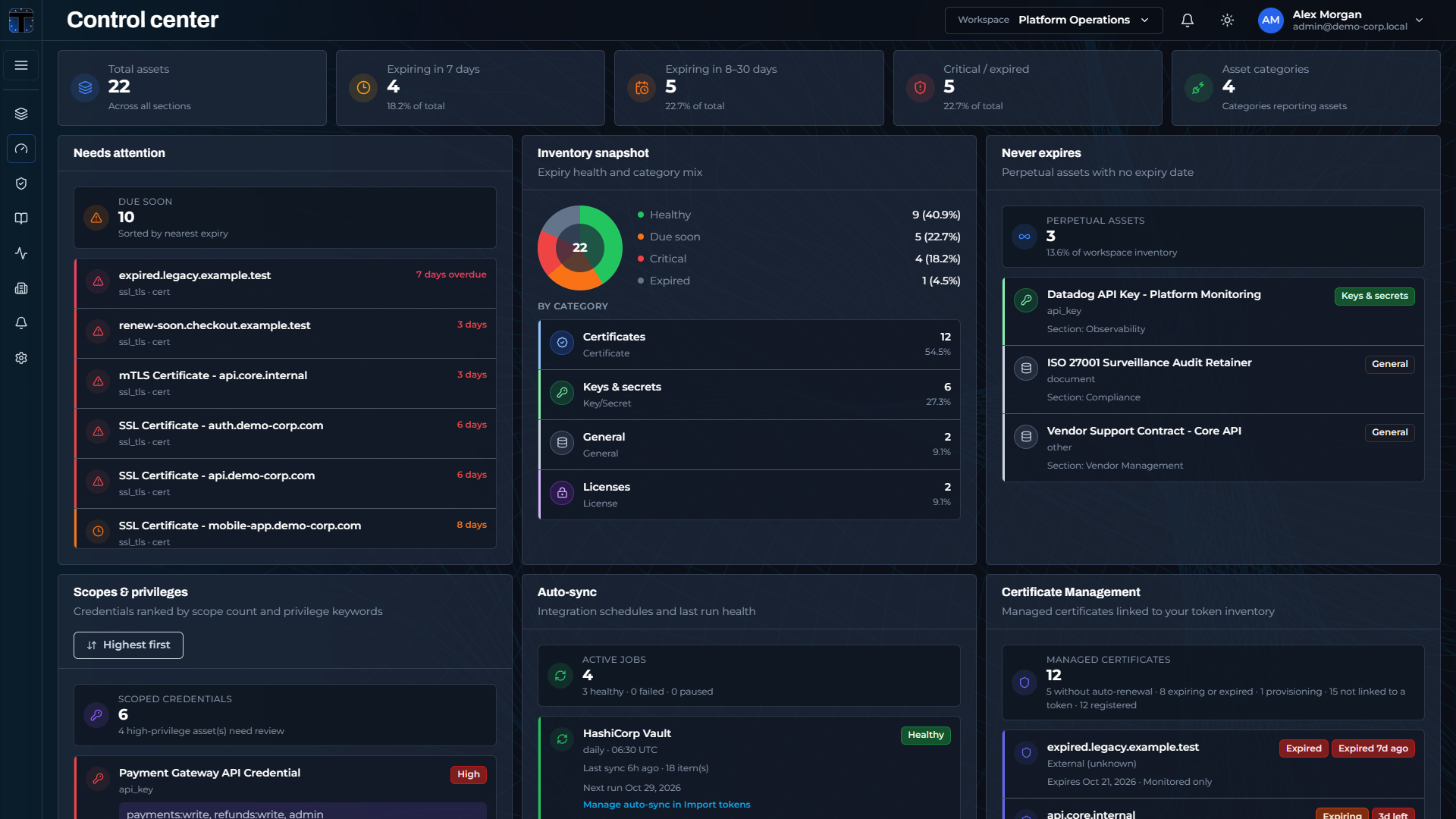
Screenshots and GIFs show the current interface with illustrative sample data. Media capture notes.
What makes TokenTimer different?
Certificate Lifecycle Management (CLM)
An outbound-only agent renews, deploys, reloads, and verifies certificates on your infrastructure (ACME via certbot/acme.sh, DNS-01 across major providers, atomic rollback), enrolls and renews IIS certificates from a Microsoft AD CS enterprise CA on domain-joined Windows hosts, and publishes one certificate version through your own Vault KV v2 to assigned Linux consumers (NGINX, HAProxy) that deploy it locally, whether it is an ordinary, SAN, or wildcard certificate. Keys and Vault or DNS credentials stay on your hosts. Approval gates, a kill switch, and renewal-failure alerts keeping humans in control. It also distributes and revokes internal CA trust anchors in machine trust stores on Windows, Debian/Ubuntu, and RHEL/Fedora. cert-manager and machine-token executors are supported too. The control plane never receives or stores private key material. Watch the demo.
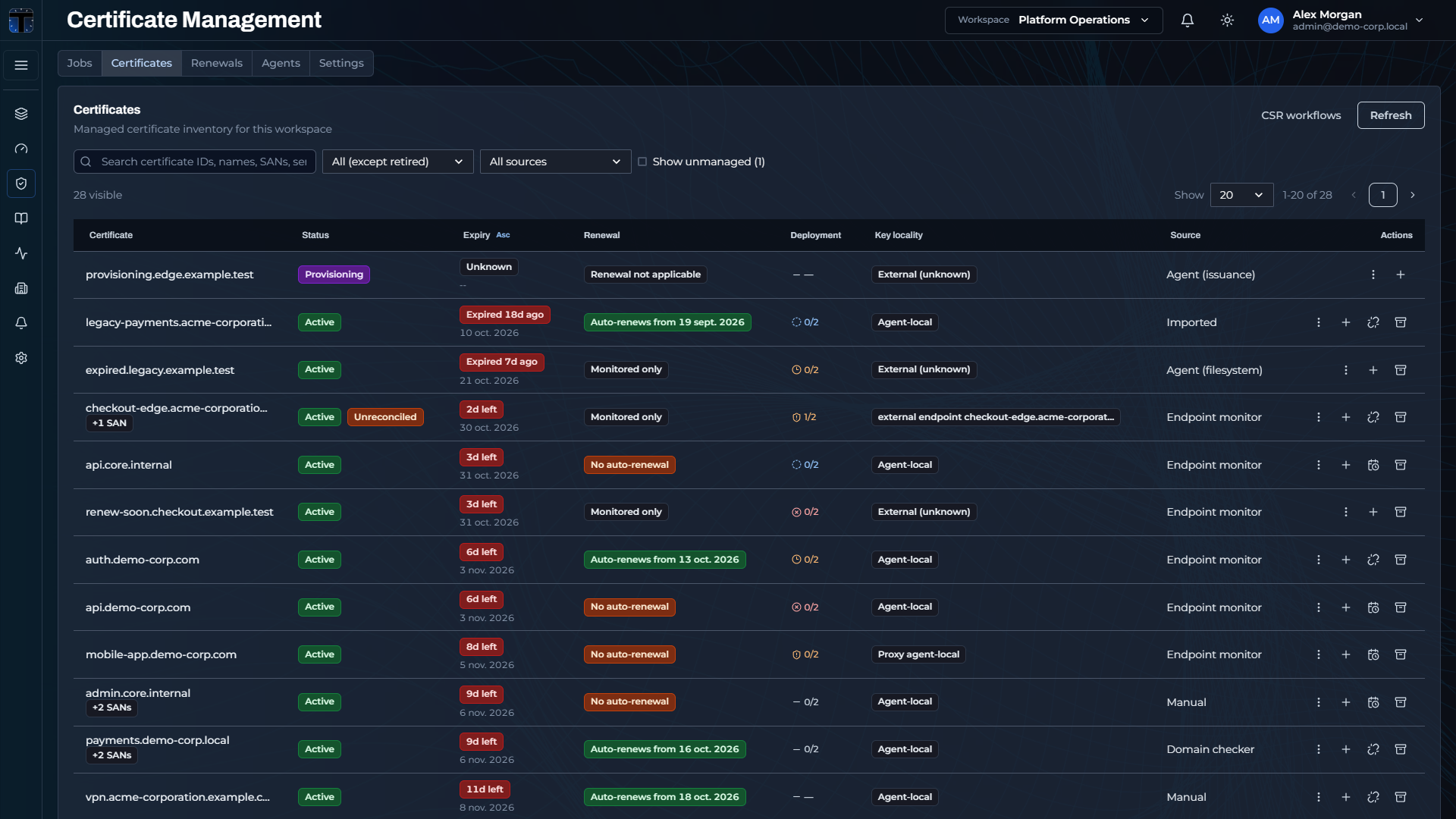
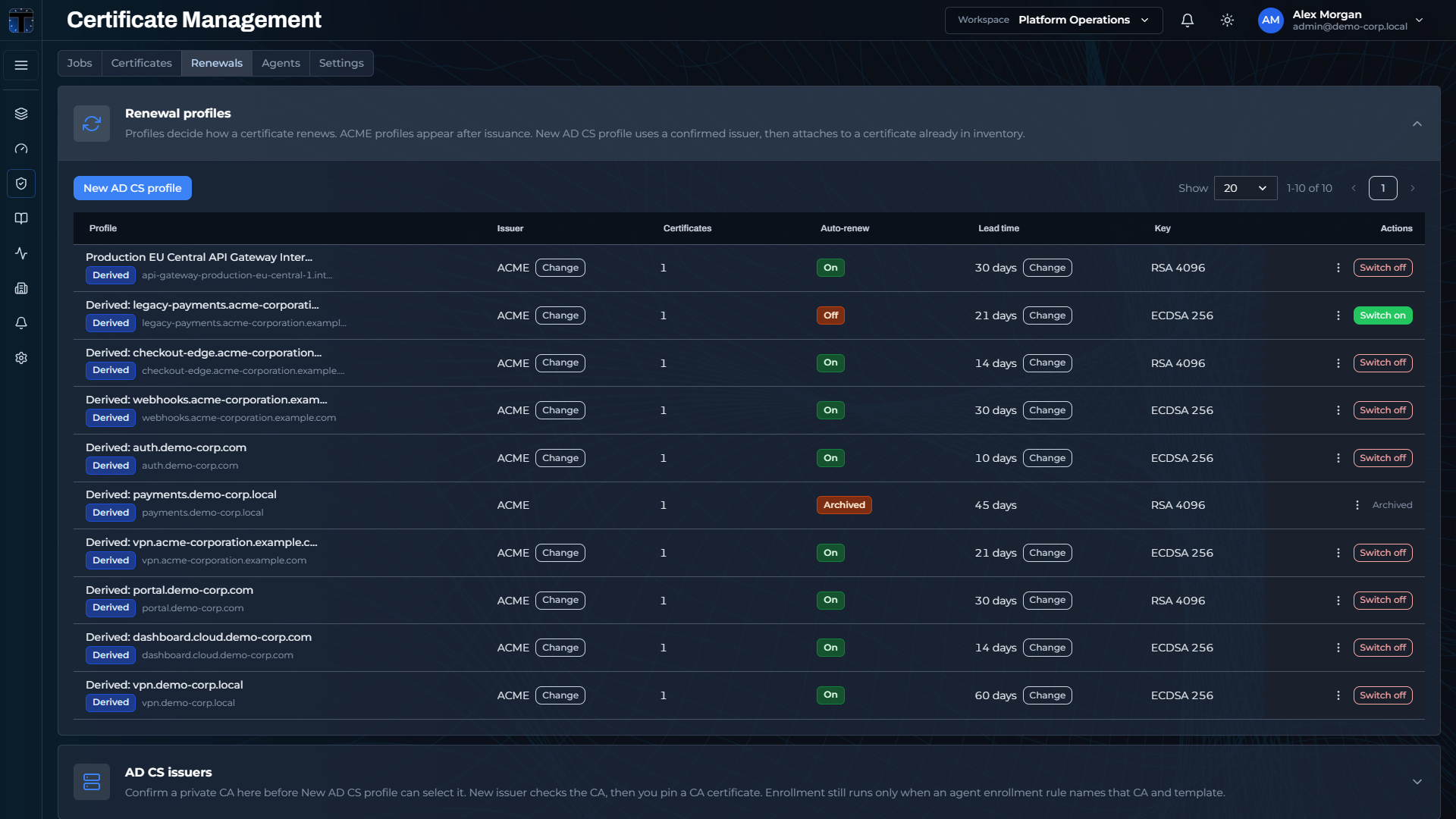
Renewal profiles and issuer setup |
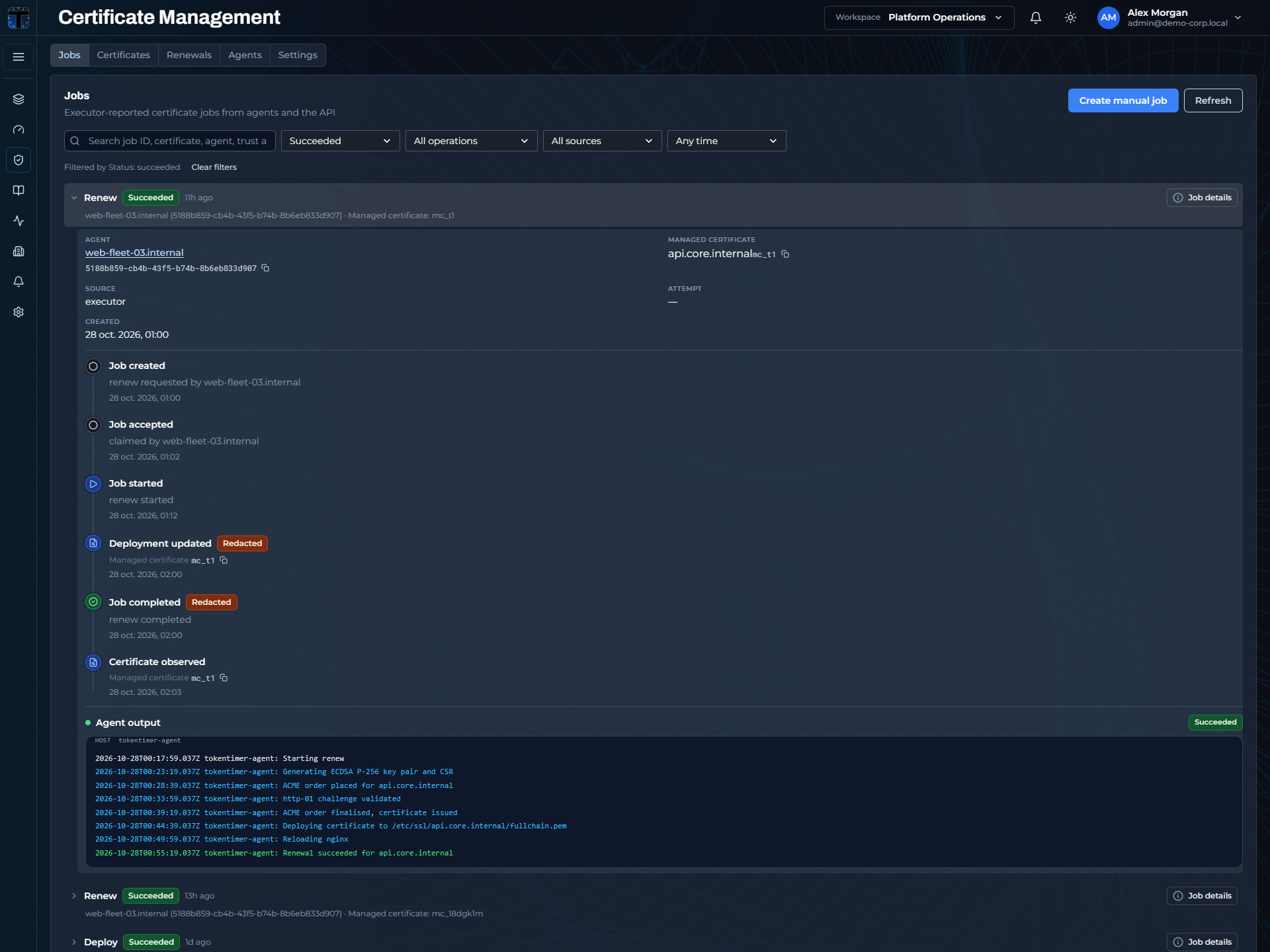
Renewal timeline and agent shell output |
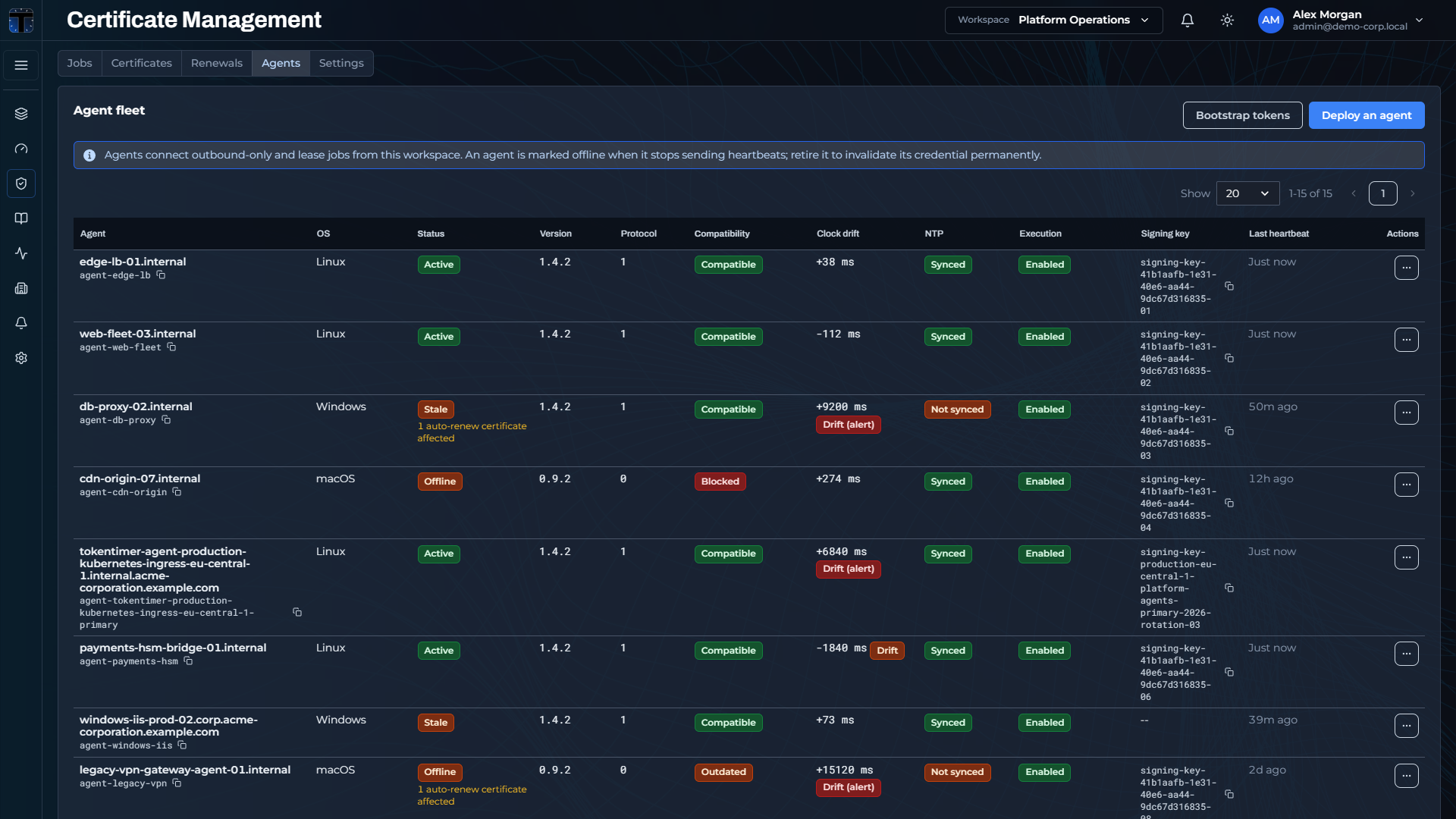
Agent fleet health |
Unified expiration visibility
Track certificates, tokens, secrets, licenses, subscriptions, and other expiring assets across providers and environments in one place. Filter by category, section, owner, or urgency, and see at a glance what expires next.
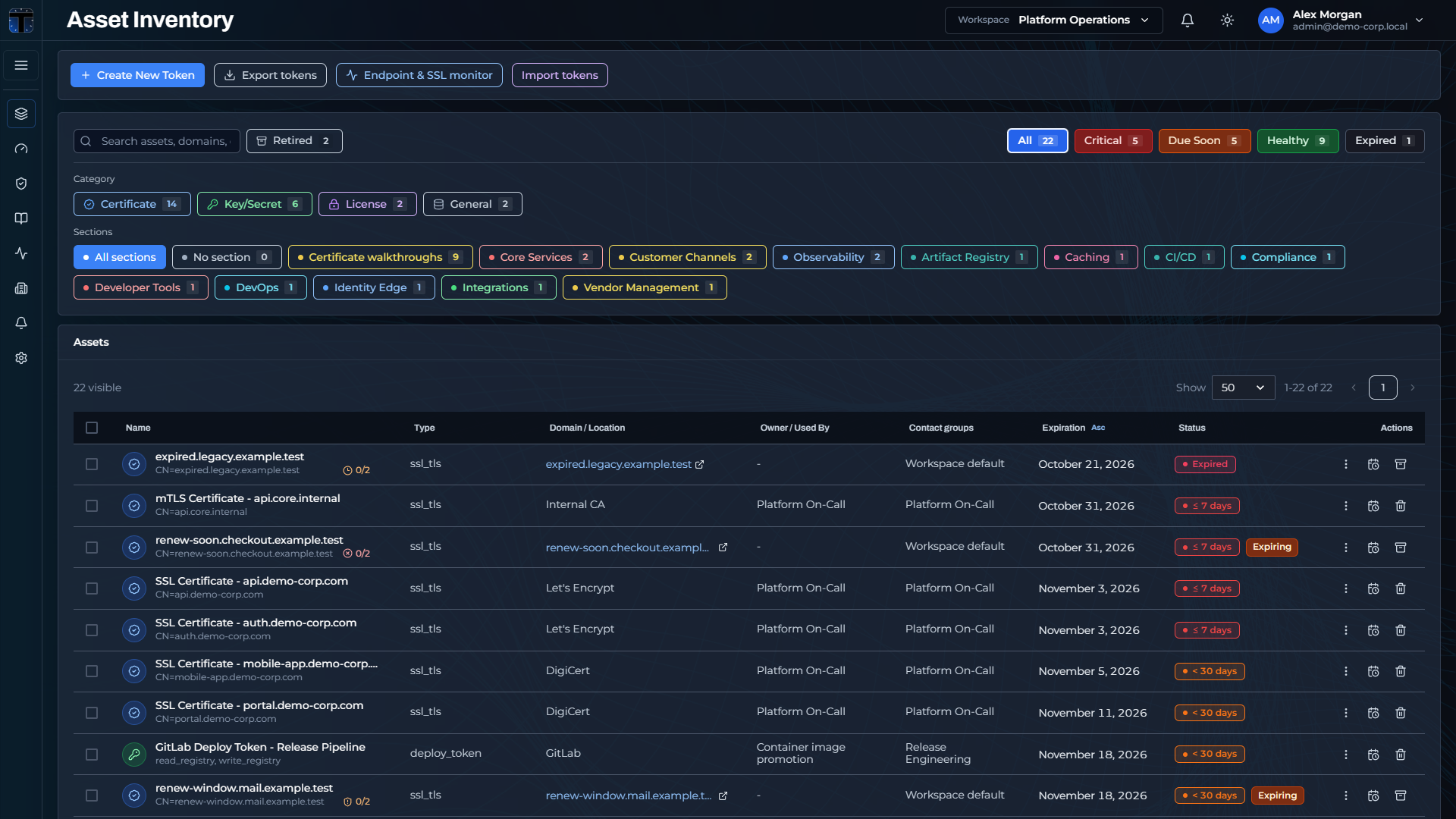
Flexible multi-channel alerting
Notify teams through email, Slack, Microsoft Teams, Discord, PagerDuty, WhatsApp, and webhooks, with configurable delivery and escalation options.
PagerDuty expiration incidents correlate triggers and automatic recovery, while acknowledgment stays in PagerDuty.
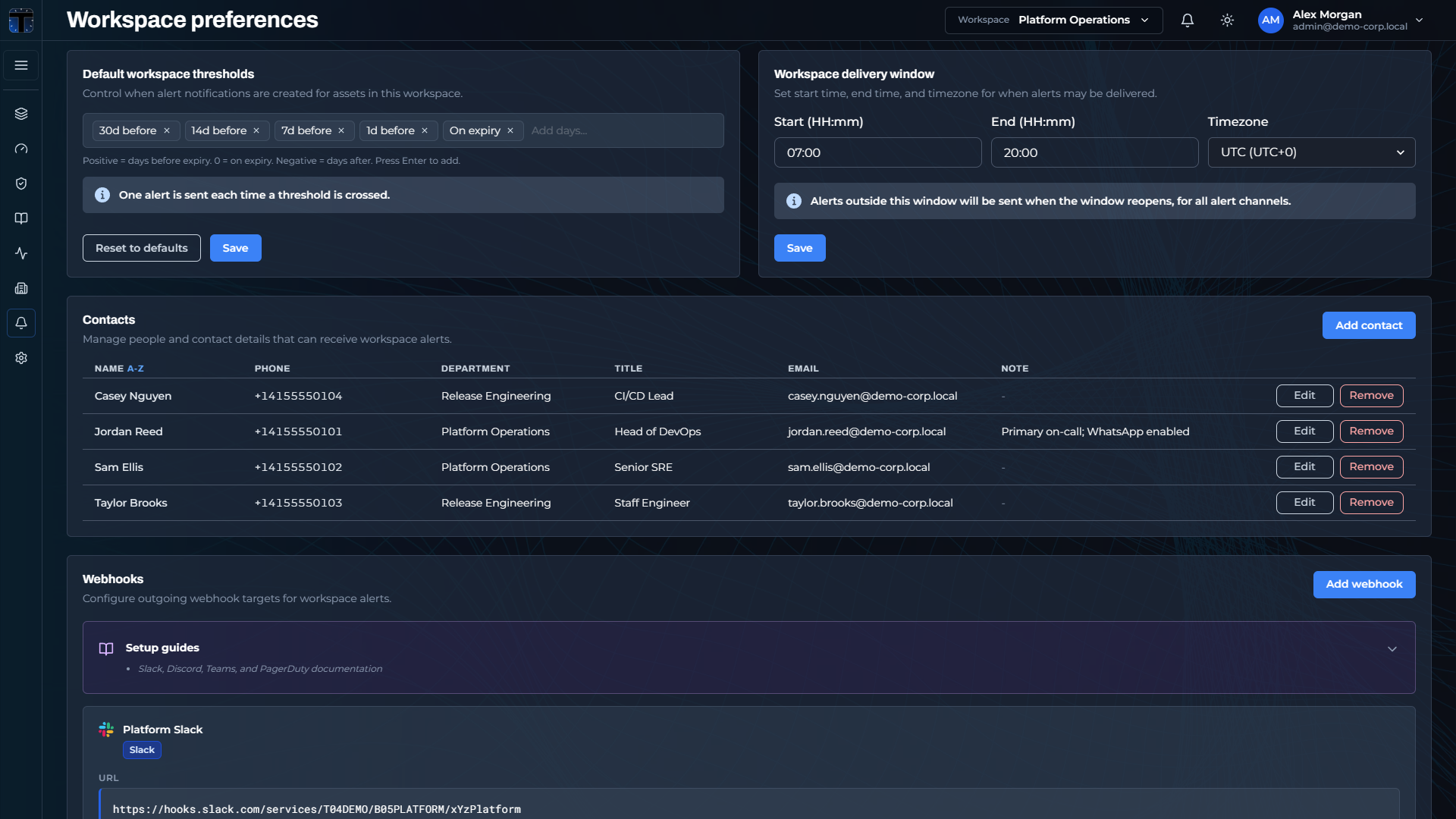
Native integrations, auto-sync, and automated discovery
Connect TokenTimer to providers like HashiCorp Vault, AWS Secrets Manager, Azure Key Vault, Microsoft Entra ID, GCP Secret Manager, GitHub, and GitLab to automatically import and keep expiration metadata up to date, discover public subdomains for SSL certificate imports, and monitor HTTPS endpoints for SSL expiry and health.
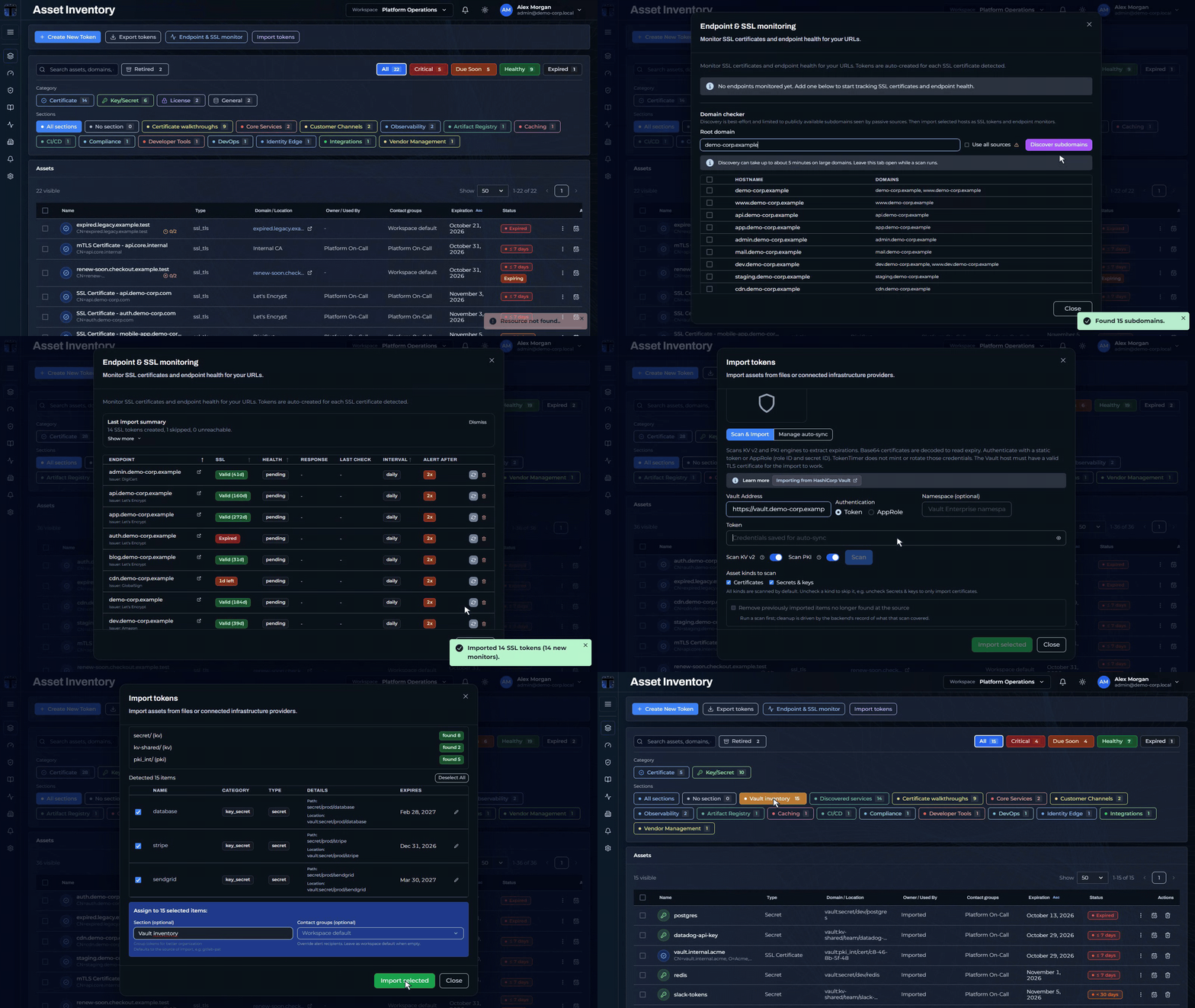
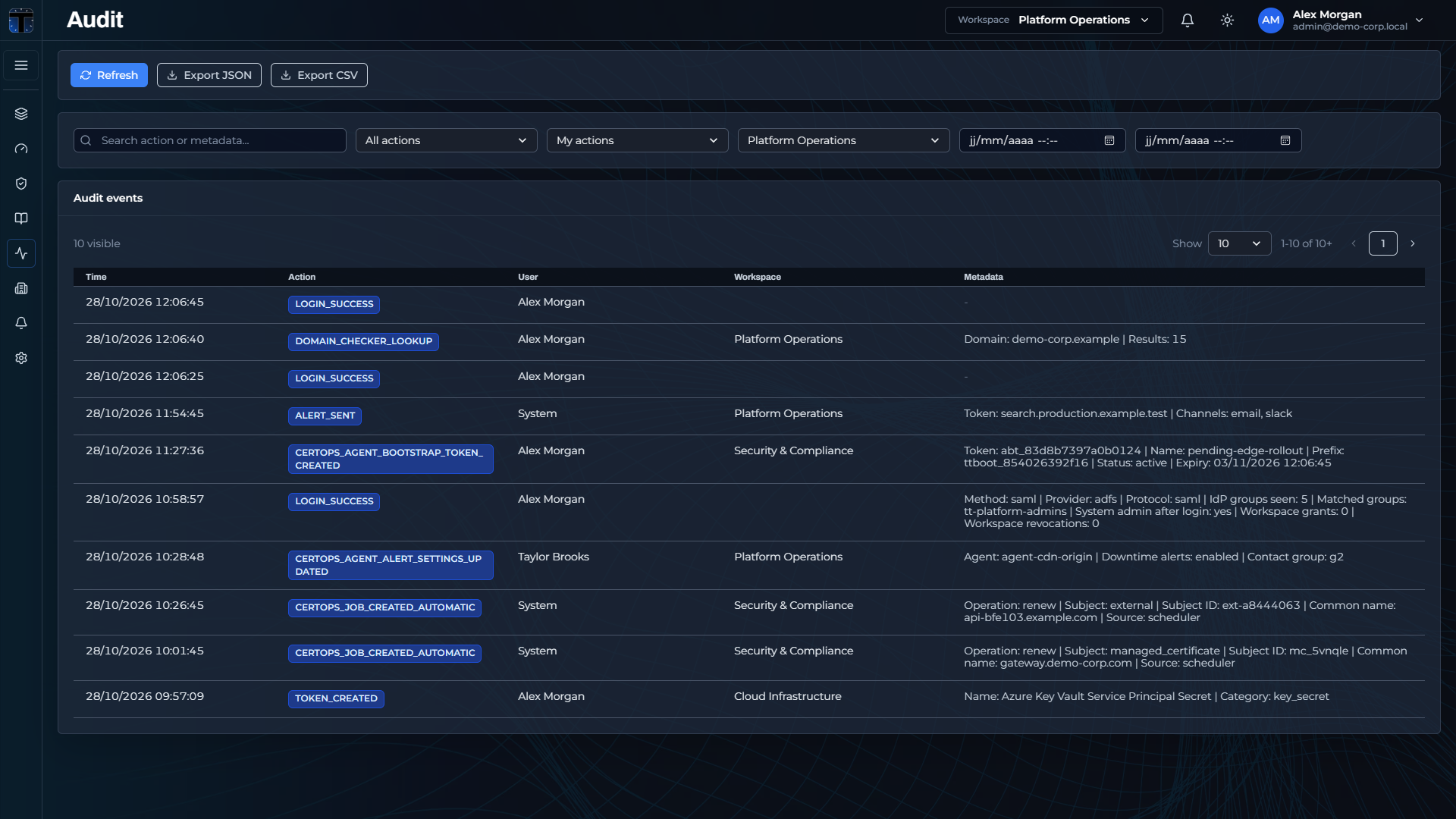
Built for teams and audits
Organize assets with workspaces, control access with RBAC, and keep an audit trail of important actions and alert activity. Approvals are bound by hash to the exact job that runs, and each renewal step records its own evidence, so the trail shows who approved what and how the result was verified. Watch the dashboard walkthrough.
Security-first by design
TokenTimer stores expiration metadata, ownership, and status information without storing secret values or private keys. Integration scan credentials are discarded after one-off imports; if you enable auto-sync, they are encrypted at rest in the database for scheduled re-scans.
Get Started
 |
 |
 |
|---|
Run it on your own server
 |
 |
 |
|---|
Documentation
| QUICKSTART.md | Step-by-step setup guide |
| First asset and alert check | Verify the installation with a tracked asset and an alert |
| DEVELOPMENT.md | Local development, worker runner, and cron scheduling |
| docs/CONFIGURATION.md | Environment variables and Vault AppRole inventory authentication |
| .github/maintainers/certops/CONTEXT.md | Certificate Lifecycle Management domain model and behavior (certops technical namespace) |
| Agent overview | Installation, policy, and focused operator references |
| Install an agent on Linux | systemd installation and registration |
| Install an agent on Windows | Native service installation and registration |
| Microsoft AD CS enrollment | Domain-joined Windows enrollment from an enterprise CA, allowlists, and qualification scope |
| Certificate distribution through Vault | Shared ordinary, SAN, and wildcard certificates via customer Vault KV v2 and Linux consumers |
| docs/certops/executor-api.md | Machine API tokens and executor job API for external renewal tooling |
| docs/AUTHENTICATION.md | Auth model, admin bootstrap, invitations, RBAC |
| deploy/helm/README.md | Helm chart installation and configuration |
| apps/worker/queue-architecture.md | Alert queue and worker design |
| CHANGELOG.md | Release notes |
| ROADMAP.md | Engineering roadmap |
| https://tokentimer.ch/docs | Online user docs (self-hosted and cloud; Certificates at /docs/certificates) |
Worker deployment: Docker Compose runs one worker type per container. The
worker image default command runs all workers in one process (runner.js all).
See DEVELOPMENT.md for scheduling, timezones, and observability.
Contributing
We welcome contributions. Start by reading the documentation above and exploring the codebase. Join the discussions on GitHub Issues for feature requests, bug reports, and questions.
Reporting a security issue
If you've found a security-related issue with TokenTimer, please email [email protected]. Submitting to GitHub makes the vulnerability public, making it easy to exploit. We'll do a public disclosure of the security issue once it's been fixed.
After receiving a report, TokenTimer will take the following steps:
- Confirmation that the issue has been received and that it's in the process of being addressed.
- Attempt to reproduce the problem and confirm the vulnerability.
- Prepare a patch/fix and associated automated tests.
- Release a new version of all affected versions.
- Prominently announce the problem in the release notes.
- If requested, give credit to the reporter.
License
This project is licensed under the GNU Affero General Public License v3.0 (AGPLv3). TokenTimer Core is open source: you may self-host, modify, and integrate it freely. If you run a modified version as a network service, you must make the corresponding source available to its users under the same license.
A commercial license without AGPL's source-disclosure obligations is available for organizations that want to embed or redistribute TokenTimer Core without those terms. Contact [email protected].
"TokenTimer" is a trademark of Tokentimer Sàrl, Switzerland.