
tlsbollei/KittyLoader
tlsbollei/KittyLoader has 271 GitHub stars and 36 forks. Star changes are not measured yet. Last checked 2026-11-13 17:20 UTC. Last push 2025-09-22.
What you can do
- Hijacks early execution by replacing the C runtime entrypoint (__scrt_common_main_seh) with custom assembly.
- InLoadOrderModuleList
- InInitializationOrderModuleList
- InMemoryOrderModuleList
Measured star growth
- in 24h
- Collecting history
- in 7 days
- Collecting history
- in 15 days
- Collecting history
- in 1 month
- Collecting history
Net star changes over overlapping periods, not daily totals. Missing measurements are left blank. Stars measure attention, not software quality.
About
KittyLoader is a highly evasive loader written in C / Assembly
SecurityREADME.md
Original« La force se cache dans l’invisible, et l’invisible gouverne tout. »

KittyLoader


[!CAUTION] Disclaimer & Legal Notice
This repository, KittyLoader, and all associated code, techniques, and information are provided strictly for educational and academic research purposes.This sample and its methodologies have been proactively disclosed to relevant cybersecurity defense organizations and vendors. It is actively used by defensive engineers to research attack patterns, develop detection capabilities, and enhance security products.
You are required to use this knowledge and these tools only on systems you own or have explicit, written permission to test.
Any unauthorized use against systems you do not own is illegal and strictly prohibited.This tool was created to advance the field of defensive cybersecurity. The author, tlsbollei, assumes no liability and is not responsible for any misuse or damage caused by this software.
By accessing this repository, you acknowledge that you understand its purpose is to learn about modern malware techniques, evasion tactics, and ultimately to improve our collective ability to defend against them.
By proceeding, you agree to use this information responsibly and legally.
About>
KittyLoader is a highly evasive loader written in C / Assembly.
Features
Hijacks early execution by replacing the C runtime entrypoint (__scrt_common_main_seh) with custom assembly.
Hides all modules by walking PEB->Ldr lists and unlinking its module entry (LDR_DATA_TABLE_ENTRY) from :
- InLoadOrderModuleList
- InInitializationOrderModuleList
- InMemoryOrderModuleList
Deploys a wide variety of anti-analysis techniques, including :
- Multilayer scoring (debugger, sandbox/resources, API integrity/hook checks, human-input entropy, contextual cues like domain/time of day) combined into a weighted overall confidence that continuously re-evaluates
- Picks an operational state (full → halted) and throttles/pauses with jittered, CPU-cycle-based delays in a loop that keeps reassessing the environment.
- API integrity/inline-hook heuristics and light tamper probes; human-interaction entropy sampling; randomized yet precise timing jitter to throw off debuggers
- Adds controlled noise (junk calcs + jittered delays) and spreads logic across multiple signals, reducing single-indicator detection.
Embedded payload is encrypted at rest, with key and nonce derived at runtime from entropy sources: PID, TID, QPC, memory load, CPU info (CPUID), tick count.
Preferred algo is ChaCha20, but in case of failure falls back to RC4, decryption occurs in place after the encrypted blob is copied into memory.
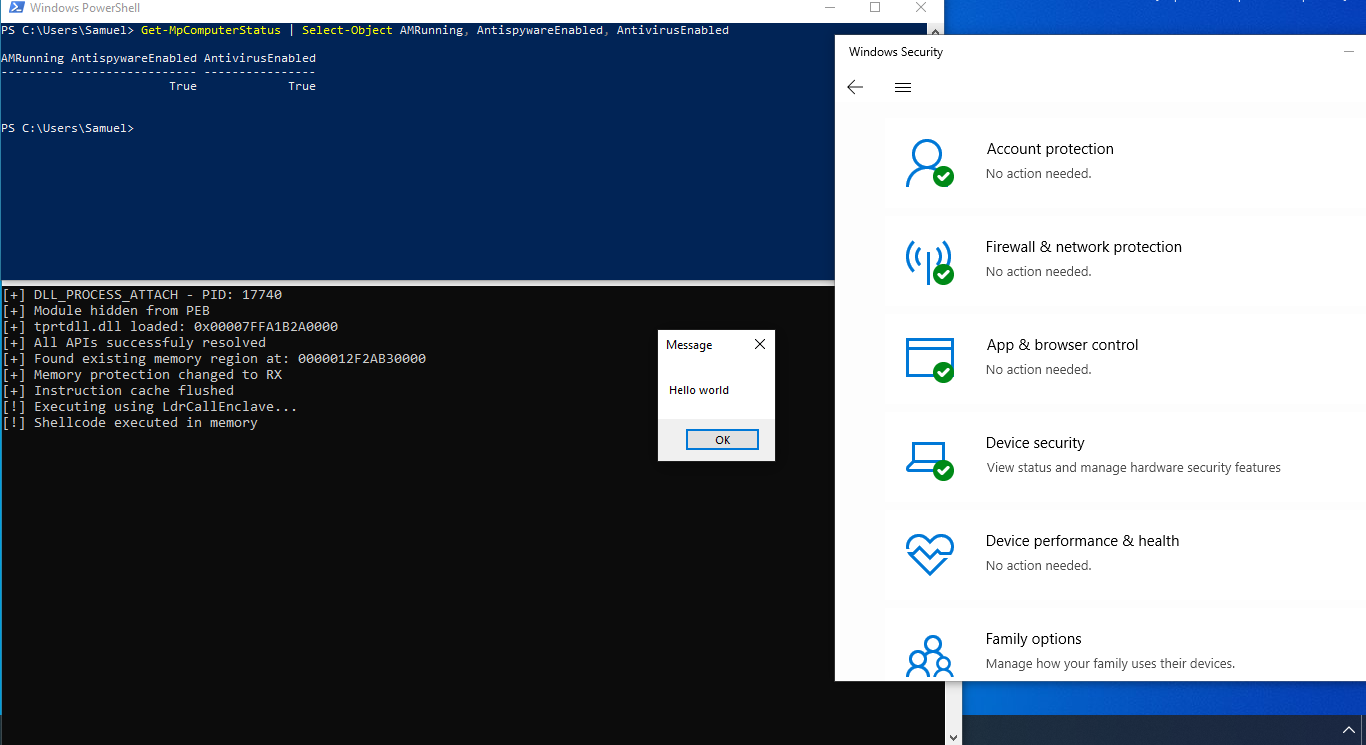
APIs are initially attempted to be resolved via tprtdll.dll, which is quite the modern technique, it does so using GetModuleHandleW(L"tprtdll.dll") with DONT_RESOLVE_DLL_REFERENCES to minimize operation footprint.
Uses high-entropy randomness (PID/TID/GetTickCount/__rdtsc and more) to vary scan starts, delays, and sizes—reducing deterministic patterns and signature matches to cripple static.
Searches for (RX/RWX/RW, non-guarded) and guards behind additional is_region_safe() heuristic, and does the following :
- Resolves sensitive APIs via stealthy, hash-based lookups instead of plain export walking—shrinks observable footprints and evades basic hooks
- Loads libraries with quiet flags (DONT_RESOLVE_DLL_REFERENCES, LOAD_LIBRARY_SEARCH_SYSTEM32) which minimizes I/O usage and loader footprint
Writes and decrypts payload in scattered, variably sized chunks with micro-jitter—disrupts linear memory-write/decrypt heuristics and timing correlations
- Performs staged protection flips (RW → RWX → RX) and later restores RW before wipe/free—mimics legitimate behavior and lowers post-execution forensics
Execute via LdrCallEnclave, normally intended for SGX/VBS enclaves, instead of jumping to a secure enclave, we jump to an arbitrary function pointer in normal (VTL0) user memory - latest version adds timing camouflage and a plausible execution context
Cleans up carefully (I-cache flush, SecureZeroMemory, free) with randomized post-execution timing—limits residue and timeline clustering
[!NOTE] To fix in the future - ChaCha20 implementation bug, entry hijack ASM prologue/epilogue issues, control flow and compile hazards, and silence anti analysis more. Add fallbacks if LdrCallEnclave fails, and implement more stable key derivation. Or just fix it yourself!
Credits:
Explore related projects
trimstray/the-book-of-secret-knowledge
A collection of inspiring lists, manuals, cheatsheets, blogs, hacks, one-liners, cli/web tools and more.
258,211 starsHack-with-Github/Awesome-Hacking
A collection of various awesome lists for hackers, pentesters and security researchers
125,431 starsswisskyrepo/PayloadsAllTheThings
A list of useful payloads and bypass for Web Application Security and Pentest/CTF
82,655 starscaddyserver/caddy
Fast and extensible multi-platform HTTP/1-2-3 web server with automatic HTTPS
79,021 stars